Rang Vidya: Natural Dyes & the Artisans Reviving Them
From a 5,000-year-old madder-dyed cotton in Mohenjo-daro to a Munnar vat in 1995, the story of how India almost lost its plant colours and the artisans who brought them back.
In Sanskrit, the word for colour is varna. The same word later came to mean caste, class, and sound. For early Indian thought, a thing's colour was its essence, and the dyer's job was to pull that essence from a root, a leaf, a bark, or a crushed insect and fix it onto cloth. India dyed cloth with plants for five thousand years. Then in one colonial century it almost forgot. This lesson walks from a Harappan madder fragment, through the Vedic bridal hymn that names blue and red as the colours of an auspicious beginning, through the 1859 indigo revolt in Bengal and the 1856 coal-tar discovery that killed the trade, into the hill-station vat where a woman named Bindu Nayar taught a young man with Down syndrome how to lift a cloth from indigo and watch it turn blue in the air.
A Monsoon Morning in Munnar
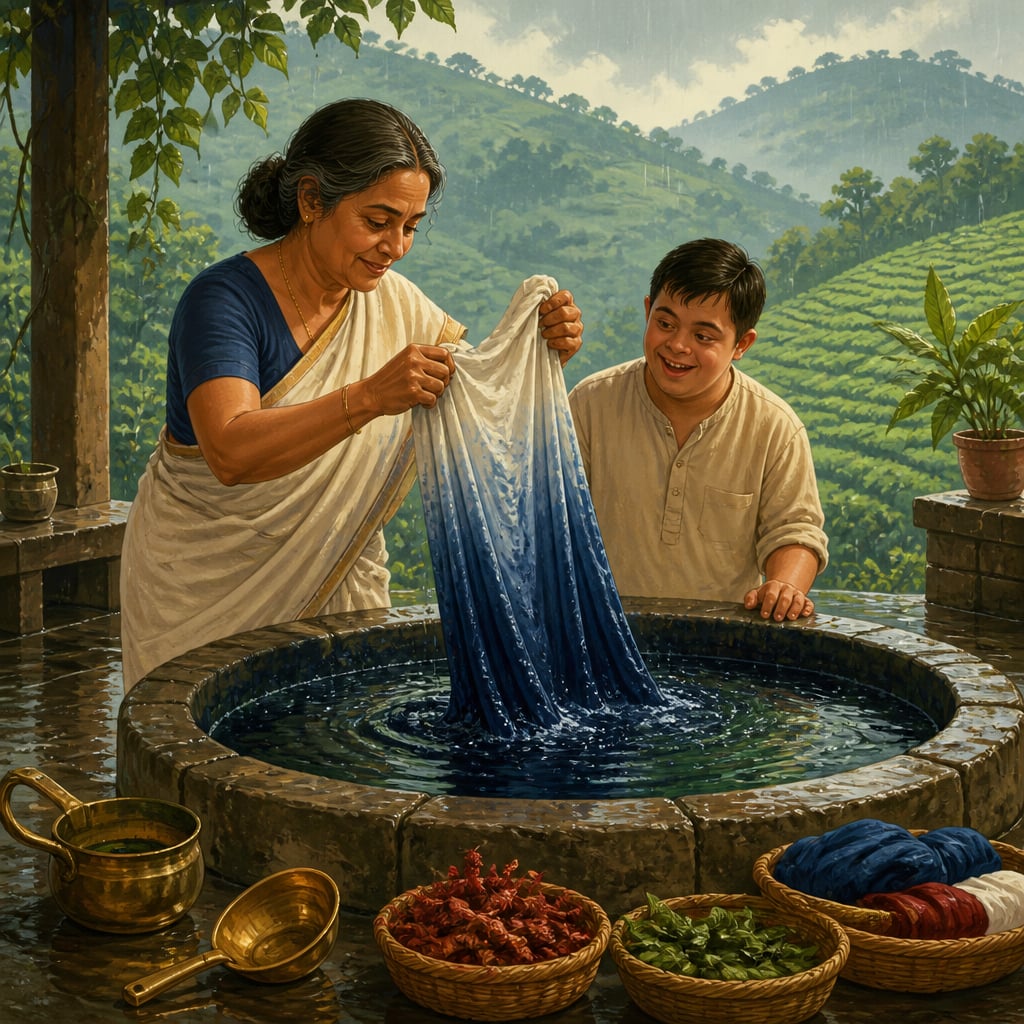
Munnar, Kerala. One morning in 1995, before the monsoon fog has lifted off the tea slopes, Bindu Menon Nayar is lowering a length of bleached cotton into a clay vat of fermenting indigo. The vat smells sweet and earthy, like overripe fruit. The cloth goes in pale and comes out the colour of a frog's back, green and wet. She hangs it on a bamboo line. The mountain air finds the fabric, and something impossible begins to happen. The cloth turns. Yellow, then teal, then the deep navy the Rig Veda called nila. A young man called Suresh stands beside her, watching with the slow, full attention of Down syndrome. He will become her first student. In 1991, Bindu's parents founded Srishti Welfare Centre to give meaningful work to adults with developmental disabilities. Bindu's job, starting today, is to teach them a craft that India had almost lost in one lifetime: how to dye cloth with plants.
India had dyed cloth with plants for five thousand years. How did the country that gave the world the word indigo almost forget how to do it? The answer is a story that runs from a Vedic wedding hymn to a German chemistry lab.
The Word That Means Colour
In Sanskrit, the word for colour is varna. It is the same word that later came to mean caste, class, and the basic sound of a letter. That is not an accident. Early Indian thought saw colour as essence. A thing's varna was what made it itself. The dyer's craft was therefore not decoration. It was the act of pulling a hidden essence out of a root, a leaf, a bark, or a crushed insect, and fixing that essence onto cloth.
Archaeologists have found the physical record. At Mohenjo-daro, in the Indus Valley, researchers examined a small scrap of dyed cotton that had survived five thousand years inside a silver vessel. Chemical analysis published in the early 2000s showed that the cloth had been dyed with manjistha, Indian madder root, which gives a deep red. That is the oldest dyed cotton known to archaeology anywhere in the world. It is Indian. It is Harappan. And it proves that the rangrez's craft was already mature on the banks of the Indus three thousand years before Kalidasa and five thousand years before Bindu Nayar.
The Rig Veda knows these colours. In the ancient bridal hymn of Surya, the wedding garment of the bride is described in a single famous phrase:
नीललोहितं भवति कृत्यासक्तिर्व्यज्यते।
nīlalohitaṃ bhavati kṛtyāsaktir vyajyate
It becomes blue and red, and the binding is revealed.
Rig Veda 10.85.28, Surya Sukta (bridal hymn)

The bride's wedding cloth is nila-lohita: blue and red. Indigo and madder. The two oldest dyes in Indian memory. They are not chosen for fashion. They are chosen because they mark an auspicious beginning. Three thousand years later, the bride at an Indian wedding still wears red. The dye palette is Vedic.
A Garden Full of Dyes
India's climate grows more dye plants than any other country on earth. A traditional Indian rangrez could pull a full palette from roadside weeds, forest trees, and kitchen gardens:
- Nil (Indian indigo, Indigofera tinctoria): blue, from fermented leaves
- Manjistha (Indian madder, Rubia cordifolia): red and rose pink, from the root
- Haridra (turmeric, Curcuma longa): bright yellow, from the rhizome
- Kusumbha (safflower, Carthamus tinctorius): orange and crimson, from dried petals
- Harda (myrobalan, Terminalia chebula): beige, and a natural mordant for other dyes
To this core palette a dyer might add pomegranate rind for mustard, kattha (catechu) for brown, lac insects for deep crimson, kesu flowers for saffron orange, and walnut husk for grey-black in the Himalayan foothills. A Gujarati dyer and a Manipuri dyer used partly different plants but the same underlying logic.
The Science of a Vat
Most natural dyes need help to bond with cloth. That help is called a mordant: a metallic salt or a plant tannin that first attaches itself to the fibre and then grips the dye. Alum is the commonest mordant. Iron gives darker shades. Harda (myrobalan) is the vegetable alternative. A good rangrez knew how to layer mordant and dye so that the colour survived decades of washing in hard village water.
Indigo is the one dye that works differently, and the one every Indian dyer had to master. Indigo is not water-soluble in its blue form. To use it, the dyer ferments the leaves in a vat with lime, jaggery, and water, until the colour drops out of solution and becomes a pale yellow-green liquid. Cloth dipped in that liquid comes out yellow-green. Only when the cloth meets air does the magic happen. Oxygen pulls the indigo back into its blue form, and the fabric turns blue before the dyer's eyes. A vat well-kept by the same hands for years gives the deepest blues. A vat handled carelessly dies.
This is why the word for a dyer in North India is rangrez, which literally means colour-pourer, and why rangrez communities of Sindh, Rajasthan, and Gujarat guarded their vats like living beings. A family vat in an Ajrakh workshop in Kutch could be more than a hundred years old. The grandson tending it was tending something his great-grandfather had fed.
The Perkin Crash
In 1856, an eighteen-year-old English chemistry student named William Perkin accidentally produced the first synthetic dye, a purple he called mauve. It came from coal tar, was cheap to manufacture, and did not need a fermenting vat, a mordant garden, or a rangrez apprentice. Within forty years, German and British chemical companies had synthesised almost every colour an Indian rangrez could make. BASF released a factory-made indigo in 1897. By 1914, the Bengal indigo export economy had collapsed.
The collapse had already become political once. In 1859, the peasant farmers of lower Bengal rose up against the British planters who forced them to grow indigo on their best land for almost nothing. They called the uprising the Nil Bidroha, the indigo revolt. Villages refused to plant. A Bengali play called Nil Darpan by Dinabandhu Mitra, performed in 1860, dramatised the cruelty of the indigo system and reached a huge Indian and British audience. The revolt did not end plantation indigo, but it broke its moral legitimacy. Thirty-seven years later, Perkin's chemistry finished the job.
But the synthetic crash did more than end a colonial export trade. It ended the everyday Indian dyer. A housewife in Bikaner could now buy a packet of German dye powder for less than the cost of a bundle of manjistha roots. The rangrez communities lost their customers. The dye gardens were uprooted. Vats that had been fed for three generations were emptied and never refilled. Between about 1900 and 1980, India forgot most of what it had known about plant colour. The knowledge did not vanish completely. It shrank to a few Ajrakh workshops in Kutch, a few Kalamkari households in Andhra, and a few older dyers in the Himalayan foothills. But it shrank fast.
The Revival
When Bindu Nayar lowered her first cotton into indigo at Munnar in 1995, she was part of a quiet movement of designers, chemists, and activists who had begun, in the 1980s and 1990s, to rebuild the craft. Rta Kapur Chishti, a saree historian, had spent years walking through weaving villages, documenting which regional sarees still used which natural dyes. The Canadian designer Charllotte Kwon had founded Maiwa Handprints in 1984 and begun buying naturally-dyed cloth directly from Indian and Pakistani artisans. In Auroville, Tamil Nadu, the Spanish dyer Jesus Ciriza Larraona was building a fermentation-vat indigo practice that would soon supply designers worldwide.
Two of the most loved Indian revivals belong to women who built Aranya Naturals and Aavaran.
Aranya Naturals grew out of Bindu Nayar's work at the Srishti Welfare Centre in Munnar. Her studio trained adults with Down syndrome, cerebral palsy, and autism to dye cloth with local plants. The colours came from tea leaves, marigold, pomegranate rind, eucalyptus, and vat-fermented indigo. By the 2010s, Aranya was exporting scarves and yardage to fashion houses in Tokyo, Paris, and New York. Every piece carried the initials of the artisan who dyed it. The revival was also a quiet social experiment: what if the Indian craft that the modern market had abandoned could be rebuilt by the Indian workers that the modern market had also abandoned?

Aavaran, in the village of Akola near Udaipur, was founded in 2007 by the designer Alka Sharma. Akola had been a mud-resist dyeing centre for centuries. By the 1990s, most of its rangrez families had quit the craft. Alka trained local women to use dabu mud resist with natural dyes such as indigo, madder, and pomegranate rind. Today, Aavaran runs a stitching unit and a shop in Udaipur, and a village workshop that has brought back several lost Akola block-print traditions. Her decision was to keep production in the village, train women in place, and refuse to move the craft to a city factory.
The Garden Behind the Vat
Thirty years after Bindu lowered her first cloth into the Munnar vat, Aranya Naturals is still running in the same hill-station compound. The vat she keeps today is not the same one. A natural indigo vat is alive: it ferments, feeds, rests, and eventually dies. This is her fourth or fifth. Suresh, her first student, is in his fifties now and still comes to the studio. The young trainees around him are the children of her first dyers.
What the modern revival has rebuilt is not only the technique. It is the whole ecology around the technique: the dye gardens, the mordant recipes, the fermentation schedule, the regional plant palette, the dyer communities, and most of all the slow, patient teaching that the craft requires. A synthetic dye-house can be built in a month. A living natural indigo vat takes years.
The rebuild has a name. Jesus Ciriza Larraona, a Spanish dyer who moved to Auroville in the early 1990s, spent years tracing the smell of real fermentation back to a single family of natural indigo dyers in a south Indian village. He founded The Colours of Nature in 1993 as an Auroville research unit. His workshop today runs sixty-two living indigo vats of a thousand litres each. In 2016, Levi Strauss and Co. hand-picked Jesus as the first partner in their global Collaboratory program, specifically because his fermentation process uses no chromium, no hydrosulphite, and a fraction of the water that industrial indigo dyeing consumes. The oldest Indian dye is now, by measurement, one of the cleanest dyes in the world.
The Rig Veda's bridal hymn speaks of a cloth that becomes nila-lohita, blue and red, because those are the colours of a clean beginning. Indian hands knew how to pull those two colours out of living plants for five thousand years. They almost forgot inside one colonial century. What a handful of artisans and designers rebuilt in the last thirty years is the living memory of how the old bride's garment was actually made. Not from a factory. From a garden. From a fermenting vat. From a teacher and a first student on a monsoon morning, watching a cloth turn blue for the very first time.
Key figures
Bindu Menon Nayar
The founder of Aranya Naturals, a natural-dye studio inside the Srishti Welfare Centre in Munnar, Kerala. Bindu's parents founded Srishti in 1991 as a training and work centre for adults with developmental disabilities. Bindu set up Aranya Naturals inside Srishti in the mid-1990s to rebuild natural dyeing as a craft that the centre's artisans could learn and practise as a living.
Alka Sharma
A Jaipur-trained designer who founded Aavaran in 2007 in the Rajasthani village of Akola, near Udaipur. Aavaran is a natural-dye, dabu-mud-resist, and block-print workshop that trains local women in a craft that had almost disappeared from their own village when Alka arrived. Today, Aavaran runs a village workshop, a stitching unit, and a retail shop in Udaipur.
Rta Kapur Chishti
An Indian saree historian, textile scholar, and revival activist. Rta Kapur Chishti spent decades walking through weaving villages across India documenting regional saree traditions and the natural dyes that still survived in them. Her field work and her books are among the most important contemporary records of what was left of Indian natural dyeing at the end of the synthetic dye century.
Case studies
The Madder-Dyed Cotton of Mohenjo-daro
Sometime around 2600 BCE, in a workshop on the banks of the Indus river, a Harappan dyer fermented a vat of manjistha (Indian madder) root and dipped a length of cotton in it. The cloth turned a deep brick red. It was later wrapped around a copper object and placed inside a silver vessel. The vessel and its contents were eventually buried at the city now called Mohenjo-daro. They stayed buried for the next four and a half thousand years. In the 20th century, archaeologists excavating Mohenjo-daro recovered the silver vessel, and in the early 2000s a chemical team analysed the small cotton fragment still inside it. The test confirmed the red was madder. The cotton itself was mature domesticated Indian cotton. This was the oldest dyed cotton ever recovered anywhere in the world.
The Harappan madder fragment is a direct physical proof of something the Rig Veda already knew three thousand years later: India was a mature plant-dye culture long before any written record of its dyers. The rangrez's craft, at Mohenjo-daro, was not experimental. The cotton had been properly mordanted, properly dyed, and properly finished. The dyer knew what she was doing. The fragment suggests that the domestication of cotton and the mastery of madder dyeing in India ran together from the beginning. What the Surya Sukta later calls nila-lohita, blue and red, was already a working dye palette in the Indus Valley.
The fragment pushed the known history of Indian natural dyeing back by at least two thousand years. It showed that Indian cotton dyeing with madder was already a developed craft in the Harappan period. It also confirmed India's place as the earliest known plant dye culture in the world. For the modern Indian natural dye revival, the Harappan evidence is foundational. It proves that the knowledge the synthetic dye century almost destroyed was not a recent luxury. It was one of the oldest continuous craft traditions on earth.
The craft the modern Indian natural dye revival is trying to save is not a nineteenth-century hobby. It is a four-and-a-half-thousand-year-old continuous tradition that came very close to vanishing inside a single colonial century. Its depth in time is the reason the revival matters. You do not lightly lose something that has been fed by the same hands for five thousand years.
The Harappan evidence is now part of every serious Indian textile history textbook and every museum exhibition on Indian dyes. It is also used by contemporary revival workshops such as Aranya Naturals and Aavaran as the historical anchor of their work. The madder root their artisans grow today in a dye garden is the same species that coloured that Harappan cotton four and a half thousand years ago.
The Mohenjo-daro madder cotton is dated to approximately 2600 BCE. This is older than the pyramids at Giza, older than any Chinese silk fragment recovered by archaeology, and older than any Egyptian linen with identified dye. Indian natural dyeing is the oldest documented plant dye tradition in the world.
The Nil Bidroha: Bengal's Indigo Revolt of 1859
Between about 1830 and 1860, British planters in Bengal forced thousands of peasant farmers to grow indigo on their best rice fields, under a contract system called daadon. The planters advanced a small loan at the start of the season, bought the crop back at a fixed low price, and charged the farmer for any shortfall. The system trapped entire villages in a cycle of debt. The indigo was processed in planter-owned factories, shipped down the Hooghly, and sold in Europe for many times the price paid to the farmer. In 1858, a Bengali playwright named Dinabandhu Mitra wrote a play called Nil Darpan (Mirror of Indigo) dramatising the cruelty of the planters. In 1859, the peasants of the Nadia district refused to plant indigo for the next season. The refusal spread across lower Bengal. By 1860, more than sixty per cent of the indigo farms of Bengal were in open peasant revolt. The uprising came to be known as the Nil Bidroha, the indigo revolt.
The Nil Bidroha is a tragic inversion of everything the Vedic dye tradition stood for. The Rig Veda's nila is the blessing colour, the auspicious blue that marks a clean beginning. In colonial Bengal, the same nila had become a curse: a crop forced on unwilling farmers, grown on land that should have fed them, processed in factories owned by other people, and sold in markets where the farmer's labour disappeared into a European consumer's ledger. The revolt was not against the plant. It was against the theft of the relationship between the farmer and the plant.
The 1859 to 1860 revolt did not end plantation indigo immediately. But it broke the moral legitimacy of the daadon system. A British government Indigo Commission in 1860 investigated the abuses and issued a report that supported many of the peasants' complaints. Over the next decade, the Bengal planters began to lose both peasant cooperation and British political support. The final blow came from chemistry. In 1897, BASF launched a factory-made synthetic indigo in Germany. By 1914, Bengal's indigo export trade had collapsed completely. The indigo fields went back to rice. The peasants were free of the daadon. But the Indian rangrez who used natural indigo for his own craft lost his supply chain at the same time, and the household dye tradition began to shrink.
The Nil Bidroha is one of the earliest peasant-led refusals of colonial extraction in Indian history. It is also a parable about what happens when a traditional plant and a traditional craft are captured by an alien market. The plant did not change. The relationship did. The revolt restored the relationship but could not restore the craft. The craft needed a separate revival, and that revival did not begin for another hundred and twenty years.
The Nil Bidroha is now studied in Indian school history books as one of the early agrarian revolts that prefigured the national freedom movement. Mahatma Gandhi's first major Indian satyagraha in 1917 was also on behalf of indigo farmers, in Champaran, Bihar, against the same daadon-style planter system that had persisted there after Bengal's revolt. Natural indigo is now being re-cultivated in small quantities in Bengal and Tamil Nadu as part of the broader Indian natural dye revival, but the scale is tiny compared to the old plantation economy.
At the peak of the 1860 revolt, an estimated sixty per cent of Bengal's indigo plantations were in open refusal. Dinabandhu Mitra's play Nil Darpan was translated into English by Michael Madhusudan Dutt and published in 1861, and its publisher, Reverend James Long, was briefly imprisoned by the British authorities. The BASF synthetic indigo release of 1897 had reduced Bengal's indigo export earnings to near-zero by 1914.
Aranya Naturals: An Indigo Vat at Srishti Welfare Centre
In 1991, Ravi and Lakshmi Nayar founded the Srishti Welfare Centre in Munnar, Kerala, to provide training and meaningful work for adults with developmental disabilities: Down syndrome, autism, cerebral palsy, and intellectual disability. Their daughter Bindu Menon Nayar, a designer, joined Srishti in the mid-1990s and decided to build a natural dye studio inside the welfare centre. She called it Aranya Naturals, from the Sanskrit aranya, meaning forest. The first dye bath she ran was an indigo fermentation vat. Her first student, a young man named Suresh with Down syndrome, was taught to stir the vat, check its smell, dip the cloth, lift it out, and hang it to oxidise on a bamboo line in the Munnar air.
Bindu Nayar was doing two revivals at once. The first was the technical revival of Indian natural dyeing, using tea leaves, eucalyptus, marigold, pomegranate rind, and vat-fermented indigo. The second was a social revival: rebuilding a craft that the modern market had abandoned, using the labour of Indian workers that the modern market had also abandoned. Both the craft and the workforce had been written off by industrial logic. Aranya Naturals was built on the intuition that the two rejections belonged together, and that the craft's patient rhythms were, in fact, uniquely suited to workers who needed the world to slow down around them.
Aranya Naturals became one of the most respected natural dye workshops in India. By the 2010s, its scarves, stoles, and yardage were being bought by fashion houses in Tokyo, Paris, and New York, and featured in exhibitions at the Victoria and Albert Museum in London. Every piece that leaves the workshop carries the initials of the artisan who dyed it. Suresh, the first student, is still at the studio today, more than thirty years later. The Srishti Welfare Centre now also runs a paper-making unit, a bakery, a cafe, and a small museum of natural dye samples, but Aranya remains the centre's most public face.
A craft and its workers can be revived together. The pieces of the modern economy that get thrown away are often the pieces that belong together: a traditional craft the market no longer wants, and a community of workers the market cannot use. Aranya Naturals showed that if you give them the same workshop, the same teachers, and the same patient rhythm, they will rebuild each other. The revival is both a textile story and a social story, and it would not have worked as only one of the two.
The Aranya model (natural dye revival inside a welfare and training centre) has been studied and partly copied by several Indian and international artisan cooperatives. It is one of the reference examples for craft revival as a form of inclusive employment, and is featured in case studies on textile sustainability and disability inclusion. Visitors can tour the studio in Munnar by appointment and see the vat, the dye garden, and the artisans at work.
Aranya Naturals has trained several hundred adults with developmental disabilities in natural dyeing since 1995. Its indigo vats have been in continuous use for more than two decades. Its scarves and yardage sell at Good Earth, Fabindia, Anokhi, and at export boutiques in Tokyo, Paris, London, and New York.
Aavaran: Rebuilding a Village Dye Tradition in Akola
Akola is a small village in the Chittorgarh district of Rajasthan, about three hours from Udaipur. For centuries, Akola was a dabu mud-resist dyeing and block-printing village, famous for its natural indigo blues, its madder reds, and a local palette of dabu patterns that belonged to its own printers. By the 1990s, almost all of the village rangrez families had quit the craft. The synthetic dye century had taken their markets. The younger generation was migrating to cities for wage labour. In 2007, a Jaipur-trained designer named Alka Sharma made a decision. Instead of setting up a studio in Udaipur or Jaipur, she moved the workshop into Akola village itself, trained local women in dabu and natural dyeing, and committed to keeping production inside the village. She called the workshop Aavaran, meaning covering or garment.
Alka Sharma's decision was a direct challenge to the default pattern of Indian craft revival, which often takes a traditional technique out of its village and moves it into a city workshop where the designer can control the quality and sell to an urban market. Her view was that the craft belonged to the village. If the village lost the craft, the craft lost its roots. If the craft lost its roots, the revival was only cosplay. Aavaran therefore built itself as a village institution: a dye garden, a mud-resist workshop, a block store, a stitching unit, and a retail shop in Udaipur that sold what the village made. The women learned the craft from older rangrez who still remembered it, and taught their own daughters inside the same workshop.
Aavaran rebuilt the Akola dabu tradition within a decade. It now employs several hundred women in Akola and the surrounding villages, mostly in natural dyeing, dabu printing, and stitching. Aavaran's garments are sold at its own Udaipur shop and through a network of Indian retailers, and several lost Akola block-print patterns have been brought back into regular production. The village itself has become a destination for craft researchers and design students, who come to see dabu printing being practised where it was born, not in a city workshop copy. Alka Sharma has received multiple design and craft awards for the work, and Aavaran is cited as one of the model village-based craft revivals in India.
A craft is not only a set of techniques. It is a set of techniques plus the place they belong to, the people who grew up with them, and the land the plants come from. You can move the techniques to a city. You cannot move the place. Aavaran chose to keep the craft in its place, and that choice is the reason the revival worked. For any reader thinking about how to save a tradition, the Akola model is the one to study: small, local, village-based, rooted in the actual community that once held the craft.
The Aavaran model is now part of the standard case-study set in Indian craft and design schools, including the National Institute of Design and the National Institute of Fashion Technology. It is often compared with Avani in Kumaon, Charaka in Karnataka, and Khamir in Kutch as examples of village-based artisan revival that refused to move production into a city. The Udaipur shop and the Akola village workshop are both open to visitors by appointment.
Aavaran has worked with several hundred women artisans in Akola and surrounding villages since 2007. It has brought back several lost Akola dabu patterns, rebuilt the village dye garden, and kept production inside the village while selling through a retail shop in Udaipur and a growing online presence.
Historical context
The Indian natural dye tradition runs from the Harappan period (c. 3000 to 1500 BCE), through the Vedic era and the classical and medieval courts, into the colonial collapse of 1856 to 1914 when synthetic coal-tar dyes replaced the older craft, and into the contemporary revival of the 1980s to the present.
India has been the world's most important source of plant dyes for most of recorded history. Indian indigo, madder, turmeric, and lac were traded west to Rome, Persia, and the Arab world and east to Southeast Asia from at least the first millennium BCE. The rangrez communities of Sindh, Rajasthan, Gujarat, and Bengal kept large fermentation vats of indigo that were alive for decades and sometimes for more than a century. These vats were fed daily and tended like living beings in the family. The synthetic dye crash of the late 19th and early 20th century broke this economy within one or two generations. The revival that began in the 1980s has rebuilt a small but growing ecology of workshops, dye gardens, and designer markets.
India's natural dye collapse happened in parallel with similar collapses in every other plant-dye economy of the 19th and 20th centuries. French madder cultivation in Provence was wiped out by synthetic alizarin within a decade of its 1868 discovery. Japanese indigo farming shrank drastically under the same pressure. The Turkish madder trade out of Smyrna fell apart. What made India's case different was the sheer depth of the surviving knowledge. When the revival began in the 1980s, there were still Ajrakh dyers in Kutch, Kalamkari painters in Andhra, and Himalayan plant dyers whose family vats and recipes had never been fully interrupted. The revival could therefore work from living teachers, not only from archives.
The madder-dyed cotton fragment recovered at Mohenjo-daro and dated to around 2600 BCE is the oldest dyed cotton known to archaeology anywhere in the world. The Bengal indigo export economy fell from being India's second-largest export crop in the 1870s to near-zero by 1914, a collapse of nearly complete extinction within forty years of Perkin's 1856 discovery.
The Indian natural dye tradition is one of the clearest examples in world history of an entire skilled craft ecology that was built over five thousand years and then almost destroyed within one colonial century. The survival and revival of that ecology is a test case for every traditional craft that is now under pressure from industrial substitution. The revival also ties directly into the current global conversation about textile sustainability, fair artisan wages, and chemical pollution in dyeing. Indian natural dyes, grown on local plants and fixed with low-toxicity mordants, are now part of the answer to problems that synthetic dyes helped create.
Living traditions
The Indian natural dye revival has moved from a small designer niche in the 1980s to a recognised segment of the Indian and global textile market by the 2020s. Aranya Naturals, Aavaran, Avani, Maiwa's Indian partner network, Colours of Nature, Khamir, Sadhna, Charaka, and several other workshops now employ thousands of artisans between them. Indian naturally-dyed cloth is sold through high-end Indian retailers (Good Earth, Fabindia, Anokhi, Nicobar) and exported to fashion houses in Japan, Europe, and the United States. The 2020s have also seen serious scientific interest in natural indigo fermentation at Indian institutes such as the National Institute of Fashion Technology and the Ahmedabad-based National Institute of Design.
- Tending a living indigo vat: A natural indigo vat is fermented from indigo leaves with lime, jaggery, and water. It needs to be fed, stirred, rested, and watched daily. A rangrez knows the vat by smell: a sweet, slightly fruity surface means the vat is alive, a sour smell means it is dying. A well-tended vat can stay in continuous use for many years. The same hands that feed it learn to read its moods. Natural indigo dyeing is a relationship, not a process.
- Village-based artisan training: The strongest Indian natural dye revivals have kept the workshop inside the artisan village rather than moving production to a city factory. The dye garden, the block-maker, the printer, the washer, and the stitcher all live within walking distance. Women can join without leaving their families. Knowledge is transmitted by doing, not only by teaching. This model also keeps the craft's income inside the village economy rather than extracting it.
- Dye gardens and plant sourcing: A serious natural dye workshop grows its own core dye plants, including indigo, madder, marigold, and turmeric, along with wild-collected plants such as harda, pomegranate rind, lac insects, eucalyptus, and walnut husk. The dye garden is a living archive. It protects the workshop from the volatility of the wider dye plant market and keeps a small genetic pool of dye-quality varieties alive.
Reflection
- A natural indigo vat takes weeks to build and years to mature. A synthetic dye-pot can be mixed in five minutes. Both will colour a piece of cloth. Where in your own life have you chosen the fast version of something that was originally slow? What, if anything, do you suspect was lost in the switch? Would you go back to the slow version for any of them?
- The Sanskrit word varna means both colour and essence. For the Indian rangrez, the red was not added to the madder root. It was already in it. Think of one thing you own or use daily whose quality comes from what it is, and one whose quality is added on top. How do the two things feel different to you? Which one do you trust more, and why?
- The Indian natural dye revival began with individual teachers in individual villages, teaching a small number of students at a time. If you were to save one skill, craft, language, recipe, or practice from disappearing in your own family, community, or neighbourhood, which one would you choose? Who in your life could you teach it to, and when could the first meeting happen?