Block Printing: Bagru, Sanganer, Bagh & Dabu
Four Centres, One 400-Year Conversation Between Wood, Mud and Cloth
Meet the Chhipa printer communities of Bagru and Sanganer, the Khatri revivers of Bagh, and the mud-resist masters of Dabu. Learn how a teakwood block, a river, and a family recipe can carry a tradition through 400 years of royal patronage, colonial disruption and industrial copy-print, and meet the brands and artisans keeping it alive today.
Ismail Khatri, Winter 1984
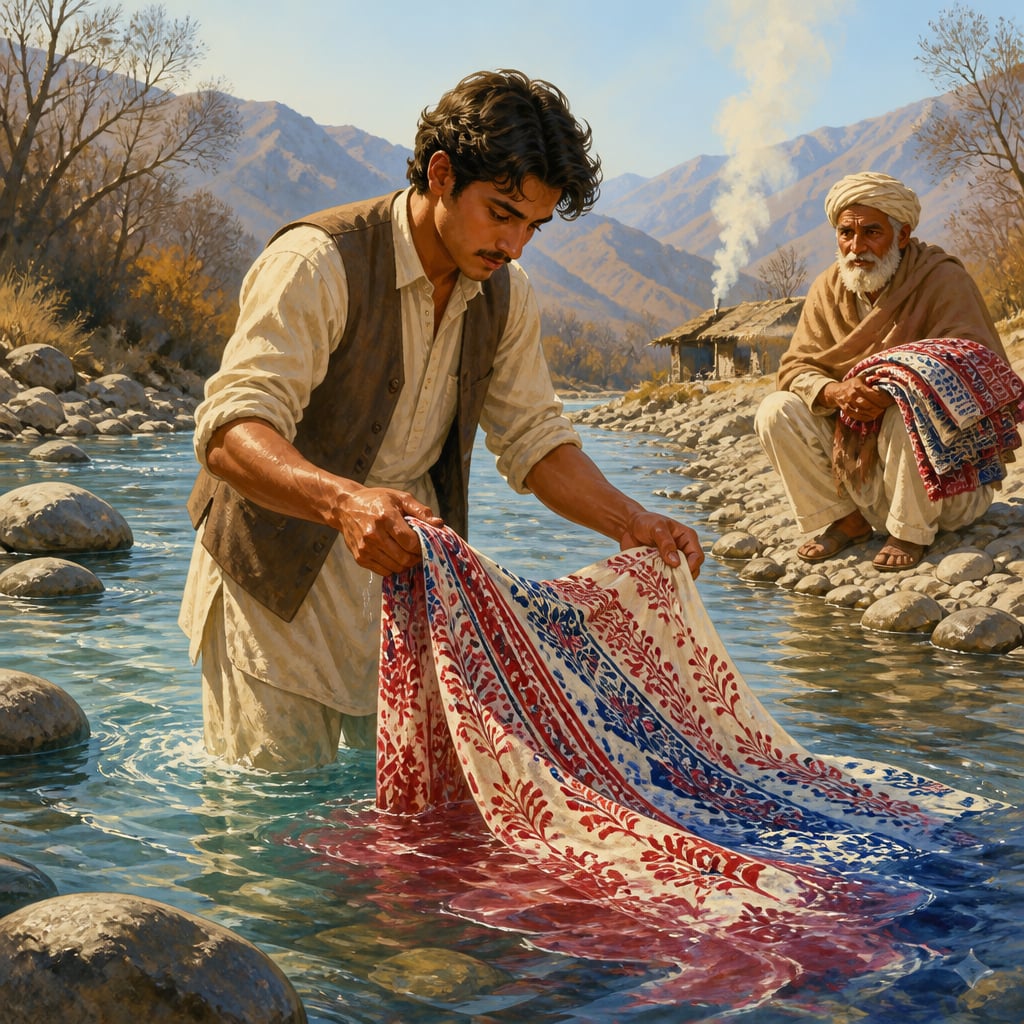
In the winter of 1984, Ismail Mohammad Khatri was nineteen years old and standing thigh-deep in the Baghini river in a small village in western Madhya Pradesh. The water was cold enough to sting his legs. He was holding a length of cotton cloth that he and his father had stamped at sunrise, and he was pulling it slowly through the river so the current could wash away the loose mud paste. The cloth was meant to end up the colour of ripe pomegranate skin. Right now, soaking wet, it looked like grey paper. Behind him, on the bank, his father watched without speaking. The family workshop was almost empty. Mill-printed copies from Ahmedabad had killed the market for hand-printed cloth three years before. Most of the other Khatri families in Bagh had already folded up and moved to Indore. Tonight his father would ask him the question Ismail had been avoiding for months. Would he keep printing, or would this be the end of the line?
Four decades later, Ismail is the reason Bagh printing is still alive. To understand why that matters, we have to understand what Indian block printing is, where it comes from, and why four small towns in Rajasthan and Madhya Pradesh, each with a different signature, became the living centres of a craft the world once could not get enough of.
What block printing actually is
Block printing is the simplest kind of textile printing, and the most patient. A printer carves a pattern, in mirror image, into a flat piece of hardwood. He dips the block into a tray of dye or mordant paste. He lines it up against a stretch of cotton laid on a long padded table, and presses it down with the heel of his hand. Then he lifts, re-dips, and moves exactly one block-width down the cloth. A six-metre saree takes several hundred stamps. A single slip of the wrist ruins a day's work.
Two things make Indian block printing unusual among world textile crafts:
- It uses mordants, not just dyes. Most of the colour comes from a chemical reaction in the cloth, not from the paste you stamp on. The printer is really stamping a recipe. The colour arrives later, when the cloth is boiled in madder root or soaked in indigo. This is why Indian prints hold their colour for centuries while most painted cloth fades in a generation.
- It is organised around communities, not individuals. Almost every working block printer in India today belongs to the Chhipa, Khatri or Chhimba community. The word chhipa comes from chhapna, to stamp. These are hereditary castes of printer families who have held the recipes, the blocks and the customer lists for three hundred years or more.
So block printing is really three crafts at once: the wood carver who makes the block, the printer who stamps the cloth, and the dyer who fixes the colour in a copper pot or a river. Usually all three live on the same street.
Bagru and Sanganer: the twin printing towns of Jaipur
When the kings of Amber moved their capital to the new city of Jaipur in 1727, they brought their printers with them and settled them in two villages just outside the walls. Sanganer, on the south side, became the court's fine printing suburb. Its signature is delicate floral buti patterns on a white cotton ground, printed in bright reds, blues and greens. This was the cloth that Jaipur's queens wore and Jaipur's merchants exported.

Bagru, on the south-west side, took the rougher work. Bagru cloth is printed on a pale cream or dull-brown ground, because the cotton is first soaked in harda, a yellow wash made from myrobalan fruit, which acts as a base mordant. Onto that ground, Bagru printers stamp the iron-based black called syahi and the alum-based red called begar. The two recipes together gave Bagru its famous rust-and-charcoal palette. This is the earthy look most people now associate with the word block-print.
The split was not accidental. Sanganer served the court and the export trade. Bagru served the village buyer, who wanted sturdy everyday cloth that could survive the monsoon. Today both towns have Geographical Indication tags. Sanganeri Hand Block Printing got its GI in 2010. Bagru got its own in 2011. The tags are the result of a decade-long fight against factories in Surat and Ahmedabad that print Sanganer-style patterns on screen machines and sell them to tourists as the real thing.
Bagh: the slow river tradition
Three hundred kilometres east of Bagru, in a very different landscape, is the village of Bagh. It sits inside the Vindhya hills, on the bank of a small river called the Baghini. Bagh printing is older than Bagru. Its patterns are heavier, its ground is usually black or dark red, and its motifs are geometric. A classic Bagh print is laid out like a Persian carpet: a central field of repeating stars or leaves, framed by a running vine border.
What makes Bagh special is the river itself. Bagh cloth has to be washed in the Baghini, because the minerals in the water are said to deepen the alum-red and lock in the iron-black. Printers who tried to set up shop on other rivers never got the same colour. This is both a blessing and a trap. It is the reason Bagh prints look like nothing else. It is also the reason Bagh almost died in the 1970s, when cheap mill cloth destroyed local demand. The craft could not move.
Ismail Khatri, the young man from the opening of this lesson, is the reason it did not die. He chose to stay. Over the next forty years, he rebuilt the vegetable-dye recipes from his grandfather's notebooks, trained a new generation of Khatri printers, and took Bagh cloth to the Victoria and Albert Museum in London, where he ran the first-ever block-printing workshop inside the museum. In 2011, the Government of India gave him the Padma Shri. The same year, Bagh received its own GI tag.
Dabu: mud remembers

There is a fourth sub-tradition that runs alongside all of these, called dabu. Dabu is not a place. It is a technique. A printer mixes local clay, lime, gum from the acacia tree, and chaff from millet husks into a thick grey paste. He stamps that paste onto the cloth with a wooden block, lets it dry in the sun for a few hours, then sprinkles fine sawdust on top to keep the paste from cracking. When the cloth is dunked into an indigo vat, the dye cannot reach the places covered by the paste. Those places stay white, or the original ground colour, while everything around them turns deep blue.
Dabu is the Indian answer to Japanese katagami and Indonesian batik. It is quietly one of the most beautiful resist techniques on earth, because the cracks in the drying mud create hairline white veins that no factory machine can fake. The villages of Akola and Bagru both keep dabu alive today. A single Akola dabu saree can go through six rounds of mud-stamping and indigo dipping before it is finished. Nobody rushes dabu. The mud has to dry on its own schedule.
The Chhipa community
So who are these families? The Chhipa and Khatri communities are scattered across Rajasthan, Madhya Pradesh, Gujarat and Sindh. Oral histories in Bagru say the Chhipa printers of that town descend from a group that migrated from Sawai Madhopur in the 1590s, carrying their blocks and their harda recipe on bullock carts. The Khatris of Bagh and Kutch trace their arrival to the same era, from what is now Pakistan.
For three centuries these families printed for village weddings, royal courts, temple offerings and the long-distance export trade. When the East India Company began shipping Indian block-printed cotton to Europe in the 1680s, it set off a fashion craze so severe that England banned the cloth in 1686 to protect its own wool mills. The word calico comes from Calicut, the port the cloth shipped from. The word chintz comes from the Sanskrit chitra, meaning spotted or painted. Three centuries of English vocabulary remember Indian block prints.
Then came the Industrial Revolution, and Manchester learned to copy the patterns on steam-driven rollers. By 1850, Lancashire was exporting machine-printed chintz back into India at a fraction of the hand-printed price. The Chhipa and Khatri communities went into a long, slow decline that lasted almost a century.
What saved it
Three things rescued Indian block printing in the twentieth century, and two of them involved outsiders who fell in love with the craft.
The first was Anokhi, founded in Jaipur in 1970 by Faith Singh, an Irish-born woman who had married into a Rajasthani family, and her husband John. Anokhi went directly to the Chhipa printers of Bagru and Sanganer and built a long-term design relationship with them. It was the first serious modern brand to treat hand block printers as design partners rather than wholesale suppliers. In 2005, the Singhs opened the Anokhi Museum of Hand Printing inside a restored 16th-century haveli at Amber, which is now the definitive institution of the craft anywhere in the world.
The second was Brigitte Singh, a French textile scholar who moved to Amber in the 1980s, studied Mughal floral prints in museum archives, and rebuilt motifs that had been lost for two hundred years. Her signature red poppy print is now in the V and A's permanent collection. Brigitte works with a small atelier of Bagru printers, and her cloth sells to couture houses in Paris. She proved, almost single-handedly, that hand block printing could command the same prices as the finest French fabric.
The third was the GI tag. Bagh got its GI in 2008. Sanganer got its GI in 2010. Bagru got its GI in 2011. A GI tag is not a brand. It is a community title deed. It says that only printers who actually live in these villages, use these recipes, and belong to these lineages can call their cloth by these names. Every time a tourist in Jaipur gets fooled into buying a screen-printed Sanganeri fake, a small part of what the GI tag was meant to protect quietly leaks away. But the legal framework now exists, and the Chhipa and Khatri communities are learning to use it.
The hand of the printer
Back on the banks of the Baghini river, it is 2024. Ismail Khatri is sixty years old now. He is wearing a Padma Shri medal on his kurta. The workshop behind him, which was almost empty in 1984, now employs twenty-three Khatri printers, including both his sons and two of his nieces. The blocks on his carving table include patterns his grandfather used, patterns he has reconstructed from V and A archives, and new patterns he is designing for a young Mumbai fashion label that orders four hundred metres at a time. On the river, a length of cloth that he stamped at dawn is slowly losing its mud and revealing a field of deep pomegranate red. The craft did not end with him. It started again.
Key figures
Ismail Mohammad Khatri
Padma Shri master block printer of Bagh (Madhya Pradesh) and the man who single-handedly saved the Bagh tradition from extinction in the late twentieth century
Faith Singh
Co-founder of Anokhi (1970) and of the Anokhi Museum of Hand Printing in Amber (2005)
Brigitte Singh
French textile scholar and designer who revived Mughal floral block prints at Amber from the 1980s onwards
Case studies
The Chhipa of Bagru and the 2010 Sanganeri GI Tag
By the early 2000s, Jaipur's tourist bazaars were flooded with cheap screen-printed cloth from factories in Surat and Ahmedabad, all labelled 'Sanganeri hand block print'. The real Chhipa printers of Sanganer and Bagru, whose families had held the recipes for three hundred years, were losing market share to machine-made imitations sold at a tenth of the price. In 2005, a group of Chhipa printer associations, backed by the Rajasthan state government and a handful of textile scholars, filed a Geographical Indication application with India's GI registry. The application argued that only cloth printed by Chhipa families actually living in Sanganer, using specific recipes and hand-carved wooden blocks, could legally be called 'Sanganeri Hand Block Printing'. The case worked its way through the GI Registry in Chennai for five years.
The GI tag is a modern legal translation of a much older Dharmic principle: that authority over a craft belongs to the community and the soil that produced it, not to any individual who can mimic the output. The Arthashastra treats trade identity as something that belongs to the guild and the town, not to the trader. The Chhipa of Bagru have always operated as a parampara, a living lineage whose knowledge cannot be detached from the lineage and sold. The GI tag simply gave that parampara a courtroom vocabulary.
In 2010, Sanganeri Hand Block Printing received its GI tag. Bagru followed in 2011. The tags do not stop factory copies from existing, but they give Chhipa printer associations the legal standing to sue traders who label machine-printed cloth as Sanganeri or Bagru. Several Jaipur traders have already been forced to relabel their stock. More importantly, the tags have given the Chhipa community a seat at the table when government craft policy is written.
A tradition that has been held by a community for three centuries does not need to justify itself, but it does need legal tools to defend itself in a modern economy. The Chhipa case shows that dharmic lineage and GI law can be stacked on top of each other without contradiction. Old parampara, new courtroom.
Sanganeri Hand Block Printing received its GI tag in 2010; Bagru followed in 2011; Bagh had already received its own GI in 2008. Three tags in three years, across two states, for one related craft.
Brigitte Singh and the Recovery of Mughal Florals
In the early 1980s, a young French textile scholar named Brigitte Singh, who had studied in Paris and was researching Mughal court textiles, moved to Amber in Rajasthan and settled there permanently. She spent years reading block-print archives in the Victoria and Albert Museum, in Paris, and in Jaipur's royal collections, and cross-referencing them with surviving Mughal miniature paintings to identify floral motifs that had been in active use in the seventeenth century but had disappeared by the nineteenth. Working with Chhipa block carvers in Bagru, she reconstructed these lost patterns block by block and set up a small private atelier just below Amber Fort. Her most famous design, a single red poppy repeated across a pale cream ground, was a reconstruction of a Mughal court motif.
Brigitte Singh's work is a living example of the Dharmic principle that knowledge is recovered, not invented. The Chhipa blocks she commissioned are not new designs; they are restorations of patterns that the community had once known and forgotten. The French scholar and the Rajasthani printers together functioned as what the tradition would call shrotriya, careful listeners who transmit what was once heard. No new information is created. What is broken is repaired and returned to service.
Brigitte Singh's red poppy print is now in the permanent collection of the Victoria and Albert Museum in London. Her cloth is used by couture houses and high-end interior brands in Paris, Milan and New York. More importantly, the reconstructed Mughal floral archive she built with her atelier is now taught to younger Chhipa block carvers as part of the living vocabulary of Bagru printing. Motifs that had been dead for two centuries are back in production.
A tradition does not have to be defended only from the inside. An outsider who listens carefully, studies the archives, and commits decades can help a community recover knowledge the community itself had lost. The story of Brigitte Singh is a reminder that respect and scholarship are also forms of seva, service to a craft that is older than any one of its servants.
Brigitte Singh moved to Amber in the early 1980s and has worked there continuously for over four decades; her reconstructed red poppy print is held in the V and A's permanent textile collection.
Ismail Mohammad Khatri: the Man Who Would Not Close the Bagh Workshop
Bagh block printing is older than Bagru but always more isolated. It survived for centuries inside a small cluster of Khatri families on the banks of the Baghini river in Dhar district, Madhya Pradesh. In the 1960s and 70s, mill-printed cloth from Ahmedabad wiped out Bagh's local market. By 1980, most Khatri families in Bagh had shut their workshops and moved to cities to take wage jobs. Ismail Mohammad Khatri, a teenager then, chose to stay with his father and keep printing. Over the next thirty years he painstakingly rebuilt the vegetable-dye recipes from his grandfather's notebooks, re-carved lost blocks, trained his sons and nieces, and began carrying Bagh cloth to design exhibitions in Mumbai, Delhi and London.
Ismail Khatri's life is the Gita's sahaja karma in action. He did not stay in Bagh because it was profitable; he stayed because it was the work he was born into, and he refused to let the imperfections of the moment become a reason to abandon it. The Bhagavad Gita tells Arjuna that every undertaking is covered by fault as fire is covered by smoke. The test of a life well lived is not the absence of smoke but the willingness to keep tending the fire until the cloth turns the colour of pomegranate red.
In 2011, the Government of India awarded Ismail Khatri the Padma Shri, and Bagh block printing received its Geographical Indication tag the same year. Ismail has conducted the first block-printing workshop at the Victoria and Albert Museum in London and has trained dozens of younger Khatris. His workshop now employs over twenty printers, including his two sons. Bagh cloth is sold by designers in Mumbai, Delhi, Tokyo and Paris. A craft that was one closure away from extinction in 1984 is now a protected, teachable, internationally known tradition.
Sometimes a single family's refusal to close is all that stands between a tradition and the archive. Ismail Khatri did not save Bagh by being a revolutionary. He saved it by not leaving. In a world that celebrates disruption, the discipline of simply staying is its own quiet kind of greatness.
Ismail Mohammad Khatri received the Padma Shri in 2011; Bagh block printing received its GI tag the same year. His workshop has grown from near-empty in 1984 to over twenty active printers in 2024.
Historical context
Late Mughal to Colonial transition to contemporary revival (c. 1590-2025 CE)
Block printing in Rajasthan and Madhya Pradesh grew up alongside Rajput and Mughal court patronage in the sixteenth and seventeenth centuries. The Chhipa community of Bagru traces its arrival to the 1590s from Sawai Madhopur. Sanganer was established as Jaipur's printing suburb after the new capital was founded in 1727. Bagh printing is older and more isolated, developing inside the Vindhya hills in Madhya Pradesh. For three hundred years these communities supplied both village everyday wear and the long-distance chintz export trade that made India the world's largest textile exporter. The Industrial Revolution and the flood of Manchester roller-print imitations almost destroyed all four centres by the mid-twentieth century. Revival, which began with Anokhi in 1970 and accelerated with the GI tags of 2008-11, is now just over fifty years old and still fragile.
Living traditions
Hand block printing from Bagru, Sanganer and Bagh is now a living international language. Every major Indian designer, from Anokhi and Fabindia to Raw Mango and Good Earth, builds collections on these prints. The GI tags of 2008-11 give the Chhipa and Khatri communities a legal footing to defend their work against factory fakes. Ismail Khatri's Padma Shri, Brigitte Singh's poppy print in the V and A, and the Anokhi Museum at Amber together mean that a craft that was minutes from extinction in 1984 is now studied in textile departments from Ahmedabad to Kyoto. The fragility has not gone away. The mill copies are still out there. But the line has held.
- Harda Bath and Block Stamping: The full Bagru cycle: raw white cotton is soaked in a harda (myrobalan) wash, sun-dried for a day, then stamped with syahi (iron-black) and begar (alum-red) recipes using hand-carved teak blocks. The cloth is then boiled with alizarin or madder root to fix the colours. The whole cycle takes about a week per length of cloth.
- Dabu Mud Resist with Indigo Dipping: A clay-lime-gum-chaff paste is stamped onto cotton using wooden blocks. The cloth is sun-dried, then dipped in an indigo vat. The covered areas resist the dye and stay pale. Multiple rounds of stamping and dipping produce the characteristic layered blue of Akola dabu cloth.
- Baghini River Washing: Bagh printers carry freshly stamped cloth down to the Baghini river and wash it in flowing river water. The mineral content of this particular river is said to deepen the alum-red and set the iron-black. The wash removes loose mordant paste and begins the colour-fixing reaction.
- Anokhi Museum of Hand Printing: Housed in a restored sixteenth century haveli just below Amber Fort, this is the definitive museum of Indian block printing. Galleries cover the history, chemistry and regional variations of the craft. Live demonstration rooms show Chhipa printers at work every day except Mondays. The museum shop carries authentic pieces from the Singh family's Anokhi brand.
- Bagru Printing Village: A working Chhipa printing village thirty kilometres west of Jaipur. Visitors can walk through the printer mohalla, watch harda washing and block stamping in open courtyards, and buy cloth directly from family workshops including the Padma Shri Titanwala family's unit. The whole town smells of indigo and myrobalan.
- Bagh Village and the Baghini River: The home village of Bagh block printing, hidden inside the Vindhya hills. Visitors can meet Ismail Khatri and his family workshop, watch cloth being washed in the Baghini river, and visit the nearby Bagh Caves, a set of fifth to seventh century Buddhist rock-cut monasteries whose wall paintings have been an influence on some Bagh textile motifs.
Reflection
- Ismail Khatri chose to stay with his family's craft in 1984 when every economic signal told him to leave. Is there a skill or practice in your own life that you have been treating as a backup option, because the market seems to reward something else? What would it take to invest in it as a primary craft instead?
- Why do you think the Chhipa and Khatri communities organised themselves around shared recipes and shared wells, rather than each printer guarding his own secret formula? What does that collective structure suggest about how knowledge is best preserved?
- A Geographical Indication tag protects a tradition as a community title deed, not as an individual trademark. Is authenticity something that belongs to a person, a place, a community, or a practice? Where does it actually live?