Madhubani: Mithila's Living Canvas
From a drought-year courtyard in 1966 to a Padma Bhushan and a railway station: how the painted walls of Janaka's kingdom became the world's best-known women's art tradition.
For as long as oral memory runs, the women of Mithila have painted the mud walls and floors of their homes for every wedding, every Chhath, and every festival. The painting was never sold. It was the house itself, dressed. Then, in the winter of 1966, a second monsoon failed. The rice crop died. A young officer from the All India Handicrafts Board, Bhaskar Kulkarni, walked into the Jitwarpur courtyard of a Brahmin widow named Sita Devi with a bundle of blank handmade paper and one question: could the painting move from the wall to the page? Within ten years, Sita Devi's paintings hung in the Victoria and Albert Museum in London, and she had been awarded a Padma Shri. This lesson walks from the Kohbar wedding wall of the old Maithili home, through the five styles of the tradition (Bharni, Kachni, Godna, Tantrik, and Kohbar), past W. G. Archer's 1934 earthquake discovery of the wall paintings exposed by collapsed houses, into the 1966 drought and the long, surprising rescue that followed: Padma Shris for Sita Devi, Jagdamba Devi, Ganga Devi, and Baua Devi, the Mithila Museum in Tokamachi, Japan, the 2007 GI tag, and the 2017 Madhubani Railway Station, painted end to end by more than two hundred and fifty women from Mithila itself.
The Drought Year Paper
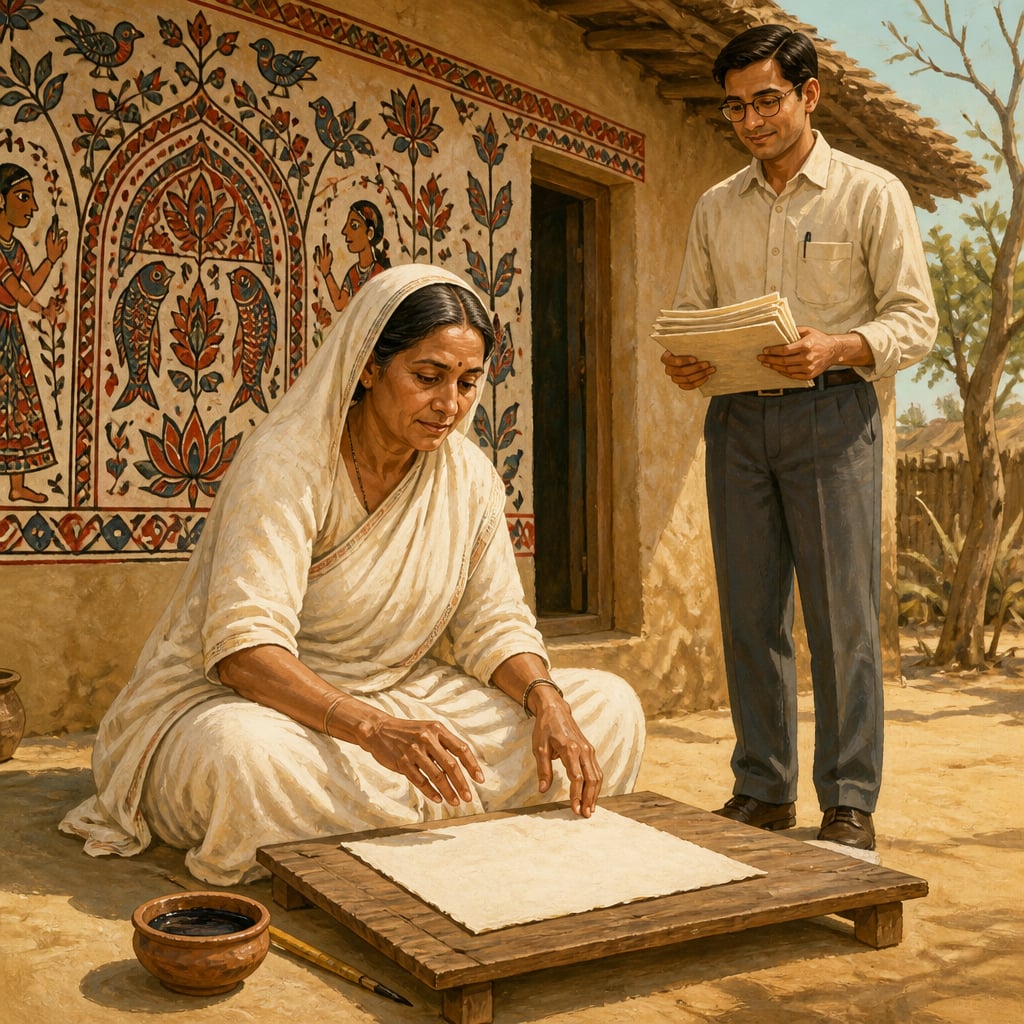
Jitwarpur village, Madhubani district, Bihar. A dry afternoon in late 1966. The monsoon has failed for the second year in a row. The fields are hard and pale. A young officer from the All India Handicrafts Board in Delhi, Bhaskar Kulkarni, walks past a row of mud houses toward the courtyard of a Brahmin widow named Sita Devi. In his cloth bag, he carries a bundle of blank handmade paper, a few bamboo pens, and small bottles of colour. Sita Devi is standing in her courtyard, staring at the cracked ground. She has painted the walls of her home for every wedding and every Chhath for the last thirty years. But there is no wedding this year. There is no food either.
Kulkarni is on an emergency mission. The drought has destroyed Mithila's rice crop for two seasons running. The Handicrafts Board has sent him from village to village to find a craft, any craft, that the women of Mithila can sell to outside buyers for cash. Wall paintings cannot be sold. A wall cannot be taken to Delhi. He sits down on a low stool, opens his bag, and asks her whether the imagery she paints on her courtyard walls could also be painted on a sheet of paper.
Sita Devi had never held a sheet of paper like this before. She took it anyway. Within a decade, her paintings would hang in the Victoria and Albert Museum in London, and she would be awarded a Padma Shri by the Government of India. A tradition that had never been for sale, and almost died for want of a market, was about to become the best-known women's painting tradition in India.
A Painting Tradition With No Known Beginning
Mithila is the old name for the region of north Bihar and a small part of Nepal that was once the kingdom of King Janaka, the father of Sita in the Ramayana. Maithili women have painted the walls, floors, and courtyards of their homes for as long as their oral memory runs. The Valmiki Ramayana, at Bala Kanda 1.73.27, records the verse that Janaka spoke when he gave his daughter in marriage to Rama in this very region:
इयं सीता मम सुता सहधर्मचरी तव। प्रतीच्च चैनां भद्रं ते पाणिं गृह्णीष्व पाणिना॥
iyaṃ sītā mama sutā sahadharmacarī tava pratīcca cainām bhadraṃ te pāṇiṃ gṛhṇīṣva pāṇinā
This is Sita, my daughter, your companion in dharma. Receive her. May good be with you. Take her hand with your hand.
Valmiki Ramayana, Bala Kanda 1.73.27
This wedding verse is the single most important text behind the painting tradition. The marriage of Sita and Rama, painted generation after generation on the wall of the Kohbar, the inner chamber where a new bride is led on her wedding night, is the heart of Mithila painting. The Kohbar wall is painted with a bamboo grove, a lotus pond, fish, turtles, parrots, a central sun and moon, and the joined hands of the bride and groom. Every image is a fertility symbol. The bamboo is the bridegroom. The lotus is the bride. The painting is a blessing written in pigment.

Before the painting goes on the wall, another painting goes on the floor. This is the aripan: a geometric diagram drawn in wet rice paste on the mud floor of the courtyard or the threshold, on every auspicious occasion. The aripan is not decoration on top of the floor. It is the floor in a ritual sense, made visible. When the Mithila image moves from floor to wall to paper, the underlying geometry of the aripan still structures it.
The Five Styles
When Kulkarni returned to Delhi with the first bundle of Mithila paintings on paper, something unexpected emerged. The paintings did not all look alike. They fell into distinct styles, and the styles ran along caste and family lines.
- Bharni (भरनी, "filled"): bold forms filled in with thick colour. Flat areas of red, yellow, green, indigo. Practised mainly in Brahmin and Kayastha households. This is Sita Devi's style.
- Kachni (कचनी, "line"): dense black-and-white line work with fine hatching, almost no flat colour. Also a Brahmin and Kayastha tradition. This is Ganga Devi's style.
- Godna (गोदना, "tattoo"): adapted from the body-tattoo motifs of the Dusadh community, a Dalit caste for whom tattoo was the traditional art. Concentric rings, stylised human figures, bamboo stems running vertically across the page. This is Baua Devi's style.
- Tantrik: deities in their awesome forms, Kali, Durga, the Shiva linga, yantra diagrams, the Dasha Mahavidya. Painted for ritual use in temple corners and on specific pilgrimage days.
- Kohbar: the bridal-chamber style proper, with its lotus pond, bamboo grove, and twinned sun and moon. Every Mithila wedding produced a Kohbar wall. When the village painters began to draw on paper, the Kohbar became the single most requested image for outside buyers.
Each style belongs to a specific caste and household tradition. A Brahmin woman of Jitwarpur and a Dusadh woman of Jitwarpur were living fifty metres apart but painting from two different visual grammars. One of the quiet changes the 1966 paper project produced was that all of these styles suddenly sat inside the same Delhi exhibition. The caste walls did not come down. But the paintings now spoke on the same paper.
W. G. Archer and the 1934 Earthquake
The outside world had glimpsed Mithila painting once before, in an accidental way. On 15 January 1934, a massive earthquake struck Bihar and Nepal, killing roughly ten thousand people and flattening thousands of mud houses across the Mithila plains. A British civil servant named William George Archer, posted as a sub-divisional officer in Madhubani, walked through the rubble. He saw something no outsider had documented: the inside walls of the collapsed Maithili homes, their paintings still fresh, suddenly open to the sky.
Archer photographed them. He returned to study the tradition when he could, and in 1949 he wrote a short article for the journal Marg titled Maithil Painting. The article noted that Mithila had an unbroken tradition of women's wall painting of remarkable visual sophistication. Marg at the time had a small readership of art historians and administrators. The article was read by a few dozen people and then effectively forgotten for seventeen years. But it was the first written record that told the modern art world that Mithila existed.
In 1966, when the All India Handicrafts Board began its drought relief programme for Bihar, the officer who proposed visiting Mithila was Pupul Jayakar, the Indian textile scholar and administrator, who had read Archer's Marg article years earlier. Jayakar sent Kulkarni. What Archer had seen as a field of collapsed walls in 1934, Jayakar turned into a field assignment in 1966.
From Wall to Saree to Railway Station
The first Mithila paintings sold in Delhi were small, quiet, and priced low. By 1970, Kulkarni's programme had expanded into a painters' cooperative. In 1975, Jagdamba Devi of Jitwarpur became the first Mithila painter to receive a Padma Shri. Sita Devi received hers in 1981, and, decades later, a Padma Bhushan in 2006. Ganga Devi, a Kayastha painter of Rasidpur, received the Padma Shri in 1984 and was invited to paint a full Ramayana cycle for the Mithila Museum in Tokamachi, Japan, in 1987. Baua Devi, a Dusadh woman of Jitwarpur, travelled to Japan alongside Ganga Devi and later became the first Dalit master painter of the Godna style to be awarded a Padma Shri, in 2017.
By the 2000s, the paintings had moved off paper. Mithila motifs now appeared on cotton and silk sarees, on kurtas, on coasters, on notebooks, on ceramic tiles. The Mithila Art Institute, founded in 2003 in Madhubani town by the American scholar David Szanton with the painter Rani Jha, began formal training for younger painters and pushed the tradition into new materials and larger formats. In 2007, the Geographical Indication (GI) tag for Madhubani painting was granted, protecting the name from imitation and ensuring that any work sold as Madhubani was in fact made by painters of the Mithila region.

The biggest public transformation came in 2017. The Madhubani Railway Station in Bihar was painted inside and out by local women painters, across ceilings, walls, and platform pillars. More than two hundred and fifty women worked on the station over several months, under the Indian Railways station beautification programme. The station is now a tourist destination in its own right. Travellers on the Delhi-Darbhanga trains stop specifically to photograph it. The tradition that once dressed the inside of a mud house now dresses the inside of a railway station.
Modern Echoes
The art historian Carolyn Henning Brown, writing in the early 1980s, noted that Mithila painting is one of the very few traditional Indian arts where the practitioners are overwhelmingly women and where the transition from domestic ritual to international market happened within a single generation. It is also one of the very few where the oldest traditional art and the newest feminist entrepreneurship share the same signature: Sita Devi's name, in Devanagari, at the bottom right corner of the paper. Before 1966, a Maithili woman did not sign her wall. The wall was the house's. After 1966, she signed her paper. The painting was now hers.
The Ethnic Arts Foundation in the United States, founded by Szanton, now runs auctions of contemporary Mithila painting that reach tens of thousands of dollars for senior artists' works. The Mithila Museum in Tokamachi holds over fifteen thousand paintings in a dedicated museum funded by the Japanese industrialist Tokio Hasegawa, a Japan-India cultural exchange without parallel for any other Indian folk art. The 2017 railway station project has become a model case study at the National Institute of Design in Ahmedabad for how a state commission can work with a living craft community at scale.
Back in her Jitwarpur courtyard on that dry afternoon in 1966, Sita Devi took the first sheet of paper Kulkarni handed her and began to draw a lotus pond. She did not yet know the Padma Shri was coming. She only knew that the bamboo, the lotus, and the fish she had painted on her wedding wall would now have to carry her village through the year the rice failed. Fifty-eight years later, they still do.
Key figures
Sita Devi of Jitwarpur
A Brahmin painter of Jitwarpur village, Madhubani district, and the most internationally celebrated master of the Bharni (filled colour) style of Mithila painting in the twentieth century. Sita Devi was among the first painters Bhaskar Kulkarni visited in 1966. She became the face of the Mithila tradition on paper, and her paintings were exhibited at the Victoria and Albert Museum in London, the Hermitage in St Petersburg, and several American museums during her lifetime.
Ganga Devi
A Kayastha painter of Rasidpur village and the most celebrated twentieth-century master of the Kachni (line) style of Mithila painting. Ganga Devi was trained in Kachni from childhood by her mother, and she pushed the style into ambitious long-format narrative work during the 1970s and 1980s. Her 1987 commission from the Mithila Museum in Tokamachi, Japan, to paint a full Ramayana cycle, is one of the largest single works in the history of the tradition.
Baua Devi
A painter of the Dusadh community of Jitwarpur village and the most celebrated master of the Godna (tattoo-derived) style of Mithila painting. The Dusadh are a Dalit caste of Mithila for whom body tattooing was a traditional art, and the Godna style translated those tattoo motifs onto paper. Baua Devi was one of the first Dalit women painters whose work entered national and international exhibitions through the Mithila paper programme.
Case studies
The 1934 Earthquake and W. G. Archer's Accidental Field Survey
On 15 January 1934, a magnitude 8.0 earthquake struck the Bihar-Nepal border region, killing approximately ten thousand people and destroying tens of thousands of mud houses across the Mithila plains. William George Archer, a young British Indian Civil Service officer posted as sub-divisional magistrate in Madhubani, spent the following weeks coordinating the relief operation. Walking through villages whose houses had collapsed inward, Archer saw something no outsider had documented. The inside walls of the ruined Maithili homes, their wedding and festival paintings intact, were suddenly open to the sky. Archer took photographs and rough notes. Over the next decade, even after he returned to London and became a curator of Indian art at the Victoria and Albert Museum, he continued to correspond with Maithili informants about the tradition. In 1949, he published a short article titled Maithil Painting in the Indian arts journal Marg. The article was technically informed, affectionate in tone, and almost no one outside a small circle of art historians read it at the time.
The Maithili women who painted those walls did not paint for an outside audience. They painted for their households, for their weddings, for their festival days, and for the deities of their domestic shrines. When the earthquake opened their walls to the sky, it did not turn their art into public art. It only made public art's categories temporarily inadequate. The paintings were ritual objects in a collapsed domestic setting. An outsider could only see them as strange beautiful wall paintings. A Maithili viewer could still see them as wedding Kohbars, Chhath aripans, and Sama Chakeva panels, waiting for the next ritual that would not come because the house was gone. What Archer did was honour the paintings as paintings. What the women carried inside themselves was the memory of what those paintings had been for.
Archer's 1949 Marg article was read by a handful of people. One of them was Pupul Jayakar, the Indian textile scholar and administrator who would later head the All India Handicrafts Board. When the 1966-67 Bihar drought forced Jayakar to look for craft income programmes across the state, she remembered Archer's article. She sent Bhaskar Kulkarni to Madhubani district. Kulkarni walked into Sita Devi's courtyard in Jitwarpur with a bundle of paper. The chain from the 1934 earthquake to the 1966 paper programme ran through Archer's notebook, a niche art journal, and one Indian administrator's memory. Without any one of those links, the Mithila tradition as we know it today would not exist.
Careful documentation of a living tradition, even when no one seems to be reading it, creates the conditions for that tradition's revival in a crisis decades later. Archer thought he was writing a short article about an obscure women's painting. He was actually laying the first stone of an intervention that would reshape the economy of Madhubani district for the next sixty years. The lesson for anyone working on a tradition today is that documentation pays off across generations, not quarters.
Archer's Mithila field notes, archived at the British Library in London and partially at the Victoria and Albert Museum, remain a standard reference for historians of Mithila painting. The 1949 Marg article is now reprinted in Mithila painting anthologies and is studied at Indian art-history programmes as a case study in accidental documentation. The lesson of Archer's decade-long follow-up correspondence (years of small, apparently unread work that later turned out to matter) is itself cited in contemporary craft-documentation programmes across India.
The 1934 Bihar-Nepal earthquake is estimated to have killed approximately ten thousand people and to have destroyed more than eighty thousand homes across the Mithila plains. Archer's 1949 Marg article is sixteen pages long and includes eight photographs. The direct chain from that article to the 1966 Handicrafts Board paper programme is documented in Pupul Jayakar's The Earthen Drum (National Museum, 1980).
The 1966-67 Drought and the Handicrafts Board Paper Programme
Two consecutive monsoons failed across Bihar in 1965 and 1966. The state's rice harvest collapsed. By winter 1966, the Government of India was coordinating emergency food imports from the United States under the PL-480 programme. The Indian Ministry of Industries, through the All India Handicrafts Board, launched a parallel cash-for-craft programme to give rural households income during the food crisis. Pupul Jayakar, who ran the Board's programme, sent a young officer named Bhaskar Kulkarni to Madhubani district because she had read W. G. Archer's 1949 Marg article on Maithili wall painting. Kulkarni arrived in late 1966 and began visiting the traditional painting households of Jitwarpur, Ranti, Rasidpur, and neighbouring villages. He carried blank handmade paper, bamboo pens, and small bottles of colour. He asked each painter whether she could move her courtyard-wall imagery onto a sheet of paper. Some said no. Several said yes. Among the first to say yes were Sita Devi (Brahmin, Bharni style), Jagdamba Devi (Brahmin), Ganga Devi (Kayastha, Kachni style), and Baua Devi (Dusadh, Godna style).
The move from wall to paper was not trivial. A Maithili wall painting is not an easel painting reduced in size. It is a ritual object painted on a specific architectural surface for a specific household purpose. Moving it to paper required the painters to keep the Kohbar's symbolism, the Bharni or Kachni technique, and the wedding grammar, while losing the wall as a surface and the household as a context. That translation work is what these first-generation post-1966 painters performed. They kept the substance and changed the surface. They also, quietly, took personal authorship of paintings their grandmothers had painted anonymously. When Sita Devi signed her first sheet of paper, she was ending a centuries-old tradition of anonymous domestic art and beginning a new tradition of signed public art. The two have co-existed ever since: the aripan on the threshold is still unsigned; the paper painting on the wall of a Delhi museum is signed Sita Devi, Jitwarpur.
Within a decade, the Handicrafts Board's paper programme had grown into a self-sustaining painters' cooperative. The first national recognition arrived in 1975, when Jagdamba Devi of Jitwarpur received the Padma Shri, becoming the first Mithila painter to be awarded by the Government of India. Sita Devi received the Padma Shri in 1981 and the Padma Bhushan in 2006. Ganga Devi received the Padma Shri in 1984, painted the Ramayana cycle for the Mithila Museum in Tokamachi, Japan, in 1987, and completed her autobiographical series My Cancer in the last years of her life. Baua Devi received the Padma Shri in 2017. The drought year of 1966 had turned, across two generations, into the foundation decade of a new women's art school.
A well-designed crisis intervention can do more than relieve the crisis. It can open a path that was not visible before the crisis began. The Handicrafts Board in 1966 was not trying to build an internationally recognised women's art school. It was trying to put cash into Maithili households while the rice was failing. The art school came as a side effect, because the intervention was designed in a way that respected the existing skill base rather than replacing it. The general lesson is that crisis programmes that ask people to keep doing what they already do, but on a new surface that can be sold, often go further than crisis programmes that ask people to learn a new skill from scratch.
The Handicrafts Board's 1966 Mithila programme is now a standard reference case in Indian craft-policy curricula at the National Institute of Design in Ahmedabad and the National Institute of Fashion Technology in Delhi. It is taught as the clearest Indian example of a successful surface-migration intervention: the same grammar, a new medium, a new market, a new form of authorship. The Mithila Art Institute in Madhubani town, founded in 2003 by David Szanton and Rani Jha, is the direct institutional descendant of Kulkarni's original programme.
The 1966-67 Bihar drought was the worst food crisis in the state since the Bengal famine of 1943. The Handicrafts Board's Mithila paper programme reached approximately five hundred households in the first three years. By 1980, the programme's painters were earning, on average, several times the local agricultural wage. By 2020, senior painters' works were being auctioned at the Ethnic Arts Foundation for tens of thousands of US dollars per painting.
The Madhubani Railway Station Project, 2017
In 2017, the Government of India's Ministry of Railways launched a station beautification programme that invited local artists and artisans to paint walls, pillars, and ceilings of their district's railway stations. The Madhubani Station, on the Jainagar-Darbhanga line in north Bihar, was selected as one of the pilot sites. A local cultural organisation, Craft Village, coordinated with district authorities and the Mithila Art Institute to assemble a team. Over several months in 2017, more than two hundred and fifty women painters, most of them from Jitwarpur, Ranti, Rasidpur, and the neighbouring villages, painted over seven thousand square metres of interior and exterior wall surface. The style chosen was a mix of Bharni, Kachni, and Godna, with large Kohbar panels in the waiting hall and Ramayana scenes along the platform walls.
The Kohbar had always been painted on the inside wall of a private house for a private purpose. Moving it to the wall of a public railway station was, at first, a strange thing to do from the tradition's own point of view. But the painters themselves were not troubled by it. The Kohbar's grammar is fertility and auspicious beginning. A railway station is where people begin journeys. The painters treated the station as a very large threshold, and painted it accordingly. What had been domestic became civic without losing its original meaning. This is what the tradition's moral lesson about surface and substance looks like in practice.
The Madhubani Railway Station project was widely covered in the Indian and international press. Travellers began to stop at the station specifically to photograph it. The women painters, many of whom had worked only on paper and saree before the station project, now had large-surface public experience that expanded what they could be commissioned to do. Other railway stations and civic buildings across Bihar commissioned similar work. By 2024, several thousand square metres of public wall space across the state were painted in Mithila style. The project became a reference case for the National Institute of Design's craft-scale curriculum.
A living tradition can scale without losing itself, but only if the scaling honours the grammar of the tradition rather than forcing it to behave like a different kind of art. The station project worked because its commissioners asked the painters to paint what they already painted, at a larger size, on a public surface. It did not ask them to become muralists in a European sense. The same principle has worked for every successful expansion of Mithila painting over the last fifty years, from paper to saree to ceramic to railway station. It will likely work for whatever surface comes next.
The Madhubani Railway Station project is now cited across state-government cultural policy documents as a model for craft-tradition public commissions. Similar projects have followed across Bihar and Jharkhand, including several painted state transport offices and a painted government school complex in Jitwarpur itself. The project has become the most visible public-facing face of the Mithila tradition in twenty-first-century India.
The 2017 Madhubani Railway Station project employed more than two hundred and fifty women painters over several months and painted over seven thousand square metres of interior and exterior wall surface. The station is now one of the most photographed small-town stations in India.
Historical context
The Mithila painting tradition, in continuous practice as a women's wall and floor art across the Maithili plains for many generations before external documentation, enters the written record through W. G. Archer's field notes after the 15 January 1934 Bihar-Nepal earthquake and his 1949 article in Marg. The tradition's public emergence dates from the 1966-67 Bihar drought and the All India Handicrafts Board's paper-painting programme under Pupul Jayakar and Bhaskar Kulkarni. Since then, it has moved through steady growth in the 1970s, rapid national recognition from the 1975 Padma Shri for Jagdamba Devi onwards, international recognition from the 1980s via the Tokamachi Mithila Museum in Japan, and broad commercial diffusion from the 2000s onwards across sarees, kurtas, ceramics, public walls, and the 2017 Madhubani Railway Station project.
Mithila painting belongs to a much wider Indian tradition of women's ritual wall and floor art, which includes Warli painting in Maharashtra, Pithora painting in Gujarat, Kaavi mural tradition in Goa, and the Bhilali wall paintings of Madhya Pradesh. What makes the Mithila case distinctive is the speed and completeness of its move from wall to paper under administrative intervention during a single drought, the resulting shift from anonymous household art to signed individual authorship, and the scale at which the tradition has re-entered the public surface of India (sarees, public walls, the Madhubani Railway Station) fifty years after it almost died of hunger.
The 1966 Mithila paper programme is often compared, in the anthropology of craft revival, to the Smithsonian's 1970s intervention in American quilt-making and the French museum-backed revival of Provencal block printing in the same decade. In all three cases, a traditional domestic women's art was moved into a marketable portable medium by a well-placed external institution. Mithila is the most successful of the three by a large margin, both in scale of income generated for the original communities and in the international art-historical status of its senior painters.
The Mithila Museum in Tokamachi, Japan, founded and funded by the Japanese industrialist Tokio Hasegawa, now holds over fifteen thousand Mithila paintings, making it the single largest collection of the tradition anywhere in the world. The 2007 GI tag for Madhubani painting protects the name and geographic origin of the tradition. The 2017 Madhubani Railway Station beautification project employed more than two hundred and fifty local women painters, painting over seven thousand square metres of interior and exterior wall surface.
Mithila painting is the clearest case in modern Indian craft history of a tradition that moved, in one working lifetime, from domestic ritual art to internationally exhibited fine art, without breaking its own visual grammar. The same Kohbar wall that dressed a Maithili bride's chamber in 1940 now hangs in Tokyo and St Petersburg in 2024. The painters who did this were almost all women, almost all from rural households, and almost all from Brahmin, Kayastha, and Dalit backgrounds that sat beside each other in Jitwarpur but rarely shared space elsewhere. The tradition's recovery is therefore also a social story about what happens when a women's art, practised across caste lines, finds a single new market.
Living traditions
Mithila painting has become the most broadly recognised women's folk art tradition in India. Its painters have received Padma awards across five decades (Jagdamba Devi 1975, Sita Devi 1981 and 2006, Ganga Devi 1984, Mahasundari Devi 2011, Baua Devi 2017, Dulari Devi 2021 and others). The GI tag was granted in 2007. The Ethnic Arts Foundation runs international auctions of contemporary work. The Mithila Art Institute has trained over a thousand younger painters. The Madhubani Railway Station project demonstrated that the tradition can be used at civic scale on public surfaces. A saree painted in Madhubani Kohbar style is now a standard bridal choice in Maithili households across India and the diaspora.
- The Kohbar wedding wall: The original ritual use of Mithila painting. A Kohbar wall is painted on the inside wall of the bridal chamber, usually by the bride's female relatives and neighbours, in the days before the wedding. The central composition is a lotus pond with a bamboo grove beside it, a sun and moon above, and fish, turtles, parrots, and the joined hands of the bride and groom scattered through the field. The Kohbar is painted in Bharni (filled colour) style in most households. It is considered essential for the marriage's auspicious start. Many Maithili weddings still include a Kohbar wall, though in urban households the wall is sometimes replaced by a large paper painting pasted or framed on the bridal room's wall.
- Aripan floor painting for festivals: Aripan, the floor painting in wet rice paste, is made on the mud floor of the courtyard or threshold on every auspicious Maithili occasion: weddings, Chhath, Sama Chakeva, Kojagra, first-rice feeding of an infant. The patterns are geometric (lotus mandalas, sun-and-moon discs, footprints of the goddess Lakshmi). The aripan is temporary and is washed or walked away by the next day. It is the ritual base on which the more elaborate wall painting rests.
- Painting on paper, saree, and public wall: The post-1966 expansion of Mithila painting. Painters now produce work on handmade paper (the classic post-1966 surface), on cotton and silk sarees, on kurtas and dupattas, on ceramic tiles, on public walls, and on the interior and exterior surfaces of civic buildings such as the Madhubani Railway Station. The new surfaces carry the same iconography as the Kohbar wall: lotus, bamboo, fish, sun-and-moon, deities in Bharni or Kachni style, Godna tattoo motifs, tantric yantras. The tradition adapts; the grammar does not change.
Reflection
- Before 1966, Maithili women painted entire walls that they never signed, because the wall was considered the house's, not the painter's. Think of someone in your own family or life whose work has gone unsigned in this way for years. What do you think it would mean for them, and for those around them, if their name began to appear on that work?
- The Kohbar painted on the Madhubani Railway Station in 2017 carries the same lotus, bamboo, and joined hands as the Kohbar painted on a mud wall in 1940. The grammar did not change. Only the surface changed. Think of one tradition in your own life that you feel is slipping. Can you separate its substance from its surface? What would it look like to carry the substance onto a different surface?
- The 1934 earthquake and the 1966 drought both revealed the Mithila painting tradition to outsiders. In both cases, disaster did not create the art. It only made it visible. Has there been a hard season in your own life (a loss, a move, a job change, an illness) that revealed something you had not known was there? What was it, and what happened next?