Kalamkari: Srikalahasti & Machilipatnam Traditions
Two towns in coastal Andhra, one Persian word, and the slow resurrection of a cotton cloth on which the Ramayana was once read aloud in village squares.
Kalamkari is Persian for 'pen work'. But under that single word there are two very different Indian traditions. In Srikalahasti, near Tirupati, masters draw the Ramayana and the Mahabharata on cotton cloth with a bamboo pen tipped in fermented iron-black dye. In Machilipatnam, on the Bay of Bengal coast, printers stamp Persian and Mughal floral patterns on cloth with carved teakwood blocks, the same cloth that Europe once called chintz and banned in its own markets to save its own mills. Both traditions nearly died during the colonial century. Both were saved by Kamaladevi Chattopadhyay in the 1950s. Both got separate GI registrations in 2008. This lesson follows a living master at his kalam in a ground-floor workshop in Srikalahasti, and asks how a cloth that was once the book of the village came back from near-extinction.
A Workshop in Srikalahasti
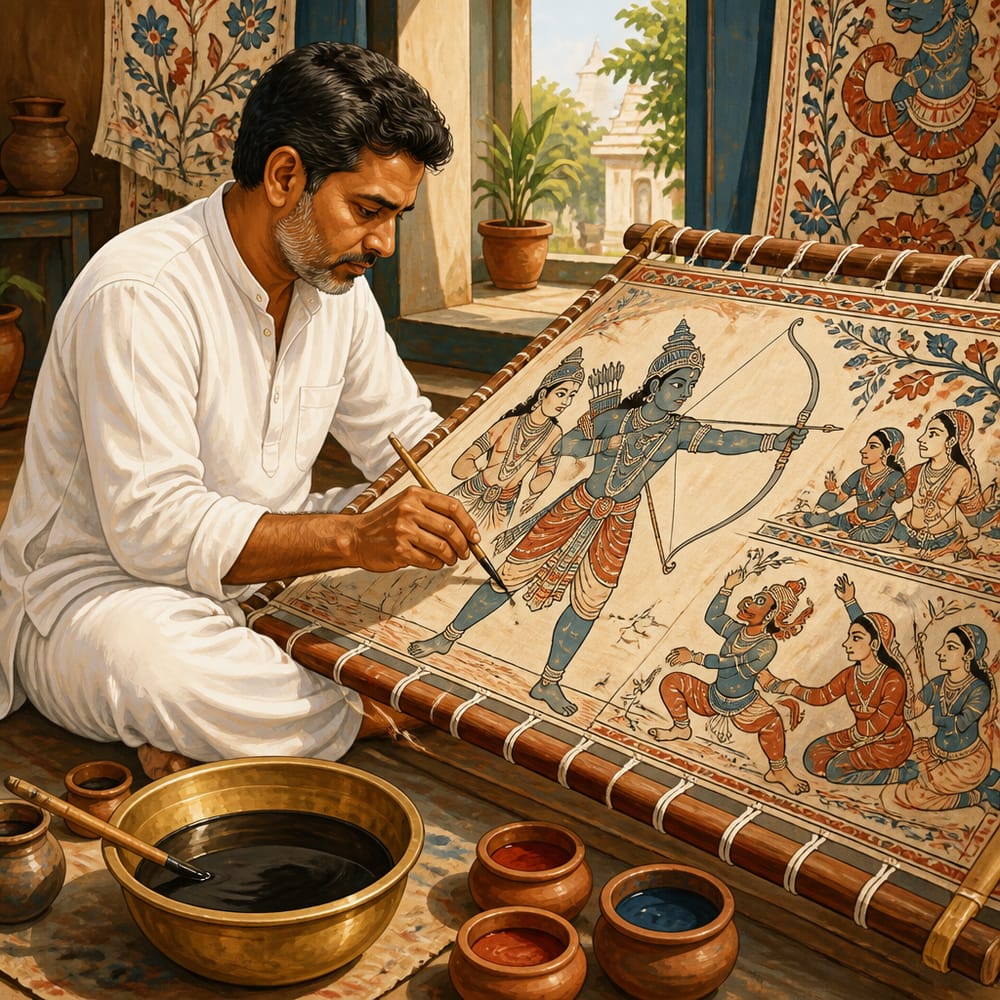
In a whitewashed ground-floor workshop in Srikalahasti, in Andhra Pradesh, a short walk from the Kalahasteeswara temple, on an ordinary morning in the early 2020s, Jonnalagadda Niranjan sits cross-legged on a raw cotton sheet spread across the floor. In his right hand he holds a thin kalam, a pen made from a sharpened bamboo sliver wrapped at one end with a twist of raw wool. The wool holds the dye. The bamboo steers the line. The cloth on the floor in front of him is already six feet long. It has been washed, soaked in buffalo milk, and sun-dried twelve times.
He dips the kalam into a small earthen bowl. The bowl holds a liquid that looks almost black but is really a rust-coloured iron acetate, fermented for three weeks from jaggery, iron nails, and water. His hand is steady. The line he draws is thin as a hair and does not stop. Line by line, a figure begins to appear on the cloth. The figure is Rama. Above Rama the line continues, and Sita begins to form. Niranjan has drawn this scene, from memory, hundreds of times in his life. His father drew it before him. His father's father did not.
Because for almost a hundred years of the colonial century, nobody in this family drew anything. The kalam was put down. The workshops were empty. The tradition almost died. This lesson is the story of how it did not.
Two Names, One Word
The word Kalamkari comes from two Persian words. Kalam means pen. Kari means craftsmanship or work. Together it is 'pen work': cloth on which figures are drawn by hand, rather than printed with blocks.
That is only half the story, though. Under one name there are two very different Indian craft traditions, practised in two towns in coastal Andhra Pradesh about four hundred kilometres apart.
- Srikalahasti, near Tirupati, is the temple tradition. Here the kalam is used as a pen in the strictest sense. Every figure, every border, every tree, every chariot is drawn by hand on white cotton cloth. The subject is almost always religious: the Ramayana, the Mahabharata, the Bhagavata, the lives of local temple deities. The finished cloth is a narrative. The craftsman is a scribe with a brush.
- Machilipatnam (also called Masulipatnam), on the Bay of Bengal coast, is the trade tradition. Here the design is carved into small teakwood blocks, stamped on the cloth in sequence, and then finished with dye and wax. The subject is often floral or geometric, with heavy Persian and Mughal influence. Over the centuries it was made for export: to Iran, Turkey, Indonesia, and later to Europe.
Both traditions use the same family of natural dyes. Both use the same multi-step mordant and wash process. But the hand that works the cloth is different. One draws. The other stamps.
The Srikalahasti Story
Srikalahasti is a temple town. Its central shrine is the Kalahasteeswara temple, one of the Pancha Bhuta Sthalas of Shiva, dedicated to the vayu (air) element. For hundreds of years, the temple was the main patron of the local cloth painters. The painters produced:
- Temple hangings: long horizontal cloths with scenes from the epics, hung inside the prakara (outer corridor) of the temple on festival days
- Ratha covers: the coloured cloth wrapped around the temple chariot during processions
- Storyteller scrolls: large painted cloths carried from village to village by travelling storytellers, who unrolled them panel by panel to narrate the Ramayana aloud to village audiences at night
A Srikalahasti cloth is read the way a book is read. The figures are named. The scenes follow a narrative order. The borders carry small decorative motifs that mark where one story ends and the next begins. For an illiterate village audience, the cloth was the book.
The Machilipatnam Story

Machilipatnam's story is the story of a seaport. In the 17th century, the town was the biggest port on the eastern coast of India and the main export harbour of the Golconda Sultanate. Ships from Persia, the Dutch East India Company, and the English East India Company loaded bales of Machilipatnam cloth and carried them west.
What they carried was called chintz in Europe. The word comes from the Hindi chint, meaning spotted or variegated. Chintz was the Machilipatnam block-printed, hand-dyed cotton cloth, in brilliant colours that did not fade when washed. Europe had never seen anything like it.
By the late 17th century, chintz was so popular in England and France that the mills of both countries went bankrupt trying to compete. In 1686, France banned the import of Indian chintz to protect its own silk weavers. England passed a similar ban in 1720. For nearly a hundred years, the Indian cloth that had arrived from Machilipatnam was smuggled into Europe inside corsets and petticoat linings.
The technique was also the distant ancestor of European printed cotton. When British textile printers finally cracked the colour-fast dye process in the 18th century, the Industrial Revolution in printing cloth was set in motion. Machilipatnam had, without meaning to, shaped the global cotton print industry that would later come back to ruin it.
The Dyes and the Process
Both traditions share a long, slow, mostly chemical-free process. A Kalamkari cloth is not painted in the ordinary sense. It is dyed, section by section, with natural materials that react with mordants applied in specific orders.

| Colour | Source | Method |
|---|---|---|
| Black | Iron acetate (kasimi), fermented from jaggery, iron, and water | Drawn directly with the kalam |
| Red | Alum mordant, followed by a boil with chay root or madder | Alum painted first, red appears after boiling |
| Yellow | Pomegranate rind, myrobalan, or turmeric | Painted with a brush |
| Blue | Indigo, applied after other areas are sealed with molten wax | Cloth is dipped in an indigo vat |
| Beige ground | Buffalo milk and myrobalan | Cloth is soaked and sun-dried twelve times before drawing begins |
A single nine-foot temple hanging from Srikalahasti can take a master artist four to six weeks. A full Machilipatnam wall hanging, in fine detail, can take two or three months. The cloth is washed in running river water between stages, ideally in the Swarnamukhi river near Srikalahasti or the Krishna river near Machilipatnam. Local masters insist that the minerals in the water matter. Printers who moved away from the rivers say their colours changed.
The Century of Silence
Like many Indian crafts, Kalamkari almost did not survive the 19th century. When the British took over Machilipatnam in the 18th century, the export trade that had kept the block printers in business moved to Lancashire mills. By 1830, imported English cotton print was cheaper than the hand-printed Machilipatnam cloth it had copied. The Machilipatnam workshops closed one by one.
Srikalahasti suffered the same fate through a different door. As temples lost their land and their ritual income through the colonial century, they stopped commissioning temple hangings. The travelling storytellers who had read the Ramayana from painted cloth in village squares found that fewer villages could afford to host them. By 1900, the living Kalamkari tradition in both towns had shrunk to a handful of old men.
What saved it was a single woman. Kamaladevi Chattopadhyay, the founder of the All India Handicrafts Board in the 1950s, walked through the small towns of newly independent India looking for crafts worth saving. In Srikalahasti and Machilipatnam she found a few remaining old masters, set up training centres, and paid for apprentices to learn from them. She put Kalamkari cloth in the Central Cottage Industries Emporium in Delhi and began sending pieces to exhibitions abroad.
She did not save the tradition by herself. The masters still had to teach, and the apprentices still had to sit through years of kalam practice before their hands were steady enough to draw a face. But she bought them time. In the 1960s and 1970s, a new generation of Srikalahasti masters, led by Jonnalagadda Lakshminarayana and his son Jonnalagadda Gurappa Chetty, began rebuilding the temple-cloth tradition. Gurappa Chetty received the Padma Shri in 1981. He was the first Srikalahasti Kalamkari artist to be given a Padma honour.
In 2008, both Srikalahasti Kalamkari and Machilipatnam Kalamkari were granted separate Geographical Indication tags by the Government of India. For the first time in two hundred years, the name Kalamkari had a legal meaning, tied to a specific technique practised in a specific place.
The Kalam, Still Moving
It is morning again in Niranjan's workshop in Srikalahasti. The cotton is spread on the floor. His father's kalams are lined up in a small wooden box on the shelf above him, the bamboo sticks dark with decades of iron-black dye. The Ramayana scene he began with Rama and Sita is now almost finished. The next panel, when he starts it, will be the building of the bridge to Lanka.
यदा यदा हि धर्मस्य ग्लानिर्भवति भारत। अभ्युत्थानमधर्मस्य तदात्मानं सृजाम्यहम्॥
yadā yadā hi dharmasya glānirbhavati bhārata abhyutthānamadharmasya tadātmānaṃ sṛjāmyaham
Whenever dharma declines, O Bharata, and adharma rises, I send forth Myself in a new form.
Bhagavad Gita 4.7
Krishna's promise in the Gita is that whenever dharma falls, the divine manifests itself again in visible form. The Srikalahasti Kalamkari artist takes that promise very literally. Every time the kalam touches the cloth, a scene from the avatars returns to visible form. Rama comes again. Krishna comes again. The epics, which once circulated only through village storytellers and temple walls, now return to the eye through the hand of a painter in a single quiet workshop.
What the tradition almost lost, it has now carried across the world. Dr. Jonnalagadda Niranjan, born in Srikalahasti in 1967, was awarded the Padma Shri in 2008 for keeping the kalam moving. His father, Shilpa-Guru J. Gurappa Chetty, trained hundreds of artists in the decades after Independence and is the reason more than two hundred working Kalamkari artisans in Srikalahasti today can trace their teaching line back through a single room. Niranjan himself now runs natural-dye and painting workshops in Zurich, Taipei, Colombo, and New York. The kalam that a nineteenth-century colonial officer wrote off as a dying craft is now held in hands on four continents.
That is what nearly ended in 1900. And what almost ended again in 1950. And what did not end. What the colonial century broke was the market for the cloth. What it could not break was the teaching line that drew the cloth in the first place. Niranjan learned the line from his father. His father learned it from his father. Niranjan's students are learning it from him. The kalam is still moving.
Key figures
Jonnalagadda Gurappa Chetty
A master Srikalahasti Kalamkari artist of the mid and late 20th century, son of Jonnalagadda Lakshminarayana. Together with his father, Gurappa Chetty rebuilt the Srikalahasti temple-cloth tradition after the colonial-era collapse. He trained dozens of apprentices and set standards for freehand drawing, natural dye preparation, and narrative composition that are still followed in the town today.
Kamaladevi Chattopadhyay
An Indian freedom fighter, social reformer, and founder of the All India Handicrafts Board and the Crafts Council of India. In the 1950s and 1960s, she led the rebuilding of several Indian craft traditions that had nearly died during the colonial century, including Kalamkari, Kantha, Dhokra, Kathakali theatre, and handloom weaving across many regions.
The Pitchuka Family of Pedana
A lineage of Machilipatnam Kalamkari block-printing masters based in the village of Pedana, the main surviving centre of the Machilipatnam tradition. The Pitchuka family has passed down the teakwood-block carving, the mordant-and-dye chemistry, and the Persian-influenced floral vocabulary of Machilipatnam Kalamkari across several generations of the 20th and 21st centuries.
Case studies
The Temple Hangings of Srikalahasti
For centuries, the Kalahasteeswara temple in Srikalahasti was the main patron of the local Kalamkari masters. Every major festival (Maha Shivaratri, Karthika Masam, the annual Brahmotsavam) required new painted cloths. Some were hung along the prakara (outer corridor) of the temple with scenes from the Shiva Purana. Some wrapped the temple chariot during processions. Some were carried from the temple into the surrounding villages by travelling chitrakars, who unrolled them at night in village squares and recited the Ramayana and the Mahabharata aloud to audiences that could not read. The masters produced these cloths on commission from the temple and from village patrons, working in ground-floor workshops a short walk from the main shrine. A full narrative cloth for a village Ramayana night could take six to eight weeks of continuous work.
The Srikalahasti temple-cloth system was a complete dharmic teaching ecosystem. The temple provided commissions, pilgrims, and a context for the narratives to be told. The masters provided the hands, the memory, the kalam, and the drawing. The chitrakars provided the voice that carried the finished cloth into the villages. The villagers provided the audience. Each role in the system depended on the others. The painter was not painting for his own aesthetic satisfaction. He was painting a book that a storyteller would carry to a community that would learn the epics by seeing them. For the temple, the cloths were not decoration. They were one of the main ways the village audience actually learned dharma.
Through the colonial century, every part of this ecosystem collapsed. Temple lands were taken under colonial revenue settlements and the temple's commissioning budget shrank. The travelling chitrakars stopped coming to villages because villages could no longer pay them. The master workshops received fewer and fewer commissions. By 1900 the chain was broken. The old masters were still there, but they were drawing almost no new cloth. Only after Kamaladevi Chattopadhyay's 1950s intervention did the workshops have any paid work again. And even then, the travelling-chitrakar part of the chain never fully returned. The Srikalahasti Kalamkari tradition today produces cloth, but the cloth no longer reaches village audiences the way it used to. What remains is the drawing itself.
A craft is almost never isolated. It is embedded in a system of patrons, practitioners, intermediaries, and audiences. When any one part of the system collapses, the craft itself is in trouble, even if the masters are still alive and the technique is still known. The Srikalahasti tradition lost its travelling chitrakars and its village audiences in the colonial century. It did not lose the drawing. But the drawing alone is not the whole craft. The drawing was the script of a performance. The performance is now gone. Understanding a craft historically means understanding the whole ecosystem around it, not just the technique in the master's hand.
The collapse of the Srikalahasti temple-cloth ecosystem is a warning for every modern craft revival. It is not enough to save the technique. You also have to rebuild some version of the patron, the audience, and the occasion the craft was made for. The current Srikalahasti revival relies on state emporiums, museums, designer partnerships, and pilgrimage tourism to replace the temple-and-village audience that is no longer there. Whether that is enough is still an open question for the tradition.
At peak, in the 17th and 18th centuries, Srikalahasti temple patronage supported several dozen full-time master workshops in the town. By 1900, fewer than five of those workshops had any active commissions. By 1950, the tradition in Srikalahasti was sustained by a small handful of elderly masters who had almost no paid work.
The Golconda Chintz Trade from Machilipatnam
In the early 17th century, Machilipatnam (also called Masulipatnam) on the Bay of Bengal coast was the biggest port on the eastern coast of India and the main export harbour of the Qutb Shahi sultanate of Golconda. In 1610, the English East India Company opened a factory at Machilipatnam. In 1611 the Dutch followed. For the next hundred years, bales of block-printed cotton cloth from Machilipatnam and its hinterland villages, including what is now Pedana, were shipped out to Persia, Aden, Basra, Mocha, and the ports of Europe. The cloth was famous for two things at once. First, its colour-fastness: unlike European prints of the same period, Machilipatnam cloth held its brilliant reds, blues, and yellows through repeated washing. Second, its design vocabulary: Persian-influenced florals, Mughal garden motifs, and geometric borders that matched Islamic as well as Hindu taste. A single shipload of Machilipatnam cloth could be traded for its weight in pepper, silk, or silver in the Persian Gulf.
From an Indian craft perspective, the Machilipatnam export trade was a triumph and a trap at the same time. It was a triumph because it showed that Indian textile technique was far ahead of the rest of the world. Colour-fast dyeing of cotton was a technical achievement that European mills could not replicate for more than a century after they first encountered it. It was a trap because the craft became economically dependent on foreign merchants. When the trade shifted, the craft had nothing else to fall back on. The village workshops of what is now Pedana had not been building a domestic market. They had been building a ship manifest. When the ships stopped coming, the looms stopped too.
Between 1686 and 1720, France and England both banned the import of Indian chintz to protect their own mills. From 1800 onward, British-run Lancashire mills mechanised cotton printing using techniques they had learned directly from places like Machilipatnam, and then flooded the Indian market with machine-printed copies of the same patterns. By 1850, the Machilipatnam export workshops were effectively closed. By 1900, only a small number of block printers survived in the village of Pedana, and even those were working at a tiny fraction of the old volume. The craft had nearly died where it had once been the largest textile export of the eastern Indian coast.
A craft that depends entirely on export demand is as fragile as the shipping lane that feeds it. When the buyer's country decides to copy the technique and ban the original, the craft loses both markets at once. The Machilipatnam story is a warning that technical excellence alone is not enough. A sustainable craft also needs a diverse set of buyers, preferably including a domestic market that cannot be banned by a foreign government. The Srikalahasti tradition, which was tied to temples and villages rather than to ships, was dealt a different hand. But both traditions collapsed in the colonial century, because both lost the patron relationships they had been built around.
The Machilipatnam collapse is studied by historians of globalisation as one of the clearest early examples of a colonial extraction cycle: Europe imports a superior Indian textile, learns the technique, bans the Indian import, mechanises production at home, and then floods the original market with machine copies. The same pattern played out later with Indian silk, Indian calico, and Indian handloom cotton more broadly. The 2008 GI is Indian law's first structural answer to this cycle for Machilipatnam specifically.
At peak, in the mid-17th century, Machilipatnam handled the majority of Indian cotton cloth exports to the Persian Gulf and a large share of exports to Europe. By 1900, the surviving Machilipatnam Kalamkari block-printing workforce had shrunk to a few dozen families, mostly based in Pedana. The 2008 GI registration was the first legal protection the tradition ever received.
Jonnalagadda Niranjan and the Teaching Line
Jonnalagadda Niranjan is a master Srikalahasti Kalamkari artist whose teaching line runs directly back through his father Gurappa Chetty (Padma Shri 1981) to his grandfather Jonnalagadda Lakshminarayana, one of the handful of Srikalahasti masters still working when Kamaladevi Chattopadhyay's All India Handicrafts Board reached the town in the 1950s. Niranjan's workshop in Srikalahasti produces full narrative temple hangings, ritual cloths, and smaller Ramayana and Mahabharata panels. The hangings are sold through Lepakshi emporiums, through direct buyers at the workshop, through occasional museum and designer commissions, and through online platforms such as Gaatha that profile individual master artists and sell directly from their workshops. Niranjan personally trains a rotating group of younger apprentices, most of them from Kalamkari families in or near Srikalahasti.
The Srikalahasti guru-shishya parampara operates in Niranjan's workshop in exactly the form it has for generations. Apprentices sit with the master on the same floor mat. They start with sketching and kasimi-line practice on scrap cotton. They progress over years to drawing full human figures, then full scenes, then whole narrative panels. The master does not explain every decision. He draws, and the apprentice copies, and the copying is corrected until the hand develops its own memory. This is how Niranjan learned from his father. This is how his father learned from his grandfather. It is also how the tradition survived 1900, when the only teaching material the elder masters had was their own drawing, passed hand-to-hand to the next generation with no buyer for any of it.
Today Niranjan's workshop is one of the most active Srikalahasti Kalamkari teaching centres. Through him and a small number of peer masters, the freehand drawing tradition of the town continues to be handed forward. His pieces are represented in national museums, sold through state emporiums, and occasionally used in international exhibitions of Indian craft. The Lepakshi emporium network and Gaatha's direct-to-artisan platform are the main channels through which urban Indian and international buyers reach his work. Buying from either of these channels is the most reliable way to get a genuine Srikalahasti Kalamkari today and to support the workshop economy that keeps Niranjan's apprentices in training.
When a dying craft is revived, what actually gets revived is a specific teaching line in a specific family. It is almost never a whole industry. The Srikalahasti tradition is alive today because Kamaladevi reached Lakshminarayana, Lakshminarayana trained Gurappa Chetty, Gurappa Chetty trained Niranjan, and Niranjan is now training the next cohort. Break any link in that chain and the craft does not recover, however much institutional support there is. Honouring a living craft means honouring the specific masters whose hands still hold it, not just the tradition in the abstract.
Buyers who want to support Srikalahasti Kalamkari in a way that actually reaches the master artists should look for pieces directly attributed to named workshops, such as the Jonnalagadda family workshop in Srikalahasti. Lepakshi emporiums, the Central Cottage Industries Emporium in Delhi, Gaatha.com, and direct workshop visits during a Tirupati trip are the main ways to do this. Anonymous 'Kalamkari print' sarees in urban retail, even when genuinely made in India, are usually machine prints that do not return any money to the master teaching line that the tradition actually depends on.
The Jonnalagadda teaching line in Srikalahasti is now in its fourth documented generation: Jonnalagadda Lakshminarayana, Jonnalagadda Gurappa Chetty (Padma Shri 1981), Jonnalagadda Niranjan, and the current cohort of apprentices. The line has so far produced one Padma Shri and a continuing family of working master artists. Most Srikalahasti Kalamkari pieces in national collections after 1960 can be traced back to this workshop or its students.
Lepakshi and Gaatha: Two Ways to Buy Real Kalamkari
Today, an urban buyer in Bangalore, Delhi, or Hyderabad who wants to buy a real Srikalahasti or Pedana Kalamkari piece faces a specific problem. Most of what is sold as 'Kalamkari' in ordinary retail is actually a machine-printed cotton from a mill in another state, using Kalamkari motifs but none of the natural-dye or hand-drawing process. The price tag says Rs. 1,500. The piece looks like Kalamkari. The money goes to a printing factory, not to a master workshop. A real Srikalahasti hand-painted temple hanging or a real Pedana block-printed cotton costs several times more, and can be very hard to find through ordinary retail channels. Two kinds of platforms have emerged to bridge this gap. First, the Andhra Pradesh state government runs a chain of Lepakshi Handicrafts Emporiums that stocks certified Srikalahasti and Machilipatnam Kalamkari pieces sourced directly from master workshops in both towns. Second, online platforms like Gaatha (gaatha.com) and iTokri profile individual master artists by name, photograph their workshops, and sell their work directly to urban Indian and international buyers. Both models try to ensure that the money reaches the actual master.
From a dharmic perspective, a craft purchase is a three-way relationship, not a transaction. The buyer receives an object that was made by named hands. The master receives payment that sustains the teaching line that produced the object. The tradition as a whole receives a small confirmation that the patronage relationship, which collapsed in the colonial century, is being rebuilt. A machine-printed saree that uses Kalamkari motifs breaks all three parts of this relationship at once. The buyer thinks they have bought a traditional craft and has not. The master receives nothing and loses one more potential buyer to a printing factory. The tradition is further weakened. Choosing where to buy is therefore not only an economic decision. It is a decision about which patronage relationships one is willing to be part of.
Buyers who use Lepakshi or Gaatha (or equivalent platforms) can be reasonably sure that a piece labelled 'Srikalahasti Kalamkari' or 'Machilipatnam Kalamkari' is real, that it is hand-made in the named town, and that a meaningful share of the price reaches the master workshop. A typical Gaatha-listed Srikalahasti cotton wall hanging costs several thousand rupees and comes with the name of the master artist. A certified Lepakshi saree in natural dyes costs several thousand rupees more than a mass-market cotton saree. The price difference is the actual cost of the craft. It is also the subsidy that keeps the teaching line alive.
The hardest problem for a modern Indian craft tradition is not keeping the technique alive. It is keeping the patronage relationship alive after the temple and the village audience have been replaced by urban retail. State emporiums like Lepakshi and direct-to-artisan platforms like Gaatha are two attempts at a solution. They are imperfect, but they work, and they give buyers a way to spend craft money in a way that actually reaches the master. When you buy a Kalamkari piece, the most important single question is not how it looks. It is where the money goes.
The Lepakshi-and-Gaatha model is becoming the standard way to connect urban Indian buyers to real handmade Indian crafts. It applies not only to Kalamkari but also to Pochampally ikat, Banarasi sarees, Channapatna toys, Dhokra metalwork, Kashmir carpets, and many others. A reader who wants to support any Indian craft tradition has, for the first time in history, a reliable online way to do so. What is still missing is the general awareness that would make direct-to-artisan the default rather than the exception.
A certified Srikalahasti Kalamkari cotton temple hanging on Gaatha or at a Lepakshi emporium typically costs between Rs. 5,000 and Rs. 50,000, depending on size and complexity. A full-scale Ramayana or Mahabharata hanging can exceed Rs. 1 lakh. A mass-market machine-printed Kalamkari saree in ordinary retail typically costs Rs. 1,000 to Rs. 3,000. The price gap, often ten to thirty times, is mostly the cost of hand labour, natural dyes, and the master teaching line.
Historical context
The Kalamkari story runs from the temple art of the medieval Kakatiya and Vijayanagara periods, through the 16th and 17th-century Qutb Shahi export trade from Machilipatnam, through the 18th and 19th-century colonial collapse under the East India Companies and the Lancashire mills, through the 1950s revival under Kamaladevi Chattopadhyay, into the 2008 Geographical Indication registrations that finally gave both Srikalahasti and Machilipatnam Kalamkari a legal name.
The painted and printed cotton tradition of coastal Andhra Pradesh is very old. Archaeological evidence of mordant-dyed cotton in India goes back to the 3rd millennium BCE at Mohenjo-Daro. In the medieval period, temple patronage sustained narrative cloth painting across southern India: the kalamkari scroll, the Tamil Kalankari, the Andhra pata, and the Kerala thulapani. Srikalahasti, the temple town dedicated to Shiva as Vayu Lingam, became one of the main centres for religious narrative cloth drawn by hand. Machilipatnam, 400 kilometres to the north on the Bay of Bengal coast, became the main centre for block-printed commercial cloth exported through its seaport. Both traditions survive today, in drastically reduced form, in the hands of a few dozen master artist families clustered around Srikalahasti and the nearby village of Pedana.
The Machilipatnam chintz trade shaped European textile history more directly than almost any other Indian craft. The French and English import bans of 1686 and 1720 are the only known examples of major European states banning a South Asian cloth to protect their own industries. The 18th-century British textile printing industry that eventually led to the Industrial Revolution was built on reverse-engineering the colour-fast dye process first seen in Machilipatnam and Ahmedabad. The Srikalahasti narrative cloth tradition, by contrast, has parallels in the Tibetan thangka, the Ethiopian Orthodox story-cloth, and the early Christian narrative embroideries of Coptic Egypt. In all of these, cloth is used as a readable book for a largely non-literate religious audience. Srikalahasti is one of the few places in the world where this narrative-cloth tradition is still practised by artists whose teaching lineage can be traced continuously back to medieval temple workshops.
By 1900, the number of active Kalamkari master artists in Srikalahasti and Machilipatnam combined had dropped to the low dozens. In 2008, at the time of the two GI registrations, there were a few hundred practising artists across both traditions. Today, estimates put the combined number of full-time Srikalahasti and Pedana Kalamkari artists at between 1,000 and 2,000, most of them working in family workshops in the two historic centres.
Kalamkari is the Indian craft through which Europe first discovered the possibility of colour-fast printed cotton. It is also the craft that most directly influenced the global textile printing industry of the 18th and 19th centuries. On the Indian side, it is one of the clearest examples of a tradition that survived a near-complete collapse through a combination of post-independence institutional support (Kamaladevi's All India Handicrafts Board) and a small number of surviving master teachers who refused to stop training the next generation. Without both of those, neither Srikalahasti nor Machilipatnam Kalamkari would be alive today.
Living traditions
The 2008 Geographical Indication registrations finally gave both Srikalahasti Kalamkari and Machilipatnam Kalamkari a defended legal name. Today the tradition is supported by the Andhra Pradesh state emporium Lepakshi, by the Central Cottage Industries Emporium in Delhi, by online direct-to-artisan platforms like Gaatha that profile named master artists, and by designer partnerships with labels that use Kalamkari motifs in contemporary sarees, home furnishings, and apparel. The Jonnalagadda family workshop in Srikalahasti continues to train the next generation of freehand painters. The Pedana block printers continue to produce hand-dyed cotton in Persian and Mughal floral patterns. Both centres face the steady pressure of machine-printed imitations sold under the same name.
- Freehand kalam drawing on treated cotton: The core Srikalahasti practice. A cotton sheet is treated with buffalo milk and myrobalan, sun-dried twelve times, and laid flat on the workshop floor. The master sits cross-legged beside it with a bamboo kalam and a clay pot of fermented iron-acetate dye. He draws each figure of the scene from memory, without sketches or templates. A complete nine-foot Ramayana panel can take four to six weeks of continuous work.
- Teakwood block printing at Pedana: The core Machilipatnam practice, now almost entirely based in the village of Pedana. Designs are carved in mirror image into small blocks of teakwood, one block per colour or per motif. A master printer then stamps the blocks onto treated cotton in a precise sequence, aligning borders and repeats by hand. The cloth is washed, mordant-dyed, wax-resisted, and dyed again for each colour. Persian and Mughal-influenced floral patterns dominate.
- Natural dye preparation from river-washed materials: Both traditions depend on a small set of natural dyes prepared in the traditional way. Kasimi, the iron-acetate black, is fermented in clay pots for two to three weeks. Red comes from alum mordant followed by a boil with chay root or madder. Yellow comes from pomegranate rind or myrobalan. Blue comes from indigo. Between stages, cloth is rinsed in running river water, traditionally the Swarnamukhi near Srikalahasti and the Krishna near Pedana. Masters insist the river minerals matter.
Reflection
- Is there any piece of printed or painted cotton in your home that is sold as 'Kalamkari'? Look at it carefully. Does it have the heavy natural-dye red, the iron-black outlines, and the hand-drawn feel of a Srikalahasti or Pedana piece? Or does it have the flat, even, slightly plastic look of a machine print that is only using Kalamkari motifs? What would change in how you buy and gift this kind of cloth if you could tell the difference?
- The Srikalahasti masters of 1900 kept teaching the craft even when there was no buyer left for the finished cloth. If you had a skill or a piece of knowledge whose market had collapsed, would you still teach it? What reasons would you give a young apprentice for learning something that currently pays nothing? Think of a specific skill, a specific younger person in your life, and a specific reason that is not purely economic.
- The travelling chitrakars of Andhra Pradesh taught the Ramayana and the Mahabharata to village audiences by unrolling a painted cloth and reciting the scenes aloud. The cloth was the book. Is there anything in your own life that you could teach better through a drawing, a painting, a short visual story, or a cloth, rather than through a written document? Who would the audience be? What would the cloth look like?