Ajrakh & Rogan: Sacred Geometry of Kutch

From the four-and-a-half-thousand-year-old trefoil shawl on a priest-king in Mohenjo-daro to the village of Ajrakhpur that the Khatri families built from nothing after the 2001 Gujarat earthquake, the story of two Kutch crafts that print the cosmos in indigo and red and paint it, drop by drop, in boiled castor oil.

Ajrakh is not one print. It is sixteen prints, in sequence, on the same length of cotton. Between each stamp the cloth is washed, dried, dyed, boiled, sun-bleached, steamed, and washed again. A single nine-yard Ajrakh shawl takes three to four weeks of patient, resist-dyed, multi-block work by a Khatri master in the village of Ajrakhpur in the Kutch district of Gujarat. The village itself is only twenty-three years old. The families who live in it were displaced from the nearby village of Dhamadka in the great Bhuj earthquake of 26 January 2001, and rebuilt the entire craft from zero. This lesson walks into an Ajrakhpur courtyard at dawn, where a young Khatri printer is beginning the fourth of sixteen stages on a shawl commissioned by a Chennai designer who works with slow-fashion buyers in London and Tokyo, and then walks three hours east to the village of Nirona, where the last family still practising the dying Rogan oil-painting art of Kutch works with a stylus, a bowl of boiled castor oil, and a hand that has kept a tradition alive that almost nobody else in the world remembers how to do.

Dawn in Ajrakhpur
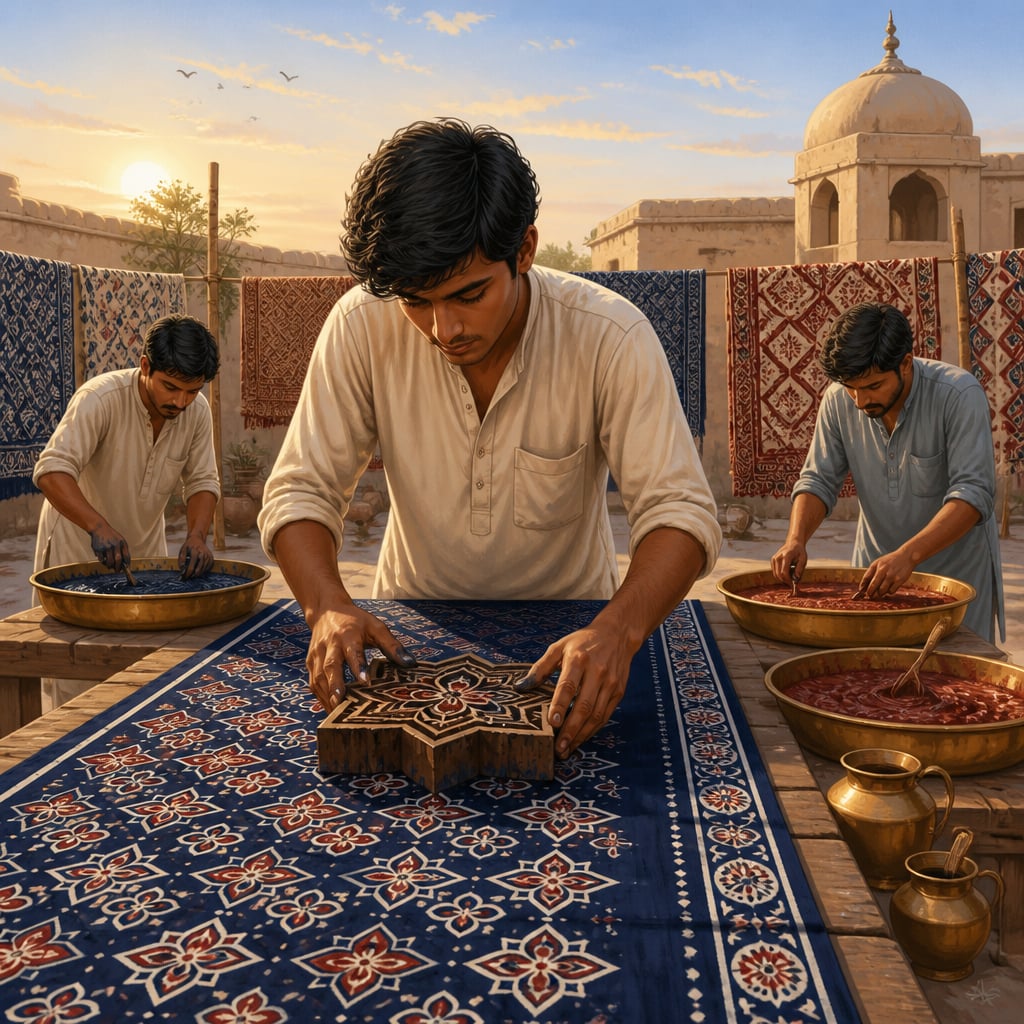
Khatri printer aligning Ajrakh block on indigo cotton at dawn

It is five in the morning in Ajrakhpur, a village in the Kutch district of Gujarat, about fifteen kilometres east of Bhuj. The eastern sky is pale but the sun has not cleared the low hills. In a long, open-walled shed at the edge of the village, a young Khatri master block printer we will call Sufiyan Khatri, a composite drawn from the younger generation of Ajrakhpur printer families, is laying a six-metre length of cotton cloth across a long padded table. The cloth has been soaked for two days in castor oil, camel dung, and soda ash, washed in the village pond, and sun-dried. It is the colour of weak tea and smells faintly of cow.

This is only stage four of sixteen. The shawl will not be finished for another three weeks. Sufiyan's father Mohammad is at the carving bench at the back of the shed, finishing the mordant block they will use this morning. The block is four inches square, carved in teakwood, showing a trefoil flower inside an eight-point star. The same motif, with small variations, has been stamped on Khatri cloth for at least four generations of the family. If the Indus Valley archaeology is read the way the Khatri community reads it, the motif is closer to four and a half thousand years old.

The shawl is an order from Chinar Farooqui, whose Chennai label Injiri sells hand-printed Ajrakh to slow-fashion buyers in London and Tokyo. Before Injiri began placing direct orders in 2009, the Khatri printers of Ajrakhpur sold most of their cloth through middlemen at a third of what it was worth. Farooqui did not invent the price. She agreed to pay what the cloth actually cost.

This lesson is about two Khatri crafts that live in the same district of Gujarat: Ajrakh, the sixteen-stage resist-dyed block print; and Rogan, the castor-oil painting tradition of Nirona village, which came close to dying out and is now held alive by a single family of brothers.

The Word and the Sixteen Stages

Ajrakhpur courtyard showing all sixteen stages of Ajrakh production

The word Ajrakh is usually traced to the Arabic azrak (blue) or the Sindhi ajarak (today, keep it). Both fit a cloth whose dominant colour is deep indigo. Both are probably folk etymologies. The word is old enough that its true origin is lost.

What is not in question is the process. A finished Ajrakh shawl is the result of sixteen distinct stages, each taking between a few hours and a few days. The cloth is never idle. If it is not being printed, it is being washed, dried, dyed, or steamed. The sequence runs roughly:

  1. Saaj: initial wash in the village pond to remove starch.
  2. Kasaav: soak in castor oil, camel dung, and soda ash.
  3. Harda: second soak in ground myrobalan as a base mordant.
  4. Kat: resist outline in lime and gum-arabic paste.
  5. Kariyana: iron-black mordant for lines that will become black.
  6. Gach: alum mordant for areas that will become red.
  7. First rab: steaming to fix the mordants.
  8. Vichharnu: madder and alizarin dye bath for the red.
  9. Minakari: accent prints in additional colours.
  10. Saaf: a long rinse in running water.
  11. Nilo: immersions in the indigo vat for the blue.
  12. Tapai: sun bleaching to brighten the white ground.
  13. Second rab: a second steaming to fix the indigo.
  14. Second vichharnu: a second dye bath to deepen the red.
  15. Mino: final accent printing and border work.
  16. Washing, drying, and folding in the Khatri family compound.

A single Ajrakh shawl takes between three and six weeks of this continuous sequence. If any stage is skipped or rushed, the colours will not lock in and the shawl will fade within a few washes. The Khatri claim is not that they invented the cloth. It is that they remember the sequence.

The Sindh Origin and Mohenjo-daro

The Khatri printers of Kutch are Muslims whose oral history traces the community to Sindh, in what is now Pakistan. They migrated into Kutch in the sixteenth and seventeenth centuries, probably under the protection of the Rao rulers of Bhuj, carrying with them the recipes, the block-carving skills, and the dye knowledge that define the tradition.

The claim that Ajrakh is four and a half thousand years old rests on one of the most famous objects in Indian archaeology: the small limestone priest-king of Mohenjo-daro, excavated in the 1920s from the Indus Valley city in present-day Pakistan. The statue wears a shawl draped over the left shoulder, and the shawl carries a repeating trefoil motif enclosed in small circles that looks unmistakably like the trefoil-in-star pattern still stamped on Ajrakh shawls today. Fragments of dyed cotton from the same site, now held in the National Museum in New Delhi, use the same madder-red and indigo-blue chemistry the Khatri printers use now. The claim is not that the Mohenjo-daro cloth is itself an Ajrakh. It is that the visual and chemical vocabulary of Ajrakh was already present in the Indus Valley by around 2500 BCE. No other Indian textile tradition can make a comparable claim with this much archaeological evidence on its side.

From Dhamadka to Ajrakhpur

For most of the twentieth century, the Khatri Ajrakh printers lived and worked in Dhamadka, a village about fifty kilometres east of Bhuj. Dhamadka had everything the craft needed: a village pond, mineral-rich well water for the dye vats, and a cluster of Khatri family workshops close enough to share blocks and recipes. The best-known Dhamadka master through the 1970s and 1980s was Ismail Mohammad Khatri, whose workshop was the first stop for outside designers and museum buyers looking for the living tradition.

On the morning of 26 January 2001, a magnitude 7.7 earthquake struck Kutch. The epicentre was close to Bhuj. Thousands were killed across the district and much of Dhamadka was destroyed. The Khatri workshops survived the first tremors, but the village water table shifted. The wells ran dry or turned salty. A craft that depends on water cannot continue without water.

What the Khatri families did next is one of the most remarkable stories in modern Indian craft history. Rather than scatter into the cities, they decided together to rebuild the entire craft infrastructure from zero. They found a piece of land fifteen kilometres east of Bhuj, bought it, and named the new village Ajrakhpur, Ajrakh-town, in honour of the craft they were saving. They laid out plots, drilled new wells, built workshops, dug a new village pond, and replanted the neem and babool trees the printers use for dye. By 2003, the first new Ajrakhpur shawls were being printed. That same year, Dr Ismail Khatri received an honorary doctorate from De Montfort University, Leicester, the first such honour for a traditional Indian craftsman. In 2019, he received the Padma Shri.

The Khatri families did not save individual workshops. They saved the entire ecosystem.

Rogan: The Other Kutch Art

Abdul Gafur Khatri drawing Rogan tree-of-life with iron stylus

Three hours east of Ajrakhpur, in a village called Nirona on the edge of the Rann of Kutch, lives a Khatri family of a different branch whose art is not block printing at all. It is Rogan, from the Persian word for 'oil'. Castor oil is heated for hours over a slow fire until it thickens into a dark sticky gum called rog. The gum is cooled, mixed with natural pigments, and applied to cloth with a long metal stylus. The artist does not draw on the cloth the way a pen draws on paper. He holds the stylus above the cloth, coaxes a fine thread of coloured gum from its tip, and lets the thread fall in the shape of a flower, a leaf, or a peacock. Half the work is done on the cloth and half in the air above it. A single Rogan wall hanging can take two to three weeks of continuous work.

Rogan came to Kutch from Iran several centuries ago, carried by Khatri families who settled first in Sindh. For most of its history, several Kutch families practised it. But because Rogan was never tied to a ritual function, and because the Indian market for luxury oil-painted wall hangings shrank to almost nothing in the twentieth century, the number of practising families fell to one by the 1980s. That family was the Khatris of Nirona, led by Abdul Gafur Khatri, whose ancestors had done Rogan work for eight generations.

In 2014, Prime Minister Narendra Modi, on an official visit to the United States, presented President Barack Obama with a Rogan tree-of-life painting made by Abdul Gafur Khatri in his Nirona workshop. The gift received global press coverage and put Rogan back on the map of the world's surviving traditional arts almost overnight. Orders began to arrive from buyers who had never heard of Nirona. In 2019, Abdul Gafur Khatri received the Padma Shri, the same year and the same honour as Ismail Khatri of Ajrakhpur. Two Khatri masters from two villages in Kutch received the same national recognition in the same year, decades after both crafts had come close to disappearing.

The Nirona workshop is still in the same one-room building. Abdul Gafur's brothers and his nephew Rizwan work alongside him now, and younger children are being trained in the stylus technique from childhood. The eight-generation family line did not end. The craft was saved by a single family who refused to stop practising it when everyone else had stopped.

Living Institutions

The Ajrakh and Rogan traditions are not saved by any single family alone. Kala Raksha, a textile preservation trust founded in Sumrasar Sheikh village in 1993 by the American textile scholar Judy Frater with a group of local community women, has done much of the patient, unglamorous work of keeping the craft economy stable. In 2005, Frater opened the Kala Raksha Vidhyalaya in Adhoi, a design school for young Kutch artisans and the first of its kind in India. Several of its graduates now run their own workshops in Ajrakhpur.

The second new institution is the direct-market designer partnership. Injiri, founded by Chinar Farooqui in 2009, is the best-known example. Similar partnerships now link the Khatri printers to Aneeth Arora of Pero, Sanjay Garg of Raw Mango, and the export label Maiwa in Vancouver. None of these existed twenty years ago. They are the new infrastructure that has replaced the middleman economy that dominated Kutch textile sales for most of the twentieth century.

Sufiyan finishes printing the mordant block on the Chennai shawl. He rinses the block in a clay bowl of water and sets it aside. His father Mohammad hands him the next block, a finer-lined one for the narrow border. The sun is above the hills now. It is nine in the morning. They will print until noon, then wash the cloth in the village pond and lay it in the sunning field for the afternoon. The pattern being stamped on it today was stamped in the Indus Valley before Moses walked out of Egypt. The village it is being stamped in was built in 2002. Both facts are true, and the craft lives in the distance between them.

Key figures

Dr Ismail Mohammad Khatri

A Khatri master block printer from Dhamadka village in the Kutch district of Gujarat, and the single most important figure in the modern survival of the Ajrakh tradition. Ismail Khatri was born into a printer family in Dhamadka in the 1950s and learned the sixteen-stage Ajrakh process from his father and grandfather in the family workshop. Through the 1970s, 1980s, and 1990s, he worked as a master printer and as an international ambassador for the tradition, hosting textile scholars, museum curators, and designers from around the world in his Dhamadka workshop.

Abdul Gafur Khatri of Nirona

A Khatri master of the Rogan castor-oil painting tradition from the village of Nirona in the Kutch district of Gujarat, and the senior living practitioner of a craft that came close to extinction in the twentieth century and is now held alive by a single family. Abdul Gafur Khatri was born into the Rogan-painting family of Nirona in the 1950s and learned the craft from his father, who had learned it from his father, in a continuous line of eight generations.

Judy Frater

An American textile scholar and cultural preservationist who moved to the Kutch region of Gujarat in the 1980s to study the women's embroidery and textile traditions of the Rabari, Mutwa, Jat, and Sodha communities. She conducted extensive ethnographic fieldwork in the 1980s and 1990s, published the foundational study 'Threads of Identity' in 1995, and in 1993 co-founded the Kala Raksha textile preservation trust in Sumrasar Sheikh village together with a group of local community women.

Case studies

The Sindh Origin: Mohenjo-Daro and the Priest-King's Shawl

In 1927, during the second major excavation season at the ruined Indus Valley city of Mohenjo-Daro in what is now Sindh, Pakistan, Sir John Marshall's team of the Archaeological Survey of India uncovered a small limestone statue about seventeen centimetres tall, showing a bearded seated figure with his left shoulder draped in a shawl. The figure was given the nickname 'priest-king' by Marshall's team, though there is no direct evidence that he was either a priest or a king. What mattered for textile history was the shawl itself, which showed a clearly carved repeating pattern of trefoil flowers enclosed in circles, set in a tight geometric grid. The statue was dated, on the basis of the Mohenjo-Daro stratigraphy, to roughly 2500 BCE. In the same excavation season and in subsequent work at Harappa and Dholavira, small fragments of dyed cotton cloth were recovered from the Indus Valley sites. Chemical analysis of the fragments showed evidence of madder-red and indigo-blue dyeing using methods very similar to those still in use today by the Khatri block-printing community of Kutch.

For the Khatri community of Ajrakhpur, the Mohenjo-Daro evidence is not just an archaeological curiosity. It is the documentary proof of a claim that the community has always made about itself through oral tradition: that the Ajrakh cloth they print today is the continuation of a textile tradition that has been continuous in the Sindh-Kutch region for four and a half thousand years. The community migrated eastward from Sindh into Kutch in the sixteenth and seventeenth centuries, but the migration was within the same textile culture. The dye vocabulary did not change when the community crossed the Rann. The design grammar did not change. The Khatri community's sense of its own history runs through Mohenjo-Daro the way a river runs through its own silt. The cloth they print today is a continuation of the cloth the priest-king was wearing when he sat for the sculptor.

The Mohenjo-Daro statue is now held in the National Museum of Pakistan in Karachi and is one of the most famous artefacts of the Indus Valley civilisation. The dyed cotton fragments from the same excavations are held in museum collections in India and Pakistan. The Khatri community's claim to four and a half millennia of continuous tradition is now widely accepted in Indian textile scholarship, and the Mohenjo-Daro evidence is routinely cited in academic and popular writing on the Ajrakh tradition. The archaeological record does not, of course, prove that the specific Khatri families of Ajrakhpur are direct lineal descendants of the weavers of Mohenjo-Daro. What it proves is that the visual vocabulary and the chemical vocabulary of the tradition they practise today were already fully present in the Indus Valley by 2500 BCE, and that no other living Indian textile tradition has this depth of archaeological support for its antiquity.

A living tradition is not the same thing as a scholarly claim about antiquity, but when the two coincide the combination is extraordinarily powerful. The Khatri printers of Ajrakhpur are not making cloth in the same way their neolithic ancestors did. The community has evolved, the specific techniques have been refined, and the families themselves have changed over the centuries. What has not changed is the underlying design vocabulary (the trefoil motif, the eight-point star, the indigo-and-madder palette, the resist-print logic) that the Mohenjo-Daro priest-king wore on his shawl. When you look at a modern Ajrakh shawl next to a photograph of the priest-king statue, you are looking at an unbroken visual conversation that has lasted longer than almost any other cultural artefact in the world. The lesson is that the deepest traditions are not preserved by museums. They are preserved by the families who keep practising them.

The Mohenjo-Daro argument is now the standard starting point in any academic or popular account of the Ajrakh tradition, and it gives the Khatri community a unique position in Indian craft preservation discourse. No other Indian textile tradition has a comparable archaeological depth. The Ajrakh tradition is now frequently cited as the single most important living demonstration of textile continuity from the Indus Valley civilisation to the present day, and is a recurring case study in design-historical scholarship on the long-term survival of traditional craft vocabularies.

The Mohenjo-Daro priest-king statue, excavated in 1927 by Sir John Marshall's team of the Archaeological Survey of India, is dated to approximately 2500 BCE and shows a bearded figure wearing a shawl with a repeating trefoil-in-circle pattern. Fragments of cotton cloth from the same site show evidence of madder-red and indigo-blue dyeing. The Khatri block-printing tradition of Ajrakhpur uses the same design vocabulary and the same family of dyes today, approximately 4,525 years later.

The 2001 Bhuj Earthquake and the Founding of Ajrakhpur

On the morning of 26 January 2001, as the Republic Day parade was unfolding on Rajpath in New Delhi, a magnitude 7.7 earthquake struck the Kutch district of Gujarat. The epicentre was near the village of Chobari, about twenty kilometres from the town of Bhuj. The earthquake killed more than twenty thousand people across the district and destroyed more than three hundred thousand houses. Among the villages damaged was Dhamadka, the home of the Khatri block-printing community, about fifty kilometres east of Bhuj. The Khatri workshops themselves survived the first tremors, but the village water table shifted, the old wells that had supplied the Ajrakh washing and dyeing stages either ran dry or turned salty, and the villagers found themselves with no usable water for a craft that depends on large quantities of clean mineral-rich water at nearly every one of its sixteen stages. A craft that cannot wash cloth cannot make cloth.

The Khatri community's response to the Dhamadka water crisis was a classical community response in the Indian dharmic sense: the family elders met, consulted the younger printers, discussed the options, and decided collectively that the tradition was more important than the attachment to the old village location. The Ajrakh tradition belonged to the Khatri community as a whole, not to any individual family, and it was the community's responsibility to ensure that the tradition continued even if it meant building an entirely new village together. This is the kind of decision that only a community with deep internal trust and a shared sense of collective obligation can make. The Khatri community, whose families had been working the same craft side by side for at least four hundred years in Kutch and much longer in Sindh before that, had the trust. They made the decision.

The Khatri families purchased a tract of land about fifteen kilometres east of Bhuj, in an area with an undisturbed water table and access to the Bhuj-Bhachau road for commerce. They laid out plots for approximately forty family houses and workshops. They drilled new wells, dug a new village pond, built the houses using local construction techniques reinforced for earthquake resistance, constructed the workshops with sunning yards and steam rooms, and replanted the dye-yielding trees (neem, babool, pomegranate) that every Ajrakh printer needs. The village was named Ajrakhpur, literally 'Ajrakh-town'. The first new shawls were being printed in the new village by 2003. Within a decade, Ajrakhpur had replaced Dhamadka as the beating heart of the Ajrakh tradition. Dr Ismail Khatri was awarded an honorary doctorate by De Montfort University in the UK in 2003 in recognition of his leadership in the rebuilding. In 2019, he received the Padma Shri. The new village today is a functioning centre of one of the world's longest continuously surviving textile traditions.

The 2001 rebuilding of the Ajrakh tradition in Ajrakhpur is one of the clearest modern examples of community-led craft preservation in the face of catastrophic infrastructure loss. The lesson for any community facing a similar crisis is that the tradition is not the village. The tradition is the people, the skills, the recipes, and the community bonds that hold them together. If the village becomes uninhabitable, the tradition can move. But the tradition can move only if the community trusts itself enough to make the decision together. The Khatri families had four hundred years of shared craft history to draw on, which is what gave them the trust to buy land and build from zero. Most modern communities do not have this depth of pre-existing trust, and this is one reason catastrophic relocations usually fail. The Ajrakhpur story is the story of what becomes possible when the trust is already there.

The Ajrakhpur case is now a standard reference in disaster resilience and craft preservation scholarship, cited alongside the post-tsunami rebuilding of craft communities in Tamil Nadu and Sri Lanka in 2004-2005, and the post-earthquake rebuilding of Nepal's Newari craft traditions in 2015-2016. The pattern of a community-led collective relocation, rather than individual household dispersal, is now studied in disaster response curricula as one of the most successful models for saving place-based traditional knowledge in the face of infrastructure loss. The Khatri community's willingness to pool resources, purchase land, and build together is what made the model work.

The 26 January 2001 Bhuj earthquake registered a magnitude of 7.7, killed more than twenty thousand people across the Kutch district, and destroyed more than three hundred thousand houses. The new village of Ajrakhpur was founded on a tract of land purchased by the Khatri community in 2001-2002 and was fully functional as a printing village by 2003. It currently houses approximately forty Khatri family workshops and is the principal living centre of the Ajrakh tradition in India.

Judy Frater, Kala Raksha, and the Vidhyalaya Design School for Artisans

In 1993, an American textile scholar named Judy Frater, who had been conducting ethnographic fieldwork in the Kutch region since the early 1980s, co-founded a textile preservation trust in the village of Sumrasar Sheikh in Kutch, together with a group of local community women from the Rabari, Mutwa, Jat, and Sodha communities. The trust was named Kala Raksha, meaning 'Art Protection' in Sanskrit. Its initial focus was on the women's embroidery traditions of Kutch, which were being undervalued by middleman markets and were in slow decline. Kala Raksha offered fair prices, training, and direct market access to Kutch women embroiderers. After the 2001 Bhuj earthquake, the trust expanded its work to include the Ajrakh printing community of Ajrakhpur, supporting them in the rebuilding of the new village and in the re-establishment of the printing workshops. In 2005, Frater and her collaborators founded the Kala Raksha Vidhyalaya, a residential design school in the village of Adhoi specifically dedicated to training traditional Kutch artisans, including Khatri block printers, Rabari embroiderers, and Mutwa textile workers, in contemporary design thinking without requiring them to abandon their community aesthetic vocabulary.

The dharmic framing of the Vidhyalaya's pedagogy is that the artisan already possesses, through her lineage and apprenticeship, the complete aesthetic grammar of her community tradition. What she does not possess (because the urban design education system was never built for her) is the contemporary market vocabulary that would let her translate that grammar into products that urban and international buyers are willing to pay for at a fair price. The traditional solution to this problem, adopted by almost every previous craft-training institution in India, was to send the artisan to an urban design school where she would learn the urban vocabulary at the cost of her community grammar. Frater's innovation was to invert the relationship: to bring the contemporary design vocabulary to the artisan, in her own village, in her own language, at her own pace, and to treat her tradition as the primary knowledge and the urban vocabulary as the supplement. This is a subtle but profound shift, and it is the reason the Vidhyalaya works when many previous efforts have failed.

The Kala Raksha Vidhyalaya has trained more than three hundred Kutch artisans since its founding in 2005, including several dozen Khatri block printers from Ajrakhpur and the surrounding villages. Several of the graduates now run their own independent workshops and sell directly to urban Indian and international markets. The graduates have collectively expanded the design vocabulary of Kutch textiles in ways that would not have been possible through the traditional apprenticeship alone. The school has become a widely studied model for craft-training institutions elsewhere in India and in other craft regions of the world. Judy Frater herself was awarded the Padma Shri in 2010 for her contribution to Indian textile preservation, becoming one of a small number of foreign-born scholars to receive the national honour for work in Indian traditional arts. The Vidhyalaya continues to run annual residential programmes and remains one of the most important modern institutions supporting the Ajrakh and Rogan traditions of Kutch.

When you are training traditional artisans, the most important thing you can do is treat their tradition as the primary knowledge and the contemporary vocabulary as the supplement, not the other way around. Almost every previous attempt to 'modernise' Indian craft has done this backwards and has weakened the tradition in the process. The Vidhyalaya's model of bringing the urban vocabulary to the village, in the artisan's own pace and on the artisan's own terms, is the correct model. It is also the more difficult model, because it requires teachers who are willing to live in the village, respect the tradition, and learn it themselves before they can teach anything on top of it. Judy Frater spent more than a decade living in Kutch and learning the embroidery traditions of the Rabari women before she founded the Vidhyalaya. The pedagogy came out of that decade of learning. It could not have come out of a curriculum written in a design school office.

The Kala Raksha Vidhyalaya model is now being studied and partially adapted by craft-training institutions across India, including the Handloom School in Maheshwar (Madhya Pradesh), the Craft Resource Centre in Kolkata, and several smaller NGO-run training centres in Odisha and Tamil Nadu. The underlying insight, that the artisan's tradition should be the primary knowledge and contemporary design vocabulary should be the supplement, is now widely accepted in Indian craft preservation discourse. The Vidhyalaya remains the single most successful implementation of this insight in India.

Kala Raksha was founded in 1993 in Sumrasar Sheikh village of Kutch by Judy Frater and her community partners. The Kala Raksha Vidhyalaya design school was founded in 2005 in Adhoi village and has trained more than three hundred Kutch artisans in its annual residential programme. Judy Frater was awarded the Padma Shri in 2010 for her contribution to Indian textile preservation.

Chinar Farooqui, Injiri, and the Direct-from-Workshop Designer Model

In 2009, a Chennai-based designer named Chinar Farooqui founded a slow-fashion label called Injiri, with a specific commitment to sourcing her cloth directly from traditional Indian weaver and printer workshops at prices that covered the full production cost plus a fair margin for the workshop. One of her earliest and most important supplier relationships was with the Khatri block-printing workshops of Ajrakhpur, which at the time were still recovering from the 2001 earthquake and the subsequent rebuilding of the village. Farooqui placed direct orders with Dr Ismail Khatri and with several of the other Khatri family workshops for custom colour palettes and pattern combinations, and paid prices that reflected the full sixteen-stage production cost. The Injiri collections were then retailed through the label's own shop and through slow-fashion boutiques in Chennai, Mumbai, London, Tokyo, and New York.

The dharmic framing of the designer-workshop partnership is that a designer who pays a fair price is not simply another customer. She is a partner in the survival of the workshop itself, and the relationship between designer and workshop is a commitment that both sides make for the long term. This was the understanding that governed the patronage of the royal courts and temple administrations that supported Indian craft traditions for most of their history. A king who commissioned a master weaver did not treat the transaction as a one-off purchase. He committed to a continuing relationship that would support the weaver's household for years or decades. Farooqui and Injiri are, in a sense, a modern re-implementation of the same logic. The label does not buy one shawl and move on to the next supplier. It builds a multi-year relationship with a specific workshop and pays the prices that allow the workshop to survive and train the next generation.

Injiri has become one of the most important designer labels in the modern Kutch textile economy. Its orders have allowed several of the Ajrakhpur workshops to significantly expand their production, take on additional apprentices, and pay fair wages. Its retail success in London, Tokyo, and New York has demonstrated that there is a substantial international market for slow-fashion hand-printed Ajrakh at fair prices, which has encouraged other designer labels (Raw Mango, Pero, Maiwa) to enter the same supply chain. The direct-from-workshop model that Injiri helped establish is now the dominant model for high-end Kutch textile sales and has largely replaced the middleman economy that dominated the twentieth century. The Ajrakhpur Khatri workshops now receive roughly sixty to seventy percent of the retail price of their cloth, compared to twenty to thirty percent under the old middleman model.

A designer who commits to fair prices and long-term relationships can do more for a craft tradition than a hundred government grants. The Injiri model is not subsidy. It is honest commerce conducted at the right price, which is a different thing and a much more durable one. The lesson for designers is that sourcing directly from the workshop at fair prices is not just ethical. It is also a sustainable business model, because the workshops that survive under fair pricing produce better cloth than the workshops that survive under middleman rates, and the better cloth commands better retail prices. The lesson for customers is that buying from a fair-trade designer label is a way of funding the survival of the tradition itself. The lesson for workshops is that the designer-workshop partnership is a genuine alternative to the middleman economy, and that it can be built one relationship at a time.

The Injiri case is now the standard reference for the direct-from-workshop designer model in Indian craft preservation scholarship. Several dozen other designer labels have adopted similar models, and the pattern has spread from the Kutch textile traditions to Banarasi silk, Chanderi weaving, Kanchipuram silk, Patola of Patan, and Pochampally ikat. The underlying insight, that honest commerce at fair prices is a more durable form of craft preservation than subsidy or grants, is now one of the most important emerging ideas in Indian craft economics.

Injiri was founded in Chennai in 2009 by Chinar Farooqui and has been a direct supplier relationship with the Khatri Ajrakh workshops of Ajrakhpur since its early years. The label retails through boutiques in Chennai, Mumbai, London, Tokyo, and New York, and has been a significant contributor to the shift away from middleman-dominated sales in the Kutch textile economy. Similar direct-from-workshop partnerships have been built by Raw Mango (Sanjay Garg, Delhi), Pero (Aneeth Arora, Delhi), and Maiwa (Charllotte Kwon, Vancouver).

Historical context

The story of Ajrakh and Rogan in Kutch spans an extraordinary time depth. At one end, the trefoil-in-circle motif on the shawl of the priest-king statue of Mohenjo-daro, dated to roughly 2500 BCE, represents the oldest visible ancestor of the modern Ajrakh design vocabulary. At the other end, the post-2001 rebuilding of the entire craft in the newly built village of Ajrakhpur represents one of the most recent and most successful craft preservation efforts in the world. Between these two endpoints lies the slow migration of the Khatri community from Sindh to Kutch under the Jadeja Rajput rulers of Bhuj in the sixteenth and seventeenth centuries, the colonial century in which the Indian dyeing industries were pushed to near-extinction by the Lancashire mills, the post-independence revival efforts of the All India Handicrafts Board under Pupul Jayakar, the 1993 founding of the Kala Raksha trust and its 2005 design school, the 2014 Obama gift of a Rogan painting that put Nirona on the world map, and the 2019 Padma Shri awards to Dr Ismail Khatri and Abdul Gafur Khatri.

Ajrakh is one of the two or three Indian textile traditions whose continuous practice can be traced, through both archaeological and community evidence, to the Indus Valley civilisation. The Mohenjo-daro priest-king statue, excavated in the 1920s by Sir John Marshall's team of the Archaeological Survey of India, wears a shawl with a repeating trefoil-in-circle motif closely resembling the central motif of modern Ajrakh. Fragments of dyed cotton cloth from the same site show evidence of madder-red and indigo-blue dye chemistry identical to the Ajrakh tradition. The Khatri community of Ajrakhpur is the living inheritor of a visual and chemical vocabulary that has been continuous in the Sindh-Kutch region for four and a half millennia. Rogan, by contrast, is a much younger tradition that arrived in Kutch from Iran through Sindh several centuries ago and was practised at a much smaller scale until the 1980s, when it came close to disappearing altogether. Both traditions are now protected by the modern Indian Geographical Indication framework and by the national honours awarded to their leading masters in 2019.

Ajrakh has two close global parallels and one important distant relative. The first parallel is the **batik** tradition of Java and Bali in Indonesia, which also uses resist techniques on cotton cloth and produces multi-stage dyed textiles in indigo and other natural dyes, though batik uses wax rather than gum-arabic paste for the resist. The second parallel is the **adire** tradition of the Yoruba people of Nigeria, which uses indigo resist dyeing on cotton with tied or stitched resists and produces geometric patterns that are superficially similar to Ajrakh. The distant relative is the **shibori** tradition of Japan, which shares the cloth-resist logic but not the block-printing method. Among all of these, Ajrakh is distinctive in the depth of its archaeological record (Mohenjo-daro), in the sixteen-stage complexity of its process, and in the continuity of its community of practice (the Khatri families of Kutch, whose lineage is unbroken). Rogan, by contrast, has no close global parallel. The castor-oil stylus painting technique survives nowhere else in the world today except in the Nirona workshop.

The Ajrakh tradition is now practised by approximately forty Khatri families in Ajrakhpur village and neighbouring settlements in the Kutch district of Gujarat. The Rogan tradition is practised by a single family (the Khatri family of Nirona village), including Abdul Gafur Khatri, his brothers, and his nephew Rizwan, with several younger children being trained. The 2001 Bhuj earthquake, which forced the founding of Ajrakhpur, killed over twenty thousand people across the Kutch region and destroyed more than three hundred thousand houses. Ajrakhpur village was built from zero between 2001 and 2003 on a tract of land purchased by the Khatri community for the purpose.

The Kutch Khatri story is the clearest modern example of two things that craft preservation scholarship often treats as incompatible: the extreme antiquity of a tradition (the Mohenjo-daro trefoil motif on a modern Ajrakh shawl) and the extreme recency of the infrastructure that keeps it alive (the village of Ajrakhpur, built in 2002). The lesson is that a tradition's depth in time and its fragility in the present are not opposing facts. They are the same fact. A tradition that has been continuous for four thousand years is continuous because, at every critical moment, a community decided together to keep it going. The earthquake of 2001 was one of many such moments. The willingness of the Khatri families to buy land, build a new village, and rebuild the entire craft infrastructure from zero is the kind of act that has been happening, in different forms and in different generations, for as long as Ajrakh has existed.

Living traditions

Dr Ismail Khatri received an honorary doctorate from De Montfort University, Leicester, in 2003 (the first such honour for a traditional Indian craftsman) and the Padma Shri in 2019. Abdul Gafur Khatri of Nirona received the Padma Shri for Rogan in 2019. Judy Frater, founder of the Kala Raksha trust and the Kala Raksha Vidhyalaya, received the Padma Shri in 2010 for her contribution to Indian textile preservation. The Ajrakh and Rogan traditions are now protected under the Indian Geographical Indication framework through their inclusion in the Kutch handicrafts and handloom GI registrations. Major Indian and international designers including Chinar Farooqui of Injiri (Chennai), Sanjay Garg of Raw Mango (Delhi), Aneeth Arora of Pero (Delhi), and the export label Maiwa (Vancouver, Canada) now source directly from the Khatri workshops in Ajrakhpur, paying fair prices and building long-term design relationships that bypass the middleman economy that dominated the twentieth century. The 2014 gift of a Rogan painting by Prime Minister Narendra Modi to President Barack Obama brought the Nirona workshop to international attention and triggered a permanent increase in orders from global buyers.

Reflection

More in Chitrakala (चित्रकला) - Printed Textiles

All lessons in Chitrakala (चित्रकला) - Printed Textiles · Traditional Crafts & Textiles course