Pochampally & Sambalpuri: Eastern Ikat Traditions
From Vinoba Bhave's 1951 walk into Pochampally to the Bhulia weavers of Bargarh, the story of Indian ikat and the thousands of coconut-fibre knots that hold a saree together before it exists.
On 18 April 1951, an old man in a white dhoti walked into a Telugu weaver village called Pochampally and began India's Bhoodan land-gift movement. Eight hundred years earlier, in a different century and a different language, a king named Ramai Dev of Patnagarh invited Bhulia weavers from the Raipur region to settle in western Odisha. From those two separate origins, two of India's great ikat traditions were born. This lesson walks into a Barpali courtyard where a Bhulia weaver is tying fifteen thousand coconut-fibre knots on the yarn for a Sambalpuri wedding saree, and asks what ikat actually is: a pattern that already exists in the yarn before the cloth does, held temporarily in negative by thousands of tiny knots.
Five in the Morning in Barpali
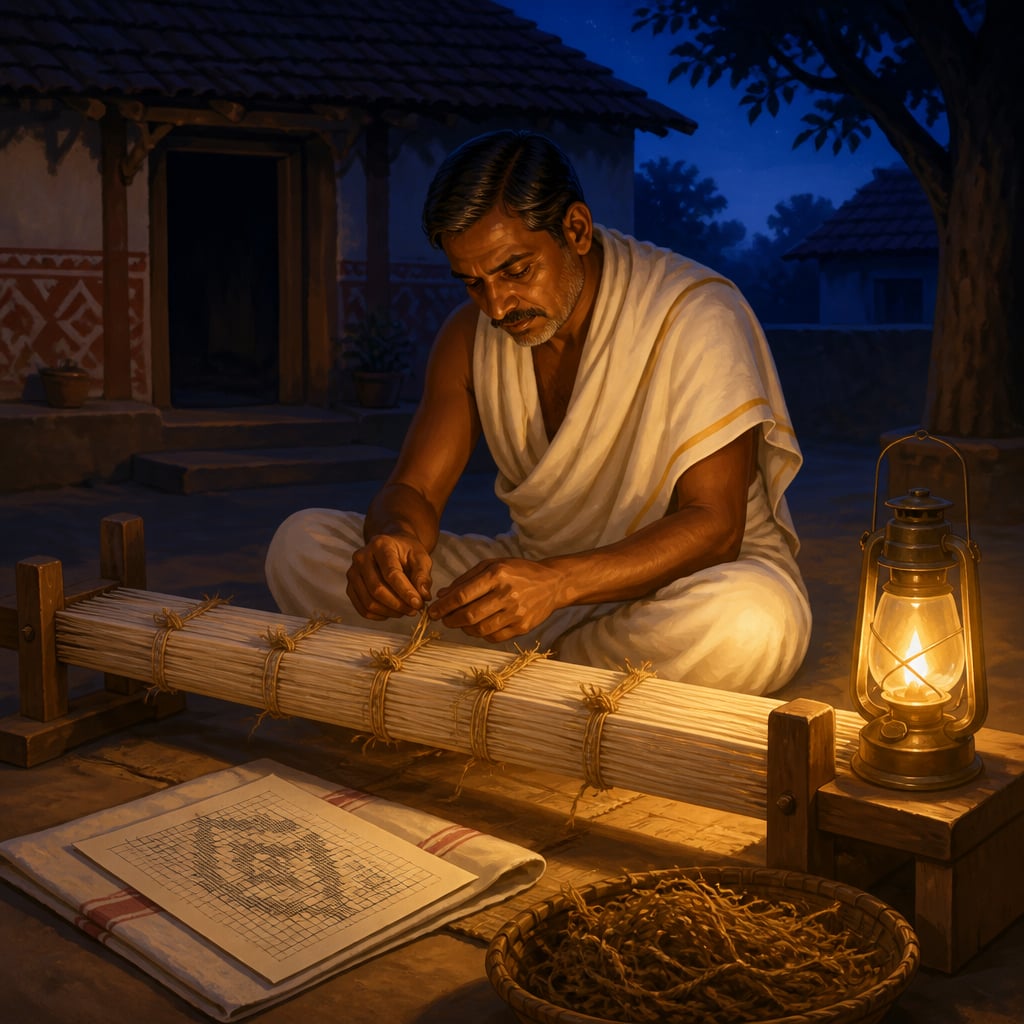
It is five in the morning in Barpali, a weaving town in the Bargarh district of western Odisha. The sun is still behind the mango trees. In a mud-walled courtyard at the end of a narrow lane, a weaver we can call Kamalakanta Meher, a composite drawn from the old Bhulia master weavers who still live and work in this town, is kneeling in front of a long wooden frame. The frame holds a sheet of two thousand four hundred cotton warp threads stretched tight from one end to the other. His wife Gouri is working at a second frame across the courtyard, with a shorter bundle of weft threads. His daughter Sushama, twelve years old, is cutting small pieces of coconut-fibre string at a low stool and passing them up to him one by one.
Kamalakanta is not weaving yet. He will not weave for another three weeks. What he is doing this morning is tying knots. The two thousand four hundred warp threads have to be bundled into groups of four. Each group has to be tied at precise points along its length with a tight coconut-fibre knot. There is a grid paper tacked to the wall. The grid shows a saktapar pattern, the chessboard weave, commissioned for a wedding six weeks away in Bhubaneswar. Each small square on the grid corresponds to one coconut-fibre knot on the yarn. Two thousand four hundred warp threads. Several thousand weft threads. Maybe fifteen thousand knots to tie in total, and later all to be untied. One misplaced knot will push the pattern off by a row, and the entire saree will come out crooked.
Why tie knots in the yarn before the weaving has even begun? Why not just weave the pattern into the cloth the way an embroiderer does, motif by motif? The answer is the whole secret of ikat. In an ikat saree, the pattern does not live in the weave. It lives in the yarn. The yarn is dyed before it touches the loom. Wherever the coconut-fibre knot was tight, the dye cannot reach. When the knots are untied and the yarn is dried and strung onto the loom, the undyed sections line up in space to form the pattern. The weaver is not drawing the pattern with the shuttle. He is assembling a pattern that already exists, dot by dot, in the yarn itself.
The Word and the Three Kinds
The word ikat comes from the Indonesian Malay verb mengikat, which means to tie or to bind. The word entered English through Dutch colonial trade records in Southeast Asia in the nineteenth century and has since been used as the umbrella term for tie-resist yarn dyeing traditions across India, Indonesia, Japan, Yemen, Uzbekistan, and parts of Latin America. In India, the technique has several older regional names. The Bhulia weavers of western Odisha call it baandha (to tie), using the Odia word. The Padmasali weavers of Pochampally call it pogudu bandhu, using the Telugu. Some northern weavers call it chitki. The technique is much older than the Indonesian name the English borrowed for it.
There are three technical kinds of ikat, and the difference matters.
Warp ikat dyes only the warp, the lengthwise threads. The weft is plain. This is the simplest form, and it is used in everyday cotton Pochampally sarees and in the cotton lungi cloth of southern Telangana.
Weft ikat dyes only the weft, the crosswise threads. This is the Odisha signature. Most Sambalpuri sarees are weft ikat, which gives them a pattern that reads in bands across the body of the saree.
Double ikat dyes both the warp and the weft, and the two sets of yarn must be aligned on the loom so that the coloured sections of one line up with the coloured sections of the other at exactly the right point. A single double-ikat saree can take six months of one family's work. Only three places in the world still do it at the level of mastery a buyer would recognise: Patan in Gujarat (the Patola tradition you will meet in the next lesson), a few workshops in Japan, and a small number of the most experienced weavers of Pochampally and Sambalpur.
The signature of a real handloom ikat saree is a small blur at the edge of every motif. The blur is there because yarn moves slightly during dyeing, stringing, and weaving, and no amount of skill can keep the transition perfectly sharp. A machine-printed imitation has perfectly sharp edges. The blur is how a buyer tells a real ikat from a print.
Pochampally: The Telugu Weaver's Geometry
Pochampally is a small town in the Yadadri Bhuvanagiri district of Telangana, about fifty kilometres east of Hyderabad. It was renamed Bhoodan Pochampally in 1951, on a date I will come back to. The weaving community is Padmasali, the Telugu weaver caste, whose mythic origin traces them to the sage Bhavana Rishi and whose members are spread across Telangana, Andhra Pradesh, and northern Tamil Nadu.
The Padmasali weavers of Pochampally work primarily in warp ikat, using cotton and silk yarns. Their patterns are geometric: chowka (square), tilaka (forehead mark), diamond lattices, parrot motifs, elephant motifs, and the chevron stripes that resemble the Indonesian cloth that first inspired the technique in the region. The Pochampally tradition is not a thousand years old. The ikat technique as practised here today came into the area in the late nineteenth century, probably from the Chirala region of coastal Andhra, and stabilised in the early twentieth century.
What Pochampally does that no other ikat centre in India does at comparable scale is volume production. A Pochampally weaver can produce a simple cotton ikat saree in two weeks. Thousands of sarees leave the town every month for retail markets in Hyderabad, Chennai, Bangalore, Mumbai, and Delhi. The town cluster today has more than ten thousand weaver families working in and around the village. In 2005, Pochampally Ikat received its Geographical Indication registration.

Sambalpuri: The Bhulia Chessboard
Three hundred kilometres east, across Chhattisgarh and into Odisha, is a very different ikat tradition. Sambalpuri sarees come from five districts of western Odisha: Sambalpur, Bargarh, Sonepur, Boudh, and Balangir. The weavers are the Bhulia community, also called Meher, after a clan name that most of them carry as a surname today.
The Bhulia are not indigenous to Odisha. According to their own oral history, their ancestors were invited into western Odisha in the twelfth century by Ramai Dev, the first king of Patnagarh, who needed skilled weavers to clothe his new court and the deities of his temples. The ancestors walked from what is now the Raipur region of Chhattisgarh, carrying their looms with them. They settled in the river valleys of the Mahanadi and the Tel. They have been weaving there for roughly eight hundred years.
The Sambalpuri tradition is weft ikat, not warp ikat, and this gives the saree a very different feel from a Pochampally. The pattern runs across the body of the cloth in broad bands of contrasting colour. The classic motifs are the shankha (conch), the chakra (wheel), and the phula (flower). Three of the most famous Sambalpuri patterns are the saktapar (a small-squared chessboard, the most technically demanding weft ikat in India), the pasapalli (a pattern based on the ancient dice game pasa that Yudhishthira played in the Mahabharata, woven as concentric squares), and the bomkai (a heavier silk variant from Ganjam district with an extra-weft brocade border around the ikat body).
These are not decorative choices. The shankha is the conch of Jagannath, the god of Puri. The chakra is his discus. The phula is the flower offered at his altar. A Sambalpuri saree is, like a Kanchipuram, liturgical clothing. It carries temple iconography in its yarn, and the Bhulia weavers understand their work as a form of daily worship directed at the deity their king brought them to dress eight hundred years ago.

The Vinoba Walk
On 18 April 1951, an old man in a white cotton dhoti, with no shoes and a walking staff, walked into Pochampally village at the head of a small group of followers. He had walked from Hyderabad. His name was Acharya Vinoba Bhave, Gandhi's spiritual successor, and he had come to speak about land reform. He met with the harijan community in the village. They told him they owned no land at all. Vinoba asked whether anyone in the village would donate land to them. A farmer named Vedre Rama Chandra Reddy stood up and donated one hundred acres on the spot.
That moment was the beginning of the Bhoodan (land-gift) movement. It swept through rural India over the next thirteen years. Vinoba walked more than sixty thousand kilometres across the country on foot. Farmers donated close to four million acres of land. The village of Pochampally, where it all started, was renamed Bhoodan Pochampally. And the national attention that the walk brought to the village became, quite accidentally, the beginning of its ikat revival. Urban buyers began to travel to the village looking for the place the old man had walked into. The weavers were there to receive them.
Boyanika and the Village That Won a Prize
Sambalpuri had no equivalent moment of national attention in the 1950s. What it did have was a state government that by 1981 had realised the Bhulia weavers were being cheated by middlemen on almost every saree they sold. That year, the Odisha State Handloom Weavers Cooperative Society was founded under the brand name Boyanika. Its job was simple: to buy directly from the Bhulia weaver families at a fair price, warehouse the sarees in Bhubaneswar, and retail them through its own chain of outlets across India. There are now more than forty Boyanika stores in Indian cities, from Bhubaneswar to Delhi to Bangalore to Mumbai. The cooperative is the single largest buyer of handloom Sambalpuri ikat in the country.
Seventy years after the Bhoodan walk, Pochampally received another piece of national attention. In November 2021, the United Nations World Tourism Organization named it one of its Best Tourism Villages of the year, one of only three Indian villages on a global list. The citation mentioned the ikat weaving tradition, the cooperative workshops, and the sustained community that had kept the craft alive across generations. Buses of domestic and foreign tourists now arrive in Bhoodan Pochampally every week, looking for the same thing Vinoba's followers came for in 1951: a village where the work being done is genuinely done by the people who live there.
What the Knot Is For
Kamalakanta Meher in Barpali finishes another coconut-fibre knot on the warp frame. His daughter Sushama passes him the next piece of string. Thirty-six knots on this row. Thirty-six knots on the next row. The grid on the wall has eighty rows. The knots will take him the rest of the week. Then the tied yarn will be taken to a dye pot in the courtyard and submerged in madder red. After drying, some of the knots will be cut and new knots tied in a different pattern, and the yarn will be dipped again in indigo blue. After three or four dyeing cycles, the knots will all come off. The yarn will look like a field of coloured dots. Only when it is strung onto the loom, and the weft is passed through it in the correct order, will the dots resolve themselves into a chessboard that was designed six weeks ago on a piece of grid paper.
The Barpali courtyard is not alone. Bargarh district today has more than twelve thousand looms working the Sambalpuri bandha, and carries two Padma Shri honours to its name. Kailash Chandra Meher received the Padma Shri in 2005 for integrating new dye palettes into the tie-dye process without breaking the old grid logic. Radhashyam Meher, the master weaver whose design renewals in the mid-twentieth century lifted Sambalpuri into national recognition, is the reason the Barpali knot is now the single best-known ikat in India. The Sambalpuri sari received its Geographical Indication protection in 2010. The knots a young weaver ties in a Barpali courtyard this morning will be walked into a saree shop in Bangalore next month, where the buyer will ask for the GI label before she asks the price.
The knot is not an obstacle to the pattern. The knot is the pattern, held temporarily in negative. This is the whole logic of Indian ikat. The pattern is built before the cloth exists, thread by thread, and the cloth that finally comes off the loom is the unfolded memory of the knots. A saree that was first tied in a Barpali courtyard in April will be worn in a Bhubaneswar wedding hall in June, and the bride will not see the knots at all. She will only see what the knots were for.
Key figures
Acharya Vinoba Bhave
A Maharashtrian scholar, social reformer, and the spiritual successor of Mahatma Gandhi. Vinoba Bhave was born in 1895 in Gagode, Maharashtra, and lived until 1982. He was deeply involved in the Indian independence movement, the Sarvodaya (welfare-of-all) philosophy, and the ashrams at Wardha and Sevagram. In 1951, a year before Nehru announced the First Five-Year Plan, he began walking across rural India on foot, village by village, asking landowners to donate land to the landless. He called the movement Bhoodan.
Ramai Dev of Patnagarh
The twelfth-century founder-king of the Chauhan dynasty of Patnagarh, in what is now the Balangir district of western Odisha. Ramai Dev consolidated a new kingdom in the region and built temples for its deities. According to Bhulia oral history, he sent messengers into the Raipur region of modern Chhattisgarh inviting skilled weaver families to migrate south-east and settle in his new territory, so that the courts and temples of his kingdom could be properly clothed.
Vedre Rama Chandra Reddy
A landowning farmer of Pochampally village in the Nalgonda district of what was then Hyderabad State and is now Telangana. On 18 April 1951, when Vinoba Bhave walked into his village and asked whether anyone would donate land to the landless harijan community, Rama Chandra Reddy stood up and offered one hundred acres on the spot. It was the first Bhoodan donation in the history of the movement.
Case studies
The Vinoba Bhave Walk into Pochampally, 18 April 1951
On the morning of 18 April 1951, an old man in a white cotton dhoti, with no shoes and a walking staff, walked into the village of Pochampally in the Nalgonda district of what was then Hyderabad State. He had walked from the city of Hyderabad, about fifty kilometres west. His name was Acharya Vinoba Bhave, and he was the spiritual successor of Mahatma Gandhi. A small group of Sarvodaya workers walked with him. He sat down in the village square and asked to meet the harijan community. They came. They told him they owned no land at all. Vinoba asked whether anyone in the village would donate land to them. A farmer named Vedre Rama Chandra Reddy stood up and offered one hundred acres on the spot. The village, which until that day had been an obscure Telugu weaver settlement known only to its own neighbours, suddenly had a guest whose walk across the country would soon be national news.
The Bhoodan movement that began in Pochampally that afternoon was, for Vinoba, a direct application of the old dharmic idea that land is not owned but held, and that those who hold more than they need are obliged to share with those who have less. What he did not know, and could not have planned, was that the national attention the walk would bring to Pochampally would become the beginning of a craft revival. The Padmasali weavers of the village had been sitting at pit looms for generations, weaving warp-ikat cotton sarees for local markets. They had no marketing, no cooperative, no urban buyers. In the years after Vinoba's walk, journalists arrived. Then photographers. Then buyers. Then Delhi-based craft revivalists. Then designer collaborations. The village became, without planning it, a national craft destination. Seventy years later, the UNWTO named it one of the three Indian villages on its Best Tourism Villages list of 2021.
Over the next thirteen years of walking, Vinoba Bhave collected close to four million acres of donated land from landowners across rural India, in one of the largest voluntary land-transfer movements in recorded history. The village of Pochampally was renamed Bhoodan Pochampally and became a pilgrimage site for Sarvodaya workers and rural development scholars. Its weaving tradition, which until 1951 had been regionally known but commercially marginal, now has a national retail presence, a Geographical Indication registration (granted in 2005), and a UNWTO Best Tourism Village listing (granted in 2021). None of these were planned. They followed, in accidental sequence, from a single afternoon's conversation between an old man and a village farmer.
A craft tradition can be rescued by an intervention that was not designed to rescue it. Vinoba Bhave walked into Pochampally to talk about land, not about ikat. But the national attention he brought to the village was the beginning of its commercial revival. The lesson is that the most important help a craft receives is often from people who are there for another reason entirely. A weaver who waits for a planned craft revival program may wait forever. A weaver who is ready to receive whatever attention walks in the door, for whatever reason, has a chance.
The Pochampally story is now the standard case study for 'unplanned craft revival' in Indian textile heritage scholarship. Several other Indian villages have tried to replicate the pattern by inviting prominent visitors, by seeking UNESCO or UNWTO recognition, or by hosting designer collaborations. Not all of them have succeeded. The part of the Pochampally pattern that is easiest to miss is that Vinoba's visit was not arranged by the weavers. They were ready for him when he arrived, and their readiness is what turned the visit into a revival.
The Bhoodan movement, begun at Pochampally on 18 April 1951, collected close to four million acres of donated land from rural Indian landowners over the next thirteen years. Vinoba Bhave walked more than sixty thousand kilometres on foot during that period. Bhoodan Pochampally's weaver cluster today has more than ten thousand weaver families, and the village has been named a UNWTO Best Tourism Village of 2021.
The Bhulia Migration under Ramai Dev of Patnagarh
In the twelfth century, in the forested uplands of what is now western Odisha, a new kingdom was being established. Ramai Dev, the founder-king of the Chauhan dynasty of Patnagarh, had consolidated his territory along the upper reaches of the Mahanadi and Tel rivers. He was building temples for the deities of his court. He was appointing priests. He was establishing the rituals and ceremonies of a new capital. But he had a problem. He had no weavers skilled enough to clothe the deities of his temples or the queens of his household in the way his dharmic obligations required. There were no handloom silk weaving communities in the immediate hinterland of Patnagarh. The nearest skilled weaving communities were in what is now the Raipur region of Chhattisgarh, several hundred kilometres to the north-west, where the Bhulia clan had been working cotton and silk for generations.
The dharmic obligation of a Hindu king in the medieval period included the proper daily dressing of the deities of his court's temples. The garments of the deity were a form of worship, not an afterthought. A king who could not dress his deities properly was failing at one of the most fundamental duties of his office. Ramai Dev's solution was the traditional one: he sent messengers to the weaver villages of the Raipur region and formally invited the Bhulia weaver families to migrate into his kingdom. He offered them land to settle on, protection, and a continuous supply of work from his court and temples. The Bhulia families that accepted the invitation walked several hundred kilometres with their looms on their backs, their wives, children, and elders with them. They settled in the river valleys of the Mahanadi and the Tel, in what is now the Bargarh, Sambalpur, Sonepur, Boudh, and Balangir districts of western Odisha. They were promised that their work would always be needed. And it has been, for eight hundred years.
The Bhulia weaver community, now called Meher after their clan name, still lives in the same river valleys where Ramai Dev settled them in the twelfth century. They still weave weft ikat, double ikat, and supplementary-weft brocade sarees, using the same underlying technique their ancestors carried into Odisha with them eight hundred years ago. They still dress the deities of Jagannatha at Puri, Samaleswari at Sambalpur, and Lingaraja at Bhubaneswar with their ceremonial cloths. The 2007 GI registration for Orissa Ikat formally protects the textile tradition their community has carried from the twelfth century to the present. The Patnagarh court is gone. The Bhulia weavers are still there.
A craft tradition can outlive the kingdom that invited it in. Ramai Dev's court has been dust for several centuries. His palace is a ruin. But the weaver families he invited into his kingdom are still weaving, and their cloth is still being used in exactly the temples he built it to clothe. The invitation he extended was not a commercial contract. It was a dharmic bond, and the bond has outlasted everything else from his reign. When you are building something that you want to outlast you, consider whether the people you are inviting into the work share your understanding of what is at stake. If they do, they may still be there long after you and your kingdom are gone.
The Ramai Dev invitation is one of the clearest documented examples in medieval Indian history of a ruler deliberately importing a craft community to serve a new dharmic purpose. The model (invite skilled artisans, give them land, give them continuous work, embed them in the liturgical life of the court) is the same one Krishnadevaraya would use four centuries later at Kanchipuram. Both invitations resulted in craft traditions that have outlasted the dynasties that issued them. The lesson for modern craft preservation is that the strongest durable bond between a community and a place is not a market. It is a dharmic one.
The Bhulia (Meher) weaving community of western Odisha currently numbers several thousand weaving families across the five districts of Bargarh, Sambalpur, Sonepur, Boudh, and Balangir. Their oral migration history traces a continuous lineage from the twelfth-century invitation by Ramai Dev of Patnagarh to the present day, roughly eight hundred years of settled craft practice in the same river valleys.
Bhoodan Pochampally and the UNWTO Best Tourism Village Listing of 2021
In November 2021, the United Nations World Tourism Organization announced its inaugural list of Best Tourism Villages, forty-four villages worldwide selected for having sustained traditional cultures, crafts, and community life in a way that could support sustainable rural tourism. Out of the forty-four, three were Indian. One of the three was Bhoodan Pochampally. The selection committee cited the village's handloom ikat tradition, its Padmasali weaving cooperative, its sustained community weaving culture, and the Bhoodan memorial commemorating Vinoba Bhave's 1951 land-reform walk. The announcement came at a moment when the global COVID-19 pandemic had frozen international travel for more than eighteen months, and domestic rural tourism had become newly important for Indian handloom economies.
The UNWTO listing was, in the end, a recognition of the same thing Vinoba Bhave had noticed when he walked into the village in 1951: that Pochampally was a place where something real was being done by the people who lived there, and that the something was worth bringing others to see. The dharmic logic of tourism, when it is done right, is not far from the dharmic logic of pilgrimage. A visitor walks into a place to see what is being done. The people who do the work are honoured by the walk. The visitor goes home changed. In both the 1951 case and the 2021 case, the village's role was simply to be what it had always been. The rescue came from outside because the thing being rescued was still there to be found.
Tourist footfall at Bhoodan Pochampally grew by an estimated forty percent within a year of the UNWTO announcement, bringing a wave of domestic and international buyers directly to the weaver cooperatives. The Pochampally Handloom Park expanded its visitor programming. Several Telangana tourism department initiatives followed, connecting the village to guided bus tours from Hyderabad. The ikat weaver cooperatives reported increased direct sales during 2022 and 2023. The pattern of a rural handloom village gaining new life from an unplanned international recognition, first demonstrated by the 1951 Bhoodan walk, had repeated itself seventy years later through an entirely different institution and an entirely different reason.
The second important rescue of a craft village is usually easier than the first, because the infrastructure built by the first rescue is still in place. The cooperative workshops, the Bhoodan memorial, the Handloom Park, and the national awareness that dated from 1951 were all still there in 2021 when the UNWTO announcement came. The village did not have to build from scratch. It only had to receive a new form of attention into an old form of readiness. This is what sustained craft preservation looks like: not a single dramatic intervention, but a sequence of unrelated interventions that each find the community ready for them.
The Pochampally UNWTO case is now the standard reference for Indian handloom craft villages seeking international recognition as a revival strategy. The Tamil Nadu, Odisha, and West Bengal state tourism departments have all begun preparing similar nominations for their own craft villages. The underlying model, that deliberate international recognition can substitute for market access that commercial sales alone cannot provide, is particularly important for handloom traditions in regions where the local urban retail market is small or fragile.
The UNWTO Best Tourism Villages 2021 list included forty-four villages from thirty-two countries. Three were Indian: Bhoodan Pochampally (Telangana), Ladhpura Khas (Madhya Pradesh), and Kongthong (Meghalaya). Pochampally was the only one of the three recognised specifically for a handloom textile tradition. Tourist footfall at the village is estimated to have grown roughly forty percent in the year after the announcement.
Boyanika: The Odisha State Handloom Cooperative
By the late 1970s, the Bhulia weaving community of western Odisha was in a familiar trap. The weavers produced some of the most technically demanding handloom textiles in India, including saktapar, pasapalli, bomkai, and double-ikat silk sarees that required three to eight weeks of combined tying and weaving for a single piece. But the weavers were being paid a tiny fraction of the retail price by middlemen. A saree that took two weavers six weeks to tie and weave might sell in a Delhi or Mumbai shop for five thousand rupees, while the weaver family received four hundred rupees for their work. The price gap was not a market efficiency. It was a trap. The weavers had no way to reach the urban retail market directly, no warehousing, no brand, no credit. The Odisha state government, watching the tradition slowly die, decided to intervene.
The cooperative model of craft preservation is not new to Indian dharmic economics. Village guilds (shrenis) in the classical and medieval periods collectively negotiated with royal courts, temple administrations, and long-distance traders on behalf of individual craftsmen. The guild was the shield between the skilled maker and the commercial buyer. The Boyanika cooperative of 1981 is a direct modern descendant of this older guild structure. Its job is the job a shreni always had: to pool the bargaining power of scattered makers, to warehouse their output, to reach markets that no individual maker could reach alone, and to return a fair share of the retail price to the people who actually did the work. The only thing that had changed between the classical shreni and the modern cooperative was the legal form. The underlying economic logic was the same.
The Odisha State Handloom Weavers Cooperative Society, branded as Boyanika, was founded in 1981. It began by signing up Bhulia weaver families in the Bargarh, Sambalpur, Sonepur, Boudh, and Balangir districts and offering to buy directly from them at a fair price. The cooperative opened its first retail outlet in Bhubaneswar, then in Kolkata, then in Delhi, then in Mumbai, Chennai, and Bangalore. By the 2010s, Boyanika was running more than forty retail outlets across India, and its annual sales had crossed one hundred crore rupees in peak years. It is the single largest buyer of handloom Sambalpuri ikat in the country, and the middleman economy that had trapped the Bhulia weavers for decades was substantially, though not entirely, displaced.
A cooperative is the right structure for almost every situation in which scattered makers face concentrated buyers. The Bhulia weavers could not have built an urban retail chain as individual families. No weaver could have afforded the rent on a Delhi shop, the credit to warehouse sarees for six months, the legal work to handle interstate taxation, or the marketing to compete with private retailers. What they could not do alone, the cooperative did for all of them together. The lesson is repeated across Indian cooperative history: from Amul for milk to IFFCO for fertiliser to Boyanika for silk. When individual bargaining power is weak, pooled bargaining power through a cooperative is usually the correct answer.
The Boyanika model is now being studied and partially replicated by handloom cooperatives across India, including Co-optex in Tamil Nadu (which predates Boyanika but was institutionally reformed along similar lines in the 2000s), the Kullu Shawl Weavers Cooperative in Himachal Pradesh, and the Kashmir Pashmina cooperatives in Srinagar and Leh. Boyanika also operates an online retail channel and has partnered with private designers such as Gaurang Shah and Sanjay Garg to extend the urban market for handloom ikat. The cooperative remains the single most important institutional actor in the modern survival of the Sambalpuri tradition.
The Boyanika cooperative now runs more than forty retail outlets across India, serves several thousand Bhulia weaver families, and is estimated to be the single largest buyer of handloom ikat in the country. Peak annual retail sales have been reported at over one hundred crore rupees, returning a much larger share of the retail price to weavers than the middleman economy that preceded the cooperative.
Historical context
The eastern Indian ikat story runs from the twelfth-century migration of the Bhulia weaver community into western Odisha under King Ramai Dev of Patnagarh, through the early twentieth-century stabilisation of the Pochampally warp-ikat tradition in Telugu country, through the 18 April 1951 Bhoodan walk of Vinoba Bhave that renamed Pochampally on the national map, through the 1981 founding of the Boyanika cooperative in Odisha, and into the 2005 Pochampally GI registration, the 2007 Orissa Ikat registration, and the 2021 UNWTO Best Tourism Village recognition of Bhoodan Pochampally.
Ikat weaving in India has two separate origin streams that later met in the same technical tradition. The western stream arrived in Gujarat through Indian Ocean trade contact with Indonesia and the Southeast Asian archipelago, where tie-dye yarn weaving had already been practised for centuries. The Patola tradition of Patan, in Gujarat, is the oldest continuous double-ikat craft in India. The eastern stream arrived in western Odisha in the twelfth century when the Bhulia weavers were invited by Ramai Dev from the Raipur region of modern Chhattisgarh. The Pochampally tradition of Telangana is younger than both, stabilising in the late nineteenth and early twentieth centuries under Padmasali weavers who learned the technique probably from the Chirala region of coastal Andhra. The three traditions share the same underlying logic but have distinct motifs, communities, and regional identities. All three are now protected under the Indian Geographical Indication framework.
Ikat is one of the few textile techniques that has developed independently in multiple world regions. The major ikat centres outside India are Central Java and Bali in Indonesia, the Okinawa islands of Japan (where the Kasuri tradition uses the same logic), the Uzbek silk towns of Margilan and Bukhara, the highlands of Guatemala (where the technique is called **jaspe**), and parts of coastal Yemen. Each tradition developed its own motifs and dye sources but uses the same underlying method: the pattern is dyed into the yarn before the cloth exists. The Indian traditions at Patan, Pochampally, and Sambalpur are distinctive in two ways. First, they are all still practised on hand looms at commercial scale. Second, their motifs are liturgically linked to specific Hindu temple traditions, in a way that the Indonesian and Uzbek ikat traditions are not.
About ten thousand weaver families are active in the Pochampally cluster today. Several thousand more Bhulia families weave in the five-district Sambalpuri belt of western Odisha. The Boyanika cooperative alone runs more than forty retail outlets across India, making it the single largest handloom-cooperative retail network in the country. In 2021, Bhoodan Pochampally was named one of three Indian villages on the UNWTO Best Tourism Villages list, out of forty-four villages selected worldwide.
The eastern Indian ikat story is the clearest demonstration that handloom craft is preserved as much by accidents of history as by deliberate policy. The Bhulia tradition survived eight hundred years because a twelfth-century king invited the weavers to settle. The Pochampally tradition survived the twentieth century because a Gandhian reformer walked into the village in 1951 and turned it into a national symbol. The Boyanika cooperative survived because the Odisha state government intervened in 1981 to protect the weavers from middlemen. The UNWTO tourism listing of 2021 is the latest link in a chain of unplanned rescues. None of them were planned in advance. All of them were real.
Living traditions
The Pochampally Ikat GI was granted in 2005, the Orissa Ikat GI covering Sambalpuri in 2007, and the Bomkai saree GI in 2009. The Boyanika cooperative of Odisha and the Pochampally Weavers' Cooperative Society of Telangana are the two largest institutional buyers of handloom ikat in India. The November 2021 UNWTO Best Tourism Village listing for Bhoodan Pochampally was one of three Indian villages selected out of forty-four worldwide, and brought significant new domestic and international tourism to the village. Designer collaborations by Sanjay Garg (Raw Mango), Sabyasachi Mukherjee, Gaurang Shah, and others have extended the reach of eastern Indian ikat into the urban designer market. The Fabindia retail chain has been sourcing from both clusters since the 1970s and remains one of the largest private-sector buyers.
- Yarn tying and multi-bath resist dyeing: The pre-loom stage of ikat weaving, where groups of warp or weft threads are bundled, tied with coconut-fibre or cotton-film knots at calculated points, and then submerged in successive dye baths. After each dye bath the yarn is dried, some knots are cut and new knots tied in a different position, and the yarn is dipped again in a second or third colour. The entire tying-dyeing-retying cycle for a single complex saree can take three to four weeks, longer than the weaving itself. The whole pattern is present in the yarn before the loom is touched.
- Festival and wedding commissions for temple cities: The commercial calendar of the Bhulia and Padmasali weaving communities is anchored by festival and wedding commissions from the temple cities of eastern India. The Jagannatha temple at Puri, the Samaleswari temple at Sambalpur, the Lingaraja temple at Bhubaneswar, and the Khandoba and Mahalakshmi shrines of Telangana all order silk vastrams from the local weaving communities for daily dressing and for major festivals. The annual Ratha Yatra at Puri, the Durga Puja at Bhubaneswar, and the Bonalu festival at Hyderabad are the three largest commission seasons of the year.
- Cooperative retail through Boyanika and the Pochampally handloom park: The primary modern sales channel for both ikat traditions is the state-backed weavers' cooperative. In Odisha, the Boyanika cooperative, founded in 1981 as the Odisha State Handloom Weavers Cooperative Society, runs more than forty retail outlets across Indian cities from Bhubaneswar to Delhi to Mumbai, and is the single largest buyer of Sambalpuri handloom ikat in the country. In Telangana, the Pochampally Handloom Park and the Pochampally Weavers' Cooperative Society perform a similar role, supplying both wholesale buyers and direct urban retail customers.
Reflection
- Look through your own wardrobe, or the wardrobe of someone close to you. Is there a saree, a dupatta, a scarf, or a cotton stole that has the characteristic slightly blurred pattern edge of a handloom ikat? Hold it up to the light. Where do you think it was woven? Who gave it to you, or who bought it for you? Does knowing that the pattern was tied into the yarn, knot by knot, before the cloth was made change how you see it?
- Think of a recurring task in your own work or life that has both a visible performance stage and an invisible preparation stage. For a Bhulia weaver, the tying of knots is the invisible stage and the weaving is the visible one. How much time do you currently spend on preparation for your task versus on the visible performance? What would change if you doubled or tripled the preparation time, the way an ikat weaver does?
- Has something you cared about ever been rescued, saved, or kept alive by an unplanned intervention from someone who was not thinking about your situation at all? Think of a specific case. Who walked in? What were they actually there for? And what did their presence do, accidentally, for you or for the thing you cared about?