Bandhana Kala: The Science of Resist Dyeing
From the indigo vats of Ajrakhpur to the Salvi looms of Patan, the art and chemistry of telling a dye where not to go.
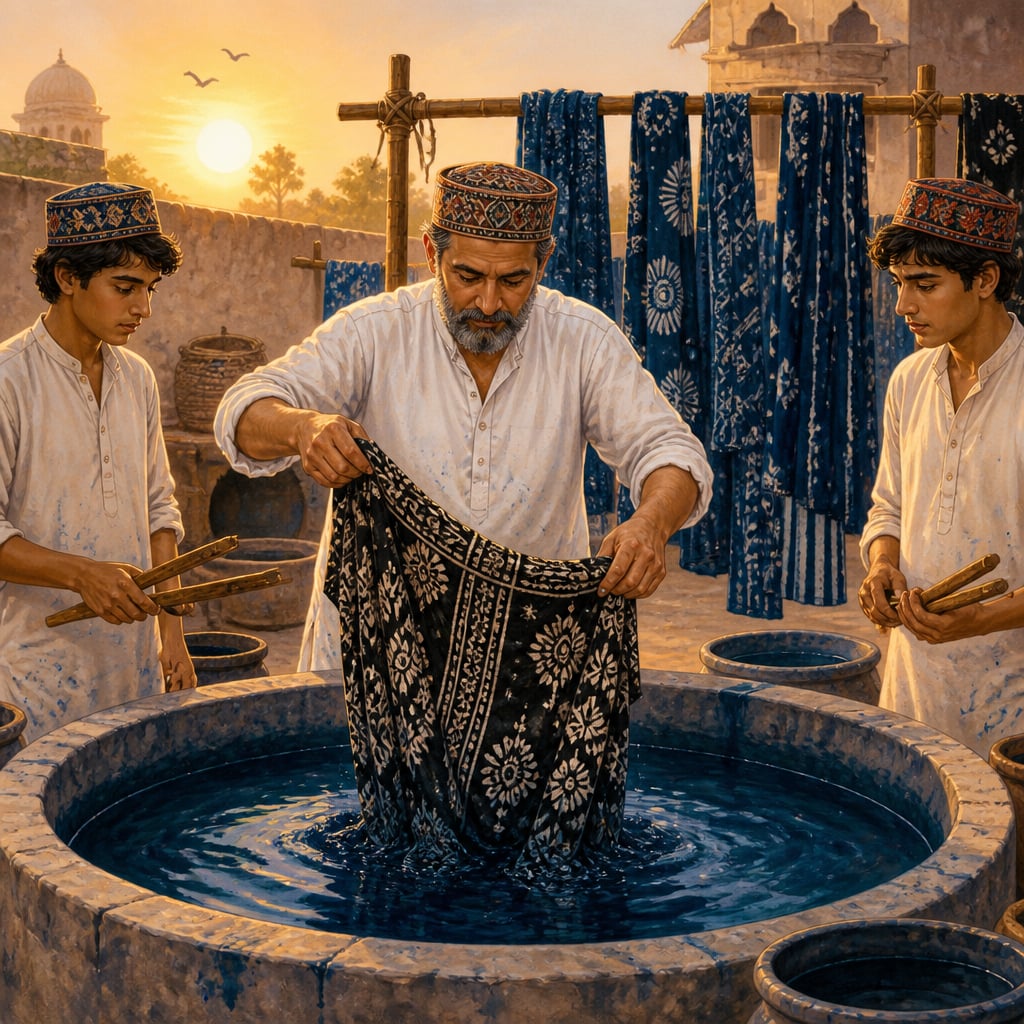
Dr. Ismail Khatri lowers a block-printed cotton cloth into a round indigo vat in Ajrakhpur, Kutch. It goes in yellow, comes out yellow-green, and turns blue as it meets the air. That small chemical drama is the entire idea of resist dyeing: the cloth holds a pattern not because colour was painted on it, but because colour was blocked from some of it. This lesson walks the three great Indian resist-dye families (tie, paste, and ikat), the chemistry of indigo and madder, the state ledger that first taxed them in Kautilya's Arthashastra, the medieval trade that carried them to Cairo, and the 1721 British Parliament ban that tried and failed to stop them.
The Indigo Vat
On a dusty morning in Ajrakhpur, a new village on the eastern edge of the Rann of Kutch, a dyer named Ismail Mohammed Khatri lowers a block-printed cotton cloth into a round earthen vat. The vat is half-sunk into the ground. It smells faintly of ripe fruit and river mud. The liquid inside is the colour of weak tea.
Ismail Khatri is a ninth-generation Ajrakh dyer. His family came from Sindh about four hundred years ago, settled in the Kutch village of Dhamadka, and stayed there printing and dyeing cotton cloth for ten generations. On 26 January 2001, a 7.7 earthquake in Bhuj flattened Dhamadka, split every indigo vat in the village, and broke the underground water supply the craft had depended on for centuries. The Khatri families lost their homes and their workshops in the same hour. Within two years they had picked up what was left of their tools, walked twenty kilometres east to a piece of empty land, and started again. They called the new place Ajrakhpur. The place of Ajrakh. They dug new vats in the new ground and lit new fires.
On the day of the indigo dip, the cloth Ismail lowers into the vat is white, with black outlines already block-printed onto it in a resist paste made of lime, gum, and iron. He holds it under for two or three minutes. Then he lifts it out. The cloth is yellow-green, almost the colour of a young lemon leaf. He lays it flat on the ground. As the air touches it, the colour begins to change. Yellow. Yellow-green. Green. Blue-green. Blue. Under a minute later, the whole cloth is deep indigo. Every inch that the black resist paste was touching is still white. The pattern has appeared as if by the hand of a god.
This is not magic. It is chemistry. Indigo dye is only blue when it is oxidised. Inside the vat, it is a pale yellow-green solution held in an oxygen-starved state by days of fermentation. When the wet cloth leaves the vat and the liquid on the cloth meets the air, the indigo oxidises in seconds and turns blue. The resist paste, wherever it has been stamped onto the cloth, keeps the dye from ever reaching the cotton fibre underneath. What the cloth 'resists' is the dye itself. The pattern is simply the places where the dye was told no.
That is the whole idea of resist dyeing. The art of telling a dye: not here.
Three Ways To Tell Dye No
Indian resist dyeing has three great families. Each family uses a different way of telling the dye where not to go.
- Tying. In bandhani, thousands of tiny pinches of cloth are tied with fine thread before the dip. The ties block the dye. When the ties are cut, each pinch opens to a bright white dot. A single bandhani saree can carry a hundred thousand such dots, arranged into flowers, peacocks, elephants, and family crests. Bandhani is the tradition of Gujarat and Rajasthan, and gives this chapter its Sanskrit name, Bandhana (binding).
- Paste or wax. In Ajrakh, a thick resist paste made from lime, gum arabic, and iron-mud is stamped onto the cloth with carved wooden blocks. The paste hardens. The cloth goes through several dye baths, and wherever the paste has stuck, no colour can reach the fibre. Indonesian batik is a cousin of the same technique, using hot wax instead of mud-lime paste. The Bagh prints of Madhya Pradesh and the Dabu mud-resist prints of Rajasthan also sit in this family.
- Yarn-tying. In ikat, the dyeing happens before the weaving. Individual warp and weft threads are tied and dyed in the chosen pattern, and then stretched onto the loom. When the weaver throws the shuttle, the already-dyed threads fall into place exactly where the design asks for them. The Patola double-ikat of Patan, the Pochampally ikat of Telangana, and the Sambalpuri ikat of Odisha are all in this family.
These three families look very different on the cloth. Underneath, they share one idea. Dye is not painted onto the cloth the way a signboard is painted. Dye is let into the cloth, into the spaces where the dyer has permitted it.
The Chemistry Of Colour
Every resist dye tradition stands on a small set of natural pigments. Indian dyers have been using most of them for more than two thousand years.
| Pigment | Source | Colour | Type |
|---|---|---|---|
| Indigo (nili, नीली) | Leaves of Indigofera tinctoria | Deep blue | Vat dye |
| Madder (manjishtha, मञ्जिष्ठा) | Root of Rubia cordifolia | Brick red, rose | Mordant dye |
| Pomegranate (dadima, दाडिम) | Rind of the fruit | Yellow | Mordant dye |
| Turmeric (haridra, हरिद्रा) | Rhizome | Saffron yellow | Direct dye |
| Iron (loha, लोह) | Fermented iron sulphate | Black (with tannin) | Mordant |
| Myrobalan (haritaki, हरीतकी) | Fruit | Tan base | Mordant prep |
Two technical ideas do most of the work in this table. A vat dye like indigo must first be chemically reduced inside a fermented vat to bind to the cotton fibre, and then oxidised in open air to show its colour. A mordant dye like madder or pomegranate must first pass through a metal salt (usually alum, or iron, or both) that fixes the dye permanently to the cloth. Without the mordant, the colour washes out in the first rain. With the mordant, the same colour lasts three hundred years.
The traditional dyer learns all of this without ever using the words oxidation or mordant. She learns it as a sequence of steps her mother learned from her mother. But the chemistry is real. Indian resist dye is one of the earliest stable colour technologies in human history. And because the dyer does not control the fibre directly (the resist paste or the tie does that), the same small handful of pigments becomes the vocabulary for hundreds of distinct regional patterns.

The Ledger Begins
The written record of Indian resist dyeing begins with Kautilya. In Book 2 of the Arthashastra, in the chapters that cover the state's inventory of forest products and the workshops of the Superintendent of Weaving, the Mauryan treasury taxes two of the pigments you just read about: nili (indigo) and manjishtha (madder). The fact that the state bothered to put them on a tax schedule tells us that by the 4th century BCE, both plants were already grown as commercial crops in India, sold to dyers who turned the roots and leaves into cloth.
The actual cloth from Kautilya's time is long gone. Cotton does not survive the Indian climate. But the archaeological evidence goes much further back. At Mohenjo-daro in the Indus Valley, excavators in the 1920s found a scrap of cotton wrapped around a silver vase, dyed in madder red, dated to around 2500 BCE. It is one of the earliest dyed cotton fragments ever found anywhere in the world. India had resist dyeing before India had writing.

Gujarat To Cairo
Fast forward four thousand years. In the dry dust of Fustat, the medieval capital of Cairo in Egypt, archaeologists in the 20th century began to find something strange in the old streets. Bits of block-printed, resist-dyed cotton cloth. Thousands of them. Indigo blues, madder reds, Gujarati floral patterns. The dating went back to the 13th and 14th centuries CE.
The Fustat finds are a shock of evidence. They prove that medieval Gujarat was shipping dyed cotton to the Mediterranean world for everyday use, not just as a royal luxury. Merchants in Egypt were wrapping parcels in Indian resist-dyed cloth the way a modern shop uses kraft paper. The implied trade volume is enormous. For every scrap that survived in a Cairo garbage mound, an unknown quantity must have been sold, worn out, and discarded over three centuries.
The Fustat textiles also prove that the Ajrakh and bandhani traditions of western India are at least medieval. The patterns on the Cairo fragments are recognisably Gujarati. Some of them are patterns still being printed today in Ajrakhpur, by the same community that printed them eight hundred years ago.
The Calico Century
By the 17th century, Indian resist-dyed cotton had reached the drawing rooms of London, Paris, and Amsterdam. The French called it indiennes. The English called it calico. European aristocrats, and soon European middle-class families, discovered that the dyed cotton from India was softer, lighter, brighter, and more washable than anything they had ever worn before. They went mad for it.
The European wool and silk industries panicked. In 1721, the British Parliament passed the Calico Act, banning the use or sale of Indian printed and dyed cottons in England and Wales. France banned them for longer. Both countries were trying to protect their own mills from the shock of a technology they could not yet copy.
The story ends the way colonial stories usually end. The British did eventually copy the technology. They built the Manchester and Lancashire cotton mills in the 19th century to do industrially what Indian villages had been doing by hand for a thousand years. They then flooded the Indian market with mill cloth, and used colonial policy to cripple the original industry that had taught them the craft. Indian resist dye survived only where the geography was stubborn or the community was stubborn or both. Kutch. Patan. Pochampally. A scatter of villages in Rajasthan, Madhya Pradesh, and Odisha.
The Map Today
Indian resist dye is still a working craft in about ten distinct regional centres.
- Kutch, Gujarat: Ajrakhpur, Dhamadka, and Bhujodi for Ajrakh. Kutch and Saurashtra for Bandhani. The Khatri community carries both traditions.
- Patan, Gujarat: Double-ikat Patola, still woven by three Salvi families out of the thirty-five generations of Salvis whose ancestors began the craft in the 12th century.
- Rajasthan: Bandhani in Jaipur, Jodhpur, Sikar, and Bikaner. Block-print in Bagru, Sanganer, and Dabu. The Chhipa community carries most of the block-print and dye work.
- Madhya Pradesh: Bagh block-printing in Dhar district, on the banks of the Bagh river.
- Pochampally and Koyalagudem, Telangana: Weft-ikat and double-ikat silk and cotton sarees.
- Sambalpur and Bargarh, Odisha: Sambalpuri ikat, both cotton and silk.
- Srikalahasti and Machilipatnam, Andhra Pradesh: Kalamkari (a related, though technically painted and dyed rather than pure resist, tradition).
Almost all of these traditions now hold a Geographical Indication tag, most of them registered between 2005 and 2015. None of them are museum pieces. Every one of them is still a place with a dyer at a vat, a tyer at a cloth, or a weaver at a loom.
Modern Echoes
The economy of a handloom resist-dye village has always been fragile. The pigments have to be grown. The water has to be clean. The sunlight has to bleach the cloth between dips. The buyer has to pay the real price. Any one of these failing is enough to break a workshop in a single bad year.
Designer Sanjay Garg, working through his label Raw Mango, has been one of the clearest contemporary voices rebuilding that fragile economy. Since 2008, Raw Mango has commissioned handloom Patola, Pochampally ikat, Chanderi, and Mashru pieces at couture prices and placed them on the Indian wedding circuit. A Raw Mango Patola in 2024 costs between one and three lakh rupees, and most of that price goes to the Salvi weavers and the Pochampally yarn-dyers, not the studio. The couture market now carries a small but real share of the resist-dye economy, and Sanjay Garg is one of the people who built the channel by which that money travels from the urban drawing room back to the village vat. The craft advocacy organisation Dastkar, founded by Laila Tyabji in 1981, carries a parallel channel at lower price points. The thread is still unbroken. It is just thinner every year.
Back At The Vat
In Ajrakhpur, Ismail Khatri's new village is now twenty years old. The vats he dug in 2003 are still working. He and his brothers have trained a generation of apprentices, several of whom are women, which is new for this craft. He has received the Sant Kabir Award from the Government of India and an honorary doctorate from De Montfort University in England. The cloth that comes out of his workshop is sold in Tokyo, Milan, and New York. But most mornings, he is still the one standing at the vat when the indigo comes up.
The cloth goes under yellow. It comes up yellow-green. By the time it is spread flat on the ground, it is already starting to turn blue. The pattern the resist paste was hiding becomes visible all at once, as if it had been waiting under the cotton for permission to appear.
The whole chapter that follows is the story of that permission. Who gives it. Who teaches it. And who still knows, at the end of the twentieth century of a tradition, how to tell a vat of dye: not here.
Key figures
Dr. Ismail Mohammed Khatri
A ninth-generation master Ajrakh dyer of the Khatri Muslim community of Kutch. After the January 2001 Bhuj earthquake destroyed his ancestral village of Dhamadka, he led his family in founding a new village, Ajrakhpur, twenty kilometres east, and rebuilt the Ajrakh craft from scratch on new ground. He is a Sant Kabir Award recipient and holds an honorary doctorate from De Montfort University, England.
King Kumarpala of Anhilwada-Patan
The Chalukya (Solanki) king of the Anhilwada-Patan kingdom in Gujarat, who ruled from 1143 to 1172 CE. According to the Salvi family's own oral tradition, Kumarpala invited seven hundred weaving families from Jalna in Maharashtra to settle in his capital Patan and weave Patola double-ikat silks for his court, founding the Patan Patola tradition that has continued for more than thirty generations.
Laila Tyabji
Designer, craft advocate, and founder chairperson of Dastkar, the Indian crafts and craftspeople's society, which she co-founded in Delhi in 1981. Through Dastkar, she has spent more than four decades building direct market channels between rural Indian craft communities, including Kutch Ajrakh and Bandhani workshops and Rajasthan Chhipa block-printers, and urban Indian and international buyers. She has also served on the Crafts Council of India and advised the Government of India on handicraft policy.
Case studies
The Salvi Family and the 700-Year Patola Lineage
According to the oral tradition of the Salvi weavers themselves, in the mid-12th century, the Chalukya (Solanki) king Kumarpala of Anhilwada-Patan invited seven hundred weaving families from the town of Jalna in Maharashtra to settle in his capital at Patan. They came as specialists in a single textile: the double-ikat silk saree the Gujaratis called Patola. A Patola is woven from silk threads that have already been tied and dyed in the chosen design before they reach the loom. Both warp and weft are pre-patterned. When the weaver throws the shuttle, the colours fall into place exactly where the design asks. A Patola takes six to twelve months of full-time family labour. For the next thirty-five generations, the Salvi families of Patan carried this craft forward, father to son, in unbroken lineage. By the early 21st century, only three Salvi families were still weaving the double-ikat Patola. The other hundreds had left for easier work, other cities, or extinction.
The Salvi tradition is the clearest surviving example in India of a guru-shishya parampara (master-student lineage) carried inside a family rather than a monastery or school. The Salvi father does not formally teach the Salvi son. He weaves in front of him, every day, for twenty years. By the time the son is thirty, he can pre-tie a Patola warp by eye. The craft has no textbooks. It has no certificates. It has only the unbroken daily repetition of the teaching, and the lived knowledge that if any single generation stops teaching, the craft dies in that generation. This is a working demonstration of paramparā as a survival technology, and the Patan Patola is what paramparā looks like when it is put under the most extreme test any Indian craft has ever faced.
As of 2024, only three Salvi families in Patan still weave the double-ikat Patola. Their combined annual output is under one hundred sarees. The youngest active Salvi weaver is in his early thirties, which means the next generational transition is still possible but already fragile. A single Patola saree now retails between one and ten lakh rupees, and the couture market (led by Sanjay Garg and a few other designers) carries most of that price. The Patan Patola Heritage Museum, run by one of the Salvi families in their own home, has become a pilgrimage site for textile scholars from around the world.
A craft lineage survives only as long as each generation is willing to teach the next one at a loss, when there is no market that rewards the real cost of the work. The Salvis did this for thirty-five generations and are still doing it. The lesson for modern readers is that the most fragile and most precious thing in any tradition is not the finished object. It is the teaching relationship. When the teaching relationship breaks, the object becomes impossible to replace.
The Patan Patola is the textbook example used in heritage studies and cultural economics programs to explore the question of what sustains craft lineages in the face of market collapse. It is also the central case in the field of 'intangible cultural heritage' (a UNESCO framework) for South Asia. The Salvi family's survival has become the standard reference point against which other Indian handloom revival efforts are measured.
Thirty-five Salvi generations. Seven hundred original families, now three. A single double-ikat Patola takes between six and twelve months to complete. The Patan Patola was granted a Geographical Indication tag in 2004, one of the first Indian handloom GIs registered under the 1999 Act.
The Fustat Evidence: Gujarati Dye Cloth in Medieval Cairo
In the early 20th century, archaeologists working in the medieval garbage mounds of Fustat (old Cairo) in Egypt began to find strange scraps of cotton cloth buried among the ordinary rubbish of a Mediterranean capital. The cotton was block-printed. The dyes were indigo and madder. The patterns were unmistakably Gujarati. As the fragments accumulated over decades of excavation, they reached into the thousands, and their dating stretched across three centuries, from roughly the 13th through the 15th century CE. The most important collection, the Newberry Collection, is now housed at the Ashmolean Museum at Oxford and has been catalogued in detail by the textile historian Ruth Barnes. Similar finds are held at the Victoria and Albert Museum in London and the Royal Ontario Museum in Toronto. The Fustat textiles are the single most important archaeological source for the history of medieval Indian resist dye.
The Indian textile tradition has always thought of itself as a world-trading tradition, not a local craft. The Arthashastra's inclusion of chinapatta (imported Chinese silk) as a separate tax category implies that the Mauryan state already assumed cloth crossed continents. The Fustat evidence is the archaeological proof that eight hundred years later, the implied trade was not only still happening, but happening in such volume that ordinary households in Cairo were using Gujarati dye cloth as wrapping paper. For a medieval Khatri dyer in Sindh or Kutch, the buyer in Cairo was a real customer, not a rumour. The craft survived because it served that buyer, not just the local one.
The Fustat finds have rewritten the history of Indian textile trade. They prove that medieval Gujarat was operating as a global textile exporter at a scale previously known only for silks and spices. They extend the documented history of Ajrakh and Bandhani as specific regional traditions back into the 13th century at the latest. And they show that several patterns still printed in Ajrakhpur and Dhamadka today are recognisably descendants of patterns being printed in western India eight hundred years ago. The archaeological record and the living craft overlap.
A craft that feels local to the village that makes it is often anything but. The dyers of medieval Gujarat did not know they were feeding Cairo and Alexandria. They only knew that buyers from the port city of Cambay would arrive with silver and take away as much dyed cloth as they could load. But the shape of their work, the scale of their workshops, and the patterns they refined were all shaped by a market on another continent. For modern readers, the Fustat evidence is a reminder that Indian craft has always been globally entangled, and the modern re-entry into global markets through couture and e-commerce is a resumption of an old pattern, not a new departure.
The Fustat textiles are now the primary archaeological evidence used by the Ministry of Textiles, by Indian craft heritage organisations, and by academic textile historians to argue for the antiquity and continuous cultural-economic value of the Kutch and Gujarat resist-dye traditions. They are also central to several recent and ongoing Geographical Indication applications, because they establish the historical geography of a craft in a way that oral tradition alone cannot.
The Newberry Collection at the Ashmolean Museum holds more than 1,200 catalogued fragments of Indian printed and resist-dyed cotton from the Fustat site, dating from roughly the 13th to the 15th century CE. Similar collections at the V&A and the Royal Ontario Museum hold several thousand more fragments combined, making the Fustat textiles the largest single archaeological collection of medieval Indian cotton cloth anywhere in the world.
The Calico Act of 1721 and the Technology That Could Not Be Banned
In the second half of the 17th century, Indian block-printed and resist-dyed cotton cloth reached the drawing rooms of London, Paris, and Amsterdam in astonishing volume. The French called it indiennes. The English called it calico. It was softer than European wool, lighter than European silk, brighter than any European dye, and washable in a way European aristocratic clothing had never been. European women began to prefer it for summer dresses, men for waistcoats, and households for curtains, bedspreads, and wall hangings. The European textile industries panicked. France banned the importation of printed cotton in 1686. The British Parliament passed the Calico Act in 1721, formally titled 'An Act to preserve and encourage the Woollen and Silk Manufactures of this Kingdom... by prohibiting the Use and Wear of all printed, painted, stained or dyed callicoes in apparel, household stuff, furniture, or otherwise'. Violators faced steep fines. The Act was explicitly protectionist. It was trying to save the Lancashire wool industry and the Spitalfields silk industry from a technology they could not match.
From the Indian side, the Calico Act looks like the highest compliment a craft can receive. A foreign parliament passed a law to ban something because it was too beautiful, too durable, and too cheap. The cloth being banned came from the same Khatri, Chhipa, and Salvi workshops whose descendants still work today. It was made with the same indigo, the same madder, the same iron-mud black, and the same lime-gum resist paste still used in Ajrakhpur. What the British Parliament banned in 1721 is still being made in Kutch in 2024. The craft that the world's most powerful legislative body tried and failed to stop is still a living practice in a small number of Indian villages.
The Calico Act did not save the British or French wool and silk industries. Within a century, Britain instead copied Indian resist-dye technology in a new form: the Manchester and Lancashire cotton mills of the Industrial Revolution. The mills industrialised what Indian villages had been doing by hand, and then, by colonial policy, flooded the Indian market with cheaper mill imitations and crippled the Indian village economy that had taught the craft in the first place. The end of the story, by the mid-20th century, was that Indian village resist-dye had nearly vanished, and Manchester owned the global cotton trade. But the nearly is important. In Kutch, Patan, Bagru, Pochampally, Sambalpur, and a few other stubborn places, the craft survived. It survived because the communities that carried it refused to stop, and because some of the patterns and techniques could not in fact be copied on a powerloom no matter how much the British engineers tried.
When a technology is good enough to be banned by a foreign legislature, it is also good enough to be worth saving inside its own country. The Calico Act is the clearest historical evidence that Indian resist dye was, for a long period, the best textile technology in the world. The fact that it was later industrialised and commodified does not erase that original standing. The lesson for modern readers is that the Indian craft tradition, far from being a minor folk practice, is the direct ancestor of a global industry that tried to kill it, failed, and has now circled back to prize it again through couture, GI tags, and museum collections.
The Calico Act is taught today in economic history programs around the world as a textbook example of a failed protectionist trade barrier. It is also cited by contemporary Indian craft advocacy organisations, including Dastkar and the Crafts Council of India, as historical evidence of the global value of Indian handmade textiles. The story is part of the standard case made to modern buyers: the cloth you are holding was so good that foreign parliaments once tried to ban it.
The Calico Act of 1721 was on the books in Britain for nearly a century, until it was finally repealed in 1774 when the industrial revolution had made domestic cotton production competitive. During the ban, smuggling of Indian calicoes into Britain continued at such volume that the Act is regarded by economic historians as one of the most widely violated consumer laws in British history.
Raw Mango and the Couture Channel for Indian Resist Dye
In 2008, the Delhi-based designer Sanjay Garg founded the label Raw Mango. Garg came from a small-town Rajasthani family, trained at the National Institute of Fashion Technology in Delhi, and spent his early years learning the Chanderi handloom tradition of Madhya Pradesh from weavers directly. Raw Mango began by placing commissioning orders for handloom Chanderi pieces at wholesale-couture prices. Within a few years, Garg expanded the Raw Mango commissioning model to include handloom Patola from Patan, Pochampally ikat from Telangana, Mashru from Gujarat, and several other resist-dye traditions. The Raw Mango business model places direct commissioning orders for specific techniques at the weaver or dyer level, pays couture prices for the work, and then sells the finished pieces through a small number of physical stores in Delhi, Mumbai, Bangalore, and Kolkata, and through direct e-commerce. The pieces are designed to sit on the Indian wedding circuit and in urban drawing rooms as contemporary statement pieces, not as museum objects.
Raw Mango is an experiment in rebuilding the top end of a craft economy that the colonial century had destroyed. Before 1721, the Indian resist-dye tradition had a real top-tier market. European aristocrats, Mughal courts, and Jain merchants in Gujarat all bought the highest-quality pieces at prices that covered the real cost of the work. After the colonial mill century, that top-tier market vanished. Mass-market imitations filled the gap. The real weavers and dyers were left making pieces for prices that did not cover their labour. Raw Mango, and a few other similar labels, are now rebuilding that top tier one commission at a time. A Raw Mango Patola in 2024 retails between one and three lakh rupees, and most of that price goes to the Salvi weaver or the Pochampally yarn-dyer. This is not charity. It is simply paying the real price of the real work, the way the 17th-century European and Mughal buyers did.
By 2024, Raw Mango's commissioning orders were keeping several hundred handloom looms running across Patan, Pochampally, Chanderi, and Mashru. Garg's own public interviews and the label's annual reports indicate that Raw Mango's orders alone now support a significant share of the living Patola and Mashru economies. Several other Indian couture designers, including Sabyasachi Mukherjee, Ritu Kumar, Anita Dongre, Tarun Tahiliani, and a growing number of younger labels, have followed similar commissioning models for various resist-dye traditions. The Indian couture market has become one of the three or four main economic channels by which the living Indian resist-dye economy is sustained, alongside the mass-market handloom sector, the designer-diaspora export channel, and the tourist and museum sales.
A craft economy can be rebuilt from the top end when the mass market cannot sustain it at the real cost. Raw Mango and other similar labels are proof that when a small number of urban buyers are willing to pay the full cost of a handloom Patola or a handloom Mashru, the looms stay running. The lesson for modern readers is that the single most powerful thing an urban buyer can do for Indian craft is to commission or buy directly from the maker or maker-allied brand, even if it costs two or three times as much as the imitation. The couture channel is the modern form of the old royal patronage that kept the Patola Salvi families in work for thirty-five generations.
The Raw Mango model is now studied at design schools including NIFT, NID, and Pearl Academy as a working template for couture-driven craft revival. It is also regularly cited by heritage and cultural economics researchers as a functioning example of what the Japanese call a 'living national treasure' system, in which a small number of specialist buyers sustain a traditional craft that the mass market cannot. For any reader who wants to support Indian resist dye in 2024, buying one piece from Raw Mango, Sabyasachi, Ritu Kumar, or another similar directly-commissioning label is one of the most concrete ways to translate intention into a weaver's income.
A Raw Mango Patola saree retails between one and three lakh rupees. A Raw Mango Mashru piece retails between twelve and thirty thousand rupees. Garg's public statements indicate that Raw Mango pays its weavers and dyers significantly above the prevailing wholesale market rate and places commissions for specific traditional techniques that cannot be produced on any powerloom.
Historical context
The heritage of Indian resist dyeing runs from the Indus Valley period (c. 2500 BCE), through the Mauryan administrative record in Kautilya's Arthashastra (c. 4th century BCE), through the medieval Gujarat-to-Fustat trade of the 13th to 15th centuries CE, through the Mughal and European calico boom of the 17th century, through the 1721 British Calico Act and the colonial mill collapse, and into the 21st-century Geographical Indication framework and the contemporary couture-driven revival of Patola, Ajrakh, and Pochampally ikat.
India's resist-dye traditions grew up in several independent centres at once, each with its own community, its own technique, and its own regional style. The Khatri Muslims of Sindh and Kutch carried Ajrakh and bandhani. The Salvi weavers of Patan carried double-ikat Patola from the 12th century under Chalukya patronage. The Chhipa Hindu block-printers of Rajasthan carried Bagru, Sanganer, and Dabu. The Bhulia weavers of Odisha carried Sambalpuri ikat. The weavers of Pochampally and Koyalagudem in Telangana carried telia rumal and later Pochampally silk ikat. This regional plurality, which mirrors the plurality of the silk economy described in the previous chapter, is the reason the tradition survived the colonial century: when one centre collapsed, others were still working.
Resist dyeing is an independent cultural invention found in many parts of the world. Indonesian batik uses hot wax as the resist medium, and its distinctive brown and indigo Javanese pattern tradition was itself shaped by Indian trade cloth from the Coromandel and Gujarat coasts. Japanese shibori is a tied-resist tradition parallel to Indian bandhani, with its own indigo-based palette. West African adire cloth in Yoruba country uses starch paste and indigo in a pattern family close to Ajrakh. But India is the only region in the world that has, in continuous use, all three resist-dye families (tied, paste, and yarn-dyed) practised by different artisan communities in adjacent regions, with documentary evidence reaching back to the 4th century BCE and archaeological evidence to 2500 BCE. The depth and breadth of the Indian tradition is unique.
Approximately one million artisans across India still work full-time or part-time in the resist-dye crafts. The double-ikat Patola of Patan is carried today by only three Salvi families, down from hundreds in the medieval period. A single double-ikat Patola takes six to twelve months of full-time family labour to complete and retails between one and ten lakh rupees. India holds Geographical Indication tags for Patola (Patan), Pochampally Ikat, Sambalpuri Bandha, Kutch Ajrakh, Kutch Bandhani, Sanganeri Block Print, Bagh Print, and more than a dozen other resist-dye traditions.
Indian resist dye is the clearest example in the world of a hand-made colour technology that has survived, in unbroken lineage, across four thousand years, three empires, a colonial ban, a century of synthetic pigments, and a series of natural disasters. Every saree a modern Indian bride wears from Patan or Jamnagar or Pochampally is a direct descendant of the Indus Valley cotton fragment at Mohenjo-daro. The chemistry has been stable for that long. The communities that carry it have been stable for almost that long. The lesson walks this heritage end to end, so that when the chapter turns to each specific tradition, the reader already knows what kind of thread she is looking at.
Living traditions
Almost all major Indian resist-dye traditions now hold a Geographical Indication tag, granted between 2004 and 2015: Patan Patola (2004), Pochampally Ikat (2004), Kutch Ajrakh (2015), Kutch Bandhani (2014), Sanganeri Block Print, Bagh Print, and Sambalpuri Bandha. The Development Commissioner (Handicrafts) under the Ministry of Textiles runs subsidy, yarn supply, and training schemes for resist-dye communities. Designer partnerships (Sanjay Garg of Raw Mango, Ritu Kumar, Tarun Tahiliani, and several emerging labels) carry the couture market channel. The craft marketing organisation Dastkar, founded by Laila Tyabji in 1981, runs several annual bazaars where resist-dye artisans sell directly to urban buyers. Kala Raksha and Khamir in Kutch, and the Patan Patola Heritage Museum in Patan, carry out training and documentation work alongside production.
- The sixteen-step Ajrakh process at Ajrakhpur: A full Ajrakh cloth goes through up to sixteen steps: washing the cotton, myrobalan treatment, resist printing with lime-gum paste, indigo dipping, madder dyeing, washing in the river, sun-drying, and several cycles of repeat printing and re-dyeing. Each step is done by a different member of the Khatri family, often across three generations working together. A single Ajrakh piece can take fifteen to twenty days from white cotton to finished cloth.
- Double-ikat Patola weaving at Patan: A Patola starts with long skeins of raw silk that are tied in the chosen pattern, dyed, untied, and retied for each colour, until both warp and weft threads carry a pre-planned design. Only then are the threads stretched onto the loom and woven together. The design is not printed onto the cloth or painted onto the cloth. It emerges from the interaction of the pre-dyed warp and weft as the weaver throws the shuttle. A single Patola takes six to twelve months of full-time family labour.
- Dabu mud-resist block printing at Bagru: In the Dabu tradition of Bagru village in Rajasthan, a paste of clay from local pond beds, lime, wheat chaff, and gum is stamped onto the cotton cloth with carved wooden blocks. The mud paste hardens and becomes the resist. The cloth is then dipped in indigo or other natural dye. Wherever the mud has blocked the fibre, no colour reaches the cloth, and the pattern is revealed when the mud is washed off in clean river water.
Reflection
- Look at the cloth you are wearing right now. Do you know whether any of it is resist-dyed? If it carries a pattern, was the pattern printed onto the fabric with ink, or dyed into the fibre itself? How does knowing the difference change what you think the cloth is worth?
- Why do you think human cultures all over the world (India, Indonesia, Japan, Yoruba country in West Africa) independently invented the idea of resist dyeing, rather than simply painting colour onto cloth? What does it say about the human mind that we chose this slower, harder, cleverer way?
- The whole technology of resist dyeing rests on telling the dye where not to go. The pattern lives in the places the dye was blocked. What does this have to tell us about the dharmic idea of nivritti (restraint, withdrawal) as a creative force rather than a negative one? Can an act of refusal create a pattern in a life?