Bandhani: The Thousand-Dot Artistry of Gujarat & Rajasthan
From the Ajanta wall paintings to the whitewashed workshops of Bhuj, the story of a 1,500-year-old tie-dye craft carried by nine generations of the Khatri community.
Bandhani is the thousand-dot tie-dye tradition of Gujarat and Rajasthan. Its practitioners, the Khatri community, have tied and dyed cloth in western India for at least 1,500 years. Their work is painted on the walls of the Ajanta Caves. It is described in Banabhatta's Harshacharita in the seventh century. It was worn by Mughal noblewomen and by Rajput queens. Today, it is carried by a few thousand Khatri families in Bhuj, Mundra, Jaipur, Sikar, and a handful of other towns, who tie fifty thousand knots by hand on a single saree. This lesson follows their story: the Sindh origins of the Khatri community, the slow three-step process of tying, dyeing, and untying, the earthquake of 2001 that destroyed their workshops, the Shrujan and Khamir institutions that rebuilt them, the 2009 Geographical Indication tag, and the contemporary designer labels that now commission authentic bandhani directly from named masters in Bhuj.
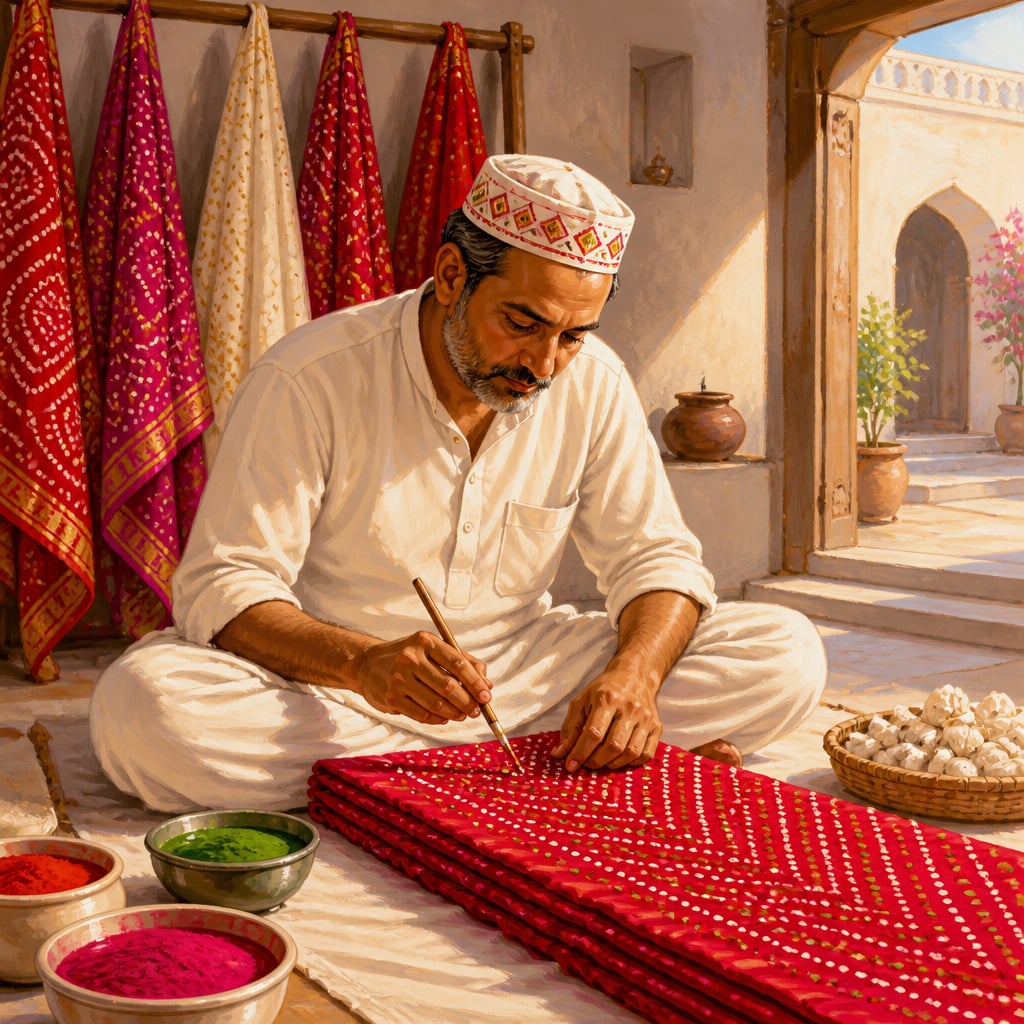
A Whitewashed Workshop in Bhuj
In a whitewashed workshop in the old town of Bhuj, in the Kutch region of Gujarat, a master tie-dyer named Abdul Jabbar Khatri is folding a three-metre length of fine cotton into a neat rectangle. The cloth is about to become a saree, but first it has to become a map. He smooths it flat on a low table with the flat of his palm. He dips his fingernail into a small cup of fugitive red dye and begins marking dots across its surface, one by one, in a pattern he has carried in his head since he was a child. The marks are smaller than grains of rice. By the end of the morning, there will be several thousand of them.
Abdul Jabbar is a ninth-generation bandhani artist. His brothers work beside him. His sisters, cousins, and aunts tie the actual knots, one for each dot he has marked, with a fine cotton thread wrapped tightly around a pinch of cloth. Each knot becomes a tiny resist when the cloth is dipped in dye. The dye seeps into the open areas of the cloth and stops at the knots. When the knots are finally untied, each one reveals a perfect white circle, surrounded by a halo of colour. On a classic bandhani odhni for a Gujarati bride, there can be fifty thousand of these circles. A single odhni can take two masters and four women four to six weeks to finish.
The craft Abdul Jabbar's family practises has been recorded in India for at least 1,500 years. It appears on the walls of the Ajanta Caves, in paintings completed in the fifth and sixth centuries CE. It is described in the Sanskrit prose of Banabhatta, the court poet of Emperor Harsha, who around 650 CE wrote a biography of his king and mentioned the bride at a royal wedding wearing an odhni of tied-and-dyed cloth. Between those Ajanta paintings and this Bhuj workshop lies an almost continuous line of Khatri families, tying knots and dipping cloth, for close to sixty generations. This lesson is about what that line has carried, and about the morning of 26 January 2001 when, for a few terrible minutes, it looked like it might break.

The Craft Is Older Than The Empires
The word bandhani comes from the Sanskrit root bandh, meaning to tie or to bind. The same root gives us bandhu (relative, friend), bandha (bond), and bandhana (binding). The word applies to any resist-dyed cloth where the resist is made by tying the fabric before dyeing. In Gujarat and Rajasthan, the word has narrowed to one particular form of the craft: the thousand-dot style that uses thread knots as resists.
Bandhani is older than any living Indian empire. In Cave 1 of Ajanta, a wall painting of a Bodhisattva and a princess shows the princess in a garment clearly stippled with small light circles on a dark ground. Textile historians have identified this as a tied-and-dyed cloth. The painting is dated between the fifth and sixth centuries CE, during the reign of the Vakataka king Harishena.
A hundred years later, Banabhatta wrote his Harshacharita, the life of Emperor Harsha of Kanauj. In the fourth chapter, describing the wedding of Harsha's sister Rajyashri to the Maukhari king Grahavarman, Banabhatta mentions the bride wearing an odhni whose pattern had been produced by binding the cloth before dyeing. The Sanskrit word he uses is bandha. This is the earliest surviving Indian literary reference to what we today call bandhani. It dates to about 650 CE.
After Harsha, the craft is mentioned in later medieval texts from Gujarat and Rajasthan. It was patronised by the Chaulukya kings of Gujarat from the tenth to the thirteenth century, by the Rajput courts of Mewar, Marwar, Bikaner, and Jaipur, and by the Mughal court from Akbar onwards. A Mughal miniature painted in Akbar's atelier in the late sixteenth century shows a court lady in a clearly-drawn bandhani odhni. The craft moved easily between Hindu and Muslim patrons, because it was worn by both.
How A Bandhani Is Made
Making a bandhani is a three-step process: tying, dyeing, and untying. Each step is done by a different person.
The tying is done almost entirely by women. The tier takes a length of fine cotton or silk and folds it into a rectangle, four or eight layers thick. A master like Abdul Jabbar then marks the pattern on the top layer with a fugitive dye. The tier sits down with a long spool of fine cotton thread, wets the fingertip of her left hand, pinches a tiny point of cloth at the first marked dot, and wraps the thread around the pinched cloth three or four times. She ties the thread off in a small knot. Then she moves to the next dot. Then the next. A skilled tier in Bhuj can tie around fifty to a hundred knots an hour, and she does this for six or seven hours a day, for several weeks, for a single saree. Each knot holds together four to eight layers of cloth at once, so one knot produces four to eight dots in the finished fabric.
The dyeing is done by men. The tied cloth is first dipped in the lightest colour, usually yellow from turmeric or pomegranate rind. It is dried in the sun. Then more knots are tied over the yellow areas that should stay yellow. Then the cloth is dipped in the next colour, usually red, from madder or lac. And so on. A three-colour bandhani needs three rounds of tying, three rounds of dyeing, and very careful tracking of which knots protect which colour at which stage. A five-colour bandhani, which some masters can still do, needs five rounds. One mistake in the sequence wastes weeks of work.
The untying is the last step. When the dye is dry, a second woman sits down with the cloth and, one by one, unties every knot. When she is finished, the cloth relaxes and the pattern reveals itself. For the tier, who has been working blind for weeks, the untying is the first time she sees what she has made.
The full vocabulary of bandhani patterns is large. A bride's odhni can carry any of these:
- Chandrakala: a moon motif, a large white circle with a halo of colour
- Bawan bagh: the fifty-two garden, a grid of fifty-two small bouquet patterns
- Ekdali: a single dot repeat, the simplest pattern and the hardest to execute cleanly
- Shikari: a hunting scene, with tiny animals picked out in dots
- Gharchola: the traditional red-and-gold marriage odhni of Gujarati brides, with a grid of zari squares and bandhani dots inside each square
The Khatri Community of Kutch
The craft is carried almost entirely by one community: the Khatris. They came originally from Sindh, in today's Pakistan, where tie-dye has been practised for many centuries. In the fifteenth and sixteenth centuries, groups of Khatri families migrated east across the Rann of Kutch into Gujarat and settled in Bhuj, Mundra, Mandvi, Anjar, and other towns of Kutch and Saurashtra. Other Khatri groups moved into Rajasthan and settled in Jaipur, Sikar, and Bikaner, where they produce a regional variation of the craft alongside leheriya, the wave-patterned tie-dye of Rajasthan.
Most of the Kutch Khatris are Muslim. Some are Hindu. Both groups speak Kachchhi and Gujarati, dress in a common regional style, and observe the same craft customs. They marry within the community. They pass the craft from parent to child. The men dye. The women tie. A Khatri family workshop is often three generations deep, with grandmothers, mothers, and daughters tying knots side by side on the same cloth. The children watch.
The best-documented Khatri masters of recent decades have come from Bhuj. Abdul Jabbar Khatri, who runs the workshop described in the opening of this lesson, and his brother Abdul Razzaq Khatri, are ninth-generation bandhani artists. They have been honoured by the Government of India with the Padma Shri, the country's fourth-highest civilian award, for their work keeping the craft alive and teaching it forward. Other masters in the community have received National Awards, Shilp Guru honours, and UNESCO craft recognition. But the most important work they do is not the awards. It is teaching the next niece, the next cousin, the next young woman who joins the circle at the low table, how to tie fifty knots in a row without missing one.

The Earthquake and After
At 8:46 on the morning of 26 January 2001, a magnitude 7.7 earthquake struck Kutch. The epicentre was about twenty kilometres north-east of Bhuj. The old town of Bhuj, where the Khatri workshops were clustered, was largely destroyed. Nearly twenty thousand people died across the district. More than a million buildings collapsed.
The Khatri families lost homes, workshops, tools, dye vats, and, in many cases, family members. They also lost cloth. A Bhuj workshop is not only a place of work. It is an archive. Generations of finished bandhani sarees, dye recipes, sample books, and hand-drawn pattern charts are stored in wooden cupboards that take a lifetime to fill. When the roofs came down, the archives came down with them.
Within months, two institutions moved in to help. Shrujan, a craft development trust founded in 1969 by Chanda Shroff in Gujarat, expanded its operations to rebuild Khatri workshops and restart the supply chain. Khamir, a craft resource centre whose name stands for Kachchh Heritage, Art, Music, Information and Resources, was set up in the aftermath of the disaster, on a piece of land outside Bhuj, as a permanent place where Kutch artisans could work, exhibit, sell, and train. Both organisations helped the Khatris get materials, find markets, and build a shared space to teach in. Both pushed for legal protection of the name.
In 2009, Kutch Bandhani received a Geographical Indication tag, legally tying the name to production by traditional Khatri artisans in specific villages and towns of Kutch and Saurashtra. The tag did not stop the flood of screen-printed polyester fakes that still pass for bandhani in cheap shops across India. But it gave the real Khatris, for the first time, a law they could stand behind.
Modern Echoes
In the years since the GI tag, a small but growing group of contemporary designers have built collections around authentic Khatri bandhani. The two most influential labels are Sanjay Garg's Raw Mango, launched in Delhi in 2008, which has produced several acclaimed bandhani collections working directly with Bhuj workshops, and Anita Dongre's Grassroot, which commissions bandhani pieces from named Khatri artisans and prints the artisan's name on the garment tag. Both labels pay the masters several times what the old trader-middleman route paid, and both publish the names of the people they work with. The effect on the Bhuj workshops has been steady. More children are staying in the craft. More young women are learning to tie.
A bandhani odhni is not just a decorative cloth. For a Gujarati or Rajasthani bride, the red gharchola, tied by a Khatri woman and dyed by a Khatri man and given by her family on her wedding day, is the single most important object she will wear in her entire life. The cloth holds her name, her lineage, her community, her faith, and the day itself. To receive a real one is to be bound, in the old sense of the word bandha, to the people who made it.
The Bhagavad Gita says that the soul casts off worn bodies the way a person casts off worn clothes and puts on new ones. For the Khatri families of Bhuj, the reverse is also true. The cloth they tie carries identities across generations. When the earthquake brought their houses down in 2001, the thing many of them went back first to save was not the furniture. It was the cloth.
Back in the whitewashed workshop in Bhuj, Abdul Jabbar is still marking dots. His thumbprint is stained red from the fugitive dye. Another thousand marks to go before lunch. Another thousand knots for the women this afternoon. The archive has been rebuilt. The line has held.
Key figures
Banabhatta
Sanskrit poet and prose writer of the early seventh century CE. He served as the court poet of Emperor Harsha of Kanauj (reigned 606 to 647 CE) and wrote the Harshacharita, a biographical prose work about his patron, around 650 CE. The Harshacharita is the earliest surviving biography in Indian literature and one of the most important sources we have for the political and cultural life of seventh-century north India.
Abdul Jabbar Khatri
A ninth-generation bandhani master of Bhuj in the Kutch region of Gujarat. He runs a family workshop along with his brother Abdul Razzaq Khatri, where they produce museum-grade bandhani sarees and odhnis, teach younger Khatri artisans, and work directly with contemporary Indian and international designer labels. He was honoured by the Government of India with the Padma Shri, the country's fourth-highest civilian award, for his work keeping the bandhani tradition alive.
Chanda Shroff
Gujarati craft revivalist, social worker, and founder of Shrujan, a craft development trust established in 1969 in Gujarat to support the embroidery and textile traditions of Kutch. Chanda Shroff started Shrujan as a small initiative to give Kutch artisan women a steady income and grew it over five decades into one of India's most important craft-development organisations. After the 2001 Kutch earthquake, Shrujan played a central role in rebuilding the Khatri and other artisan workshops across Kutch. She was awarded the Padma Shri in 2006.
Case studies
Bandhani in Ajanta and in Banabhatta's Harshacharita (5th to 7th century CE)
Two independent pieces of evidence place bandhani in India at least 1,500 years ago. The first is visual: on the walls of the Ajanta Caves in Maharashtra, specifically in Cave 1 and Cave 17, are wall paintings completed in the fifth and sixth centuries CE during the reign of the Vakataka king Harishena. Several figures in these paintings wear garments clearly stippled with small light circles on a dark ground. Textile historians have identified these as tied-and-dyed cloths. The second piece of evidence is literary. Around 650 CE, the court poet Banabhatta, who served Emperor Harsha of Kanauj, wrote the Harshacharita, a Sanskrit prose biography of his patron. In its fourth chapter, describing the wedding of Harsha's sister Rajyashri to the Maukhari king Grahavarman, Banabhatta mentions the bride wearing an odhni whose pattern had been produced by binding (bandha) the cloth before dyeing. He gives the craft its name in Sanskrit, fifteen hundred years ago, at a royal wedding in north India.
In the traditional view of craft, a technique is not considered established until a royal court has accepted it. The Ajanta paintings and the Harshacharita reference together prove that bandhani had crossed that threshold at least by the time of Harsha. A cloth Banabhatta thought worth describing in a royal biography was a cloth the court treated as a legitimate ceremonial object. This aligns with the dharmic understanding of craft as something that carries sacred and ritual weight, not merely aesthetic pleasure. The Ajanta figures wearing bandhani are often princes, princesses, and bodhisattvas, precisely the figures for whom the craft's ritual meaning would matter most.
The combined evidence gives us a firm floor date for the craft: bandhani was being practised and worn at a royal level in north India by at least the seventh century CE, and was being painted on cave walls a century or two before that. From that floor date, an almost unbroken chain of references runs through medieval Gujarati and Rajasthani texts, Mughal miniatures, colonial ethnographic surveys, and the documented Khatri workshops of the present. The Ajanta paintings and Banabhatta's sentence together establish bandhani as one of the oldest continuously practised textile traditions in the world.
A craft's antiquity is not proved by tradition alone. It is proved when independent forms of evidence (visual, literary, archaeological) converge on the same date from different directions. When they do, that convergence is worth defending, because it tells future generations where their inheritance actually comes from.
Any living craft benefits from having its own documented history accessible to its practitioners and its buyers. The Ajanta-and-Harshacharita evidence is what lets the Khatri masters of Bhuj say truthfully, to a contemporary buyer, that the cloth being handed to her is part of a fifteen-hundred-year-old lineage. The evidence is not decoration. It is what makes the claim defensible.
The Ajanta wall paintings in Cave 1 and Cave 17 are dated between the late fifth and early sixth centuries CE. Banabhatta's Harshacharita was composed around 650 CE. Between them, bandhani is attested visually and textually in India about a thousand years before the earliest documented shibori tie-dye in Japan.
Khatri Abdul Jabbar Khatri: The Padma Shri Master of Bhuj
In Bhuj, the main town of the Kutch district of Gujarat, lives a ninth-generation Bandhani master named Abdul Jabbar Khatri. His brother, Abdul Razzaq Khatri, works beside him. The brothers run a family workshop where they produce some of the finest handmade bandhani sarees in the country: traditional gharcholas, chandrakala odhnis, bawan bagh panels, and custom commissions for weddings, museums, and contemporary designer collaborations. Their training is entirely traditional: they learned the craft from their father, who learned it from his father, through at least nine documented generations. They use natural dyes where possible. They teach the younger women in their extended family, who are the actual tiers. They work directly with contemporary design labels such as Raw Mango and Grassroot to bypass the old trader-middleman route. They have been honoured by the Government of India with the Padma Shri, the country's fourth-highest civilian award, for their work keeping the craft alive.
In the traditional guru-shishya model, the greatness of a master is measured less by what he produces and more by what he teaches the next generation to produce. Abdul Jabbar and Abdul Razzaq Khatri fit this model exactly. The cloth they have made is beautiful, but the more important achievement is the training line they have held. A Khatri workshop that keeps teaching fifteen-year-old girls how to tie fifty knots in a row without missing one is a workshop that will still exist a generation from now. The Padma Shri is a recognition of this teaching role, not only of the individual cloth they have produced.
The Bhuj workshop led by the Khatri brothers is today a pilgrimage destination for textile historians, designers, and serious buyers. Their collaborations with Raw Mango and Grassroot have produced several acclaimed bandhani collections that have been shown at India Design Week and international craft fairs. More importantly, the women in their extended family who tie the knots for their workshop now earn several times what Khatri tiers typically earned a generation ago. The cousin who might have left the craft for factory work in Ahmedabad has reasons to stay.
The real measure of a craft master is the number of younger apprentices who, because of him, will still be practising the craft twenty years after he is gone. A workshop that produces beautiful cloth but fails to teach is a dead end. A workshop that produces ordinary cloth but keeps teaching is the beginning of a lineage.
Any professional who wants to leave a living legacy faces the same question the Khatri masters face. Is the work you are doing a lonely high performance, or a skill you are successfully transplanting into younger practitioners? The question is uncomfortable because the honest answer is often 'mostly the first'. The Khatri brothers are proof that the second answer is possible, and that when it is achieved, it produces both the Padma Shri and the next generation of masters, which are finally the same thing.
The Khatri brothers of Bhuj belong to a craft lineage at least nine generations deep. The Kutch Khatri bandhani cluster today has roughly two thousand working artisan families. Craft cooperation with contemporary design labels such as Raw Mango and Grassroot now accounts for a growing share of the cluster's income, at margins several times higher than the traditional trader-middleman route.
Raw Mango and Grassroot: Designer Brands Reviving the Khatri Workshop
In 2008, a young Delhi-based textile designer named Sanjay Garg launched a label called Raw Mango, dedicated to reviving classical Indian handwoven and hand-crafted textiles for a contemporary urban buyer. From its earliest collections, Raw Mango worked directly with specific named Khatri workshops in Bhuj, commissioning full collections of authentic bandhani and gharchola sarees without going through traders or middlemen. Around the same time, the designer Anita Dongre launched her Grassroot label under the House of Anita Dongre umbrella, built on the same principle: direct collaboration with Indian craft clusters, including the Kutch Khatri workshops, with the maker's name printed on the garment tag. Both labels pay the Khatri masters several times what the traditional trader route paid. Both publish the names of the artisans they work with. Both have presented their bandhani collections at Indian and international fashion weeks, placing the cloth in front of an urban and global audience that did not, a generation ago, know what a real bandhani was.
The traditional Indian craft economy was built on patron-craftsman relationships. A king, a queen, a temple, a wealthy merchant, or a religious community would commission work directly from a named artisan or workshop. Mass retail is a very recent overlay on this older model. What Raw Mango and Grassroot have rediscovered is not a new idea. It is the old patron-craftsman model, translated into a brand. In dharmic terms, a label that names its maker and commissions directly is behaving the way Ahilyabai Holkar behaved when she commissioned Paithani sarees for temple offerings: she knew the weaver, she paid on terms the weaver could live with, and she waited for the cloth to be ready.
The effect on the Bhuj Khatri cluster has been steady and measurable. Master workshops that work directly with these labels earn several times what the old trader route paid. The younger women in Khatri families who had been leaving for factory work in Ahmedabad and Surat have more reasons to stay and learn to tie. Raw Mango's bandhani collections have won design awards and have been acquired by international museum collections. Grassroot's artisan-named garments have expanded an urban market of Indian buyers who now actively ask which Khatri family wove their cloth. Neither label alone is the saviour of the craft, but together they have helped demonstrate that a clean direct-to-maker model is commercially viable, which is a precondition for any long-term revival.
A craft is saved when somebody rebuilds the patron-craftsman link that colonialism and industrial retail broke. Legal protection and institutional support matter, but in the end the weaver needs a direct, paying, respectful buyer. A brand that publishes the maker's name is doing something much more important than marketing: it is restoring the oldest form of craft economy.
The direct-to-maker model is not only a craft story. It is a principle that applies to any economy in which a product's real value is being created by a named person whose name is then stripped off by intermediaries. Consumers can change this at the level of a single purchase. The next time you buy something made by a specific identifiable human, ask whether the person who made it is named on the thing you bought. If not, ask why not.
Raw Mango was launched in Delhi in 2008 and its bandhani collections have been produced in direct collaboration with Bhuj Khatri workshops. Anita Dongre's Grassroot label credits the artisan by name on the garment tag. Direct-to-maker labels now pay Khatri master artisans roughly three to five times what the trader-middleman channel historically paid, at the same retail price point.
The 2001 Kutch Earthquake and the Khamir and Shrujan Revival
At 8:46 on the morning of 26 January 2001, a magnitude 7.7 earthquake struck Kutch district in Gujarat. The epicentre was about twenty kilometres from Bhuj, the main town of the district and the central hub of the Khatri bandhani tradition. The old walled town of Bhuj, where the Khatri workshops were clustered, was largely destroyed. Nearly twenty thousand people died across Kutch. More than a million buildings collapsed. The Khatri families lost homes, workshops, dye vats, looms, tools, and in many cases, family members. They also lost cloth: the accumulated sample books, finished sarees, and hand-drawn pattern charts of generations, which had been stored in wooden cupboards in the collapsed homes. Within months, two institutions moved in to help. Shrujan, a craft development trust founded in 1969 by Chanda Shroff, expanded its operations to rebuild Khatri workshops and restart the supply chain. Khamir, a new craft resource centre whose name stands for Kachchh Heritage, Art, Music, Information and Resources, was set up on a permanent campus outside Bhuj as a place where Kutch artisans could work, exhibit, sell, and train. Both organisations helped the Khatris get materials, find markets, and build a shared space to teach in. Both pushed for legal protection of the name, which finally arrived in 2009 with the Kutch Bandhani Geographical Indication tag.
In the traditional understanding of craft, a disaster that destroys a workshop is not only a physical loss. It is a blow to the paramparā, the living chain of transmission. The Khatri lineage was not only in the cupboards that fell. It was in the fingers and the eyes of the women who had been tying knots for generations, and that lineage could be lost if the workshops did not reopen soon enough. Shrujan and Khamir understood this. Their response was not only humanitarian in the ordinary sense. It was an act of paramparā rescue: they rebuilt the physical conditions that let the fingers keep their muscle memory intact, before the gap grew long enough for the knowledge itself to start to fade.
Fifteen years after the earthquake, the Kutch Khatri bandhani cluster is not only back but in many ways stronger than it was before. The Khamir campus outside Bhuj is a permanent craft resource centre with an on-site museum, a shop, a training programme, and exhibition space. Shrujan has expanded into a major craft education and marketing organisation with several documented revival projects to its name. The 2009 GI tag gives the community legal standing against imitation for the first time in its history. A new generation of young Khatri women, born after the earthquake, is now tying knots in workshops that their grandmothers thought they might have lost forever in 2001.
A craft can survive a physical disaster if, and only if, it has institutional friends who will show up immediately, fund the rebuild, and insist that the living teaching line not be broken. Individual heroism is not enough. Buildings can be rebuilt in months. A broken teaching line takes generations to repair, and sometimes cannot be repaired at all.
Every living tradition (a craft, a language, a ritual, a lineage of teachers) is, by definition, one disaster away from serious damage. The question is whether it has friends who will show up. Ask of anything you care about: if it were hit by a fire, a flood, an earthquake, or a political crisis tomorrow, who would show up to rebuild the teaching line, and would they show up in time? If the answer is nobody, or only individuals with no institutional backing, the tradition is more fragile than it looks. The Khatri story is what it takes for the answer to be different.
The 26 January 2001 Kutch earthquake had a magnitude of 7.7 and killed nearly twenty thousand people in the district. Shrujan was founded in 1969 by Chanda Shroff. Khamir was founded in the aftermath of the earthquake as a permanent craft resource centre outside Bhuj. The Kutch Bandhani Geographical Indication tag was granted in 2009. The Kutch Khatri bandhani cluster today has roughly two thousand working artisan families.
Historical context
Fifth century CE to the present. The earliest visual evidence for bandhani is in the Ajanta wall paintings of the fifth and sixth centuries CE. The earliest literary evidence is Banabhatta's Harshacharita of about 650 CE. The craft was patronised continuously through the Chaulukya, Rajput, and Mughal periods. Its modern history is dominated by the 26 January 2001 Kutch earthquake and the institutional revival that followed.
The Khatri community that carries the bandhani tradition originated in Sindh, the region around the lower Indus river, and migrated east into Kutch and Saurashtra in the fifteenth and sixteenth centuries. They worked under a series of Gujarati and Rajasthani patrons. In the medieval period, the Chaulukya kings of Gujarat supported Kutch workshops. From the sixteenth century, the Mughal court under Akbar and his successors brought Kutch and Rajasthani bandhani into imperial fashion. The Rajput courts of Mewar, Marwar, Bikaner, and Jaipur maintained their own bandhani and leheriya workshops. In the twentieth century, the craft survived mass-produced mill cloth and screen-printed polyester imitations largely because the wedding market in Gujarati and Rajasthani communities continued to demand the real thing for bridal odhnis.
Bandhani is part of a much larger global family of resist-dye traditions, all of which use some form of binding or tying to keep parts of the cloth white while the rest is dyed. In Japan, the equivalent tradition is called shibori, and is best-known through the deep indigo patterns of Arimatsu in Aichi prefecture. In West Africa, the Yoruba adire cloth tradition uses tied and stitched resists. In Indonesia, plangi (tie-dye) is practised on Java and Bali. Bandhani is the Indian member of this global family. It is one of the oldest: it is attested in the Ajanta paintings of the fifth and sixth centuries CE, several centuries before the earliest documented shibori in Japan.
A traditional handmade bandhani odhni can contain between five thousand and fifty thousand hand-tied knots, each made by a Khatri woman with a single cotton thread around a pinch of cloth. A skilled tier in Bhuj can tie fifty to a hundred knots an hour, for six to seven hours a day, for several weeks, to complete a single saree. The 2001 Kutch earthquake, which struck on 26 January at 8:46 AM, had a magnitude of 7.7. It killed nearly twenty thousand people in Kutch and destroyed more than a million buildings, including a large number of Khatri family workshops in Bhuj and surrounding towns.
Bandhani is one of the oldest continuously practised textile traditions anywhere in the world. The line between the Khatri woman tying knots in a Bhuj workshop today and the unknown craftspeople who tied the cloth depicted in the Ajanta paintings 1,500 years ago is a line that almost nothing else in India, or in many other countries, can match for continuity. To understand bandhani is to understand what it takes for a craft to survive that long: a tightly knit community, a strict division of labour that everyone respects, a ritual market (weddings and religious occasions) that never stops buying, and, in the last few decades, institutional support strong enough to absorb a major natural disaster without losing the lineage.
Living traditions
Contemporary designer labels working directly with Khatri masters have transformed the economics of the craft. Sanjay Garg's Raw Mango (launched Delhi, 2008) has produced several acclaimed bandhani collections in collaboration with Bhuj workshops. Anita Dongre's Grassroot label commissions bandhani pieces from named Khatri artisans and credits the maker on the garment. Fabindia sells a range of machine-screen-printed imitations alongside some authentic Khatri pieces, with the real ones clearly tagged. Online craft marketplaces such as Gaatha and iTokri connect Bhuj masters to urban buyers without a trader in the middle. The Shrujan museum near Bhuj, founded by the Shroff family, houses one of the best collections of historical Kutch bandhani and is a pilgrimage site for textile researchers and designers.
Reflection
- The Khatri families of Bhuj went back first, after the 2001 earthquake, for their cloth archives rather than for their furniture. If something similar happened to you tomorrow, what would you go back into the rubble for first, and what does that list tell you about what you actually consider irreplaceable?
- Why do you think the Khatri workshops have held their division of labour (women tie, men dye) across so many centuries, without it becoming a weakness? What does this tell you about how traditional crafts keep a complex process stable over generations?
- Krishna tells Arjuna that the soul puts on a body the way a person puts on a garment. The Khatri tradition adds: the garment, too, is carrying something. What is the relationship between the objects we wear and the identities we inhabit, and at what point does a piece of cloth stop being a commodity and become a body?