Patola of Patan: The Double Ikat Marvel
Nine hundred years ago, a Jain king brought seven hundred weaver families to Patan. Three of their descendants still tie silk threads by hand before a single weft is thrown.
Around 1140 CE, the Solanki king Kumarapala brought the Salvi weaver community from the Deccan to his capital at Patan in Gujarat. He wanted a fresh silk patola every day for his Jain morning prayers. Nine hundred years later, only three Salvi families still weave true Patan Patola. They tie and dye every single warp and weft thread before a saree begins, working from a graph paper plan pinned to the wall. A single saree takes four months to four years of work. The design appears identical on both sides of the cloth. In the 16th century, the same sarees travelled east in Gujarati merchant ships to Java and Bali, where they became sacred temple cloth. In 2013, the word 'Patan Patola' finally received legal protection under the Indian GI Act. This lesson walks into the last workshop where the pattern is still tied into the thread before it is woven.
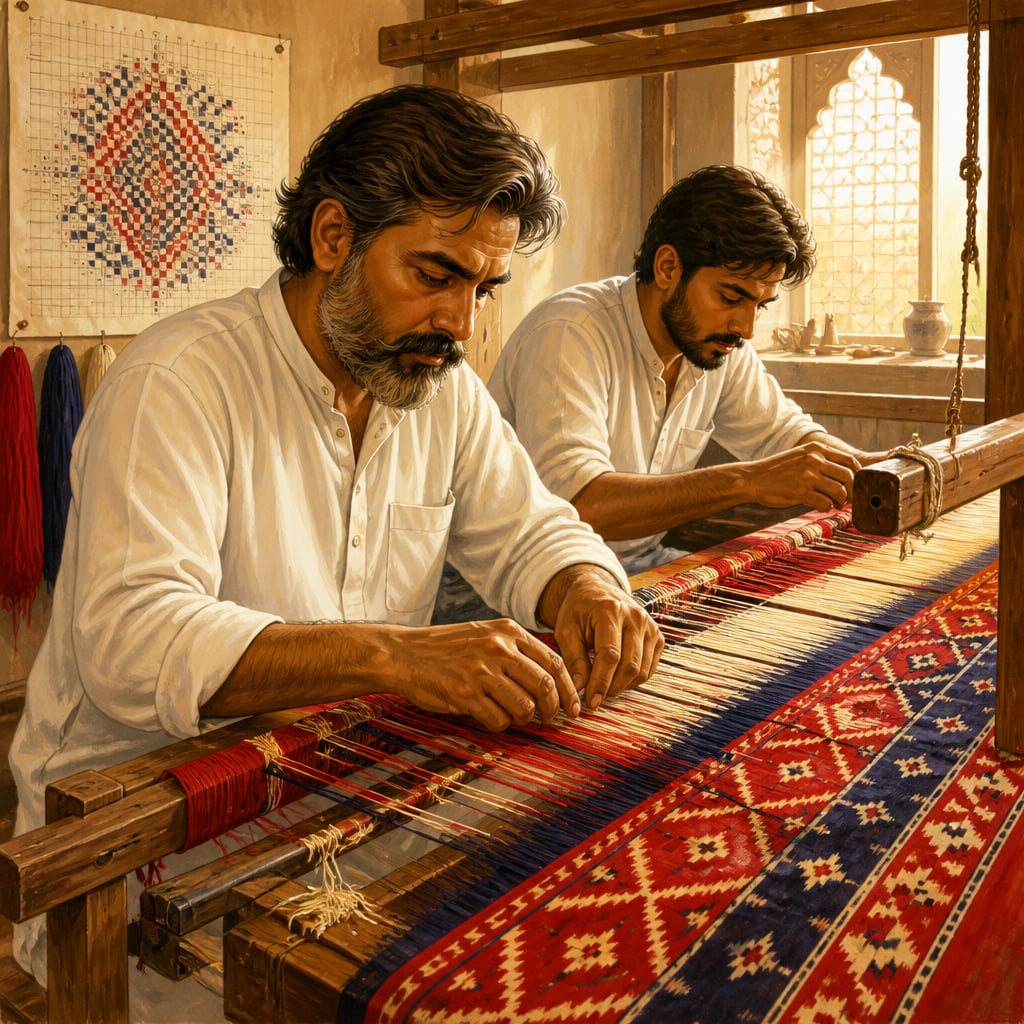
A Workshop in Patan
In a ground-floor workshop in the old city of Patan, in north Gujarat, on a weekday morning in the early 2020s, Bharat Salvi stands in front of a wooden frame with a bundle of silk threads in his hands. The bundle is about the thickness of his wrist. The silk has been bought from Bangalore and sits uncut in the workshop. Today, he will not weave a single thread. He will tie it.
Bharat Salvi is one of the three men in Patan who still weave true double-ikat Patola. The other two are his brother and his cousin. Between them, their families complete perhaps twenty to thirty full sarees a year. A single saree takes between four months and four years of work. The cheapest sells for about one and a half lakh rupees. A bridal one can cost four lakh or more. Brides wait years for them. Some families commission a saree before a daughter is even engaged, so that it will arrive in time for her wedding.
On the wall behind Bharat Salvi, a piece of graph paper is pinned up. Every small square on the graph is one thread. The pattern, which will be a Nari Kunjar (maidens and elephants), is drawn out square by square, warp and weft both. Today he will start tying the warp bundles. He will dip them in dye one colour at a time, untying and retying the ties between dips. When he is done with the warp, he will do the whole thing again on the weft. Then he will thread the loom. Only then will weaving begin. Only then will the two sides of the pattern meet each other for the first time.
How does a pattern planned thread by thread actually line up on the loom, when the warp and the weft cross each other at right angles? That is the question this lesson walks into. And the answer is almost nine hundred years old.

The Solanki Debt
Around 1140 CE, the Solanki king Kumarapala ruled Gujarat from his capital at Anahilapatak, the city we now call Patan. Kumarapala was a Jain. Every morning he wore a fresh silk cloth for his prayers. Tradition says he wanted a new Patola saree or dhoti each day for his puja. Once worn, the cloth could not be worn again for worship.
Patan did not have weavers who could make Patola. But Kumarapala had heard of the Salvi community, a clan of silk weavers living in the town of Jalna in the Deccan. The story the Patan tradition tells is that he sent for them. Seven hundred Salvi families picked up their looms and walked north into Gujarat. They settled in Patan. They have been there ever since.
The exact numbers in the story may be rounded. But the Salvi arrival at Patan is real, and it is old. When the Solanki kingdom later fell to Allauddin Khilji of the Delhi Sultanate in 1298 CE, the Salvi weavers did not leave with the falling court. They had been Gujarati for almost two hundred years already. The Sultan carried away treasures, but he left the looms. The Salvi workshops kept working through the Sultanate, through the rise of Ahmedabad as Gujarat's new capital, through the Mughal centuries, through the British Raj, through independence. Nine hundred years later, Bharat Salvi in his Patan workshop is one of the last carriers of the craft Kumarapala first brought to the city.
What Double Ikat Is
There are two kinds of ikat. Both use the same basic idea. You take the threads before you weave them. You tie them in small bundles with a resist material, usually fine cotton thread. You dip the tied bundle into a dye. The parts that are tied do not take the dye. The parts that are untied do. You then untie some bundles, retie others, and dip again in a second colour. You do this as many times as the pattern has colours. When you are finally done, the threads themselves carry the pattern, before a single weft has been thrown.
In single ikat, only one set of threads (usually the weft) is tied and dyed. The other set is a plain colour. Most Indian ikat, including Pochampally and Rajkot patola, is single ikat. The pattern softens a little at the edges because the colour is only coming from one direction.
In double ikat, BOTH the warp and the weft are tied and dyed separately. The weaver must plan the pattern twice, once for each set of threads, with complete precision, before any weaving begins. When the two sets meet on the loom, the pattern snaps into focus. A Nari Kunjar elephant on a Patan Patola has sharp edges because the warp and the weft are both carrying it. The pattern appears identical on both sides of the cloth. There is no front. There is no back.
| Single Ikat (Rajkot, Pochampally, Sambalpuri) | Double Ikat (Patan Patola) |
|---|---|
| Only the weft threads are tied and dyed | Both warp AND weft are tied and dyed |
| Pattern has slightly soft edges | Pattern has sharp, identical edges on both sides |
| One side of the saree is noticeably the back | Both sides look the same, the saree is reversible |
| Two to four weeks of work per saree | Four months to four years of work per saree |
| Rs 15,000 to Rs 60,000 | Rs 1.5 lakh to Rs 4 lakh and higher |
Only three places in the world still make true double ikat textiles. Patan in Gujarat, a village called Tenganan in Bali, and a handful of cloth traditions in Japan. Patan is the oldest of the three. And the Bali Tenganan cloth, as it happens, is a direct descendant of Patan.

The Indonesia Trade
From about 1300 CE onward, Gujarati merchant ships sailed east from the port of Cambay (now Khambhat) across the Arabian Sea, around southern India, through the Strait of Malacca, and into the Indonesian archipelago. They carried many things. But one of the most prized things in the hold was Patan Patola. The Portuguese traveller Duarte Barbosa, who wrote a book about Cambay's trade around 1518 CE, recorded that Patola was one of the most valuable textiles shipped out of Gujarat to Malacca, Sumatra, and Java.
In the courts of Java and in the noble households of Bali, the Patola did not arrive as a saree. It arrived as a royal heirloom. It was wrapped around the shoulders of kings at coronations. It was folded and kept in temple treasuries. It was passed from mother to daughter at Balinese weddings. The people of Bali gave the imported cloth a name in their own language: cepuk. A real Gujarati Patola in Bali was, and still is, considered spiritually charged. In some Balinese villages, it is wrapped around children during tooth-filing ceremonies to protect them from harm.
About four hundred years ago, the village of Tenganan in Bali began to weave its own double ikat. The Tenganan weavers say they learnt the technique from the Patola they had seen for generations. The patterns on Tenganan cloth still carry echoes of the old Gujarati Ratanchok Bhat and Pan Bhat designs. Patan's design language travelled halfway across the ocean and settled into the temples of a Hindu island in Southeast Asia, where it is still being woven today.
Three Families, Nine Hundred Years
The Patan Salvi community was never large. At its height during the Mughal period, perhaps a hundred families wove Patola. By the late nineteenth century, under British rule and the flood of cheap mill cloth, the number had dropped to perhaps twenty. By the mid twentieth century, it was under ten. Today, only three Salvi families still weave true Patan double ikat. They are all descendants of the original settlers from Jalna.
The weaving itself requires two men sitting side by side at the same loom, pulling the warp threads one row at a time to match the weft. One mistake cannot be unpicked. The saree moves forward half an inch a day on a good day. Less on most days.
Why are there only three families? The answer is not mysterious. A young Salvi boy who learns the craft today earns less in his first five years than a cousin who takes a call-centre job in Ahmedabad. A saree takes a year. A family needs to sell several a year to eat. The market for a four-lakh saree is small, and the craft lives one commission at a time. The miracle is not that the number is so small. The miracle is that it is not zero.
The 2013 Protection
For most of its history, the word Patola in Gujarat meant only one thing. A double-ikat silk woven by the Salvi families of Patan. But from the nineteenth century onward, weavers in Rajkot, about three hundred kilometres to the west, began to make a simpler single-ikat silk and sold it under the same name. By the late twentieth century, most of the sarees sold in India as Patola were Rajkot single ikat or cheaper imitations. A Patan bride could go to a shop in Mumbai, ask for a Patola, and be handed something that had nothing to do with Patan at all.
On 4 December 2013, the Patan Patola received its own Geographical Indication tag under the Indian GI Act of 1999. The registration protects the name Patan Patola for handwoven double-ikat silk made in Patan city by the Salvi families. A Rajkot single ikat cannot be legally sold as a Patan Patola. The older word Patola on its own is not exclusively protected, because Rajkot has used it too long. But the word Patan fixes the meaning where it belongs. The Salvi families, after nine centuries in the city, finally hold their own name in Indian law.
The GI did not change the market overnight. Rajkot sarees still outnumber Patan sarees in the mass market a hundred to one. But for a buyer who wants the real thing, the law is now clear. Ask for Patan Patola with the GI tag. Buy from the Salvi family showroom in Patan itself, or from the Gujarat government emporium Garvi Gurjari, which certifies handloom Patan origin. Anything else calling itself Patola is a good saree, perhaps, but it is not the thing Kumarapala's weavers walked to Patan to make.
The Thread That Holds The Pearls
About two thousand years before Bharat Salvi tied his first silk bundle, Krishna said something to Arjuna on the battlefield of Kurukshetra about how the world is held together.
मत्तः परतरं नान्यत्किञ्चिदस्ति धनञ्जय। मयि सर्वमिदं प्रोतं सूत्रे मणिगणा इव॥
mattaḥ parataraṁ nānyat kiñcid asti dhanañjaya mayi sarvam idaṁ protaṁ sūtre maṇi-gaṇā iva
There is nothing higher than Me, Arjuna. All this world is strung on Me, as pearls are strung on a thread.
Bhagavad Gita 7.7
Krishna's image is a craftsman's image. The pearls are the visible things: people, seasons, kingdoms, stars. The thread is the thing you cannot see, but without which none of the pearls can hold. For the Patan Salvis, the pattern is the pearls and the planned warp-and-weft is the thread. You cannot see the planning when you look at the finished saree, because the planning is underneath the weave. But without those months of tying and dipping, the elephant on the pallu would never have sharp edges. It would be a blur.
The modern world loves to look at the pearls. It rarely wants to look at the thread. When Indian craftsmanship is spoken of today, by designers like Ritu Kumar and Sabyasachi Mukherjee, by scholars like Jasleen Dhamija who spent fifty years documenting Indian textiles, or by the India Handloom Brand programme that the Textiles Ministry runs, the underlying point is always the same. It is the thread, not the pearls, that is hard to keep. Designers can put a Patola on a Mumbai runway. Government schemes can hand out awards. Tourists can fly to the Salvi showroom in Patan and buy a saree off the waiting list. But the thread is the apprenticeship. And the apprenticeship is, today, three families deep.
Back in the workshop, Bharat Salvi has finished tying one small section of the warp. The bundle is marked with tiny points of cotton thread where the next round of dye will not reach. He carries it to the pot by the stove. He dips it. He watches the colour take. The saree has begun. Somewhere in four months, or in a year, or in four years, a bride in Mumbai or Surat will open this saree for the first time and see that the back and the front look the same. That the elephant on the pallu has sharp edges on both sides. That the pattern she can see also belongs to the pattern she cannot. And that the thread, as Krishna told Arjuna, is the thing that holds.
Key figures
Kumarapala Solanki
The Solanki king of Gujarat from about 1143 to 1172 CE. He ruled from Anahilapatak, the city we now call Patan. Kumarapala became a devoted follower of the Jain acharya Hemachandra and adopted Jain practices for his royal household, including vegetarianism, non-violence, and the daily use of fresh silk garments for his morning worship.
Duarte Barbosa
A Portuguese writer and traveller in the early 16th century. Barbosa served as a clerk and interpreter for the Portuguese colonial administration in Cochin and was one of the first Europeans to write a detailed survey of the Indian Ocean trade. His book, known as the 'Livro de Duarte Barbosa' and written around 1518 CE, surveys the ports of the African coast, Arabia, India, Sri Lanka, Malaya, and the Indonesian archipelago.
Bharat Salvi
A senior master weaver of the Patan Patola tradition, and the head of one of the three Salvi family workshops that still practise true double ikat in Patan today. Along with his brother and his cousin, who lead the other two surviving family branches, Bharat Salvi has trained his sons and nephews in the tying, dyeing, and weaving of Patola. He also runs the Salvi family showroom and heritage museum in Patan, where visitors can see historical sarees and watch the loom at work.
Case studies
The Gujarat to Indonesia Patola Trade
From about 1300 CE onward, Gujarati merchant ships sailed east from the port of Cambay (modern Khambhat) across the Arabian Sea, around the southern tip of India, through the Strait of Malacca, and into the Indonesian archipelago. Their holds carried spices, perfumes, metals, and textiles. Among the textiles, the most valuable item was Patan Patola. The Portuguese traveller Duarte Barbosa, writing around 1518 CE, recorded Patola as one of the highest-priced Gujarat exports to Malacca, Sumatra, and Java. The cloth did not arrive in Indonesia as clothing. It arrived as heirloom and ritual cloth. In the courts of Java and Bali, kings wore it at coronations. Families kept it folded in temple treasuries. Mothers passed it to daughters at weddings. In some Balinese villages, it is still used to wrap children during tooth-filing ceremonies, and to drape the bodies of the dead before cremation. The Balinese called it cepuk. Around four hundred years ago, the village of Tenganan in Bali began weaving its own version of the double ikat, learnt from the Patola they had seen for generations. The Tenganan designs still carry echoes of old Gujarati Ratanchok Bhat and Pan Bhat motifs.
The Indonesia trade is a clear example of an Indian craft tradition reaching the world without colonial force. The Gujarati merchants who carried Patola east in the 14th to 17th centuries were private traders, not imperial agents. The Indonesian courts and villages that received the cloth did so by choice, because the Patola was more beautiful than anything they could make themselves. The absorption of the cloth into Balinese ritual life shows how a foreign craft object can become spiritually local if the receiving culture chooses to honour it. The fact that a Gujarati saree is still used today to protect a Balinese child during a tooth-filing ceremony is a small miracle of cultural continuity across eight centuries and three thousand sea miles.
By the 17th century, the Patola trade had declined as the Dutch VOC replaced Portuguese trade networks and imposed new economic controls on the archipelago. The Gujarat-Indonesia Patola flow slowed and eventually stopped altogether. But the cloth that had already arrived in Indonesia stayed in family treasuries and temple storerooms, where it remains today. The Tenganan double ikat tradition, which began as a local copy of imported Patola, survived as an independent craft. Every year, a handful of Tenganan sarees and a much smaller handful of Gujarati Patola still change hands at Balinese weddings and rituals. The trade route is gone, but the design vocabulary it carried is still alive in two countries at once.
A craft can survive its own trade route. The Gujarati merchant ships stopped sailing four hundred years ago, but the Ratanchok Bhat and Pan Bhat motifs are still being woven in Bali this year. The lesson is that what travels is not the cloth itself but the design language and the technique. If you want a tradition to reach a new place, do not just ship the finished object. Teach the pattern. The trade that ends leaves the goods behind. The teaching that ends leaves nothing behind.
Contemporary textile scholars including Jasleen Dhamija and Rosemary Crill of the Victoria and Albert Museum have traced the Gujarat-to-Indonesia Patola trade through old cloth collections in both countries. The connection has been reestablished in recent decades through cultural exchange visits between the Patan Salvi family and Tenganan weavers, and through joint exhibitions at the National Handicrafts Museum in New Delhi and the Jakarta Textile Museum.
The Gujarat-Indonesia Patola trade peaked between 1400 and 1650 CE. Tenganan village in Bali has been weaving its own double ikat (the geringsing cloth) for approximately four hundred years. Historical Patola sarees still exist in Balinese temple treasuries and Javanese royal collections, most of them five hundred or more years old.
The 2013 GI Registration for Patan Patola
For most of its history, the word Patola meant only one thing in Gujarat. A double-ikat silk woven by the Salvi families of Patan. But from the nineteenth century onward, weavers in Rajkot, about three hundred kilometres west of Patan, began making a simpler and cheaper single-ikat silk. They sold it under the same Patola name. By the late twentieth century, most of the sarees sold in India under the word Patola were Rajkot single ikats or imitations from elsewhere. A bride in Mumbai who walked into a shop and asked for a Patola could be handed something that had nothing to do with Patan. The three surviving Salvi workshops in Patan had no legal way to separate their nine-hundred-year-old craft from the newer imitations. In the 2000s, with help from the Gujarat state government and the central textiles ministry, the Patan Salvis filed an application with the Geographical Indications Registry in Chennai to protect the name Patan Patola under the Indian Geographical Indications of Goods (Registration and Protection) Act, 1999.
The GI application is a modern legal version of an older dharmic principle: a community has the right to name and protect the work it alone has carried. The Salvi teaching lineage, which had come to Patan with the seven hundred families brought by King Kumarapala around 1140 CE and had survived nine hundred years of political change, was the real substance the GI registration needed to protect. Without that unbroken teaching chain, there would have been no defined technique to register. Without the registration, the defined technique had no protection against Rajkot and imitation copies. The Salvi families held the craft. The law finally held the name.
On 4 December 2013, the Geographical Indications Registry in Chennai granted the GI for Patan Patola. The registration protects the name Patan Patola for handwoven double-ikat silk textiles made in Patan city by the Salvi community. Rajkot single ikat silks cannot legally be sold as Patan Patola. The older, broader word Patola on its own was not granted exclusive protection, because Rajkot had used it too long to be removed from the word. But the precise name Patan Patola now belongs, in Indian law, to the three Salvi workshops and their authorised dealers. Garvi Gurjari, the Gujarat state handloom emporium, now certifies Patan-origin Patola for buyers outside Patan. The market for Patan Patola remains small, but the name is legally defensible for the first time in nine centuries.
The legal protection of a craft depends on the unbroken teaching lineage underneath it. The 2013 GI would not have been possible if the three Salvi families had let the technique die in the colonial century, because there would have been nothing to register. The GI is the legal recognition of what the Salvi families had already preserved with their own hands. Preservation always comes first. Protection only comes second. Anyone who wants to protect a tradition must first find out whether anyone is still teaching it, because the registration is only as strong as the chain of hands behind it.
The Patan Patola GI case is now cited in Indian craft law and textile policy as one of the clearest examples of a GI that had to be filed by a very small community (three families) to defend an extremely scarce technique against a much larger and cheaper local imitation. It is often discussed alongside the Banarasi and Pochampally GIs as examples of how the 1999 Indian GI law can protect community-held craft knowledge. The Textiles Ministry's India Handloom Brand programme has also taken up Patan Patola for buyer-facing authentication.
The Patan Patola GI was granted on 4 December 2013, fourteen years after the Indian GI Act of 1999 came into force. It was one of many traditional Indian crafts to receive GI protection in the decade after Banarasi Brocades (2009), alongside Kanchipuram silk, Pochampally ikat, Chanderi, Mysore silk, Bidriware, and Channapatna toys.
Garvi Gurjari and the Salvi Showroom: Two Authentic Retail Channels
Imagine you live in Mumbai and you have decided to buy a real Patan Patola saree for your daughter's wedding. You have read about the 2013 GI registration and you know that most of what is sold as 'Patola' in your neighbourhood shops is Rajkot single ikat. You want the real thing. But you do not know any Salvi family personally and you are not a textile expert. Where do you go? The Patan Patola tradition today has effectively two trustworthy buying channels. The first is the Salvi family showroom itself in the Salvi Vado neighbourhood of Patan city. The Salvi house doubles as a workshop, a showroom, and a small heritage museum. Visitors walk in to watch the loom and often walk out with a written deposit paid on a saree that will take several months to a few years to finish. The second channel is Garvi Gurjari, the Gujarat state government handloom emporium. Garvi Gurjari has branches in Ahmedabad, Mumbai, Delhi, Vadodara, and several other cities. It sources its Patan Patola directly from the Salvi workshops and issues handloom authentication tags on every piece it sells. Both channels offer the GI-protected Patan Patola. Neither channel is cheap. Together, they are the only two places where a buyer without a personal Salvi connection can be confident of what she is buying.
Both channels work because they shorten the distance between the weaver and the buyer. The Salvi showroom shortens it to zero: the buyer stands in the same building as the loom. Garvi Gurjari shortens it by putting a state guarantee between the buyer and the weaver, so that a Mumbai buyer does not need to make the trip to Patan to be sure. Traditional Indian craft communities almost always used similar short channels: direct workshop commissions, trusted dealers, or temple and court emporia that vouched for the origin of the piece. What modern mass retail broke was the shortness of the channel. What Garvi Gurjari and the Salvi showroom have rebuilt is that shortness, in a modern form. The lesson is that a precious craft lives on short channels, not on long ones.
The Salvi showroom now receives a steady flow of visitors from India and abroad: brides and their families ordering wedding sarees, textile scholars, designers looking for inspiration, craft tourists, and school groups. Many visitors who come only to watch the loom end up ordering a piece. The Patan Patola Heritage Museum that the Salvi family opened on the ground floor has become a small pilgrimage site. Garvi Gurjari has turned Patan Patola into a nationally accessible object: a Mumbai bride does not need to travel to Gujarat to see one. Between the two channels, the three Salvi workshops now have a reliable, authenticated market for the twenty to thirty sarees they finish each year. This is how the craft keeps eating. It is not a mass market. It is a short and trusted market.
When a craft is very rare, the only retail model that works is the shortest one. Long channels introduce many middlemen and many places where the real thing can be swapped for a cheaper imitation. The Patan Patola tradition survives today on two channels: the Salvi showroom itself, and Garvi Gurjari's state-certified handloom emporium. Both are essentially 'buy it straight from the weaver' models dressed up in modern clothes. The same principle applies to other very rare things. If you hold or sell something rare, the length of your retail channel determines how much of what you are selling is actually the real thing. Shorten the channel.
The short-channel retail model used by the Salvi showroom and Garvi Gurjari is now being studied by Indian craft policy groups and state handloom development boards as a template for other rare-craft communities. The Textiles Ministry's India Handloom Brand programme and online platforms such as Amazon Karigar are trying to extend a version of the same model to online buyers, by placing certification tags between the weaver and the customer so that the channel remains trustworthy even when it cannot be geographically short.
The Salvi family showroom in Patan and Garvi Gurjari retail outlets in major Indian cities are the two primary authenticated channels for Patan Patola today. Between them they handle the majority of the twenty to thirty full Patan Patola sarees that the Salvi workshops complete each year.
Historical context
The Patan Patola story runs from the 12th-century Solanki court of Gujarat, through the Delhi Sultanate and Mughal periods, through the 14th to 17th century Indian Ocean trade with Indonesia, through the colonial decline of the 19th and 20th centuries, and into the 21st-century legal revival under the 4 December 2013 Geographical Indication registration.
Silk weaving in Gujarat is older than the Solanki period. Gujarati weavers had been making fine silk for Jain monasteries and royal courts for several centuries before the 12th century. But the particular double-ikat technique that defines Patan Patola came to Gujarat through the Salvi migration that the Solanki king Kumarapala arranged around 1140 CE. The Salvis settled in Patan, the Solanki capital, which later became one of the great medieval cities of western India alongside Ahmedabad, Cambay, and Surat. After the fall of the Solankis to Allauddin Khilji in 1298, Patola weaving survived under successive powers: the Tughlaq Sultans, the Gujarat Sultanate, the Mughals, the Marathas, the British. At its peak in the Mughal period, perhaps a hundred Salvi families wove in Patan. Today, only three still do. The craft is concentrated in the Salvi Vado neighbourhood of Patan city, in north Gujarat's Mehsana district.
The Patan Patola's medieval Indian Ocean reach is contemporary with the Mongol Yuan silk trade along the overland Silk Road, and with the rise of Italian silk weaving at Lucca, Venice, and Florence in the 13th and 14th centuries. The Gujarat-to-Indonesia Patola trade ran parallel to the Ottoman-to-Europe velvet trade in the same centuries. Double ikat itself is practised in only three places in the world today: Patan in Gujarat, Tenganan in Bali, and a handful of traditions in Japan (Kasuri, Oshima Tsumugi). Patan is the oldest of the three. The Tenganan cloth is a direct descendant of Patan, learnt from Patola imported four centuries ago. The Japanese traditions developed independently but share the same underlying technical discipline.
Only three Salvi families in Patan still weave true double ikat Patola today, producing around twenty to thirty full sarees a year between them. A single saree takes four months to four years of work and sells for one and a half to four lakh rupees or more. The GI was granted on 4 December 2013, one of many Indian crafts to receive legal protection after the 1999 GI Act.
Patan Patola is the oldest continuously practised double-ikat tradition in the world. It is an example of a craft that was created by royal patronage, survived the fall of its patron, flourished as a medieval export, shaped other traditions a continent away, and is now held by three families. The story is a lesson in how fragile an elite craft can be, and in how long a community can carry one when the technique is inside the family rather than outside it.
Living traditions
The 4 December 2013 Geographical Indication registration gave the name Patan Patola legal protection under Indian law. The Salvi family heritage museum, opened in the early 2010s, has turned the Patan workshop into a pilgrimage site for designers, scholars, and craft tourists. Garvi Gurjari, the Gujarat government handloom emporium, certifies Patan-origin Patola for buyers outside Patan. Contemporary designers including Ritu Kumar, Sabyasachi Mukherjee, and Sanjay Garg of Raw Mango have featured Patola sarees in recent collections, extending the craft to a new urban audience. But the underlying technique is still carried only by the three surviving Salvi family workshops in Patan itself.
- Double ikat tying, dyeing, and weaving: Every Patan Patola saree begins as raw silk bought from Bangalore. The weaver first draws the full pattern on graph paper, square by square, warp and weft separately. Then he ties small bundles of warp threads with cotton resist, dips them in the first dye, unties and retries them, dips them in the second dye, and so on through the full colour sequence. When the warp is complete, the same process is repeated for the weft. Only then does weaving begin. Two men sit side by side at the pit loom, pulling the warp threads one row at a time to match the weft. The saree moves forward half an inch a day on a good day.
- Wedding saree commissions: Most Patan Patola sarees are commissioned for weddings, usually as part of a Gujarati bride's trousseau. Because a saree takes months or years to complete, the family commissions the piece long in advance and pays a deposit. The Salvi workshop keeps a written waiting list. Pan Bhat (the paan leaf pattern) and Nari Kunjar (maidens and elephants) are the most commonly requested wedding patterns. A bride who inherits a Patola from her grandmother knows the saree has been worn to two or three weddings in its life already, and that it will go to her own granddaughter.
- The Salvi showroom and heritage museum: The Salvi family has opened a ground-floor heritage museum in Patan where visitors can see nineteenth and twentieth century Patola sarees, antique Bali cepuk cloth, old graph paper pattern books, and photographs of past masters of the craft. The museum is also a showroom: most visitors who come to watch the loom end up walking out with a deposit paid on a future saree. The museum and showroom together have turned Patan into a destination for craft lovers and designers from India and abroad.
Reflection
- A Patan Patola saree is almost finished before weaving begins. The months of tying and dyeing the threads are the real work. The weaving is the visible finish. Think of one important thing you are currently building. What is the 'tying the threads' stage for it, and how much of your attention is actually going there versus going to the visible 'weaving' stage?
- The defining feature of a Patan Patola is that both sides look identical. The saree has no back. The customer will only ever see one side in her life, but the work has been done equally on both. Is there any work in your own life that you currently do with a 'front' for others and a 'back' that only you see? What would it mean to finish the back as carefully as the front, knowing nobody but you will check?
- Nine hundred years of Patan Patola are now carried by three Salvi families in one neighbourhood in Patan. If those three let it go, the technique ends. What is something in your own life, family, or community that is currently held by two or three people, and that could end if they let it go? What is one small thing you could do this month to help make sure it survives?