Leheriya & Batik: Waves, Wax & Regional Variations
Two resist traditions, two tools. Leheriya teaches a cotton cloth to remember the wave of the monsoon with nothing but thread and hands. Batik teaches it with a copper pen full of hot wax that the poet Rabindranath Tagore brought home from Java in 1927.
In a rangrez lane of Jaipur in the monsoon of 1895, a Muslim dyer rolls a length of mulmul cotton diagonally and ties it with cotton thread at precise intervals. When the cloth is dipped and untied, diagonal stripes appear across it like waves moving across water. The pattern is called leheriya, the wave cloth, and its five-colour version is named after Maharana Pratap. Three decades later, in 1927, the Nobel poet Rabindranath Tagore travels through Java and is struck by its wax-resist cloth called batik. He sends his daughter-in-law Pratima Devi to Java to learn the technique, and she brings it back to his art school at Shantiniketan, where it grows into a whole new Indian studio tradition. This lesson follows both crafts: the indigenous wave tied in Rajasthan and the wax-pen line drawn in Bengal. It asks how each one teaches a piece of cotton to remember exactly where the colour should not go. And it looks at the brands that are keeping them alive against the rising tide of machine-printed fakes.
Behind the Tripolia Bazaar
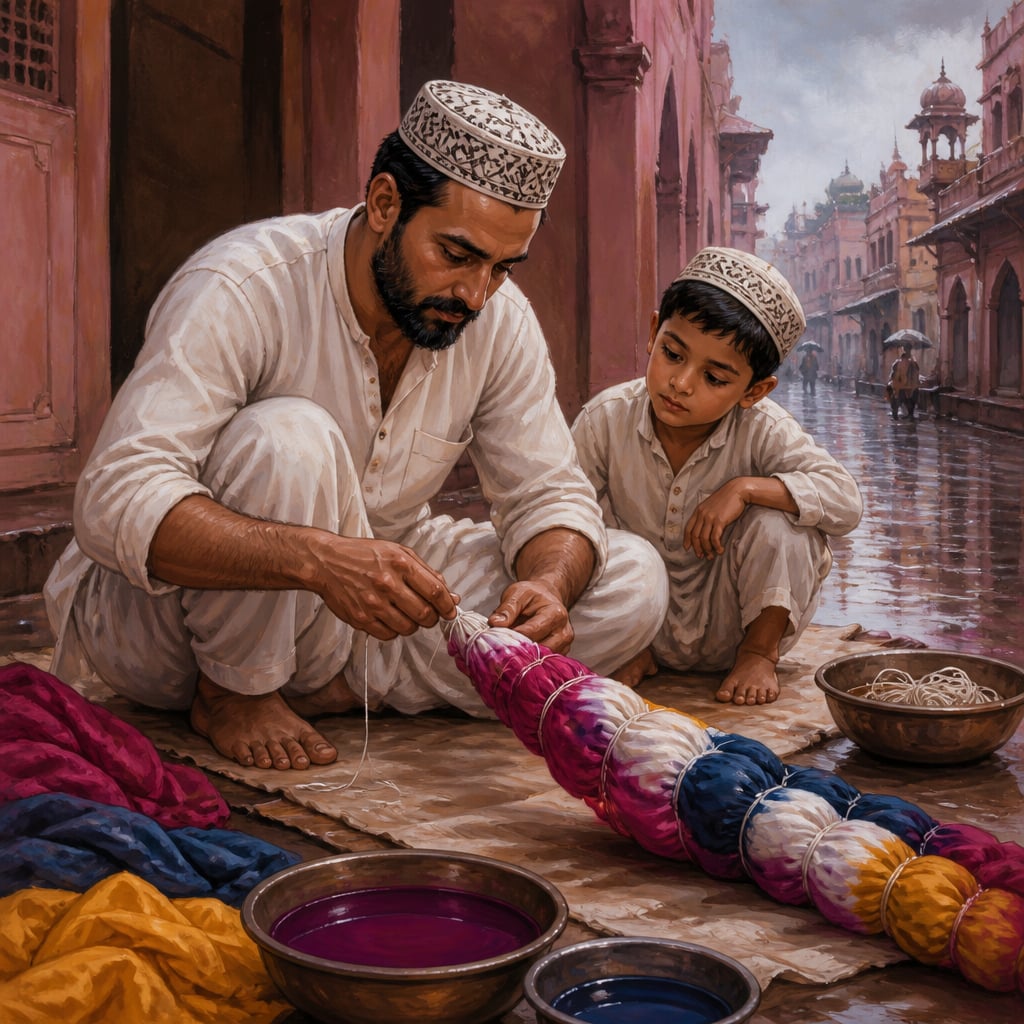
In a narrow lane behind the Tripolia Bazaar of Jaipur, on a grey morning in the monsoon of 1895, a rangrez named Imamuddin bent over a length of thin mulmul cotton laid flat on the stone floor of his workshop. (Imamuddin is a composite, drawn from the Muslim dyer families who have held this craft for more than three hundred years in the rangrez lanes of Jaipur, Jodhpur, and Udaipur.) The room smelled of turmeric, indigo paste, and wet cloth. The rain outside had not stopped for three days. His six-year-old son squatted beside him on the floor and watched.
Imamuddin was preparing a panchranga, a five-coloured turban cloth for a Shekhawati merchant who was about to travel home to his village for the monsoon festival of Teej. The merchant had asked for the Pratapshahi pattern. Imamuddin had promised to finish it in three days. He began by folding the cotton diagonally, rolling it corner to corner into a long tight cylinder, and then binding it at precise intervals with cotton thread. Each tied section would resist the dye. When the cloth was unrolled and dried, the resisted lines would appear as diagonal stripes running all the way across the cloth, like waves moving across water. That was the pattern. That was the reason for the name. Leher is the Hindi word for a wave. Leheriya is the wave cloth.
This lesson is about two resist-dyeing traditions that use very different tools to solve a similar problem. Leheriya is the indigenous Rajasthani wave-dyeing technique, tied with thread. Batik is the Javanese wax-resist technique that was carried back to India in 1927 by the artist Pratima Devi, daughter-in-law of Rabindranath Tagore, and turned into an Indian studio tradition at the Kala Bhavana art school at Shantiniketan. Both answer the same question: how do you teach a piece of cotton to remember exactly where the colour should not go?
The Wave in the Cloth
Leheriya works by tight mechanical compression, not by brush or wax. The rangrez lays a long length of light cotton (usually mulmul or voile) flat on the floor. He soaks it, wrings it, and then rolls it diagonally, from one corner to the other. The diagonal roll is the secret. It ensures that the resisted lines will appear as even diagonal stripes rather than horizontal or vertical bands.
Once rolled, the cylinder is tied at intervals with thin cotton thread. Each tie is a knot of compression so tight that the dye cannot reach the inner folds. The tied cylinder is then dipped in a dye bath, starting with the palest colour, usually yellow. After drying, some ties are opened and others are added, and the cloth is dipped again in a deeper colour. The process repeats for every colour in the final design. A panchranga uses five colours. A satranga uses seven. A mothra, the checked pattern, is made by rolling and retying the cloth in both directions, so the resisted lines cross each other at right angles.
The tools are embarrassingly simple. A roll of cotton thread. A shallow metal tray for the dye. A stone floor. A pair of hands that know exactly how tight a knot must be. The skill is not in the tools. It is in the hands of the rangrez who can already see the final wave pattern in a wet cylinder he has not yet untied.
Pratapshahi and the Monsoon Calendar
The pattern the merchant had asked Imamuddin to weave was named after a king. In the hill state of Mewar, in the late sixteenth century, Maharana Pratap Singh of Udaipur (1540 to 1597) wore a distinctive five-coloured turban as the mark of his court. The colours, in Rajasthani tradition, stood for the five elements of earth, water, fire, air, and sky, and for the five virtues a Rajput prince was meant to embody. The style entered the rangrez vocabulary as the Pratapshahi pattern and has been reproduced in Rajasthan ever since. Whether or not the historical Pratap wore the exact cloth the tradition claims is less important than the fact that the rangrez community has preserved the pattern in his name for four centuries.
The panchranga and satranga turbans belong to a larger Marwari and Shekhawati monsoon calendar. During Teej (usually in July or August, the month of Shravan) and during Gangaur in spring, the rangrez lanes of Jaipur, Jodhpur, and Udaipur become the busiest workshops in western Rajasthan. Merchant families commission new turbans and sarees. The women wear leheriya sarees to the temple and to family gatherings. The men wear leheriya safas, or turbans, as visible markers of clan identity. A single Shekhawati wedding can commission fifteen or twenty separate safas in slightly different colour sequences.
A real leheriya cloth carries something words cannot name. It carries the smell of the monsoon that produced it. The dye is mixed with water drawn from the first rains of Shravan. The cloth is tied during the wettest weeks of the year, when the humidity softens the cotton and lets the knots bite deep into the folds. Shake out a genuine handmade leheriya after four monsoons and it still smells faintly of wet earth.
| Leheriya | Batik |
|---|---|
| Resist made by tight diagonal tying | Resist made by hot liquid wax |
| Pattern created by mechanical compression | Pattern drawn freehand with a pen |
| Tools: thread and hands | Tools: tjanting pen and wax stamps |
| Light cotton (mulmul, voile) and silk | Cotton, silk, and raw silk |
| Rajasthan (Jaipur, Jodhpur, Udaipur) | Shantiniketan, Kaladera, Cholamandal |
| Indigenous Indian tradition | Javanese technique adapted in India |

The Batik Ship from Java
The other resist tradition in this lesson did not begin in India. It came back with a ship. In the summer of 1927, Rabindranath Tagore, the Nobel-winning poet of Bengal, travelled through Southeast Asia. He spent several weeks in Java, visiting royal batik workshops at Yogyakarta and Solo. He was transfixed by the Javanese technique: intricate cloths drawn with a small copper pen called a tjanting (pronounced chanting), which delivers hot liquid wax onto cotton in lines as fine as a fountain pen's ink. Wherever the wax falls, the dye cannot reach. When the wax is melted off at the end, the pattern stands out in the creamy undyed cloth against the deep blue of the indigo and the brown of the soga dye.
When Tagore returned to Shantiniketan, he did not simply import the cloth. He sent his daughter-in-law, the artist Pratima Devi (1893 to 1969), and several students from his Kala Bhavana art school back to Java to actually learn the technique from Javanese masters. Pratima Devi spent months in Java in the late 1920s working in royal workshops. She brought back copper tjanting pens, wax-melting stoves, and a head full of patterns. At Shantiniketan, she founded the batik workshop of Kala Bhavana. Her artist colleague Surendranath Kar (1892 to 1970), who had also travelled with Tagore through Southeast Asia, helped her translate the Javanese technique into an Indian studio language. Within a decade, Shantiniketan batik had developed its own vocabulary: Bengali folk motifs, Vaishnava scenes from the Krishna stories Tagore loved, and an experimental modernist palette that no Javanese master would have recognised.
Shantiniketan is not the only Indian batik centre now. The village of Kaladera near Jaipur runs a batik workshop alongside its block-printing tradition. The Cholamandal artists' village near Chennai, founded in 1966 by students of the painter K. C. S. Paniker, has produced some of the most celebrated contemporary Indian batik paintings. But the Tagore and Pratima Devi line at Shantiniketan is the mother of Indian studio batik. Every Indian batik artist since 1930 traces her lineage back to a young woman stepping off a ship in Calcutta harbour with a head full of Java.

The Two Traditions Today
Machine-printed fakes are the single biggest threat to both traditions. A screen-printed saree can reproduce the Pratapshahi pattern in an hour for a fraction of the cost of a real tied leheriya. A block-printed cloth can imitate the fine wax cracking of a real tjanting batik. In most retail markets in India today, the fakes outnumber the real things by perhaps twenty to one. The tests a buyer can actually use are old: hold the cloth up to the light and see whether the dye has passed evenly through both sides; look for the small wax-crack pattern in the undyed parts of a real batik; check whether the colour sequence on a leheriya shifts very slightly across the diagonal, which only happens when the cloth was actually dipped and not printed.
Against the fakes, two brands in particular have tried to keep the real traditions alive. Anokhi, founded in Jaipur in 1970 by the British textile designer Faith Singh and her husband John Singh, has for more than five decades sourced hand-dyed leheriya, block-printed fabric, and natural-dye work directly from Rajasthani craft communities. The Anokhi Museum of Hand Printing, housed in a restored haveli in Amber, trains the next generation of dyers and documents the technical vocabulary of the craft. Good Earth, founded in Delhi in 1996 by Anita Lal, has brought leheriya stoles, dupattas, and home textiles into the premium urban market through its Sustain line, paying weavers and dyers at scale.
The batik side is served by cooperatives like Amar Kutir, founded near Bolpur in 1958 to carry forward the Shantiniketan workshop tradition, and by individual artists working out of Cholamandal. Japanese buyers in particular, coming from a country with its own katazome wax-resist tradition, have been steady customers of Shantiniketan batik since the 1970s.
Modern Echoes
These two resist crafts belong together because they answer the same question in different technical dialects. A craft that teaches a piece of cotton to remember where the colour must not go is, at heart, a craft about restraint. Design historian Jasleen Dhamija, in her 1970 book Indian Folk Arts and Crafts, argued that India's resist traditions are among the country's oldest surviving textile technologies. The Victoria and Albert Museum in London holds a significant collection of early twentieth century Shantiniketan batik, and its public research cites Pratima Devi's Java journey as a founding moment in modern Indian textile history. The designer Rahul Mishra, who won the International Woolmark Prize in 2014, has used both leheriya and batik in his Paris couture shows as an explicit bridge between Rajasthani dye-lanes and global fashion runways.
Back in Jaipur in 1895, Imamuddin's six-year-old son watched his father tie the last knot on the Shekhawati merchant's Pratapshahi turban. He would grow up to tie his own knots on his own sons' cloths. The wave is still being tied in a few Jaipur lanes, and the wax is still being drawn in a few Shantiniketan studios. Whether the hand, and not the machine, still makes the next panchranga depends on the buyers who walk into an Anokhi showroom or a Good Earth store, and on whether they still know how to tell a real wave from a printed one.
Key figures
Maharana Pratap Singh I
The Rajput king of Mewar (ruled 1572 to 1597) who is remembered in Rajasthani tradition as the paradigmatic Rajput warrior, famous for his long resistance against Akbar's Mughal army and for the Battle of Haldighati in 1576. In the leheriya tradition, his name is attached to a specific five-colour turban pattern called the Pratapshahi, said to be derived from the ceremonial cloth of his court.
Pratima Devi Tagore
A Bengali artist (1893 to 1969) and the daughter-in-law of Rabindranath Tagore, married to his son Rathindranath. She studied painting at Kala Bhavana at Shantiniketan and was close to the Bengal school artists around Abanindranath Tagore and Nandalal Bose. In 1927 she accompanied her father-in-law on his Southeast Asian journey and, at his urging, spent several months in Java learning the wax-resist batik technique directly from Javanese masters. She brought the technique, the tools, and the pattern vocabulary back to Shantiniketan and founded the Kala Bhavana batik workshop.
Faith Singh
A British textile designer who moved to Jaipur in the 1960s, married the Indian entrepreneur John Singh, and in 1970 co-founded the textile and clothing house Anokhi. Anokhi was built from the start around traditional Rajasthani hand block printing, natural-dye work, and leheriya and bandhani tying. In 2005, Faith and her family established the Anokhi Museum of Hand Printing in a restored haveli at Amber, which trains apprentices and documents the technical vocabulary of the Rajasthani textile crafts.
Case studies
The King Whose Name Is Still Worn
In the hill kingdom of Mewar, in the late sixteenth century, Maharana Pratap Singh I (1540 to 1597) held out against the Mughal emperor Akbar for more than two decades after the Battle of Haldighati in 1576. He refused to submit. He lived in the hills, fought guerrilla campaigns, and became in Rajasthani memory the paradigmatic Rajput king of refusal. The court cloth of his rule, according to a tradition preserved in the rangrez lanes of Rajasthan, was a five-coloured leheriya turban whose colours stood for the five elements and the five virtues of a Rajput prince. Four hundred years later, the rangrez workshops of Jaipur, Jodhpur, and Udaipur still produce this exact pattern under the name Pratapshahi, and Marwari and Shekhawati merchants still commission it for Teej and for weddings.
In the Indian craft tradition, the naming of a pattern after a specific king is not a marketing device. It is a form of memory. Every rangrez who ties a Pratapshahi turban is making a small act of remembrance for the Mewar resistance. Every merchant who wears one is quietly aligning himself with that memory. The cloth becomes a carrier of a political story that no textbook and no monument alone could preserve. The Rajput idea of self-definition through refusal (refusing to submit, refusing to serve another king, refusing to change one's clan identity) is literally woven into the pattern.
The Pratapshahi pattern has survived its kingdom by more than three centuries. Mewar as a political entity was absorbed into British India in the nineteenth century and merged into independent India in 1949. But the turban is still being tied. A real Pratapshahi safa still takes a master rangrez three days to make and sells for between fifteen and fifty thousand rupees. It is still the most prestigious of the panchranga turbans in the Marwari wedding market, still worn at Teej across Rajasthan, and still understood by every Rajput and Marwari who sees it as an act of remembrance of a king who refused to bend.
When you want to preserve a political memory across centuries, a cloth is often more durable than a monument or a textbook. Monuments can be torn down. Textbooks can be rewritten. But a pattern tied into a turban that a community wears at its most important life events is almost impossible to erase, because removing it would require the community to stop being itself. The rangrez who ties a Pratapshahi today is doing more than making a garment. He is keeping a four-hundred-year-old act of resistance alive in thread.
The pattern of naming a textile after a political figure and preserving the memory through wear is not unique to the Pratapshahi. The Nehru jacket, the Gandhi topi, and the Tilak gamcha all work the same way. They are portable political memories. The Pratapshahi turban is simply the oldest and most technically demanding example in India today, and the only one that requires a hereditary resist-dyeing tradition to keep alive.
Maharana Pratap Singh ruled Mewar from 1572 to 1597. The Battle of Haldighati was fought in 1576. The Pratapshahi leheriya pattern has been continuously produced in the rangrez workshops of Rajasthan since at least the early seventeenth century, with unbroken hereditary transmission through the Muslim rangrez families of Jaipur, Jodhpur, and Udaipur.
The Merchant's Monsoon: Teej and the Rangrez Lane
Every year, in the month of Shravan (usually late July and August), the Marwari and Shekhawati merchant families of Rajasthan celebrate Teej, the monsoon festival. Women return to their parental homes. Families gather. Songs of the monsoon are sung. And everyone dresses in new leheriya. Through the eighteenth, nineteenth, and early twentieth centuries, the merchants of the Shekhawati region (including the ancestors of the Birla, Poddar, Goenka, Singhania, and Dalmia families) would send detailed orders to the rangrez lanes of Jaipur and Jodhpur several weeks in advance of Teej. Each order specified the exact pattern, the exact colour sequence, and the exact number of turbans and sarees needed for the extended family. The rangrez community built its entire economic calendar around these orders.
The Teej commissioning cycle is a perfect example of how a traditional craft economy is held in place by a seasonal ritual. The rangrez did not need to advertise. The merchants did not need to search. The monsoon festival was the annual appointment. The commissioning was the annual transaction. And the cloth carried the relationship between the two communities across generations. A Marwari merchant family might have commissioned from the same rangrez workshop for five or six generations, and the rangrez family might have known exactly which colour sequence belonged to which merchant house. The seasonal calendar was the contract.
The Teej commissioning tradition is still alive, though in reduced form. Marwari and Shekhawati families still commission new leheriya for Teej, and the rangrez lanes of Jaipur and Jodhpur still run busiest in the weeks leading up to Shravan. The old six-generation relationships have mostly thinned to one or two generations, and some merchant families now buy from brand showrooms rather than directly from the rangrez. But the seasonal pulse is still there, and when the monsoon arrives in a Jaipur rangrez lane, the stone floors are covered in wet cotton and the dye trays are full.
A craft needs more than good technique and good materials. It needs a calendar. The reason leheriya survived when so many other Indian textile crafts faded is that Teej and Gangaur kept giving it an annual appointment. When a festival calendar keeps bringing the buyer back to the maker, the craft has a steady pulse. When the calendar fades, the craft fades with it. The single most important thing a modern brand can do for a traditional craft is to find or to rebuild the calendar that once held it in place.
Modern Indian craft brands that have succeeded with leheriya (Anokhi, Good Earth, Raw Mango) all work around the same monsoon calendar. They time their leheriya collections to Teej season. They launch monsoon capsules. They invite master rangrez to their Jaipur stores in Shravan. The seasonal rhythm is the commercial engine. A craft that has a calendar has a business. A craft without a calendar struggles to find one.
Teej falls in Shravan, usually July or August. The rangrez lanes of Jaipur and Jodhpur see a four to six-week burst of monsoon work each year around it. A family wedding can commission fifteen to twenty safas. Real Pratapshahi and panchranga turbans from this season sell for fifteen to fifty thousand rupees each.
Java 1927: Tagore, Pratima Devi, and the Birth of Indian Batik
In the summer of 1927, Rabindranath Tagore, then sixty-six years old and fourteen years past his Nobel Prize, travelled through Southeast Asia. The journey took him through Singapore, Java, and Bali. In Java, he spent several weeks visiting the royal workshops at Yogyakarta and Solo. He was transfixed by the batik cloths he saw there. The fine wax lines drawn with a copper tjanting pen. The indigo and soga dye baths. The delicate cracked patterns in the undyed areas. He saw in batik a technique that could carry his Kala Bhavana art school into a new visual language. When he returned to Shantiniketan, he did not simply import the cloth. He sent his daughter-in-law, the artist Pratima Devi (1893 to 1969), back to Java to actually learn the craft from Javanese masters.
This episode is one of the clearest Indian examples of the difference between importing a product and importing a practice. Tagore could have shipped a few hundred Javanese batiks back to Shantiniketan and hung them on the walls. That would have been consumption. Instead, he chose apprenticeship. Pratima Devi spent months in Javanese royal workshops, working alongside master batik artists, learning the motions with her own hands. She brought back copper tjanting pens, wax-melting stoves, and a head full of patterns. The traditional Indian guru-shishya idea applied even across oceans and cultures: if you want to inherit a practice, you sit at the feet of its masters.
Within a decade, the Kala Bhavana batik workshop that Pratima Devi founded had developed its own Indian vocabulary. Bengali folk motifs. Vaishnava scenes from the Krishna stories Tagore loved. A modernist palette. The artists Nandalal Bose, Benode Behari Mukherjee, and Surendranath Kar all worked with the new medium. In 1958, the Amar Kutir cooperative near Bolpur was founded to extend the workshop tradition into a larger craft community. In the 1960s, the students of K. C. S. Paniker founded the Cholamandal artists' village near Chennai and took Indian batik into the fine-art market. Every Indian batik artist working today traces her or his lineage back to Pratima Devi's 1927 journey.
A tradition can be genuinely imported and genuinely adopted, but only if you do more than buy the finished product. You have to send a person. You have to spend time. You have to learn the motions. Pratima Devi did all three, and that is why Indian batik is a living craft a century later and not a museum curiosity. When a modern brand, institution, or individual wants to bring a foreign practice home, this is the only model that actually works: apprenticeship, patience, and the willingness to let the practice take its own shape in its new soil.
The Tagore-Pratima Devi model of apprenticeship over consumption is now the implicit template for several contemporary Indian craft revivals. When designers like Sanjay Garg (Raw Mango) or Aneeth Arora (Pero) have worked to adapt a foreign technique into an Indian studio context, they have tended to follow the same pattern: send a person, apprentice in the workshop, bring the practice back with the tools. The 1927 Java journey is the founding myth of this model, and it is still the right myth.
Pratima Devi lived from 1893 to 1969. Rabindranath Tagore's Southeast Asian journey took place in 1927. The Kala Bhavana batik workshop has been running continuously since the late 1920s. Amar Kutir was founded in 1958. The Cholamandal artists' village was founded in 1966. The Victoria and Albert Museum in London holds a significant collection of early twentieth century Shantiniketan batik.
Anokhi: Fifty-Five Years in a Jaipur Haveli
In 1970, a British textile designer named Faith Singh and her husband John Singh, an Indian entrepreneur, founded a small clothing and textile house in Jaipur called Anokhi. Their idea was simple and risky. Most urban Indian consumers in 1970 were moving away from traditional block printing, leheriya, and natural dyes in favour of cheaper machine-printed polyester. The Rajasthani rangrez and chhipa (block printer) communities were losing their market. Faith Singh believed that a well-run commercial label, sourcing directly from the craft communities and selling to urban Indian and international buyers, could rebuild the market. She opened the first Anokhi store in Jaipur. She travelled village by village to the workshops of Bagru, Sanganer, Jaipur, and the rangrez lanes. She worked with each community on colour, pattern, and quality.
The Anokhi model is the modern commercial version of the old Teej commissioning cycle. Faith and John Singh replaced the Marwari merchant family with the Anokhi design studio, but they kept the direct relationship with the rangrez and chhipa workshops, the seasonal commissioning rhythm, and the insistence on hand work over machine work. In dharmic terms, Anokhi understood that a craft cannot be preserved only through museum work or government schemes. It has to be preserved through a living commercial relationship with a buyer who cares about the hand. The long-term commitment of Anokhi (fifty-five years and still running) is the closest modern equivalent to the six-generation merchant-rangrez relationships of the eighteenth and nineteenth centuries.
Today Anokhi works with more than ten thousand craftspeople across Rajasthan. Its stores operate in Jaipur, Delhi, Mumbai, Bengaluru, and other major Indian cities. The Anokhi Museum of Hand Printing, founded in 2005 in a restored sixteenth century haveli at Amber, documents the leheriya, bandhani, and block-printing traditions and trains the next generation of dyers and printers. It is the most comprehensive single resource on Rajasthani hand-textile techniques in the country. Without Anokhi, the rangrez lanes of Jaipur and Jodhpur would be in significantly worse shape today than they are. Several of the smaller brands that followed (Good Earth, Raw Mango, Cord, Pero) have explicitly cited the Anokhi model as their starting point.
The single most effective way to save a traditional craft in the modern economy is to build a long-term direct commercial relationship between the craft community and a buyer who cares about the hand. Not a charity. Not a museum. Not a government scheme. A business. The business has to be run patiently, honestly, and with a five-decade horizon. Anokhi is the proof that it can be done. It is also the proof that it takes exactly that long. A craft revival is not a quick marketing campaign. It is a multi-generation commitment between a buyer and a maker.
The Anokhi model has become the template for a whole generation of Indian craft-based brands. Good Earth (1996), Raw Mango (2008), Pero (2009), and Injiri (2009) all work on variations of the same idea: direct relationships with craft communities, long-term commitments, a focus on hand work, and a premium urban and international market that will pay the real cost. The Rajasthani leheriya tradition survives today in significant part because Faith Singh spent fifty-five years proving this model could work.
Anokhi was founded in 1970 by Faith and John Singh in Jaipur. The Anokhi Museum of Hand Printing in Amber opened in 2005. The company today works with more than ten thousand craftspeople across Rajasthan. Its stores operate in eight major Indian cities, and its wholesale exports reach the United Kingdom, the United States, Australia, Japan, and other international markets.
Good Earth Sustain: The Wave on a Premium Shelf
In 1996, the designer and entrepreneur Anita Lal founded Good Earth in Delhi. The company began as a home and lifestyle brand and grew into one of India's most recognisable premium design houses, with stores in Delhi, Mumbai, Bengaluru, Chennai, and Hyderabad. In 2013, Good Earth launched its Sustain line, explicitly dedicated to traditional Indian crafts and natural materials. Among the crafts that Sustain has commissioned, documented, and brought to the premium urban and international market, leheriya has held a quiet but consistent place. Good Earth Sustain commissions real hand-tied leheriya stoles, dupattas, cushion covers, and scarves from Rajasthani rangrez workshops, sells them at urban retail prices, and uses the line to tell the story of the craft to a buyer who may have never walked into a rangrez lane.
Good Earth's approach is slightly different from the Anokhi model but rhymes with it. Where Anokhi is deeply rooted in Jaipur and has spent fifty years inside the Rajasthani craft ecology, Good Earth is a premium design house that curates across multiple Indian crafts and places each one inside a rich urban and international context. For leheriya, that means framing the cloth not only as a Rajasthani textile but as a piece of Indian monsoon memory, something a cosmopolitan Indian or international buyer might want in her home or wardrobe as an act of design choice. The traditional lens here is that a craft needs both kinds of brand: the deep local specialist and the premium urban curator. Each brings the craft to a different buyer, and together they widen the market that keeps the rangrez lanes alive.
The Good Earth Sustain leheriya line has been one of the more visible ways in which a younger urban Indian consumer, especially one who might never travel to Jaipur or Jodhpur to buy directly, has encountered real hand-tied leheriya in the last decade. The company has also used its platform to tell the story of the craft through its in-store displays and its published design journal. The effect is not as deep as Anokhi's fifty-five year commitment, but it is a real and growing contribution to the buyer education that the craft needs in order to survive.
A craft does not just need one champion. It needs an ecosystem of buyers, brands, and storytellers, each bringing a different slice of the market. The deep specialist (Anokhi) and the premium curator (Good Earth) are not competitors. They are complementary players in the same survival story. A buyer who learns about leheriya at a Good Earth store in Mumbai may or may not later walk into a rangrez lane in Jaipur, but she will pay a premium for the real thing when she sees it, and that premium is what keeps the craft running.
Good Earth has demonstrated that a premium design house can be a meaningful part of a craft revival, not only an aesthetic luxury. By commissioning real hand work, paying premium prices, and educating the urban buyer, brands like Good Earth help build the wider ecosystem that brands like Anokhi cannot single-handedly hold up. The lesson for any Indian craft in trouble is to welcome multiple kinds of champions rather than betting on just one.
Good Earth was founded in 1996 by Anita Lal. The Sustain line launched in 2013. The company operates premium retail stores in multiple Indian cities and exports to international markets through selected design partners. Its leheriya stoles and dupattas typically retail between four and twenty thousand rupees, at prices several times higher than machine-printed imitations of the same pattern.
Historical context
The leheriya and batik story runs from the court textiles of sixteenth century Mewar under Maharana Pratap, through the monsoon trade and merchant culture of Marwari Rajasthan in the eighteenth and nineteenth centuries, through Rabindranath Tagore's 1927 Java journey and the founding of the Shantiniketan batik workshop by Pratima Devi, and into the twenty-first century brand revival through Anokhi, Good Earth, and the Amar Kutir cooperative.
Resist dyeing in India is older than any of its individual regional styles. Early Indian fragments of tie-dye and wax-resist cloth have been found in Gujarat and Rajasthan dating to the early centuries of the common era. Leheriya emerged as a named technique in the Rajasthani kingdoms of Mewar and Marwar, tied to the Rajput court and to the Marwari merchant calendar of Teej and Gangaur. The batik tradition of Java was itself shaped by much older contact between Hindu and Buddhist India and the Indonesian archipelago, and its return to India through Tagore in 1927 was in some ways a cousin coming home. The two traditions sit side by side in modern Indian textile culture: leheriya anchored to Rajasthan's monsoon, and batik anchored to the Bengal modern art school at Shantiniketan.
Leheriya and batik belong to a worldwide family of resist dyeing techniques. Japanese shibori uses thread-tied and stitch-tied resists like leheriya, and Japanese katazome uses stencil wax like batik. West African adire cloth, from Yoruba weavers in Nigeria, uses both starch resist and tied resist for indigo. Indonesian batik, the direct ancestor of Shantiniketan batik, is now a UNESCO-inscribed intangible cultural heritage. The Rajasthani rangrez traditions of leheriya and bandhani are structurally closest to Japanese shibori, and the Shantiniketan batik tradition is the only Indian resist craft with a clearly traceable foreign parent craft and a single known foundational moment in 1927.
A real handmade leheriya panchranga turban takes a master rangrez about three days of continuous work. It uses five separate dye baths and two rounds of retying. A Shantiniketan batik saree with fine tjanting-pen work takes four to six weeks. Both sell for twenty times the price of a machine-printed imitation. Anokhi today works with more than ten thousand craftspeople across Rajasthan, and the Amar Kutir cooperative near Bolpur has been in continuous operation since 1958.
These two traditions are the clearest Indian example of how resist dyeing carries a seasonal, emotional, and even political memory that no printed cloth can reproduce. A Pratapshahi turban is tied during the monsoon and worn at Teej. A Shantiniketan batik cloth carries the Krishna stories Tagore loved, drawn with a Javanese pen that came back to India with a poet. Both crafts are under rising threat from machine-printed fakes, and both are being kept alive by a small number of living workshops and a small number of committed brands. If the rangrez lanes of Jaipur and the batik studios of Shantiniketan go silent, the loss will not only be of a cloth. It will be of a seasonal calendar, a political memory, and a moment of modern Indian history that began on a Java ship in 1927.
Living traditions
The leheriya tradition is now supported by a handful of committed brands. Anokhi, founded in Jaipur in 1970 by Faith and John Singh, sources leheriya, block-printed, and natural-dye work directly from Rajasthani craft communities and runs the Anokhi Museum of Hand Printing in Amber. Good Earth, founded in Delhi in 1996 by Anita Lal, sells leheriya stoles, dupattas, and home textiles through its Sustain line. Raw Mango, Cord, and Pero are other contemporary brands that commission real handmade leheriya from Jaipur and Jodhpur. On the batik side, the Amar Kutir cooperative near Bolpur has run continuously since 1958 and ships Shantiniketan batik to customers across India, Japan, and Europe. Cholamandal artists have taken Indian batik into the fine-art market. The Victoria and Albert Museum in London holds a significant early twentieth century Shantiniketan batik collection.
- Monsoon leheriya tying in the rangrez lanes of Jaipur and Jodhpur: Every monsoon, from Ashadha into Shravan and Bhadra, the rangrez families of Jaipur, Jodhpur, and Udaipur produce panchranga, satranga, mothra, and Pratapshahi leheriya turbans and sarees for the Marwari and Shekhawati wedding and festival seasons. A master rangrez can finish a real Pratapshahi turban in three days, including five dye baths and two rounds of retying. The work is done on a stone floor with nothing but cotton thread, a shallow metal tray, and a pair of practised hands.
- Studio batik at Kala Bhavana and Amar Kutir, Shantiniketan: The batik workshop of Kala Bhavana, founded by Pratima Devi in the late 1920s, has been producing wax-resist cloths at Shantiniketan for nearly a century. The Amar Kutir cooperative, founded near Bolpur in 1958, extended the workshop tradition to a larger craft community. Both workshops use copper tjanting pens, wax-melting stoves, and indigo and soga-equivalent dye baths. The motifs are Bengali folk, Vaishnava from the Krishna stories, and experimental modernist.
- Teej and Gangaur festival wear across Marwari Rajasthan: During Teej (in July or August, the month of Shravan) and Gangaur (in March or April), Marwari and Shekhawati merchant families wear full leheriya in public as a visible marker of clan identity. Women wear panchranga and satranga sarees and odhnis (headscarves). Men wear Pratapshahi and satranga safas (turbans). The colours, the sequence, and the pattern subtly tell other Marwaris which family, which trade, and which village the wearer comes from.
Reflection
- A leheriya pattern is drawn by refusal: the tied knots are the places the dye cannot reach, and the pattern is everything the dye could not do. Is there a pattern in your own life that has been drawn more by what you refused to do than by what you actually did? What was one of those refusals, and what did it shape?
- Rabindranath Tagore did not just buy batik cloths in Java. He sent his daughter-in-law to learn the craft in Javanese workshops, and she carried the practice back to Shantiniketan. Is there a practice from another culture or tradition that you have been consuming as a product, when you could actually apprentice in it? What would it look like to carry it home yourself?
- Craft traditions need makers and they also need knowing buyers. What is one craft, food, or textile that you already love, and that you could commit this year to learning how to tell the real from the fake? What would you need to learn, and whose help would you need to get there?