Yantras: Astronomical Instruments

From the gnomon to Jantar Mantar: precision without telescopes

Explore the evolution of astronomical instruments in India, from the simple gnomon (shanku) to Jai Singh II's monumental Jantar Mantar observatories. Discover how remarkable accuracy was achieved through innovative design rather than optical magnification.

Yantras: Astronomical Instruments

In Delhi's heart, amid the chaos of modern traffic, stand eighteen massive stone structures that seem almost alien. Curved walls soar thirty feet high. Staircases climb at impossible angles toward the sky. Huge sundials cast their shadows across precisely calibrated scales. This is Jantar Mantar, the largest of five observatories built by Maharaja Sawai Jai Singh II in the 18th century.

These observatories represent the culmination of a millennia-long tradition of astronomical instrumentation in India. They also mark a turning point: the last great flowering of naked-eye astronomy before telescopes transformed the science forever.
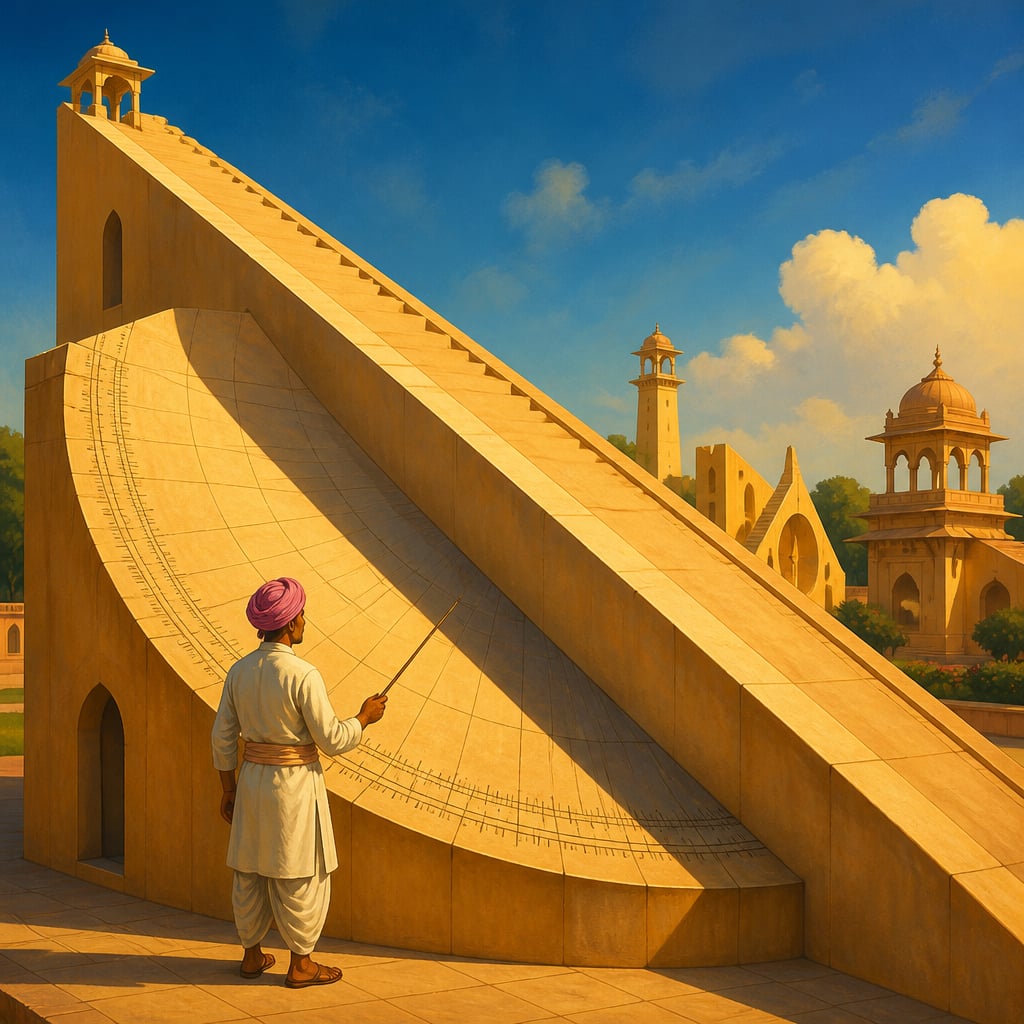
The Samrat Yantra sundial at Jantar Mantar Jaipur in morning light

The Problem of Precision

Astronomy without telescopes faces a fundamental challenge: how do you measure the position of a celestial object with sufficient accuracy? The Sun, Moon, and planets appear as small discs or points of light. Their positions must be determined against a background of stars, to fractions of a degree.

Indian astronomers achieved remarkable precision through a simple insight: bigger instruments mean better measurements. A shadow one degree off on a small sundial might miss the mark by a millimeter. On a sundial ten times larger, that same one-degree error produces a ten-millimeter shadow shift, easily detected. Scale became the solution to precision.

Early Instruments: The Foundation

The Shanku (Gnomon)
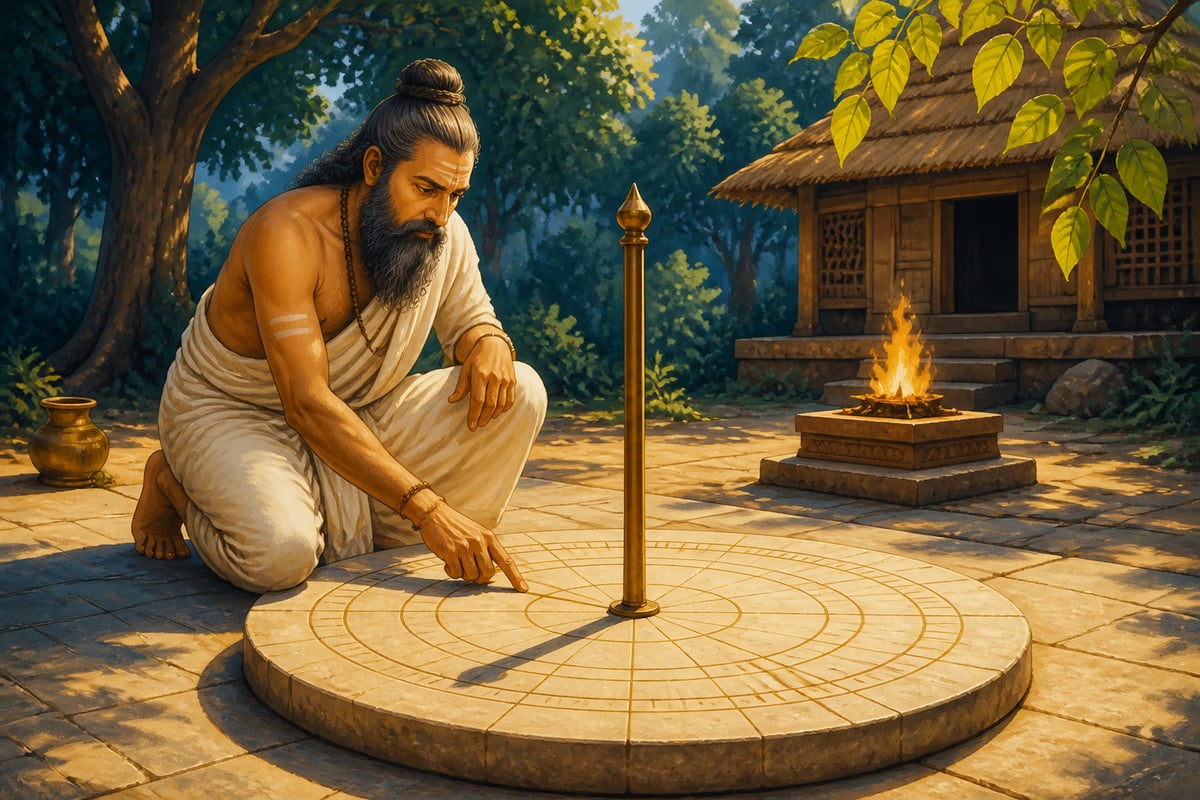
A rishi reading the shanku gnomon's noon shadow

The simplest astronomical instrument is also one of the oldest: a vertical stick casting a shadow on the ground. The Sanskrit term is shanku, and references to it appear in texts as early as the Shatapatha Brahmana (c. 800 BCE).

The shanku determines several crucial quantities:

Local noon: When the shadow is shortest, the Sun has reached its highest point. This moment is local noon.

Cardinal directions: At noon, the shadow points exactly north (in the Northern Hemisphere). By marking shadow positions throughout the day, east and west can be precisely established.

Latitude: At the equinoxes, the noon shadow angle equals the local latitude. Ancient Indian texts describe methods for determining latitude using the shanku.

Solstices and equinoxes: The shortest noon shadow occurs at summer solstice; the longest at winter solstice. When noon shadow length matches that of the equinox marks, you know the Sun is crossing the celestial equator.

The Surya Siddhanta provides detailed instructions for shanku use, including corrections for the Sun's apparent diameter and atmospheric refraction. This is not mere shadow-watching but systematic observational science.

The Chakra (Graduated Circle)

To measure angles precisely, astronomers developed graduated circles. A chakra is a metal or stone ring marked with degrees and subdivisions. By sighting along the ring and reading where a celestial body appears, its angular position could be determined.

The precision depends on the ring's diameter. A ring one meter across allows degree marks spaced about 9 millimeters apart. Subdivide to minutes of arc and you need marks 0.15 millimeters apart, near the limit of human craftsmanship. Large circles solve this problem by spreading the scale.

The Gola Yantra (Armillary Sphere)

The armillary sphere represents the celestial sphere in miniature. Nested rings represent the horizon, equator, ecliptic, meridian, and other reference circles. A sighting tube at the center allows pointing at celestial objects.

The gola yantra serves both as a teaching model (to visualize celestial geometry) and as a measuring instrument. Indian texts from the Surya Siddhanta onward describe its construction and use.

Varahamihira's Panchasiddhantika (6th century CE) describes armillary spheres clearly, suggesting they were well-established by that time. Whether they developed independently in India or arrived via Greek contact is debated, but their use in Indian astronomy is documented over many centuries.

The Jala Yantra (Water Clock)

Measuring time at night, when sundials fail, required different approaches. The jala yantra or ghati yantra used water flow for timekeeping. A vessel with a small hole at the bottom was floated in a larger basin. When full of water, it sank in approximately 24 minutes (one ghati, the traditional Indian time unit).

More sophisticated versions used multiple vessels and overflow mechanisms for continuous timekeeping. The Arthashastra (c. 300 BCE) describes elaborate water clock systems for palace timekeeping. Such clocks enabled night observations to be timestamped for later calculation.

The Dhi Yantra (Meridian Circle)

The meridian circle is mounted in the north-south plane and measures the altitude of celestial objects as they cross the meridian (their highest point). Since the meridian crossing is the moment of maximum altitude, and altitude at meridian directly relates to declination, this instrument efficiently determines celestial coordinates.

The Surya Siddhanta and later texts describe meridian instruments in detail. Their principle would later be exploited magnificently in Jai Singh's observatories.

The Islamic Contribution

Between the classical Sanskrit astronomical tradition and Jai Singh's observatories lies the crucial period of Islamic rule in India. Muslim astronomers brought their own instrumental tradition, rooted in Greek and Persian precedents.

The Astrolabe

The astrolabe arrived in India with Islamic contact, probably by the 11th century. This portable analog computer could determine time, locate celestial objects, and solve numerous spherical geometry problems.

Indian craftsmen became famous astrolabe makers. Lahore emerged as a center of astrolabe production, with families maintaining the craft for generations. The Lahore astrolabes are prized today for their precision and beauty.

The astrolabe's portability made it popular with travelers and navigators, while observatories used larger fixed instruments. Its mathematical principles were absorbed into the Indian astronomical tradition.

The Mural Quadrant

Large quadrants mounted on north-south walls enabled precise altitude measurements. The Samarkand observatory of Ulugh Beg (15th century) featured a famous sextant of enormous size. This tradition of monumental instruments influenced later Indian practice.

Jai Singh II: The Astronomer-King

Jai Singh II directing scholars at Jantar Mantar

Maharaja Sawai Jai Singh II of Amber (1688-1743) was no armchair patron. He was a practicing astronomer who corresponded with European scientists, collected astronomical treatises from around the world, and personally supervised observations.

Jai Singh faced a practical problem: the Islamic astronomical tables used for the Mughal court calendar had accumulated errors. Eclipses and planetary positions were being mispredicted. The emperor commanded him to correct the tables.

Jai Singh understood that better tables required better observations, and better observations required better instruments. He set out to build the most accurate astronomical instruments the world had ever seen.

The Innovation: Stone Monumentality

Jai Singh's key insight was to build instruments in stone at enormous scale. Previous instruments, whether Indian or Islamic, were typically made of metal or wood. The largest astrolabes and quadrants might reach a few meters across.

Jai Singh built in masonry. His primary sundial at Jaipur (the Samrat Yantra) stands 27 meters high, with a gnomon casting shadows across calibrated scales 45 meters in diameter. At this scale, time could be read to two-second accuracy.

The stone construction offered advantages beyond scale:

Stability: Metal instruments expand and contract with temperature. Stone is far more dimensionally stable.

Permanence: Metal corrodes and warps. Stone structures, properly maintained, last centuries.

Cost: Building in local stone was cheaper than importing large quantities of brass.

The Five Observatories

Between 1724 and 1734, Jai Singh built five observatories:

Delhi (1724): The first and experimental observatory, built while Jai Singh served at the Mughal court. It contains thirteen instruments.

Jaipur (1734): The largest and most elaborate, in Jai Singh's new capital city. Contains nineteen instruments, including the world's largest sundial.

Ujjain (1734): Built at the ancient prime meridian of Indian astronomy. Contains seven instruments.

Varanasi (1737): The smallest, with five instruments, built in the sacred city on the Ganges.

Mathura (1724): Later destroyed; no remains survive.

The Instruments of Jantar Mantar

Jai Singh designed or adapted numerous instruments. The major types:

Samrat Yantra (Supreme Instrument): A giant equatorial sundial. The triangular gnomon is aligned with Earth's axis. Quadrant scales on either side are parallel to the equatorial plane. This design allows the time to be read directly without complex calculations. The Jaipur Samrat Yantra, with its 27-meter gnomon, can measure time to two-second accuracy.

Jai Prakash Yantra (Jai's Instrument): A pair of hemispherical bowls set into the ground, representing the inverted celestial hemisphere. Crosswires span the bowls, casting shadows that directly indicate celestial coordinates. This original design allows the observer to stand inside the celestial sphere, reading coordinates of any object directly.

Ram Yantra (Ram's Instrument): Cylindrical buildings with calibrated walls and floor, for measuring altitude and azimuth of any celestial object. Two complementary structures allow continuous coverage.

Chakra Yantra (Circle Instrument): Graduated brass rings for measuring declination and hour angle. The Jaipur observatory has two chakras, representing the celestial equator.

Rashivalaya Yantra (Zodiac Instruments): Twelve instruments, one for each zodiac sign, allowing direct reading of celestial positions when the relevant sign is on the meridian.

Kapali Yantra (Hemisphere Instrument): Similar to the Jai Prakash but smaller, for teaching purposes.

Digamsha Yantra (Azimuth Instrument): Circular pillars with crosswires for measuring horizontal direction.

Shasthamsha Yantra (Sextant Instrument): A 60-degree arc in a darkened chamber. A pinhole allows a Sun image to fall on the arc, measuring solar altitude at noon.

Achieving Accuracy Without Telescopes

How accurate were these instruments? Jai Singh claimed accuracy of one arc-minute (1/60 of a degree) for his best instruments. Modern analysis suggests he achieved approximately two to three arc-minutes consistently, with occasional readings approaching one arc-minute.

For comparison:

Jai Singh's accuracy was comparable to the best pre-telescopic observations anywhere in the world. He achieved this through:

Scale: Large instruments spread small angular differences across large physical distances.

Multiple observations: Systematic repetition and averaging reduced random errors.

Cross-checking: The same quantity could be measured with different instruments; discrepancies revealed problems.

Calibration: Instruments were carefully aligned using astronomical observations themselves, not just surveying.

The Tragedy of Timing

Jai Singh's observatories represent a pinnacle of naked-eye astronomy. They also represent an end.

The telescope had been invented in 1608, over a century before Jai Singh began his major observatory at Jaipur. Jai Singh knew of telescopes. He obtained several from Europe and experimented with them.

Why did he persist with stone instruments?

The telescopes available to Jai Singh were small, optically imperfect, and difficult to mount for precise measurement. The crosshairs and micrometers that make telescopic measurement accurate were still being developed in Europe. Jai Singh calculated, perhaps correctly for his time, that his giant stone instruments could match or exceed telescopic accuracy.

But the calculation was time-dependent. By the mid-18th century, European telescopes had improved dramatically. By the late 18th century, the stone instruments were obsolete. Jai Singh had perfected a technology just as it was being superseded.

His observatories fell into disuse. Some were cannibalized for building stone. Only restoration efforts in the 19th and 20th centuries preserved what remains.

The Transition to Modernity

The story of Indian astronomical instruments does not end with Jai Singh's death in 1743. The transition to modern telescope-based astronomy was gradual:

Colonial observatories: The British established the Madras Observatory (1786) and later observatories in Colaba, Kodaikanal, and elsewhere. These used European telescopes and methods.

Traditional continuity: Panchanga makers continued using traditional calculation methods well into the 20th century. Some traditional astronomers viewed telescope observations as unnecessary for their purposes.

Modern revival: Independent India established world-class observatories (ARIES, IIA, GMRT) using cutting-edge technology. The Thirty Meter Telescope project represents India's continued contribution to astronomical instrumentation.

What Yantras Teach Us

The history of Indian astronomical instruments offers several insights:

Innovation within tradition: Jai Singh did not reject inherited methods; he extended them to unprecedented scale. The stone instruments embody principles known for centuries, realized with new boldness.

Cross-cultural synthesis: Indian astronomical instrumentation absorbed Greek armillary spheres, Islamic astrolabes, and eventually European telescopes. Each addition enriched rather than replaced the tradition.

The importance of timing: Jai Singh perfected naked-eye astronomy precisely when telescopes were making it obsolete. The greatest achievement of a paradigm often occurs just before paradigm shift.

Preservation matters: Without 19th and 20th-century restoration, the Jantar Mantar observatories might have vanished entirely. Living traditions require active maintenance.

Today, the five surviving Jantar Mantar observatories are UNESCO World Heritage Sites (Jaipur) and protected monuments. Tourists marvel at their strange forms without always understanding their purpose. But for those who know, they remain functional: the shadows still tell time, the scales still measure angles, the stones still teach the geometry of the sky.

The instruments have outlasted the tradition that created them. Yet in their endurance, they preserve the possibility that the tradition might someday be renewed.

Key figures

Maharaja Sawai Jai Singh II

Samrat Jagannatha

Varahamihira

Ulugh Beg

Case studies

Modern Astronomical Heritage Tourism at Jantar Mantar

The Jantar Mantar observatory in Jaipur receives over a million visitors annually and was designated a UNESCO World Heritage Site in 2010. Most visitors photograph the strange structures without understanding their function. How should such sites balance tourism, education, and scientific heritage?

Effective interpretation requires multiple levels: visual spectacle draws visitors, clear signage explains basic functions, guided tours demonstrate instruments in action (the sundials still work!), and deeper educational materials connect to both historical context and modern astronomy. Some observatories now host 'astronomy nights' where traditional instruments and modern telescopes are used side by side.

The knowledge demonstrated in this case study contributed to the broader legacy of Indian astronomy (Jyotisha), influencing developments across Asia and eventually the world.

Scientific heritage sites serve multiple purposes: preserving physical structures, transmitting knowledge, and inspiring future scientists. Successful preservation requires making ancient science accessible to modern audiences without oversimplification. Living continuity means keeping instruments functional, not just photogenic.

Science museums and heritage sites worldwide face the same challenge: making complex knowledge accessible without oversimplifying it. Interactive exhibits, augmented reality guides, and hands-on workshops are modern attempts to solve what Jantar Mantar's monumental instruments addressed through sheer physical scale.

Aryabhata's calculation of Earth's circumference (39,968 km) was within 0.3% of the actual value (40,075 km), achieved in 499 CE.

The Baghdad House of Wisdom and Indo-Islamic Astronomical Exchange

In the 8th-10th centuries, the Abbasid Caliphate's House of Wisdom in Baghdad translated Sanskrit astronomical texts into Arabic. Indian instruments like the armillary sphere mixed with Greek and Persian traditions. Centuries later, these synthesized traditions returned to India with Mughal rule. How did knowledge travel across civilizations?

The path of astronomical instruments traces a remarkable circuit: Indian texts to Baghdad, synthesis with Greek astronomy, development in Islamic observatories (Maragha, Samarkand), return to India under Mughal patronage, final synthesis in Jai Singh's observatories. Each stage added innovations: improved scales, new instrument designs, better calculation methods. Knowledge accumulates through transmission.

The knowledge demonstrated in this case study contributed to the broader legacy of Indian astronomy (Jyotisha), influencing developments across Asia and eventually the world.

Cross-cultural scientific synthesis produces achievements impossible within any single tradition. Jai Singh's observatories combined Indian theoretical foundations, Islamic instrument traditions, and awareness of European developments. The greatest scientific achievements often occur at cultural crossroads rather than in isolation.

Modern technology hubs like Silicon Valley, Shenzhen, and Bangalore thrive on cross-cultural synthesis. Engineers from India, China, Europe, and America collaborate daily, combining different technical traditions. Innovation accelerates when diverse knowledge systems interact rather than compete.

Aryabhata's calculation of Earth's circumference (39,968 km) was within 0.3% of the actual value (40,075 km), achieved in 499 CE.

From Stone Monuments to Radio Telescopes: India's GMRT

The Giant Metrewave Radio Telescope (GMRT) near Pune is one of the world's largest radio telescope arrays. Built in the 1990s under Govind Swarup's leadership, it uses innovative low-cost design to achieve world-class capability. How does modern Indian astronomy connect to its instrumental heritage?

Like Jai Singh's instruments, the GMRT achieved high performance through innovative design rather than simply spending more money. Both projects used local materials and expertise creatively. Both addressed specific scientific questions (correcting astronomical tables for Jai Singh; studying pulsars and the early universe for GMRT). The continuity lies in the approach: ambitious goals, creative engineering, systematic observation.

The knowledge demonstrated in this case study contributed to the broader legacy of Indian astronomy (Jyotisha), influencing developments across Asia and eventually the world.

Scientific inquiry persists across technological revolutions. The questions change (planetary positions to pulsar timing), the instruments transform (stone sundials to radio dishes), but the essential practice, making systematic observations to understand the cosmos, continues. Modern Indian astronomy inherits both the methods and the ambition of earlier traditions.

India's radio telescope GMRT and upcoming Square Kilometre Array contributions show that the observational astronomy tradition continues, now using radio waves instead of visible light. The questions have evolved, but the drive to observe, measure, and compute celestial phenomena remains unchanged across three millennia.

Aryabhata's calculation of Earth's circumference (39,968 km) was within 0.3% of the actual value (40,075 km), achieved in 499 CE.

Historical context

Classical through Early Modern Period

Reflection

More in Jyotiṣa: Astronomy That Mapped the Heavens

All lessons in Jyotiṣa: Astronomy That Mapped the Heavens · Bharatiya Vigyan: Inventions & Discoveries course