Nakṣatra: The 27-Star Coordinate System
Lunar mansions as celestial coordinates and calendar foundations
Explore the nakṣatra system of 27 lunar mansions, India's indigenous celestial coordinate system, and discover how Indian astronomers detected the precession of equinoxes in the 5th century CE.
Nakṣatra: The 27-Star Coordinate System
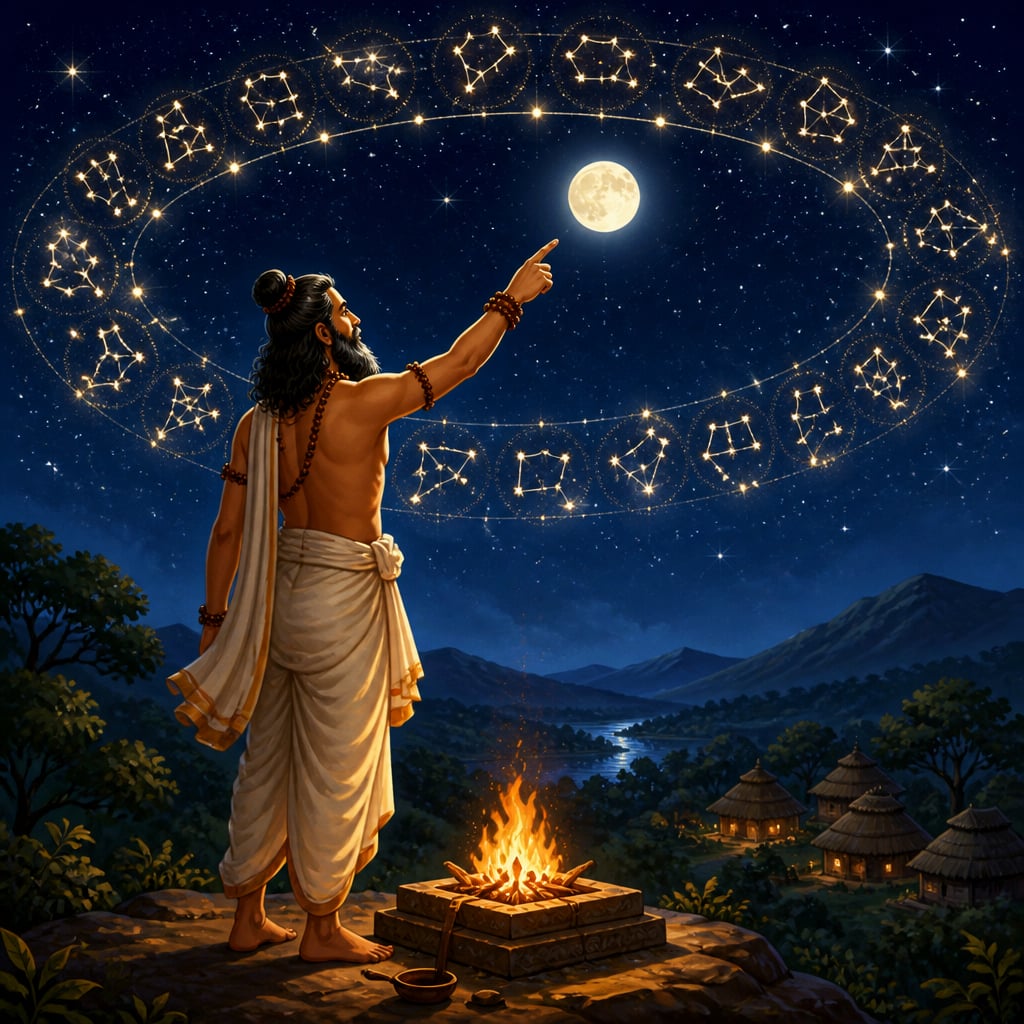
Look up at the night sky and you see chaos, thousands of stars scattered without apparent order. But ancient Indians saw something different: a cosmic map, divided into 27 segments called nakṣatras, each marking the Moon's nightly journey through the heavens.
The nakṣatra system is India's indigenous celestial coordinate system, older than the zodiac and intimately tied to the rhythms of the Moon. It remains in use today, determining festival dates, auspicious times, and personal horoscopes for over a billion people.
What Are Nakṣatras?
The Lunar Mansions
The Moon takes approximately 27.3 days to complete one orbit around Earth (relative to the stars). Ancient observers noticed that each night, the Moon appeared near a different star or star group. These 27 stopping points became the nakṣatras, literally "that which does not perish" or "star."
Each nakṣatra spans 13°20' of the celestial sphere (360° ÷ 27 = 13.33°). Together, they divide the entire sky into 27 equal segments, creating a coordinate system that tracks the Moon's position.
The 27 Nakṣatras
The nakṣatras begin with Aśvinī and proceed through the sky:
- Aśvinī (β Arietis) - The Horse-Headed Twins
- Bharaṇī (41 Arietis) - The Bearer
- Kṛttikā (Pleiades) - The Cutters
- Rohiṇī (Aldebaran) - The Red One
- Mṛgaśirā (λ Orionis) - The Deer's Head
- Ārdrā (Betelgeuse) - The Moist One
- Punarvasu (Pollux) - The Return of Light
- Puṣya (δ Cancri) - The Nourisher
- Āśleṣā (ε Hydrae) - The Embracer
- Maghā (Regulus) - The Great One
- Pūrva Phālgunī (δ Leonis) - The Former Red One
- Uttara Phālgunī (β Leonis) - The Latter Red One
- Hasta (δ Corvi) - The Hand
- Citrā (Spica) - The Bright One
- Svātī (Arcturus) - The Independent One
- Viśākhā (α Librae) - The Forked Branch
- Anurādhā (δ Scorpii) - Following Rādhā
- Jyeṣṭhā (Antares) - The Eldest
- Mūla (λ Scorpii) - The Root
- Pūrvāṣāḍhā (δ Sagittarii) - The Former Invincible
- Uttarāṣāḍhā (σ Sagittarii) - The Latter Invincible
- Śravaṇa (Altair) - The Ear
- Dhaniṣṭhā (β Delphini) - The Wealthy
- Śatabhiṣaj (λ Aquarii) - Hundred Physicians
- Pūrva Bhādrapadā (α Pegasi) - The Former Blessed Feet
- Uttara Bhādrapadā (γ Pegasi) - The Latter Blessed Feet
- Revatī (ζ Piscium) - The Wealthy
Some traditions include a 28th nakṣatra, Abhijit (Vega), used in special circumstances.
Origins and Antiquity
Vedic References
The nakṣatras appear in the oldest Indian texts. The Ṛgveda mentions several nakṣatras, and the Yajurveda and Atharvaveda contain complete lists. The Vedāṅga Jyotiṣa (c. 1400-1200 BCE), the earliest surviving Indian astronomical text, uses nakṣatras as its primary coordinate system.
The antiquity is significant: the nakṣatra system predates the 12-sign zodiac, which likely reached India from Babylon/Greece around the early centuries CE. The nakṣatras represent an indigenous Indian development in astronomical thinking.
Connection to the Moon
Why divide the sky into 27 parts? Because of the Moon.
The Moon's synodic period (new Moon to new Moon) is about 29.5 days, but its sidereal period (return to the same star position) is about 27.3 days. The nakṣatra system tracks the sidereal cycle, where the Moon is against the background stars, not its phase.
This focus on the sidereal position reflects the importance of the Moon in Indian timekeeping. The lunar month, divided into nakṣatras, became the foundation for Indian calendars.
The Nakṣatra as Coordinate System
How It Works
To specify a celestial position using nakṣatras, you identify which nakṣatra the object is in and how far through that nakṣatra it has traveled.
For example: "The Moon is in Rohiṇī, 7 degrees" means the Moon is 7° into the fourth nakṣatra, corresponding to approximately 47° from the starting point.
This system allows precise position specification without requiring numbered degrees, useful in oral traditions where complex numbers are harder to memorize and transmit.
Comparison with the Zodiac
The 12-sign zodiac divides the sky into 30° segments (360° ÷ 12 = 30°). Each zodiac sign (rāśi) contains 2¼ nakṣatras (30° ÷ 13.33° = 2.25).
Indian astronomers used both systems:
- Nakṣatras for lunar position and traditional timekeeping
- Rāśis (zodiac signs) for planetary positions and horoscopy
The two systems coexist in Indian astronomy and astrology, serving complementary purposes.
Detecting Precession
The Wobbling Earth
Earth's axis slowly wobbles like a spinning top, completing one cycle in about 26,000 years. This wobble, called precession of the equinoxes, causes the position of the vernal equinox (where the Sun crosses the celestial equator in spring) to slowly shift against the background stars.
The consequence: the stars that mark the beginning of spring today are different from those that marked it 2,000 years ago. The zodiac signs, which were originally aligned with constellations, have drifted, Aries is no longer in the constellation Aries.
Indian Discovery of Precession

Indian astronomers detected precession by the 5th century CE. The evidence is clear: different texts give different starting points for the nakṣatras, reflecting the shift that had occurred between their composition dates.
The Sūryasiddhānta includes a value for the rate of precession: approximately 54" (arc-seconds) per year. The modern value is about 50.3" per year, an error of about 7%, but a remarkable detection of a very subtle phenomenon.
Ayanāṃśa: The Correction Factor
To account for precession, Indian astronomers developed the concept of ayanāṃśa, the accumulated precession since some reference epoch.
The ayanāṃśa allows conversion between:
- Sāyana (tropical) positions: measured from the moving vernal equinox
- Nirāyana (sidereal) positions: measured from a fixed star reference
Indian astronomy traditionally uses nirāyana (sidereal) positions, which is why Hindu astrology uses a different zodiac alignment than Western astrology. The difference, currently about 24°, is precisely the ayanāṃśa.
Calendar Applications
The Lunar Month
The nakṣatras name the lunar months. A month is named after the nakṣatra in which the full Moon occurs:
- Caitra (full Moon in Citrā)
- Vaiśākha (full Moon in Viśākhā)
- Jyeṣṭha (full Moon in Jyeṣṭhā)
- Āṣāḍha (full Moon in Āṣāḍhā)
- Śrāvaṇa (full Moon in Śravaṇa)
- Bhādrapada (full Moon in Bhādrapadā)
- Āśvina (full Moon in Aśvinī)
- Kārttika (full Moon in Kṛttikā)
- Mārgaśīrṣa (full Moon in Mṛgaśirā)
- Pauṣa (full Moon in Puṣya)
- Māgha (full Moon in Maghā)
- Phālguna (full Moon in Phālgunī)
This naming convention directly links the calendar to celestial observation.
Festival Timing
Many Hindu festivals are defined by nakṣatras:
- Janmāṣṭamī (Krishna's birthday): 8th tithi of Bhādrapada when Moon is in Rohiṇī
- Mahāśivarātri: 14th tithi of Māgha/Phālguna
- Kārttik Pūrṇimā: Full Moon in Kṛttikā
- Śravaṇa Pūrṇimā (Rakṣā Bandhan): Full Moon in Śravaṇa
The nakṣatra system ensures these festivals occur when the Moon is in the cosmologically appropriate position, connecting ritual time to celestial time.
Birth Nakṣatra

In Indian tradition, a person's birth nakṣatra, the nakṣatra the Moon was in at the moment of birth, is fundamental to their identity. It determines:
- The first letter of their name (each nakṣatra has associated syllables)
- Compatible nakṣatras for marriage
- Astrological characteristics and predictions
- Appropriate rituals throughout life
This makes the nakṣatra system personally relevant to nearly every Hindu, connecting individual identity to cosmic position.
Cross-Cultural Connections
The Chinese Xiù System
China developed a similar system of 28 lunar mansions (xiù), also based on the Moon's nightly position. The similarity has led to scholarly debate:
- Independent invention? Both cultures observed the same Moon.
- Diffusion from India to China, or vice versa?
- Common origin from an earlier culture?
The systems differ in details (27 vs. 28 divisions, different star identifications), suggesting they developed independently while responding to the same astronomical reality.
Arabic Manāzil
The Arabic tradition also has 28 lunar mansions (manāzil al-qamar). There's evidence of Indian influence on Arabic astronomy through translations in Baghdad (8th-10th centuries), but the Arabic system also shows indigenous Arabian elements.
The Mazzaroth Question
The Hebrew Bible mentions "mazzaroth" (Job 38:32), which some scholars interpret as lunar mansions. If so, this suggests the concept was widespread in ancient West Asia, possibly predating the zodiac.
Living Tradition
Daily Pañcāṅga
Every Hindu pañcāṅga (almanac) lists the day's nakṣatra. Traditional families check the nakṣatra before important activities:
- Starting a new business
- Beginning a journey
- Scheduling a wedding
- Naming a child
This makes the nakṣatra system one of the most continuously used astronomical frameworks in the world.
Nakṣatra Worship
Each nakṣatra has an associated deity and ritual observances. Prayers to one's birth nakṣatra deity are common. Temples dedicated to the nakṣatra deities exist throughout India.
Modern Astronomy Connections
While modern astronomy uses different coordinate systems (right ascension and declination), the nakṣatras remain useful for identifying star positions. Amateur astronomers in India often learn star positions through the nakṣatra framework before learning Western designations.
The nakṣatras also provide a framework for archaeological astronomy, dating ancient texts by identifying which stars are described as marking equinoxes or other significant points.
What Nakṣatras Teach Us
The nakṣatra system offers several insights:
Indigenous innovation: The nakṣatras represent original Indian astronomical thinking, developed before significant Greek or Babylonian influence. They show that astronomical systems can develop independently in response to universal phenomena (the Moon's motion).
Lunar focus: While Western astronomy became increasingly solar-focused, Indian astronomy maintained strong attention to the Moon. The nakṣatras reflect this lunar emphasis, which connects to the importance of the Moon in Indian calendar, agriculture, and ritual.
Continuity with adaptation: The nakṣatra system is over 3,000 years old yet remains in daily use. It has accommodated the zodiac, incorporated precession corrections, and coexisted with modern astronomy. Living traditions can be both ancient and adaptable.
Personal connection to cosmos: Through birth nakṣatras, individuals are connected to specific celestial positions. This creates a personal relationship with the night sky that modern urban life has largely lost.
The next time you see the Moon, consider: which nakṣatra is it visiting tonight? For millennia, that question has connected Indians to the cosmic dance of Earth's nearest neighbor through the eternal pattern of the stars.
Key figures
Lagadha
Sūrya (as divine revealer)
Hipparchus (comparative figure)
Case studies
Dating the Vedas Through Nakṣatras
The Vedāṅga Jyotiṣa states that the winter solstice occurred when the Sun was at the beginning of Śravaṇa nakṣatra. Today, the winter solstice occurs in Mūla nakṣatra. Can we use this difference to date the text?
Due to precession, the winter solstice point moves about 1° every 72 years. The shift from Śravaṇa to Mūla is about 30-40°, suggesting roughly 2,000-3,000 years have passed. This is consistent with traditional dating of the Vedāṅga Jyotiṣa to 1400-1200 BCE.
The knowledge demonstrated in this case study contributed to the broader legacy of Indian astronomy (Jyotisha), influencing developments across Asia and eventually the world.
Astronomical references in ancient texts can serve as clocks, allowing us to estimate when they were composed. This technique, called archaeoastronomy, connects celestial science to historical scholarship.
Archaeoastronomy is now a recognized academic discipline used worldwide. Researchers date Stonehenge alignments, Egyptian temple orientations, and Mayan calendar references using the same principle: astronomical references in ancient records serve as timestamps that can be independently verified.
72 years - referenced in the context of Dating the Vedas Through Nakṣatras.
The Tropical vs. Sidereal Debate in Astrology
Western astrology uses the tropical zodiac (aligned with seasons), while Indian astrology uses the sidereal zodiac (aligned with stars). A person's 'Sun sign' differs between the two systems by about one sign. Which is 'correct'?
This isn't a question of correctness but of purpose. The tropical system tracks the Sun's relationship to Earth's seasons - useful for agricultural and seasonal timing. The sidereal system tracks the Sun's position against fixed stars - useful for astronomical precision and connecting to specific celestial positions. Each serves different purposes.
The knowledge demonstrated in this case study contributed to the broader legacy of Indian astronomy (Jyotisha), influencing developments across Asia and eventually the world.
Different coordinate systems aren't competitors but tools for different purposes. The persistence of both systems shows that astronomical frameworks serve cultural and practical needs beyond pure measurement.
Multiple coordinate systems coexist productively in modern technology too. Web developers use latitude/longitude, UTM zones, and local grid systems depending on the task. No single system is 'correct.' Each optimizes for different use cases, just as tropical and sidereal zodiacs serve different purposes.
Aryabhata's calculation of Earth's circumference (39,968 km) was within 0.3% of the actual value (40,075 km), achieved in 499 CE.
Birth Nakṣatra and Identity
In many Hindu families, a child's first name is chosen based on their birth nakṣatra - the nakṣatra the Moon was in at birth. Each nakṣatra has associated syllables. Why does this practice persist in an age of scientific astronomy?
The practice serves multiple functions beyond astronomy: it creates a personal connection to the cosmos, provides cultural continuity, and gives meaning to the moment of birth. The nakṣatra becomes part of identity, connecting the individual to a cosmic pattern. Whether or not one believes in astrological influence, the practice creates meaningful connection.
The knowledge demonstrated in this case study contributed to the broader legacy of Indian astronomy (Jyotisha), influencing developments across Asia and eventually the world.
Astronomical frameworks can serve identity and meaning-making functions beyond their scientific utility. The endurance of birth nakṣatras shows how astronomy interweaves with culture, ritual, and personal identity.
Modern naming traditions similarly blend practical and cultural functions. Parents choose names based on family heritage, religious significance, or cultural identity. The birth nakshatra system persists because it serves a meaning-making function that purely secular naming conventions do not address.
Aryabhata's calculation of Earth's circumference (39,968 km) was within 0.3% of the actual value (40,075 km), achieved in 499 CE.
Historical context
Vedic Period through Classical Period
Reflection
- The nakṣatra system connects individuals to the cosmos through their birth star. In modern urban life, most people never see the night sky clearly. What is lost when this connection to the stars disappears?
- Western and Indian astrology use different zodiacs (tropical vs. sidereal), giving different 'signs' for the same person. What does this tell us about the nature of astrological systems?
- The nakṣatras are over 3,000 years old and still determine festival dates and personal names. What allows some cultural systems to persist for millennia while others disappear?