Pancanga: The Living Astronomical Tradition

Traditional almanac calculations as a bridge between ancient science and living practice

Explore how pancanga (almanac) calculations are still computed traditionally for festival timing, the astronomical precision involved, and how this connects ancient science to living practice across centuries.

Pancanga: The Living Astronomical Tradition

Every year, as Diwali approaches, a question echoes across India: "What is the exact time of Lakshmi Puja this year?" The answer comes not from modern astronomers at ISRO or IIT, but from traditional pancanga makers who compute the auspicious moment using methods that trace directly back to the Suryasiddhanta and Aryabhatiya, texts composed over 1,500 years ago.

The pancanga is India's living astronomical tradition, a continuous thread connecting ancient mathematical astronomy to the daily lives of over a billion people. It is perhaps the world's longest-running applied astronomical system, computed traditionally even in an age of satellites and supercomputers.
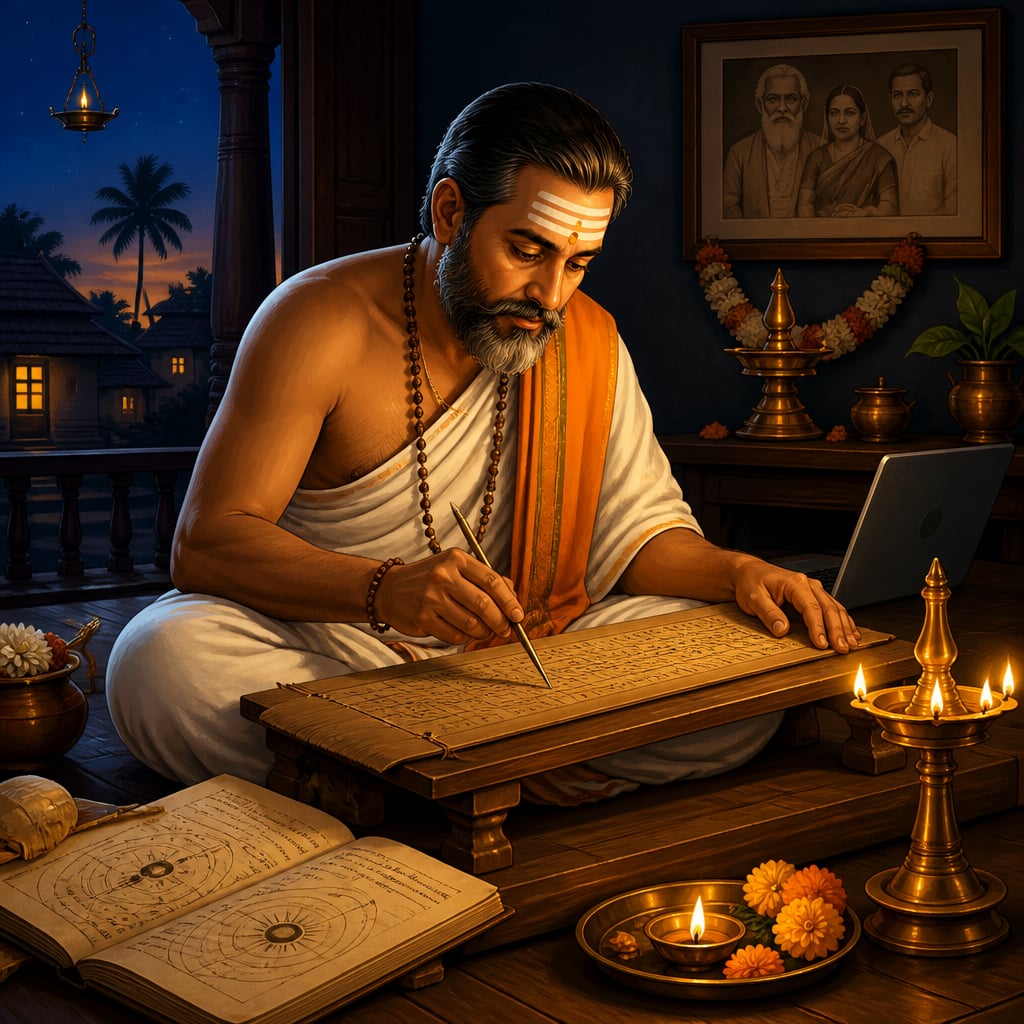
Daivajna calculating Diwali Lakshmi Puja muhurta on a palm-leaf almanac at dusk

What Is a Pancanga?

The Five Limbs of Time

The word pancanga literally means "five limbs" (panca = five, anga = limb), referring to the five elements that define any moment in traditional Indian timekeeping:

  1. Tithi (Lunar Day): The phase of the Moon, measured as one-thirtieth of the synodic month. There are 30 tithis in a lunar month, each lasting approximately 19-26 hours (variable, as the Moon's speed changes).

  2. Nakshatra (Lunar Mansion): Which of the 27 nakshatras the Moon occupies at a given moment, dividing the zodiac into 13-degree-20-minute segments.

  3. Yoga (Luni-Solar Combination): Calculated from the sum of the longitudes of the Sun and Moon, there are 27 yogas, each considered to have particular qualities.

  4. Karana (Half-Tithi): Half of a tithi, there are 11 karanas that repeat in a fixed pattern, used for determining auspicious activities.

  5. Vara (Weekday): The seven-day week, named after celestial bodies (Ravi-vara for Sunday, Soma-vara for Monday, etc.).

Every moment is uniquely specified by these five coordinates. A pancanga provides all five for each day, enabling users to identify auspicious and inauspicious times for various activities.

Beyond Simple Almanacs

While a pancanga functions as an almanac, it is far more sophisticated than Western calendars. It integrates multiple astronomical cycles, solar, lunar, sidereal, into a unified system. Computing a pancanga requires:

This is not simple arithmetic; it requires mastery of spherical astronomy, trigonometry, and continuous calculation traditions passed from guru to student.

The Precision of Traditional Calculations

How Accurate Are They?

The astronomical precision of traditional pancanga calculations is remarkable. Modern tests comparing traditional calculations with NASA ephemerides show:

This precision is not accidental. It results from over two millennia of continuous refinement, with each generation of astronomers correcting small errors and improving parameters.

The Mathematics Behind Pancanga

Traditional pancanga calculation involves:

Mean positions: First, the mean (average) positions of the Sun and Moon are calculated using linear rates from epoch values. The Suryasiddhanta, for example, gives the Moon's mean daily motion as approximately 13.18 degrees.

True positions: Corrections are applied for the elliptical orbits (called manda-samskara) and for gravitational perturbations (sighra-samskara). These corrections use sine functions (jya) computed from tables or formulas.

Local adjustments: The deshantara (longitude correction) adjusts for the observer's location relative to the standard meridian (traditionally Ujjain or Lanka).

Precession correction: The ayanamsa accounts for the slow wobble of Earth's axis, keeping the sidereal zodiac aligned with actual star positions.

All this is traditionally done by hand, using palm-leaf manuscripts, mental arithmetic, and calculation aids, a remarkable feat of computational astronomy.

The Chain of Transmission

From Aryabhata to Today

The pancanga tradition represents an unbroken chain of knowledge transmission spanning over 1,500 years:

Classical foundations (400-600 CE): Aryabhata, Brahmagupta, and the composers of the Suryasiddhanta established the mathematical framework. Their sine tables, mean motion parameters, and correction formulas became the foundation.

Regional schools (600-1200 CE): Different regions developed their own traditions, the Kerala school, the Ujjain school, the Karnataka school. Each refined calculations for local conditions and developed distinct computational traditions.

Medieval consolidation (1200-1700 CE): Scholars like Madhava of Sangamagrama (Kerala) achieved remarkable precision, developing infinite series for trigonometric functions centuries before Leibniz and Newton. Their work improved pancanga accuracy significantly.

Colonial challenge (1700-1947): British rule brought conflict between traditional and Western astronomical methods. Some pundits began incorporating modern corrections; others maintained strict traditional methods. The debate continues today.

Modern continuity (1947-present): Despite scientific education and modern technology, traditional pancanga making continues. Major publications like the Rashtriya Panchang (Government of India) and regional pancangas serve millions.

The Guru-Shishya Tradition

A grandfather teaching pancanga calculation in Varanasi

Pancanga knowledge has traditionally passed through guru-shishya (teacher-student) lineages. A student would spend years with a master, learning:

Many of these lineages continue today. In Kerala, Tamil Nadu, Karnataka, and Andhra Pradesh, traditional siddhantic astronomers (called daivajnas, ganakis, or siddhantis) maintain family traditions spanning generations.

Festival Timing: Where Science Meets Practice

Why Traditional Calculations Matter

The timing of Hindu festivals depends on pancanga calculations. Consider:

A family at the Diwali Lakshmi Puja muhurta

Diwali (Deepavali): Falls on the new Moon (amavasya) of Kartika month. But which moment? Traditional pancanga specifies the exact tithi timing, often to the minute.

Makar Sankranti: When the Sun enters Capricorn (Makara rashi). Due to precession, this now falls around January 14, not the winter solstice. The date is determined by sidereal (nirayana) calculation.

Ekadashi fasting: The 11th tithi is observed for fasting, but which 11th tithi? If the tithi changes during certain hours, the fast may be observed on a different day. Pancanga calculation determines this.

Eclipse observances: Traditional practices during eclipses depend on precise timing. Pancanga provides the contact times, maximum phase, and release times for any location.

For devout practitioners, these are not arbitrary, they connect ritual action to cosmic cycles. A puja performed at the wrong moment is like missing a celestial appointment.

Regional Variations and Debates

India has multiple pancanga traditions that sometimes give different dates for festivals:

These differences are not errors but reflect legitimate variations in computational traditions. When North and South India celebrate a festival on different days, both are following valid astronomical traditions.

The Living Science: Modern Practitioners

Traditional Scholars Today

Remarkable individuals continue the pancanga tradition:

Siddhantic astronomers in Kerala maintain the traditions of the Kerala school, famous for mathematical innovations. Some compute pancangas entirely by hand, following methods in 15th-century manuscripts.

The Tirumala Tirupati Devasthanams maintains traditional astronomers who compute temple pancangas for the world's wealthiest temple. Festival timings at Tirumala follow their calculations.

Family traditions in Varanasi where brahmin families have computed pancangas for centuries. The knowledge passes father to son, maintaining unbroken lineages.

Traditional Meets Modern

The interaction between traditional and modern astronomy is fascinating:

Government of India's Rashtriya Panchang: Published by the India Meteorological Department, it provides authoritative pancanga information using both traditional siddhantic and modern astronomical methods.

Computer-aided traditional calculation: Some traditional astronomers now use computers to speed computation while maintaining siddhantic algorithms. The method is traditional; only the computational tool is modern.

Accuracy verification: Traditional calculations can now be compared with space-age precision. The agreement validates centuries of refinement; the occasional disagreement helps identify needed corrections.

What Makes Pancanga a Living Tradition?

Continuous Practical Application

Unlike ancient Greek or Babylonian astronomy, which survive only in historical texts, Indian siddhantic astronomy remains in active use. Every day, millions of Indians consult pancangas for:

This practical application drives continuous refinement. Errors become apparent and get corrected. The tradition evolves while maintaining its core identity.

Integration of Multiple Knowledge Systems

The pancanga integrates several knowledge domains:

This integration makes the pancanga a comprehensive system rather than merely a calendar.

Adaptation Without Abandonment

The pancanga tradition shows remarkable adaptability:

Yet through all these changes, the fundamental structure, the five limbs, the siddhantic framework, the ritual applications, has remained continuous for over 1,500 years.

The Relevance of Traditional Astronomical Knowledge

Scientific Value

Traditional pancanga calculations have genuine scientific value:

Historical astronomy: Pancanga parameters encode observations from different periods. Changes in these parameters can reveal historical astronomical events.

Computational methods: The Kerala school's infinite series for sine and cosine anticipate modern mathematical techniques. These methods deserve study for their mathematical elegance.

Error correction: Traditional and modern calculations, when compared, can reveal errors in both. The dialogue improves both systems.

Cultural Value

Beyond science, the pancanga preserves:

Lessons for Modern Science

The pancanga tradition offers lessons:

Continuity with improvement: Science can maintain traditions while refining them. One need not abandon frameworks that work merely because newer alternatives exist.

Practical grounding: A knowledge system that serves practical needs (timing festivals, agriculture) sustains itself better than purely theoretical knowledge.

Holistic integration: Combining astronomical, ritual, and practical knowledge in one system created resilience the specialized modern sciences may lack.

Conclusion: The Bridge That Spans Millennia

As this chapter on Jyotisa concludes, we return to where we began, the question of living continuity.

When a pancanga maker in Kerala today calculates the exact moment of new Moon, he uses mathematical methods developed by Aryabhata and refined by Madhava. When a family in Varanasi consults the pancanga for an auspicious wedding date, they connect to astronomical traditions older than any surviving Western scientific institution.

The pancanga is not a museum piece or historical curiosity. It is a living bridge, spanning fifteen centuries, connecting the mathematical astronomy of classical India to the daily practices of modern Indians. It demonstrates that ancient science need not be abandoned for modern science to flourish, both can coexist, inform each other, and serve complementary purposes.

In an age when scientific knowledge often seems disconnected from daily life, the pancanga reminds us that science, properly integrated, can be a thread woven through the fabric of human existence, marking time, connecting generations, and bridging heaven and earth.

The stars that Aryabhata observed still shine. The Moon that the authors of the Suryasiddhanta tracked still waxes and wanes. And the calculations they developed still tell us when to gather, celebrate, and mark the passages of life, a living testament to the enduring value of carefully observed, precisely computed, continuously transmitted knowledge.

Key figures

Madhava of Sangamagrama

Kero Lakshman Chhatre

Traditional Pancanga Families

The Rashtriya Panchang Committee

Case studies

The Diwali Date Controversy of 2017

In 2017, different pancanga traditions gave different dates for Diwali - October 18 or October 19. North India largely celebrated on October 19, while some South Indian communities observed October 18. Media reported a 'calendar crisis.' Why did this happen, and who was 'correct'?

The difference arose from how different traditions handle the boundary case when amavasya (new Moon) tithi spans two days. Traditions using different muhurta calculations for Lakshmi Puja timing arrived at different conclusions. Both were mathematically valid within their respective systems. The 'crisis' reflected not error but legitimate variation in living traditions.

The knowledge demonstrated in this case study contributed to the broader legacy of Indian astronomy (Jyotisha), influencing developments across Asia and eventually the world.

Diversity in tradition is not always error. Multiple valid approaches can coexist. The pancanga tradition has always accommodated regional variations while maintaining underlying astronomical accuracy.

Regional variation in technical standards exists in modern systems too. Date formats (DD/MM/YYYY vs MM/DD/YYYY), measurement systems (metric vs imperial), and even electrical outlet standards vary by region. The key insight is that variation does not imply error when different communities optimize for different local conditions.

Aryabhata's calculation of Earth's circumference (39,968 km) was within 0.3% of the actual value (40,075 km), achieved in 499 CE.

Kerala School Calculations Meet NASA

A researcher compared eclipse predictions from traditional Kerala pancanga calculations with NASA's sophisticated computer models. The traditional methods, using algorithms over 500 years old, predicted eclipse contact times within 5-10 minutes of NASA's values. How is such accuracy possible without modern technology?

The Kerala school's precision came from three factors: (1) Centuries of observational refinement that corrected parameters over generations, (2) Sophisticated mathematical techniques including infinite series developed by Madhava, (3) Continuous practical testing - when predictions failed, methods were improved. The tradition was empirical at its core.

The knowledge demonstrated in this case study contributed to the broader legacy of Indian astronomy (Jyotisha), influencing developments across Asia and eventually the world.

Traditional knowledge can achieve remarkable precision through accumulated refinement. The contrast between 'ancient' and 'modern' is often overstated. Knowledge systems that maintain practical testing can self-correct over time.

Traditional weather prediction methods in farming communities sometimes match or complement satellite-based forecasts for local conditions. Knowledge systems maintained through empirical testing over generations can achieve surprising accuracy, even without modern instrumentation.

500 years - referenced in the context of Kerala School Calculations Meet NASA.

The Digital Daivajnas: Tradition Meets Technology

A traditional pancanga maker in South India now uses a computer program to perform calculations, but the program implements siddhantic algorithms rather than modern ephemerides. Is this still 'traditional' astronomy? He argues yes; some critics say he has abandoned the tradition. How should we understand this?

The scholar maintains that the computational method (the algorithm) is the tradition, not the computational tool (paper or computer). His grandfather used calculation aids (palm-leaf tables); he uses silicon chips. The mathematical operations are identical. However, critics argue that the embodied practice of hand calculation carries knowledge that computer use loses.

The knowledge demonstrated in this case study contributed to the broader legacy of Indian astronomy (Jyotisha), influencing developments across Asia and eventually the world.

Tradition is not frozen in time; it adapts while maintaining core identity. The debate about what is 'essential' to a tradition and what is 'accidental' is ongoing. Different practitioners may legitimately draw the line differently.

The debate about 'traditional vs modern' tools plays out in every industry. Photographers argue about film versus digital. Musicians debate analog versus digital recording. The Panchanga maker using a computer for Siddhantic algorithms shows that the real question is not the tool but the knowledge system driving it.

Aryabhata's calculation of Earth's circumference (39,968 km) was within 0.3% of the actual value (40,075 km), achieved in 499 CE.

Historical context

Continuous from Classical Period to Present

Reflection

More in Jyotiṣa: Astronomy That Mapped the Heavens

All lessons in Jyotiṣa: Astronomy That Mapped the Heavens · Bharatiya Vigyan: Inventions & Discoveries course