Siddhānta: Astronomical Schools and Texts
The five schools documented by Varāhamihira and their cross-cultural synthesis
Explore the five astronomical schools (siddhāntas) documented in Varāhamihira's Pañcasiddhāntikā, understand Greek influences through the Romaka and Pauliśa Siddhāntas, and discover how Indian astronomy achieved its distinctive synthesis of indigenous and foreign knowledge.
Siddhānta: Astronomical Schools and Texts
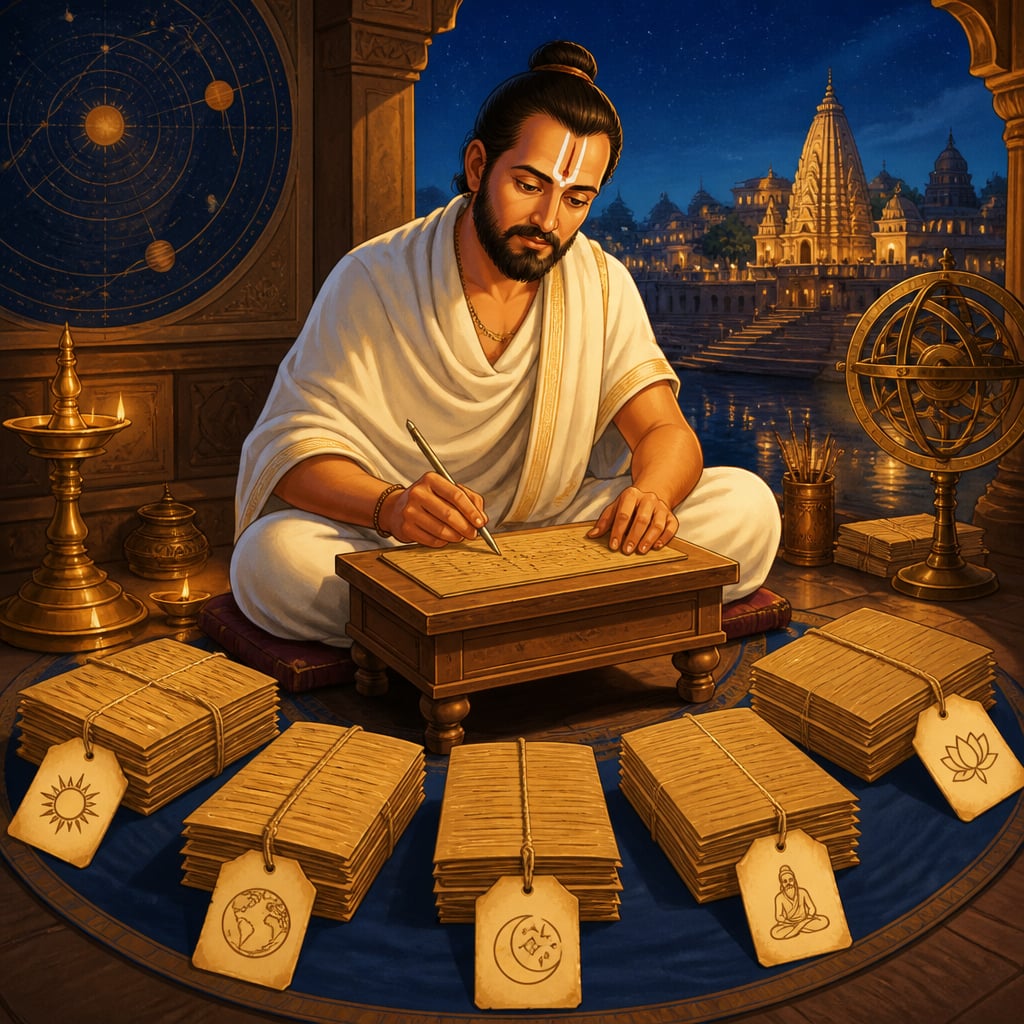
In 505 CE, a remarkable astronomer named Varāhamihira undertook an extraordinary intellectual project: he documented and compared five different astronomical systems that were circulating in India. His work, the Pañcasiddhāntikā ("The Five Astronomical Canons"), reveals something profound about Indian astronomy, it was never a single, monolithic tradition but a dynamic field where multiple schools competed, collaborated, and synthesized ideas from across the ancient world.
This is the story of the siddhāntas, the astronomical treatises that formed the backbone of Indian celestial science, and the cross-cultural exchange that shaped them.
What is a Siddhānta?
The word siddhānta means "established conclusion" or "demonstrated doctrine." In astronomy, a siddhānta is a comprehensive treatise that provides:
- Theoretical foundations: Cosmological models explaining the structure of the universe
- Computational methods: Algorithms for calculating planetary positions
- Astronomical constants: Values for planetary periods, distances, and other parameters
- Practical applications: Methods for preparing calendars, predicting eclipses, and casting horoscopes
A siddhānta was not merely a textbook but a complete working system. An astronomer trained in one siddhānta could calculate any celestial phenomenon, past, present, or future, using its methods and parameters.
Varāhamihira and the Pañcasiddhāntikā
Varāhamihira (505-587 CE) was born in Kapitthaka (modern Kayatha near Ujjain) into a family of astronomers. His father Ādityadāsa was himself an astronomer who had studied the Sūryasiddhānta. Varāhamihira became the most celebrated astronomer-astrologer of his era, serving at the court of King Yaśodharman and later becoming part of the "Nine Gems" (Navaratna) at the court of Vikramāditya (possibly Chandragupta II).
His Pañcasiddhāntikā is a comparative analysis of five astronomical systems:
1. Sūryasiddhānta (The Sun Treatise)
The most influential and enduring of the siddhāntas. According to tradition, it was revealed by the Sun god (Sūrya) to the asura Maya at the end of the Satya Yuga. While this is mythological, the text itself contains sophisticated astronomical content dating from around 400 CE (though incorporating older material).
Varāhamihira considered the Sūryasiddhānta the most accurate of the five for practical calculations. Its values for planetary periods, eclipse calculations, and other parameters remained in use for over 1,500 years. Modern pañcāṅgas (almanacs) still use Sūryasiddhānta-derived methods.
Key features:
- Sidereal year: 365.2587565 days
- Sophisticated eclipse calculation methods
- Complete planetary models for all visible planets
- Trigonometric tables with remarkable accuracy
2. Romaka Siddhānta (The Roman Treatise)
The name "Romaka" derives from Roma, Rome, indicating clear Western origins. This siddhānta transmitted Greek astronomical knowledge, likely derived from Ptolemaic astronomy, to India through trade routes connecting the Roman Empire with the subcontinent.
The Romaka Siddhānta is particularly important as evidence of astronomical exchange between the Mediterranean world and India. Its parameters differ from purely indigenous calculations, showing characteristic Greek values.
Key features:
- Uses a 19-year Metonic cycle (Greek in origin)
- Tropical year value closer to Greek calculations
- Evidence of Ptolemaic influence in planetary models
- Demonstrates that Indian astronomers were aware of Western methods
3. Pauliśa Siddhānta (Paul's Treatise)
The name "Pauliśa" likely derives from a Greek name, possibly Paulus of Alexandria (4th century CE), though this identification remains debated. Like the Romaka, it shows Greek influence but with different parameters.
Some scholars have suggested the name derives from Pulisa (a Sanskritization of a Greek name), possibly referring to a Greek astronomer whose works reached India through Alexandria.
Key features:
- Sidereal calculation methods
- Some parameters intermediate between Greek and Indian values
- Shows adaptation of Greek models to Indian frameworks
- Particularly valued for certain eclipse calculations
4. Vasiṣṭha Siddhānta (Sage Vasiṣṭha's Treatise)
Attributed to the legendary sage Vasiṣṭha, this siddhānta represents an older, more indigenous tradition. Its parameters and methods show less Greek influence than the Romaka or Pauliśa.
Varāhamihira considered this siddhānta less accurate than the Sūryasiddhānta but important as representing an ancient tradition.
Key features:
- Older computational methods
- Less sophisticated planetary models
- Represents pre-Greek-contact Indian astronomy
- Important for understanding the development of Indian astronomical thought
5. Paitāmaha Siddhānta (Grandfather's Treatise)
Attributed to Brahmā (the Grandfather of creation), this represents the oldest stratum of siddhānta astronomy. Its methods are simpler and less accurate than the later siddhāntas, suggesting it preserves an early stage of Indian astronomical development.
The Paitāmaha Siddhānta is closely related to the astronomical content of the Viṣṇudharmottara Purāṇa and represents astronomy embedded in religious cosmology.
Key features:
- Simplest computational methods
- Cosmological focus
- Represents early astronomical thinking
- Important for historical study of Indian astronomy's development
What Was Indigenous? What Was Adapted?
The Pañcasiddhāntikā reveals that Indian astronomy was neither purely indigenous nor simply borrowed. It was a creative synthesis.
Indigenous Elements
Several features of Indian astronomy developed independently:
The Nakṣatra System: The 27 (or 28) lunar mansions predate any Greek contact. They appear in Vedic texts from the second millennium BCE and represent India's original celestial coordinate system.
Large Time Cycles: The yuga and kalpa systems, measuring time in millions and billions of years, are distinctively Indian. Greek and Babylonian astronomy used much smaller cycles.
Decimal Place-Value Numerals: The number system that made complex calculations practical was an Indian innovation. Its transmission to the Islamic world and then Europe revolutionized mathematical astronomy globally.
Trigonometric Methods: While Greeks used chord functions, Indian mathematicians developed the sine function (jyā) and its derivatives, which proved more convenient for astronomical calculations.
Continuous Tradition: The paramparā (lineage) system of astronomical training maintained unbroken traditions of observation and calculation over many centuries.
Adapted Elements
Other features show clear Greek influence:
The 12-Sign Zodiac: The rāśi system (Meṣa/Aries through Mīna/Pisces) entered India from Babylon/Greece around the early centuries CE. The Sanskrit names are often translations of Greek terms.
Epicyclic Models: The use of epicycles (small circles moving on larger circles) to explain planetary motion follows Greek patterns, particularly Ptolemaic astronomy.
Certain Constants: Some planetary parameters in the Romaka and Pauliśa Siddhāntas match Greek values closely, indicating direct transmission.
The Week: The seven-day week with days named after celestial bodies follows a Greco-Roman pattern that became universal across Eurasia.
The Synthesis
What's remarkable is how Indian astronomers synthesized these elements. They didn't simply adopt Greek astronomy wholesale but:
Translated concepts into Indian frameworks: Greek models were expressed using Indian mathematical methods and terminology
Refined parameters through observation: Indian astronomers improved upon Greek values through continued observation
Maintained multiple systems: Rather than declaring one system authoritative, they preserved diversity, allowing comparison and improvement
Integrated astronomy with existing traditions: The zodiac was connected to the nakṣatra system, Puranic cosmology, and Vedic ritual
The Transmission Routes
How did Greek astronomy reach India? Several routes operated:
The Indo-Greek Kingdoms (2nd century BCE - 1st century CE)

After Alexander's campaigns, Greek kingdoms persisted in what is now Afghanistan and Pakistan. Indo-Greek kings like Menander I (Milinda) patronized both Greek and Indian learning. This created opportunities for direct scholarly exchange.
Maritime Trade
The Roman-Indian trade in spices, gems, and luxury goods peaked in the 1st-3rd centuries CE. Ships traveling between Roman Egypt and Indian ports carried not just goods but ideas. The Romaka Siddhānta's name explicitly acknowledges this Roman connection.
Alexandria as a Hub
Alexandria was the intellectual center of the Mediterranean world, home to the famous Library and scholars like Ptolemy. Indian scholars may have visited Alexandria, and Alexandrian knowledge certainly traveled eastward.
Persia as Intermediary
The Sasanian Persian Empire (224-651 CE) sat between Rome and India, and Persian scholars translated works from both traditions. The astronomical center at Jundishapur facilitated exchange.
The Kerala School: Indigenous Innovation Continues
While Varāhamihira documented the synthesis achieved by the 6th century, Indian astronomy continued to develop. The Kerala school (14th-16th centuries) represents a remarkable flourishing of indigenous innovation.
Mādhava of Saṅgamagrāma (c. 1350-1425)
Mādhava discovered infinite series for π and trigonometric functions, mathematical tools that improved astronomical calculations significantly. His series for sine and cosine anticipated European developments by over 200 years.
Parameśvara (c. 1360-1455)
Parameśvara made thousands of observations over 55 years, refining astronomical parameters through sustained empirical work. His Dṛgganita ("Observation-Calculation") system represented a return to observation-based refinement.
Nīlakaṇṭha Somayājī (1444-1544)
Nīlakaṇṭha proposed a partially heliocentric model where Mercury and Venus orbit the Sun. This was astronomically correct and preceded Copernicus's full heliocentric model by several decades.
Jyeṣṭhadeva (c. 1500-1575)

Jyeṣṭhadeva's Yuktibhāṣā provided mathematical proofs for the Kerala school's discoveries, one of the first texts anywhere to include rigorous mathematical proofs.
The Kerala school shows that Indian astronomy was not merely a recipient of foreign influence but continued to innovate independently, in some cases anticipating European developments.
Cross-Cultural Synthesis: A Model for Knowledge
The siddhānta tradition offers a model for how civilizations can engage with foreign knowledge:
Acknowledge Sources
The names "Romaka" and "Pauliśa" explicitly acknowledge Western origins. Indian astronomers didn't hide these influences but documented them openly.
Evaluate Critically
Varāhamihira compared the five siddhāntas, noting where each excelled and where each fell short. He didn't accept any system uncritically but tested them against observation.
Synthesize Creatively
Indian astronomy didn't remain either purely indigenous or purely derivative. It created something new, a synthesis that incorporated the best elements of multiple traditions.
Continue Developing
The Kerala school's innovations show that synthesis is not an endpoint but a platform for further development. Receiving knowledge doesn't mean stopping there.
The Reverse Flow: India to the World
The transmission wasn't one-way. Indian astronomy influenced other civilizations:
The Islamic Golden Age
Arab scholars translated Sanskrit astronomical texts in the 8th-10th centuries. Indian numerals, the sine function, and various astronomical parameters entered Islamic astronomy, which then transmitted them to medieval Europe.
Southeast Asia
Indian astronomical systems spread throughout Southeast Asia with Hindu and Buddhist cultural influence. Cambodia, Java, Thailand, and Burma all adopted Indian calendar systems based on siddhānta astronomy.
Tibet and China
Indian astronomical texts were translated into Tibetan and Chinese, influencing astronomical traditions in these cultures. The Indian calendar system was adopted in Tibet alongside Buddhist teachings.
The Living Tradition
The siddhānta tradition is not merely historical. Traditional pañcāṅga makers in India still use Sūryasiddhānta-based calculations, though they verify against modern ephemerides. This represents perhaps the longest continuous astronomical tradition in the world, calculations performed using methods refined over 1,500 years.
When you check a traditional Hindu calendar for festival dates or auspicious times, you're seeing the output of siddhānta astronomy, a living continuation of the tradition Varāhamihira documented in the 6th century.
What the Siddhāntas Teach Us
The story of the five siddhāntas offers several insights:
Knowledge has no nationality: The best astronomy of the ancient world drew on Greek, Babylonian, and Indian contributions. Insisting on purely "indigenous" or "foreign" origins misunderstands how knowledge actually develops.
Synthesis requires confidence: Indian astronomers adopted Greek techniques without losing their own tradition. Genuine cultural confidence means being able to learn from others without feeling threatened.
Diversity enables progress: By maintaining multiple siddhāntas, Indian astronomy allowed comparison and competition. Premature standardization might have stopped improvement.
Documentation preserves options: Varāhamihira's decision to document all five siddhāntas, even those he considered less accurate, preserved knowledge that might otherwise have been lost.
The next time you see planetary positions calculated for a pañcāṅga or horoscope, remember: you're seeing the result of a synthesis that began over 1,500 years ago, when Indian astronomers looked at Greek and indigenous traditions and created something that was neither one nor the other, but distinctively both.
Key figures
Varāhamihira
Parameśvara
Āryabhaṭa II
Śrīpati
Case studies
How the Sine Function Traveled: From India to Europe
Greek astronomers used 'chords' - straight lines across a circle - for their calculations. Indian mathematicians developed the 'jyā' (half-chord, what we now call sine), which proved more convenient. This function then traveled to the Islamic world (where it became 'jayb,' misread as 'pocket' and translated to Latin 'sinus') and eventually to Europe. How did an Indian mathematical innovation become universal?
The transmission route: India (jyā, 5th century) → Islamic mathematicians (jayb, 8th-9th century, through translations in Baghdad) → Medieval Europe (sinus, 12th century, through Spanish translations). Each civilization added refinements: Indian mathematicians developed sine tables, Islamic mathematicians improved calculation methods, European mathematicians eventually developed the analytical formulations we use today.
The knowledge demonstrated in this case study contributed to the broader legacy of Indian astronomy (Jyotisha), influencing developments across Asia and eventually the world.
Scientific concepts evolve through cross-cultural transmission. The sine function we use today is neither purely Indian nor purely European - it's the product of a global intellectual heritage. Acknowledging this complexity enriches rather than diminishes the contribution of any single culture.
Open-source software development mirrors this cross-cultural synthesis. Linux combined ideas from Unix (American), GNU (international), and countless contributors worldwide. The best technical tools emerge not from one culture but from global collaboration, each tradition contributing its strengths.
5th century - referenced in the context of How the Sine Function Traveled: From India to Europe.
The Antikythera Mechanism and Siddhānta Astronomy: Parallel Computational Traditions
The Antikythera mechanism (c. 100 BCE), discovered in a Greek shipwreck, is a complex mechanical computer for predicting astronomical phenomena. Meanwhile, Indian siddhāntas provided algorithmic methods for the same calculations using mathematics and tables. How do these represent different approaches to the same problem?
Greek astronomers sometimes built mechanical devices (like the Antikythera mechanism) to perform calculations. Indian astronomers achieved similar predictive power through algorithms and tables that could be computed by trained gaṇakas. Both approaches work - one embodies the calculation in hardware, the other in mathematical procedures. The Indian approach proved more sustainable: algorithms survive even when the trained practitioners are gone (through texts), while mechanisms can be lost.
The knowledge demonstrated in this case study contributed to the broader legacy of Indian astronomy (Jyotisha), influencing developments across Asia and eventually the world.
Different civilizations may solve the same problem through different methods. Neither mechanical nor algorithmic approaches are inherently superior - each has advantages. The diversity of approaches expands humanity's toolkit for problem-solving.
The contrast between hardware solutions (Antikythera) and software solutions (Siddhanta algorithms) persists in modern computing debates. Custom silicon chips (ASICs) versus general-purpose software, dedicated game consoles versus PC gaming. Both approaches solve the same problems through fundamentally different engineering philosophies.
100 BCE - referenced in the context of The Antikythera Mechanism and Siddhānta Astronomy: Parallel Computational Traditions.
Modern GPS and Ancient Siddhāntas: Continuous Position Calculation
GPS satellites continuously calculate positions using algorithms, updated parameters, and real-time corrections - conceptually similar to how siddhānta astronomy worked. A gaṇaka could calculate planetary positions for any time using stored parameters and computational procedures. What does this parallel reveal?
Both systems share a fundamental structure: stored parameters (satellite orbits / planetary constants), computational procedures (algorithms in both cases), and corrections for known sources of error (atmospheric effects / planetary equations). The siddhānta approach of separating data from procedures - allowing parameters to be updated while keeping methods stable - is essentially the same architecture modern computational systems use.
The knowledge demonstrated in this case study contributed to the broader legacy of Indian astronomy (Jyotisha), influencing developments across Asia and eventually the world.
Ancient computational astronomy anticipated modern algorithmic approaches. The siddhānta structure - separable data and procedures, systematic error correction, and ability to compute for arbitrary times - shows sophisticated computational thinking developed without electronic computers. Good computational architecture transcends technology.
Modern GPS satellites use the same architectural pattern: separable data and algorithms, real-time corrections, and computation for arbitrary inputs. The Siddhanta approach anticipated what software engineers now call 'separation of concerns,' keeping data, logic, and presentation independent for maximum flexibility.
Aryabhata's calculation of Earth's circumference (39,968 km) was within 0.3% of the actual value (40,075 km), achieved in 499 CE.
Historical context
Classical Period of Indian Astronomy
Reflection
- Varāhamihira openly acknowledged Greek contributions to Indian astronomy, calling them 'honored like sages.' How does this attitude compare to modern debates about the origins of scientific knowledge? What can we learn from his approach?
- The siddhānta tradition maintained multiple competing systems rather than standardizing on one. Modern science tends toward standardization. What are the advantages and disadvantages of each approach?
- The Kerala school continued to innovate within the siddhānta tradition, producing discoveries that anticipated European mathematics by centuries. Why didn't these discoveries spread globally as European discoveries did? What factors determine which discoveries become universal and which remain local?