Grahaṇa: Eclipse Prediction Science
How prediction accuracy surpassed contemporary civilizations
Explore how Indian astronomers developed sophisticated eclipse calculations while the mythology of Rāhu and Ketu served different cultural purposes - showing that scientific and symbolic understanding can coexist.
Grahaṇa: Eclipse Prediction Science
When the Moon's shadow falls upon the Earth, or Earth's shadow swallows the Moon, something remarkable happens: the cosmic clockwork reveals itself. Ancient Indian astronomers understood this clockwork with extraordinary precision, and they developed methods to predict eclipses that surpassed contemporary civilizations.
But here's what makes the Indian story unique: alongside the mathematics, the mythology of Rāhu and Ketu persisted. This wasn't confusion, it was the coexistence of two different ways of relating to the cosmos.
The Science of Shadows
Understanding the Mechanics
Indian astronomers knew exactly what caused eclipses. The Sūryasiddhānta, one of the most influential astronomical texts (compiled around 400 CE, though containing older material), explains the mechanics clearly:
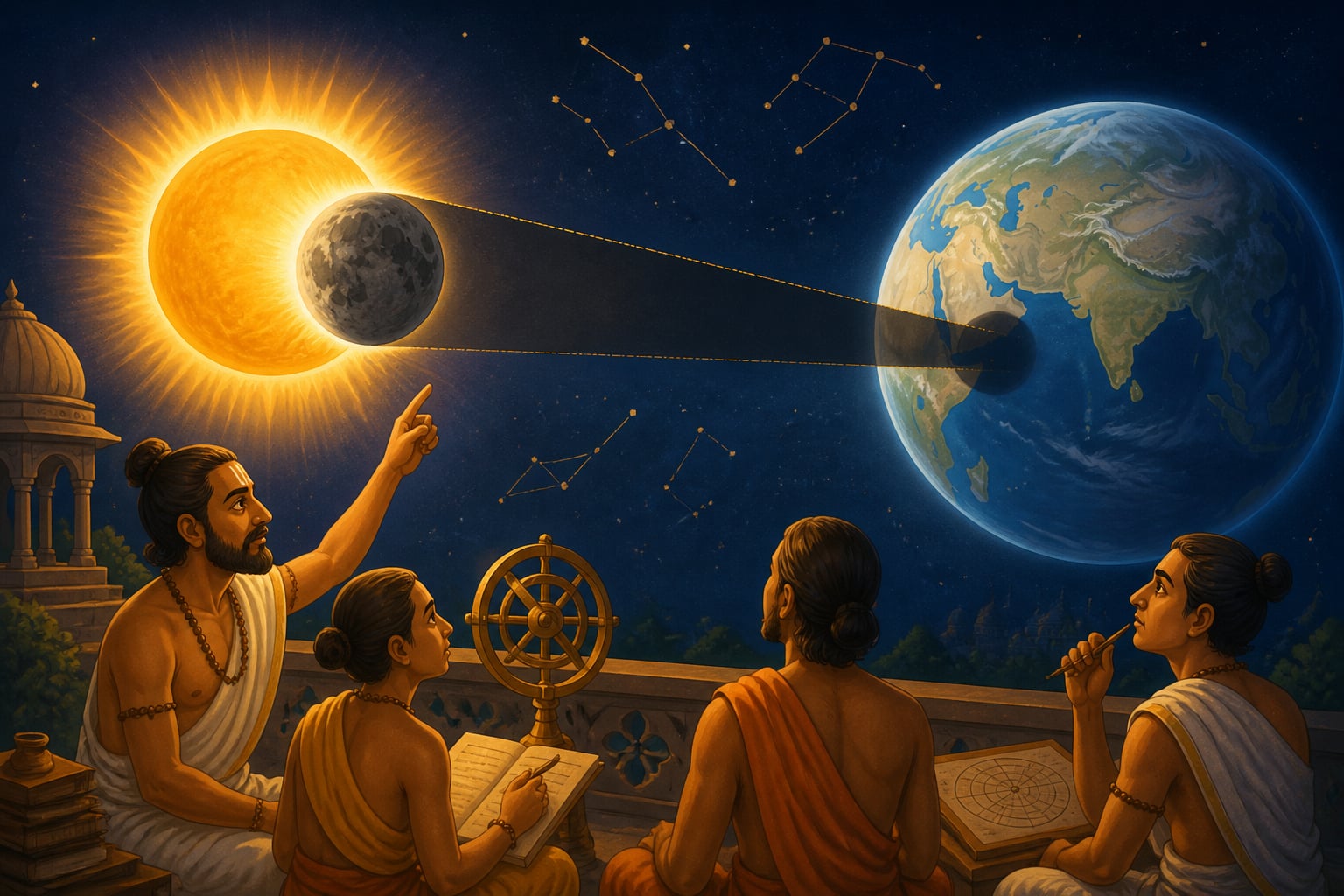
A solar eclipse (Sūrya Grahaṇa) occurs when the Moon passes between Earth and the Sun, casting its shadow on Earth. A lunar eclipse (Chandra Grahaṇa) occurs when Earth passes between the Sun and Moon, and Earth's shadow falls on the Moon.
This understanding required knowing several key facts:
- The relative sizes of Sun, Moon, and Earth
- The distances between them
- The orbital planes and their intersection points (nodes)
- The speeds at which these bodies move
The Lunar Nodes: Where Science Meets Myth
The Moon's orbit around Earth is tilted about 5 degrees relative to Earth's orbit around the Sun. This means the Moon usually passes above or below the Sun-Earth line, and no eclipse occurs.
Eclipses happen only when the Moon is near the points where its orbital plane crosses Earth's orbital plane. These crossing points are called nodes (in Sanskrit, pāta).
The ascending node, where the Moon crosses from south to north, was called Rāhu. The descending node, where it crosses from north to south, was called Ketu.
Here is where scientific and mythological frameworks intersected. The astronomers knew that Rāhu and Ketu were mathematical points, not physical objects. Yet the same names carried rich mythological meaning for ritual and cultural purposes.
Calculating Eclipses: The Method
The Sūryasiddhānta's Approach
The Sūryasiddhānta provides detailed algorithms for eclipse prediction. The method involves:
1. Finding the Moon's Position Calculating exactly where the Moon will be at any given time, accounting for its varying speed (the Moon moves faster when closer to Earth).
2. Finding the Sun's Position Similarly calculating the Sun's apparent position against the background stars.
3. Locating the Nodes The nodes themselves move slowly westward (about 19 degrees per year). Their positions must be tracked.
4. Checking for Conjunction An eclipse is possible when the Sun (or Moon, for lunar eclipses) is close to a node at the time of new Moon (for solar) or full Moon (for lunar).
5. Calculating Eclipse Details If an eclipse will occur, the texts provide methods to calculate:
- When it will begin and end
- How much of the Sun or Moon will be covered
- Whether it will be total or partial
- Where on Earth it will be visible
The Accuracy Achieved
How accurate were these predictions? Remarkably so.
Indian astronomers could predict the occurrence of eclipses to within a few hours. For lunar eclipses (which are easier to predict because they're visible from anywhere on Earth's night side), the timing was often accurate to within 15-30 minutes.
This accuracy was achieved without telescopes, without precise clocks, and without the mathematical tools that would later make European astronomy so powerful. It required centuries of careful observation, meticulous record-keeping, and sophisticated mathematical reasoning.
Āryabhaṭa's Contribution
Āryabhaṭa (476-550 CE) made significant advances in eclipse calculation. He understood that:
- The Moon and planets shine by reflected sunlight
- The Moon's and Earth's shadows are cones extending into space
- The sizes of these shadow cones can be calculated geometrically
In the Āryabhaṭīya, he provides formulas for computing the diameter of Earth's shadow at the Moon's distance, essential for calculating how long a lunar eclipse will last and how much of the Moon will be covered.
Āryabhaṭa explicitly rejected the Rāhu-Ketu demon explanation of eclipses as the physical cause, writing that the Moon's shadow causes solar eclipses and Earth's shadow causes lunar eclipses. This scientific clarity coexisted with his culture's continued use of Rāhu-Ketu terminology.
The Myth: Rāhu and Ketu
The Story

The Puranic narrative tells of the Churning of the Ocean (Samudra Manthana), when gods and demons cooperated to obtain the nectar of immortality (Amṛta). When the nectar emerged, Viṣṇu took the form of Mohinī to ensure only the gods received it.
But one demon, Svarbhānu, disguised himself and drank some nectar. The Sun and Moon recognized him and alerted Viṣṇu, who beheaded the demon with his Sudarśana Chakra. But because the nectar had touched his throat, both parts remained immortal, the head became Rāhu, the body became Ketu.
In revenge, Rāhu and Ketu periodically swallow the Sun and Moon, causing eclipses. But because they have no body/head to retain them, the luminaries soon emerge again.
The Ritual Function
This mythology served purposes that scientific explanation couldn't:
Communal Response: Eclipses became occasions for collective ritual, bathing in sacred rivers, chanting mantras, making offerings. The mythology gave these activities cosmic significance.
Moral Teaching: The story of Svarbhānu taught about the consequences of deception and the vigilance of divine order.
Marking Time: Eclipse myths connected celestial events to the larger narrative of cosmic time, the ongoing struggle between order and chaos.
Astrological Significance: Rāhu and Ketu became important in Jyotiṣa (astrology), representing karmic forces and destined challenges in a person's life.
Two Frameworks, One Culture
How They Coexisted
The Indian approach to eclipses demonstrates something sophisticated: the ability to maintain multiple frameworks simultaneously.
The gaṇaka (astronomer-calculator) used mathematical methods to predict when eclipses would occur. The purohita (priest) used mythological understanding to determine the ritual response. The jyotiṣī (astrologer) interpreted the significance for individuals and kingdoms.
These weren't seen as contradictory. A single person might wear all three hats, calculating the eclipse time mathematically, performing the appropriate rituals, and interpreting the astrological implications.
An Analogy for Modern Times
Consider how modern people might approach a sunset. Scientifically, we know the Sun doesn't actually "set", Earth's rotation carries us away from facing the Sun. Yet we still speak of sunsets, write poetry about them, and find them meaningful.
The scientific explanation doesn't diminish the experience; it adds a layer of understanding. Similarly, Indian astronomers could know that Earth's shadow caused lunar eclipses while still finding meaning in the Rāhu-Ketu mythology.
Comparison with Other Civilizations
Babylonian Eclipse Prediction
The Babylonians developed sophisticated eclipse prediction using the Saros cycle, the observation that eclipses repeat in patterns every 18 years, 11 days. This was empirical pattern recognition rather than geometric modeling.
Indian methods, while influenced by Babylonian data through Greek intermediaries, went further by developing geometric models of the eclipse mechanism.
Greek Understanding
Greek astronomers like Hipparchus and Ptolemy developed accurate geometric models. Indian and Greek astronomy influenced each other through trade routes and scholarly exchange. The Romaka Siddhānta, one of the five astronomical schools documented by Varāhamihira, shows clear Greek influence.
Chinese Eclipse Records
Chinese astronomers kept meticulous records of eclipses for millennia. Their prediction methods were largely empirical. Chinese records have proven valuable for verifying and dating ancient eclipses predicted by Indian texts.
The Khana Legend
Among the lesser-known figures of Indian astronomy is Khana (or Khanā), a legendary woman astronomer-astrologer whose story comes from Bengali folklore.
According to tradition, Khana was the daughter-in-law of Varāhamihira (or Mihira) and was so skilled at astronomical prediction that she could forecast eclipses and weather patterns. Her accuracy made her famous, and according to some versions, led to jealousy that resulted in her tongue being cut out.
While the historical details are uncertain, Khana represents the presence of women in Indian astronomical tradition. "Khanar Vachan" (Sayings of Khana) about agriculture and weather prediction remain part of Bengali folk wisdom today.
Living Eclipse Traditions
Modern Pañcāṅga
Traditional almanac makers (pañcāṅga-kāras) still calculate eclipses using classical methods. While they now verify against modern astronomical tables, the traditional calculations remain remarkably close.
Eclipse Rituals Continue
Across India, eclipse rituals persist: bathing in sacred rivers, avoiding food during the eclipse, pregnant women taking special precautions. These practices connect modern Indians to millennia of tradition, regardless of scientific understanding.
Vedic Astrology
In Jyotiṣa, Rāhu and Ketu remain the "shadow planets" (chāyā graha), important for understanding karmic patterns. This interpretive framework continues to be meaningful for millions, coexisting with scientific literacy.
What Eclipse Science Teaches Us
The Indian approach to eclipses offers several lessons:
Observation is foundation: Centuries of careful eclipse observation created the data that made prediction possible. There are no shortcuts to understanding nature.
Mathematics reveals mechanism: Converting observations into mathematical models allowed prediction, not just explanation. This is the essence of science.
Multiple frameworks can coexist: Scientific and mythological understanding served different purposes. Demanding that one exclude the other impoverishes human experience.
Knowledge travels and transforms: Indian eclipse science absorbed influences from Babylon and Greece, transformed them, and transmitted them onward to the Islamic world. Science has always been global.
The next time you witness an eclipse, you participate in an ancient human experience. Whether you appreciate it through the lens of orbital mechanics or through the story of Rāhu's revenge, you're engaging with the cosmos as humans have for millennia, with wonder, with calculation, and with meaning.
Key figures
Varāhamihira
Khana (Khanā)
Lalla
Case studies
Predicting the Eclipse of 1133 CE
In 1133 CE, a total solar eclipse was visible across much of India. Traditional pañcāṅga makers had predicted this eclipse using methods derived from the Sūryasiddhānta. How did their predictions compare with what actually happened?
Records suggest the traditional calculations predicted the eclipse timing to within about 20 minutes. The path of totality was known, and appropriate rituals were planned in advance. This accuracy was achieved using methods over 700 years old at that point, demonstrating the robustness of the underlying astronomical models.
The knowledge demonstrated in this case study contributed to the broader legacy of Indian astronomy (Jyotisha), influencing developments across Asia and eventually the world.
Well-constructed mathematical models can remain useful for centuries. The key is whether they capture the underlying reality accurately. Indian eclipse models, based on genuine understanding of orbital mechanics, continued to work long after their creators died.
Weather forecasting models today are validated the same way: compare predictions against observed outcomes over hundreds of events. The fact that Indian eclipse models maintained accuracy for centuries using pre-telescopic methods demonstrates that mathematical rigor can substitute for technological sophistication.
1133 CE - referenced in the context of Predicting the Eclipse of 1133 CE.
The 2017 American Eclipse and Rāhu
During the 2017 total solar eclipse across America, many Hindu temples and communities observed traditional eclipse protocols - not eating, bathing after the eclipse, pregnant women staying indoors. Why do these traditions continue when the scientific explanation is well known?
The scientific and ritual frameworks serve different purposes. Science tells us what causes the eclipse; ritual gives us a way to respond collectively to a cosmic event. For many practitioners, following eclipse traditions connects them to ancestors, community, and a sense of cosmic order that pure scientific explanation doesn't provide.
The knowledge demonstrated in this case study contributed to the broader legacy of Indian astronomy (Jyotisha), influencing developments across Asia and eventually the world.
Multiple frameworks for understanding the same phenomenon can coexist productively. The question isn't 'which is true?' but 'what purpose does each serve?' Scientific and traditional responses to eclipses are not necessarily in conflict.
Many people today hold both scientific and traditional worldviews simultaneously, consulting doctors and also following dietary traditions, using GPS while also checking auspicious timings. The coexistence of scientific and cultural frameworks is not contradiction but a normal feature of how human communities make meaning.
Aryabhata's calculation of Earth's circumference (39,968 km) was within 0.3% of the actual value (40,075 km), achieved in 499 CE.
When Al-Bīrūnī Studied Indian Eclipse Methods
The Persian scholar Al-Bīrūnī (973-1048 CE) spent years in India learning Sanskrit and studying Indian astronomy. He was particularly interested in eclipse calculation methods. What did he find, and what did he think of the Rāhu-Ketu explanation?
Al-Bīrūnī documented that educated Indian astronomers used mathematical methods for eclipse prediction and understood the physical cause. He noted the coexistence of scientific and mythological explanations, observing that the educated knew the difference while popular understanding remained mythological. He transmitted Indian methods to the Islamic world, where they influenced further astronomical development.
The knowledge demonstrated in this case study contributed to the broader legacy of Indian astronomy (Jyotisha), influencing developments across Asia and eventually the world.
Cross-cultural scholarly exchange has always been part of scientific progress. Al-Bīrūnī's respectful engagement with Indian astronomy - learning the language, studying the texts, distinguishing technical from popular understanding - provides a model for how civilizations can learn from each other.
International scientific collaboration today follows the same pattern Al-Biruni modeled. Researchers learn new languages, spend years in foreign labs, and engage deeply with unfamiliar methodologies. The best cross-cultural scholarship still requires the intellectual humility and linguistic investment that Al-Biruni demonstrated.
1048 CE - referenced in the context of When Al-Bīrūnī Studied Indian Eclipse Methods.
Historical context
Classical and Medieval Indian Astronomy
Reflection
- Indian astronomers knew the scientific cause of eclipses yet maintained the Rāhu-Ketu mythology for ritual purposes. Is this inconsistent, or does it represent a sophisticated understanding of how different frameworks serve different needs?
- Eclipse rituals (bathing, fasting, special precautions for pregnant women) continue in India despite widespread scientific literacy. Should these be discouraged as superstition, or do they serve valuable social/cultural functions?
- Al-Bīrūnī learned Sanskrit to understand Indian astronomy. What does this tell us about the conditions for genuine cross-cultural learning? How does it compare to how civilizations interact today?