Śūnya: The Zero That Changed Everything
How Brahmagupta's rules for zero revolutionized mathematics
Discover how Brahmagupta first defined rules for zero operations in 628 CE, and trace zero's journey through Baghdad to Europe via Fibonacci.
Śūnya: The Zero That Changed Everything
In the year 628 CE, in the ancient city of Bhillamāla (modern Bhinmal in Rajasthan), a mathematician named Brahmagupta completed a treatise that would quietly reshape the entire edifice of human calculation. The Brāhmasphuṭasiddhānta, "The Correctly Established Doctrine of Brahma", contained something unprecedented: the first systematic rules for computing with zero as a number.
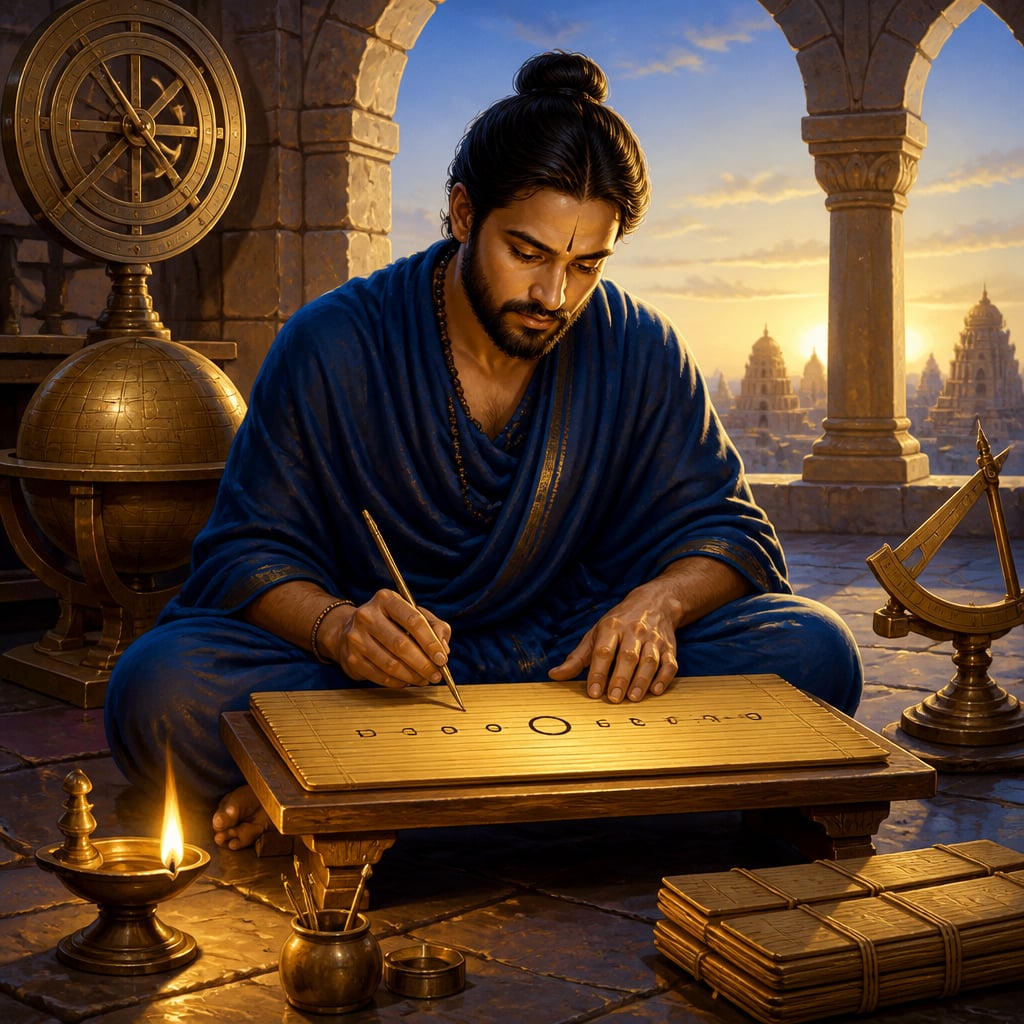
This was not merely a placeholder dot marking an empty column. This was śūnya, emptiness itself, treated as a mathematical entity with its own arithmetic properties. The implications would take centuries to fully unfold, but they would ultimately make possible everything from modern banking to the smartphone in your pocket.
The Problem Before Zero
Imagine trying to distinguish between 52, 502, and 5002 without a symbol for "nothing in this place." The Babylonians struggled with this for millennia. The Romans, with their numeral system, found multiplication and division so cumbersome that they relied on counting boards for actual calculation. A Roman merchant calculating MCMXLVII × XXIII would spend considerable time on what we solve in seconds.
The Greeks, despite their geometric brilliance, never developed a true zero. Ptolemy used a symbol resembling our "o" as a placeholder in astronomical tables around 130 CE, but it remained merely a marker, not a number you could add, subtract, or multiply.
Brahmagupta's Revolutionary Rules
Brahmagupta's genius lay not in inventing the symbol for zero, that had existed in India for at least a century before him, but in defining how zero behaves mathematically. In Chapter 18 of the Brāhmasphuṭasiddhānta, he laid out rules that seem obvious to us today but were revolutionary:
Addition and Subtraction:
- A number plus zero equals the same number
- A number minus zero equals the same number
- Zero minus zero equals zero
Multiplication:
- Any number multiplied by zero equals zero
- Zero multiplied by zero equals zero
The Troublesome Division:
- Zero divided by zero equals zero (Brahmagupta's error)
- A number divided by zero... here Brahmagupta struggled
Brahmagupta called the result of dividing by zero khachheda ("divided by emptiness") but could not fully resolve what this meant. It would take another mathematician, Bhāskara II, five centuries later to recognize that division by zero produces infinity, and even that insight required refinement over subsequent centuries.
Negative Numbers: Debts and Fortunes
Brahmagupta didn't stop at zero. He also systematically defined rules for negative numbers, which he called ṛṇa (debts) in contrast to dhana (fortunes or assets). His rules for combining positive and negative quantities read like accounting principles:
- A debt subtracted from zero is a fortune
- A fortune subtracted from zero is a debt
- The product of two debts is a fortune
- The product of a debt and a fortune is a debt
This conceptual framework, treating mathematical abstractions as financial realities, likely emerged from India's sophisticated commercial culture. Merchants dealing with credits, debts, and complex transactions needed arithmetic that could handle "less than nothing."

The Bakhshali Manuscript: Earlier Traces
In 1881, a farmer near the village of Bakhshali in present-day Pakistan unearthed a birch-bark manuscript that pushed zero's history even further back. The Bakhshali manuscript, dating to approximately the 3rd-4th century CE (though some scholars debate this), contains a dot symbol representing zero used in mathematical calculations.
This wasn't yet the fully-formed number that Brahmagupta would define, but it shows that Indian mathematicians had been working with the concept of śūnya for centuries before the Brāhmasphuṭasiddhānta. The philosophical groundwork, the comfort with "emptiness" as a positive concept rather than a frightening void, may trace back even further to Buddhist and Jain philosophical traditions.
The Journey West: Baghdad's House of Wisdom
In 773 CE, during the reign of Caliph al-Mansur, an Indian scholar arrived at the court of Baghdad carrying astronomical texts, quite possibly including works derived from Brahmagupta. The Caliph ordered these texts translated into Arabic, and the task fell to scholars at the Bayt al-Ḥikma (House of Wisdom).
Muḥammad ibn Mūsā al-Khwārizmī, the Persian mathematician whose name gives us the word "algorithm," encountered these Indian numerals and zero in the early 9th century. His book Kitāb al-Jam' wa-l-tafrīq bi-ḥisāb al-Hind ("The Book of Addition and Subtraction According to the Hindu Calculation") introduced Indian mathematics to the Arabic-speaking world.
Al-Khwārizmī recognized the system's power. In his own words, he noted that the Indians had developed a method "with nine figures and the sign 0" that made calculation immensely simpler than existing methods.

Fibonacci and the European Resistance
The final leg of zero's journey came through Leonardo of Pisa, known as Fibonacci. His father was a customs official in Bugia (modern Algeria), where the young Leonardo learned "Hindu-Arabic" numerals from Arab merchants. His 1202 book Liber Abaci introduced these numerals to Europe.
But Europe resisted. In 1299, Florence banned the new numerals in banking, fearing that the unfamiliar symbols, especially the easily-forged zero, would enable fraud. Merchants were required to use Roman numerals or write numbers out in words. The ban persisted in some form for over a century.
It took the printing press and the demands of Renaissance commerce to finally establish Hindu-Arabic numerals as the European standard. By the 16th century, the system that Brahmagupta had codified was universal among mathematicians worldwide.
Why India?
Why did zero emerge as a number in India rather than Greece, China, or Babylon? Several factors likely contributed:
Philosophical Comfort with Emptiness: In Indian philosophy, śūnya (emptiness) was not frightening but profound. Buddhism built entire philosophical systems around śūnyatā. This cultural comfort with "nothingness" as a positive concept may have made mathematicians more willing to treat it as a number.
Place Value Tradition: Indian mathematics had used place-value notation from early times, creating a practical need for a symbol indicating "nothing in this column."
Practical Commerce: India's extensive trade networks required efficient calculation methods. The pressure from merchants and accountants drove mathematical innovation.
Oral Tradition: Indian mathematics was often transmitted through memorized verses (sūtras), which encouraged compact, elegant notation systems.
The Modern Legacy
Today, every digital device depends on zero. Binary code, the language of computers, consists entirely of zeros and ones. Every photograph, every message, every calculation your phone performs reduces to patterns of presence and absence, on and off, one and zero.
When you see 1,000,000 in your bank account (hopefully), those zeros aren't just placeholders, they're the direct descendants of Brahmagupta's insight that "nothing" can be a number with which we calculate.
The journey from a 7th-century Sanskrit treatise to your smartphone took 1,400 years and crossed multiple civilizations. But it began with one mathematician's willingness to take emptiness seriously and ask: if śūnya is real, what are its properties?
Key figures
Brahmagupta
598-668 CE
Muḥammad ibn Mūsā al-Khwārizmī
c. 780-850 CE
Leonardo of Pisa (Fibonacci)
c. 1170-1250 CE
Case studies
The Merchant's Ledger: How Zero Transformed Commerce
[7th-12th Century CE] Consider a merchant on the Silk Road trading between India and Persia. Before zero, recording inventory required clumsy notation: 'five hundreds, no tens, and two' for 502. Distinguishing 52, 502, and 5020 demanded verbose descriptions. With zero, the same merchant could write compact, unambiguous numerals that enabled quick calculation of profits, losses, and inventories across thousands of transactions.
The efficiency gain was enormous. A Roman merchant using DXXII (522) required mental translation for every calculation. An Indian merchant writing 522 could immediately perform arithmetic. This advantage accelerated Indian Ocean trade networks and made India a commercial hub for centuries.
Today, efficient data representation drives business success. Companies that can process information faster - like high-frequency traders or logistics optimizers - gain competitive advantages, just as merchants with better numeral systems did centuries ago.
Mathematical innovation often arises from practical needs. Brahmagupta's abstract rules for zero emerged from a culture of sophisticated commerce that demanded efficient calculation.
Today's data-driven businesses live or die by how efficiently they encode and process information. Amazon's inventory system handles billions of SKUs because compact digital notation makes it possible. The same principle that gave Silk Road merchants an edge is now the backbone of global logistics.
Indian mathematical concepts, including the decimal system and zero, are used by over 7 billion people worldwide today.
From Śūnya to Silicon: Zero in Digital Computing
Every digital device operates on binary code - sequences of 0s and 1s. A single photograph on your phone might contain millions of these digits. The concept that 'nothing' (0) and 'something' (1) can combine to represent any information traces directly to the mathematical legitimacy that Brahmagupta gave to zero.
George Boole's 19th-century logical algebra, which underlies all computing, depends on treating 0 and 1 as values that can be manipulated arithmetically. Without the prior establishment of zero as a legitimate number with defined operations, Boolean logic would lack its mathematical foundation.
When researchers today work on seemingly abstract problems - quantum computing, category theory, or exotic number systems - they may be laying foundations for technologies we cannot yet imagine.
Abstract mathematical concepts developed for one purpose often enable unforeseen applications centuries later. Brahmagupta could never have imagined computers, but his work on zero made them possible.
Every AI model, blockchain ledger, and cloud server runs on binary logic built from zeros and ones. The $5 trillion global tech industry rests on the mathematical legitimacy of zero that Brahmagupta established. Without treating 'nothing' as a computable value, none of this infrastructure would exist.
Indian mathematical concepts, including the decimal system and zero, are used by over 7 billion people worldwide today.
The Florence Ban: When Europe Feared Zero
[1299 CE] In 1299, the city of Florence banned Hindu-Arabic numerals in banking records. The stated reason: the unfamiliar symbols, especially the easily-altered zero, could enable fraud. A merchant could turn 10 into 100 or 1000 with a few strokes. Roman numerals, though clumsy, were harder to forge.
The ban reveals how technological adoption depends on social trust, not just technical superiority. Florence's bankers weren't mathematically ignorant - they recognized that new systems require new verification methods. The ban persisted until printing standardized numeral forms and new accounting practices (like double-entry bookkeeping) addressed fraud concerns.
Similar resistance greets new technologies today. Blockchain and cryptocurrency face skepticism about fraud and manipulation, much as Hindu-Arabic numerals did. Adoption requires building trust infrastructure, not just proving technical capability.
Superior technology doesn't guarantee immediate adoption. Social systems, trust mechanisms, and institutional support must evolve alongside technical innovation.
The pattern repeats with every disruptive technology. Governments initially banned ride-sharing apps, restricted drone deliveries, and debated AI regulation. Adoption hinges not just on technical merit but on building social trust, updated legal frameworks, and fraud prevention systems alongside the innovation itself.
100 or 1000 - referenced in the context of The Florence Ban: When Europe Feared Zero.
Historical context
Classical Indian Mathematics (5th-12th Century CE)
Living traditions
Every time you type a phone number, check your bank balance, or watch a digital video, you use zero. The binary foundation of all computing, millions of calculations per second, each reducing to patterns of 0 and 1, descends directly from Brahmagupta's insight that śūnya is a number with arithmetic properties. India's IT industry, which contributes significantly to the global digital economy, works daily with the mathematical heritage that began in 7th-century Rajasthan.
- Bhinmal (Ancient Bhillamāla): The birthplace of Brahmagupta, this ancient city was a major center of learning in the 7th century. Though few ancient structures remain, the town's heritage is celebrated locally.
- Jantar Mantar, Ujjain: While the current observatory dates to the 18th century, Ujjain has been India's prime meridian and astronomical center since ancient times. Brahmagupta headed the observatory here.
- Bodleian Library, Oxford: Houses manuscripts of the Bakhshali manuscript (on loan from the British Library) and early printed copies of Liber Abaci, representing both the origins and transmission of Indian numerals.
Reflection
- Brahmagupta worked with a concept (emptiness/void) that other cultures found philosophically uncomfortable. Are there ideas today that seem too strange or unsettling to take seriously, but might prove mathematically or scientifically valuable?
- It took centuries for zero to travel from India to Europe, and more time before Europeans accepted it. What determines how quickly useful ideas spread today, and what still slows their adoption?
- Brahmagupta defined most rules for zero correctly but made an error about division by zero. How should we view scientists and mathematicians who advance knowledge but also make mistakes? Does error diminish achievement?