Computational Methods: Algorithms Before Computers

Āryabhaṭa's Kuṭṭaka and the Chakravala, recursion and iteration in ancient India

Explore the Kuṭṭaka (pulverizer) algorithm for solving linear equations and the Chakravala cyclic method for solving Pell's equation, sophisticated computational methods from ancient India.

Computational Methods: Algorithms Before Computers

The word "algorithm" comes from al-Khwārizmī, the 9th-century Persian mathematician. But the concept, a step-by-step procedure that guarantees a solution, flourished in India centuries before al-Khwārizmī was born.
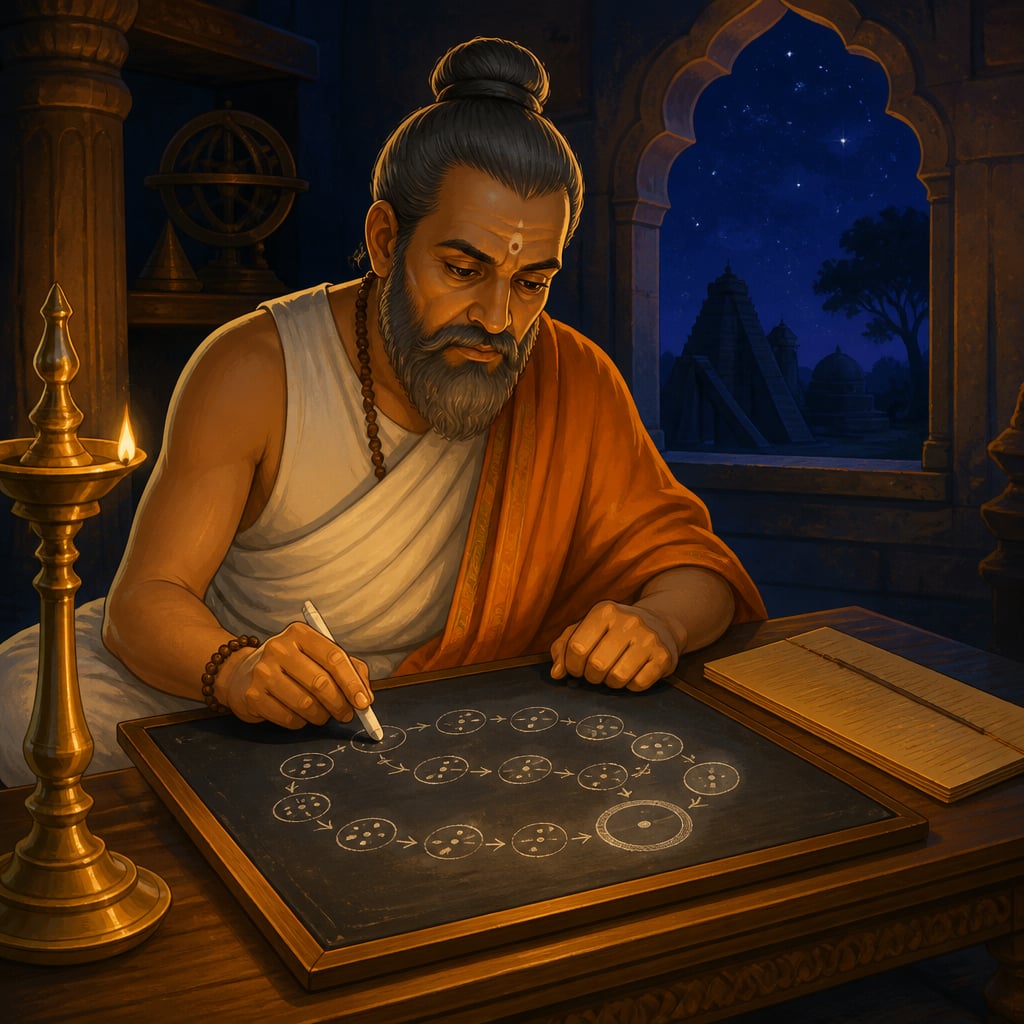
Bhaskara II working the chakravala cyclic method under a night sky

Indian mathematicians developed algorithms of remarkable sophistication: the Kuṭṭaka for solving simultaneous linear equations, the Chakravala for finding integer solutions to difficult quadratic equations, and iterative methods for computing square roots and trigonometric functions. These weren't just clever tricks; they were systematic procedures with guaranteed termination and provable correctness.

In a sense, ancient Indian mathematicians were programming, writing procedures that could be executed mechanically to produce correct results. The only difference from modern computing is that the "processor" was a human being rather than a machine.

What Makes Something an Algorithm?

An algorithm has specific properties:

  1. Definiteness: Each step is precisely defined; there's no ambiguity about what to do
  2. Finiteness: The procedure terminates after a finite number of steps
  3. Input/Output: It takes some input and produces some output
  4. Effectiveness: Each step can actually be carried out (no "imagine an infinite list" steps)

Modern computers execute algorithms millions of times per second. But algorithms existed long before computers, they're patterns of thought, procedures for solving problems, expressible in any medium from Sanskrit verses to Python code.
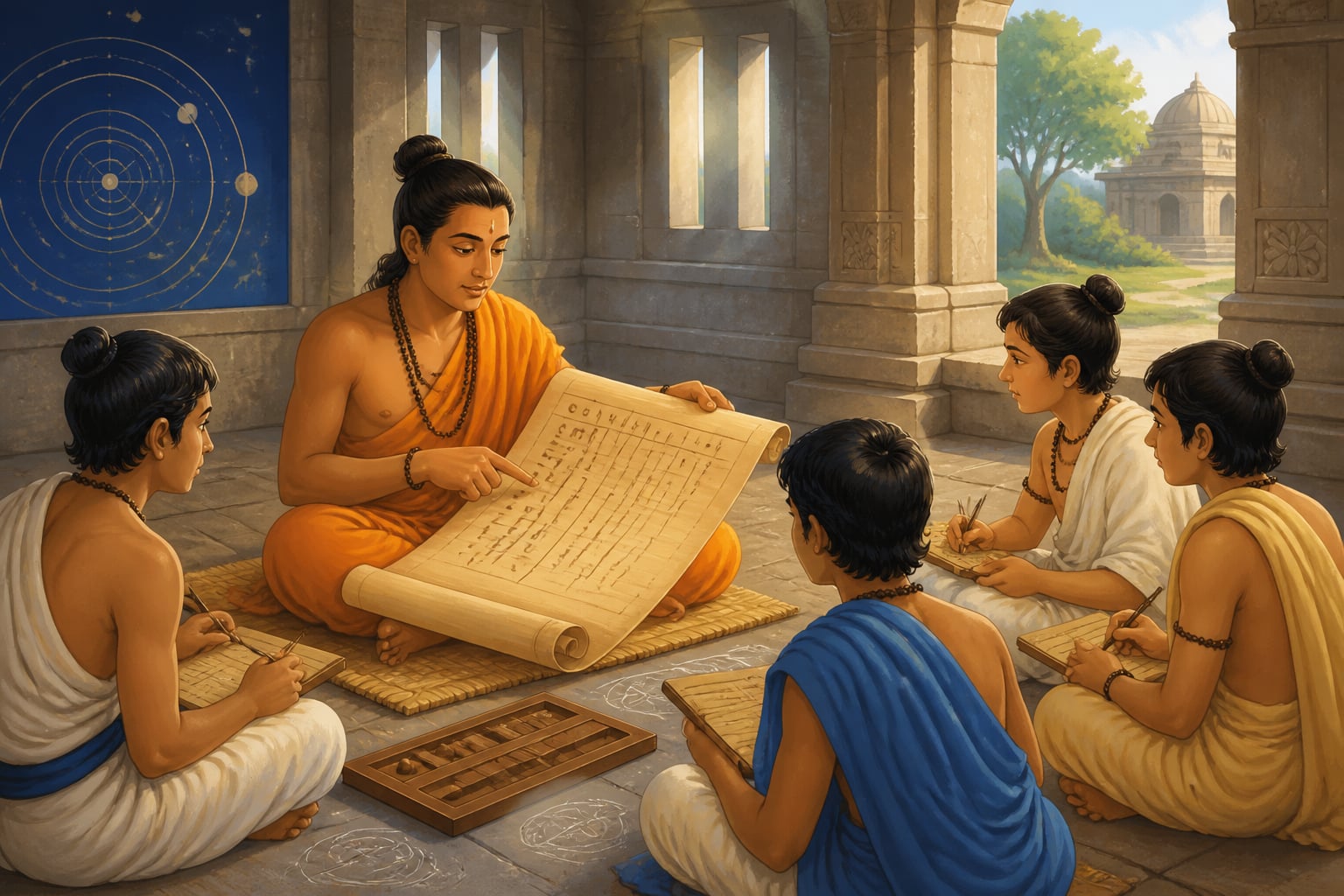
Aryabhata teaching the Kuṭṭaka algorithm to students

The Kuṭṭaka: Pulverizing Problems

The Kuṭṭaka ("pulverizer") is an algorithm for solving linear indeterminate equations, equations with infinitely many integer solutions. Given:

ax + c = by

(where a, b, and c are known integers), find integers x and y that satisfy it.

For example: 23x + 7 = 30y. What values of x and y work?

The Kuṭṭaka "pulverizes" this problem by reducing the coefficients step by step until the solution becomes obvious, then traces back to find the original answer.

The Kuṭṭaka Method

  1. Divide the larger coefficient by the smaller: 30 = 1×23 + 7
  2. Replace the problem with a smaller one using the remainder: Now solve 23x + 7 = 7y'
  3. Continue until coefficients become manageable: 7 = 3×2 + 1, etc.
  4. When the remainder is 1 (or divides the constant), the solution is direct
  5. Trace back through the steps, building up the solution

This is equivalent to the Extended Euclidean Algorithm, which modern number theory and cryptography use extensively. RSA encryption, which secures internet commerce, depends on this ancient technique.

Why "Pulverizer"?

The name kuṭṭaka comes from the root kuṭṭ (to grind, to pulverize). Just as a miller grinds grain into progressively finer powder, the algorithm "grinds" a difficult equation into progressively simpler forms until the solution emerges.

This evocative naming, mathematical abstraction through everyday imagery, characterizes Indian mathematical terminology. The procedure becomes memorable: you're pulverizing a problem.

Āryabhaṭa's Formulation

Āryabhaṭa (499 CE) described the Kuṭṭaka in characteristically compressed Sanskrit verses. His procedure solves what we now call linear congruences:

Find x such that x ≡ r₁ (mod m₁) and x ≡ r₂ (mod m₂)

Astronomers watching a rare planetary alignment over Ujjain

This type of problem arises constantly in astronomy. If the Sun has one orbital period and the Moon another, when will they align at a particular position? The answer requires solving simultaneous congruences, exactly what the Kuṭṭaka does.

Āryabhaṭa's genius lay not just in solving such problems but in providing a general method applicable to any instance. His verses encode an algorithm, not a single solution.

Brahmagupta's Extensions

Brahmagupta (628 CE) systematized and extended the Kuṭṭaka, providing clearer expositions and additional methods. He applied it to astronomical problems:

These questions, vital for calendar-making and religious festivals, require solving exactly the indeterminate equations the Kuṭṭaka handles.

Brahmagupta also developed what we call the "Brahmagupta-Fibonacci identity":

(a² + nb²)(c² + nd²) = (ac + nbd)² + n(ad - bc)² = (ac - nbd)² + n(ad + bc)²

This identity enables composition of solutions, if you have two solutions to related equations, you can combine them to get a third. This principle underlies the Chakravala method.

The Chakravala: Cycling to Solutions

The Chakravala ("cyclic method") is an elegant algorithm for solving the equation:

x² - Ny² = 1

where N is a non-square positive integer. This is the "Pell equation" (misnamed, as Pell contributed little to it).

For simple N, solutions are small. For N = 2: x = 3, y = 2 works (9 - 8 = 1).

For other N, solutions explode. For N = 61:

No trial-and-error could find this. The Chakravala systematically converges on it.

How the Chakravala Works

  1. Start: Choose an initial guess m₀ that makes m₀² - N small (ideally ±1 or ±2)
  2. Iterate: At each step, compute the next values using:
    • Choose mᵢ₊₁ to minimize |mᵢ₊₁² - N| while ensuring divisibility
    • Apply the composition formula to get new (x, y) values
  3. Terminate: When the equation reaches x² - Ny² = 1, stop

The method is "cyclic" because it repeatedly applies the same procedure. Each cycle reduces the "remainder" (the right-hand side of the intermediate equations), eventually reaching 1.

Bhāskara II's Perfection

Bhāskara II (1150 CE) perfected the Chakravala, providing the clearest exposition in his Bījagaṇita. His version ensures:

Bhāskara demonstrated the method by solving x² - 61y² = 1 completely. European mathematicians (Fermat, Euler, Lagrange) would struggle with the same equation 600 years later, not knowing that Bhāskara had already solved it.

Iterative Methods: Refining Approximations

Beyond these algebraic algorithms, Indian mathematicians developed iterative numerical methods:

Square Root Algorithm

To find √N:

  1. Start with initial guess x₀
  2. Compute x₁ = (x₀ + N/x₀)/2
  3. Repeat until sufficient accuracy

This "Babylonian method" (also known in India) converges rapidly. For √2 starting with x₀ = 1:

After just three iterations, we have five correct decimal places.

Sine Series Computation

Āryabhaṭa's difference formula for computing sine tables was iterative:

sin(θₙ₊₁) - sin(θₙ) ≈ [sin(θₙ) - sin(θₙ₋₁)] - sin(θₙ)/225

Starting from known values sin(0) = 0 and sin(90°) = R (radius), this formula generates the entire sine table through iteration. It's a discrete analog of the differential equation that defines sine.

Algorithmic Thinking in Sanskrit Verse

Indian mathematicians encoded algorithms in verse, making them memorizable and transmissible. But verse constraints forced compression, sometimes to the point of obscurity.

Consider encoding the Kuṭṭaka in Sanskrit verse:

This is remarkably like writing efficient code under memory constraints, every byte matters, and the result must be both correct and economical.

The Chinese Remainder Theorem Connection

The Kuṭṭaka solves the same problem as the Chinese Remainder Theorem (CRT):

Find x such that:

The CRT appears in Chinese mathematics around the same time as the Kuṭṭaka in India. Whether there was transmission between the traditions or independent discovery is unclear.

What's certain is that both civilizations recognized the importance of this problem type and developed general solution methods. The astronomical applications, calendar calculation, predicting celestial events, motivated both traditions.

Modern Applications: Cryptography and Beyond

The Kuṭṭaka's descendants pervade modern technology:

RSA Encryption: The RSA algorithm, which secures online banking, e-commerce, and private communication, relies on the Extended Euclidean Algorithm, essentially the Kuṭṭaka, to compute decryption keys.

Error Correction: The codes that allow CDs, DVDs, and QR codes to work despite scratches and damage use algorithms from the same mathematical family.

Computer Algebra: Modern symbolic computation systems implement Kuṭṭaka-like algorithms to simplify fractions, solve equations, and manipulate mathematical expressions.

Scheduling: Finding time slots that satisfy multiple constraints (this person available Monday, that person Tuesday) involves solving systems of congruences.

The Algorithm as a Mathematical Object

Indian mathematicians understood that algorithms themselves could be studied:

These questions, fundamental to modern computer science, were implicitly addressed in the detailed expositions of Brahmagupta and Bhāskara II.

When Bhāskara II proved that the Chakravala terminates, he was doing algorithm analysis, showing that a procedure has the properties we need. This is exactly what computer scientists do when proving algorithms correct.

From Manuscript to Machine

The transition from human-executed algorithms to machine-executed algorithms was a matter of technology, not concept. The logical structure of the Kuṭṭaka or Chakravala could run on silicon as easily as on paper and ink.

When Alan Turing formalized the concept of an algorithm in the 1930s, he was making precise what Indian mathematicians had practiced for over a millennium: the idea that computation could be broken into definite, finite, mechanical steps.

The "computer" changed from a human job title (people who computed, often women doing mathematical calculations) to a machine. But the algorithms they executed were recognizable across millennia.

The Legacy: Thinking Procedurally

The deepest contribution of ancient Indian algorithmic thinking may be the idea itself: that complex problems can be reduced to simple, repeatable steps. This is the foundation of:

When a software developer writes a loop, when a factory optimizes its assembly line, when a scientist follows a protocol, they're all thinking algorithmically, continuing a tradition that Indian mathematicians crystallized in Sanskrit verses over a thousand years ago.

Key figures

Āryabhaṭa

476-550 CE

Brahmagupta

598-668 CE

Bhāskara II

1114-1185 CE

Jayadeva

c. 1000 CE (exact dates uncertain)

Case studies

From Kuṭṭaka to Cybersecurity

When you make an online purchase, RSA encryption protects your credit card number. The security depends on the difficulty of factoring large numbers. But the encryption and decryption process uses the Extended Euclidean Algorithm - essentially the Kuṭṭaka - to compute the keys that lock and unlock your data.

RSA works because of modular arithmetic. Finding the decryption key d such that ed ≡ 1 (mod φ(n)) requires solving a linear congruence - exactly what the Kuṭṭaka does. Without this ancient algorithm, modern e-commerce would be impossible.

Today's theoretical computer science may similarly enable unforeseen applications. Quantum algorithms, developed abstractly, may protect communications or break current encryption - we won't know until the technology matures.

Algorithms developed for one purpose (astronomical calculation) can enable entirely different applications (secure communication) centuries later. Mathematical infrastructure outlasts specific applications.

Every secure online transaction, from banking to messaging apps like Signal, depends on number theory algorithms. The RSA encryption protecting your credit card uses modular arithmetic principles that Aryabhata formalized for astronomical calculations. Ancient algorithm design powers modern cybersecurity.

Indian mathematical concepts, including the decimal system and zero, are used by over 7 billion people worldwide today.

When Will the Planets Align?

[5th-12th Century CE] An astronomer needs to predict when Jupiter and Saturn will appear at the same celestial longitude. Jupiter's period is about 12 years; Saturn's is about 29 years. The question: when will both planets complete whole numbers of orbits and return to alignment?

This requires finding n such that n ≡ 0 (mod 12) and n ≡ 0 (mod 29). The Kuṭṭaka solves this systematically: n must be a multiple of lcm(12, 29) = 348. More complex cases with non-zero remainders require the full algorithm.

Modern scheduling software solves similar problems: finding time slots that satisfy multiple constraints (this person free Monday, that meeting room available, etc.). The mathematical structure is identical.

Algorithms arise from real problems. The Kuṭṭaka wasn't developed abstractly but to answer pressing questions about celestial cycles, festival dates, and calendar design.

Scheduling algorithms face the same mathematical structure today. When should two satellites pass over the same ground station? When will two periodic maintenance cycles coincide? These questions reduce to the same modular arithmetic that Indian astronomers developed for planetary conjunction problems.

12 years - referenced in the context of When Will the Planets Align?.

Finding the Needle: x² - 61y² = 1

[12th Century CE] Bhāskara II tackles x² - 61y² = 1. The smallest solution has x = 1,766,319,049 and y = 226,153,980. There are no smaller positive solutions - this is the minimum. How did he find such enormous numbers without trial-and-error?

The Chakravala systematically reduces the problem. Starting from small values, each cycle brings the equation closer to x² - 61y² = 1. The algorithm doesn't search randomly; it follows a deterministic path guaranteed to reach the goal.

Modern optimization algorithms (gradient descent, genetic algorithms) similarly use structure to find solutions in vast search spaces. The principle - exploit problem structure rather than search randomly - remains fundamental.

Systematic methods can find solutions that random search could never discover. The Chakravala's power lies not in luck but in mathematical structure - it exploits the equation's properties to converge inevitably on the answer.

Modern optimization algorithms in machine learning, like gradient descent, share the Chakravala's core insight: use mathematical structure to converge on solutions that brute-force search could never find. The difference between a good algorithm and random guessing can be the difference between seconds and centuries of computation.

Indian mathematical concepts, including the decimal system and zero, are used by over 7 billion people worldwide today.

Historical context

Classical Indian Mathematics (5th-12th Century CE)

Living traditions

Every time you make a secure online transaction, the Kuṭṭaka (as the Extended Euclidean Algorithm) protects your data. Error-correcting codes, modular arithmetic in programming, and number-theoretic algorithms all descend from Indian mathematical traditions. India's IT industry works daily with computational methods whose conceptual ancestors were developed in the subcontinent centuries ago.

Reflection

More in Gaṇita: Mathematics That Changed the World

All lessons in Gaṇita: Mathematics That Changed the World · Bharatiya Vigyan: Inventions & Discoveries course