Bījagaṇita: Algebra Before Al-Jabr

How Indian algebraists solved equations centuries before Arabic mathematics

Explore Brahmagupta's quadratic solutions, Bhāskara II's sophisticated equations, and how this knowledge traveled to Arabia and then Europe.

Bījagaṇita: Algebra Before Al-Jabr

The word "algebra" comes from the Arabic al-jabr, meaning "restoration" or "completion," from the title of al-Khwārizmī's famous 9th-century treatise. But centuries before al-Khwārizmī wrote, Indian mathematicians had developed sophisticated methods for solving equations, methods they called bījagaṇita, the "mathematics of seeds."

Bhaskara II working algebra problems at the Ujjain observatory

The name itself reveals a profound conceptual insight. A bīja (seed) contains within it the potential for a full-grown plant. Similarly, in algebra, an unknown quantity, what we call "x", is a seed that, when properly cultivated through mathematical operations, reveals its true value. Indian algebraists understood that equations are like puzzles where the unknown is hidden but can be coaxed into revealing itself.

The Roots: From Āryabhaṭa to Brahmagupta

Algebraic thinking appears in India long before it received its name. The Śulbasūtras (800-500 BCE) contain geometric problems equivalent to solving quadratic equations. The Bakhshali manuscript (3rd-7th century CE) shows equations being manipulated to find unknown quantities.

But systematic algebra as a distinct mathematical discipline emerged with Āryabhaṭa (499 CE) and reached maturity with Brahmagupta (628 CE). Āryabhaṭa's Āryabhaṭīya includes methods for solving linear equations and systems of equations, while Brahmagupta's Brāhmasphuṭasiddhānta established algebra as a comprehensive subject.

Brahmagupta devoted an entire chapter, the Kuṭṭakādhyāya, to algebraic methods. He introduced symbolic notation using abbreviations for unknowns and operations, solved quadratic equations in full generality, and tackled indeterminate equations (those with multiple solutions) that wouldn't be addressed in Europe for another millennium.
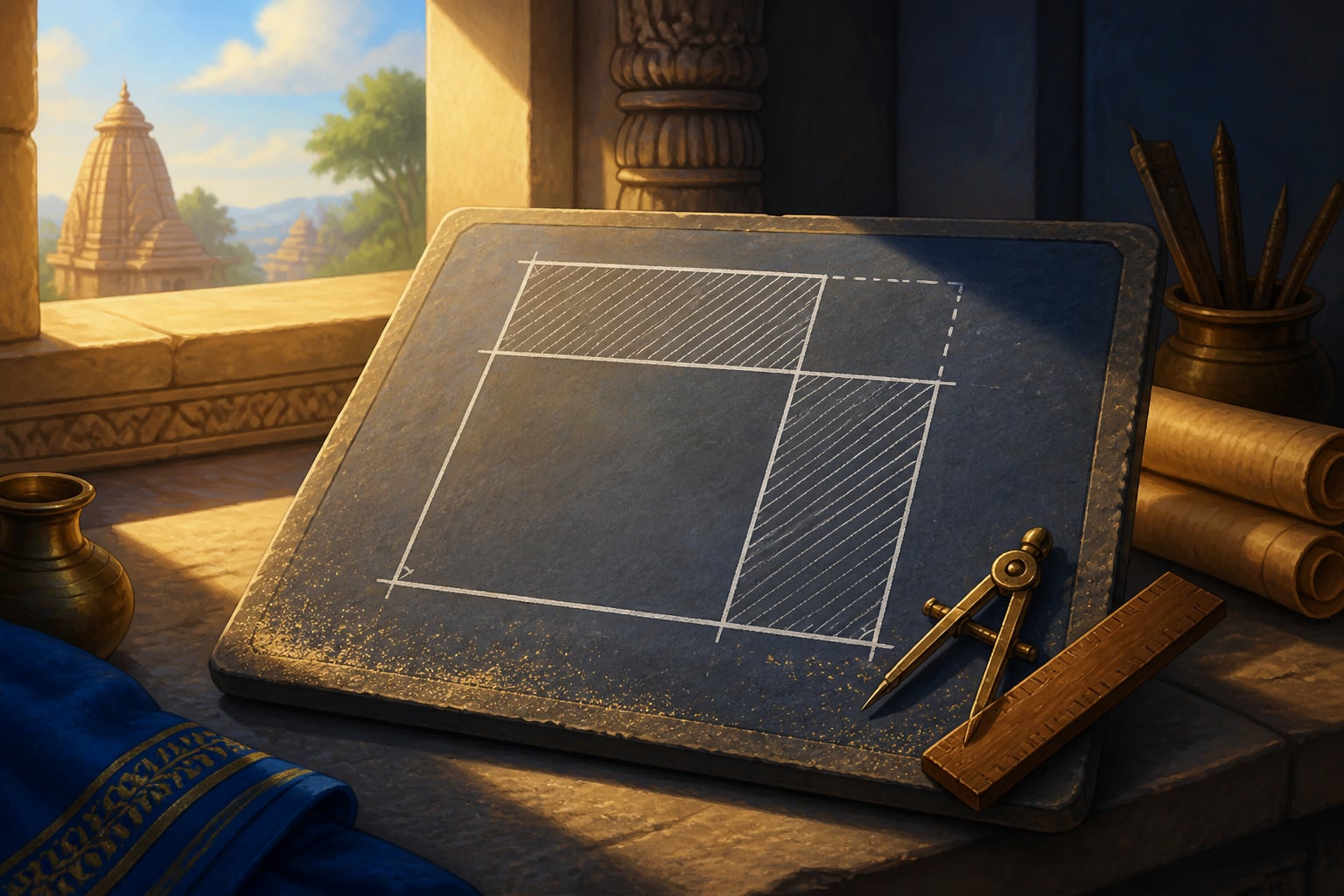
Geometric completing-the-square proof on a sand-dusted slate

Brahmagupta's Quadratic Formula

Consider the general quadratic equation: ax² + bx + c = 0. Today's students learn the quadratic formula:

x = (-b ± √(b² - 4ac)) / 2a

Brahmagupta essentially derived this formula, though he expressed it in verbal algorithms rather than modern notation. His method worked through "completing the square", a technique he systematized.

Here's how Brahmagupta approached a problem like "a square and ten of its roots equal 39" (x² + 10x = 39):

  1. Take half the coefficient of x: 10/2 = 5
  2. Square it: 5² = 25
  3. Add to both sides: x² + 10x + 25 = 64
  4. Recognize the perfect square: (x + 5)² = 64
  5. Take square root: x + 5 = 8
  6. Solve: x = 3

This procedure, described in Sanskrit verses, is mathematically identical to the quadratic formula's derivation. Brahmagupta also recognized that quadratic equations can have two solutions, including negative ones, "debts" in his terminology.

Negative Numbers and Multiple Solutions

Brahmagupta's willingness to work with negative numbers gave him an advantage over later Arabic and European algebraists. Al-Khwārizmī, writing two centuries after Brahmagupta, classified quadratic equations into six types (squares plus roots equal numbers, squares equal roots plus numbers, etc.) because he wouldn't use negative coefficients or solutions.

Brahmagupta, using his ṛṇa (debt) and dhana (fortune) framework, needed no such classification. An equation like x² - 5x - 6 = 0 presented no conceptual difficulty: one root would be a "fortune" (x = 6) and one a "debt" (x = -1). This algebraic flexibility, rooted in commercial thinking, gave Indian algebra greater generality.

Bhāskara II: The Greatest Indian Algebraist

Five centuries after Brahmagupta, Bhāskara II (1114-1185 CE) brought Indian algebra to its peak. Working at the astronomical observatory at Ujjain, he composed two masterpieces: Līlāvatī (on arithmetic, named after his daughter) and Bījagaṇita (on algebra).

Bhāskara II's Bījagaṇita is the most comprehensive algebra text from medieval India. It covers:

Bhāskara II also proved that division by zero produces infinity, refining Brahmagupta's incomplete treatment:

"A quantity divided by zero becomes a fraction with zero as denominator. This fraction is termed an infinite quantity."

This insight wouldn't be rigorously formalized until calculus developed the concept of limits, but Bhāskara's intuition was correct.

Symbolic Notation: Writing the Unknown

Modern algebra uses letters (x, y, z) for unknowns. Indian algebraists developed their own notation, using abbreviations of Sanskrit words:

A term like "yā va 3 kā 2" meant 3x² + 2y. This notation was compact enough for efficient calculation yet clear enough for communication.

Crucially, Indian algebraists used dots above letters to indicate subtraction. "yā 5 kā 2̇" meant 5x - 2y. This simple convention eliminated ambiguity and enabled manipulation of expressions with mixed positive and negative terms.

The Pell Equation: A Millennium-Long Problem

One of mathematics' most famous problems is the "Pell equation": x² - Ny² = 1, where N is a non-square integer. Find integer solutions for x and y.

This equation is misnamed, John Pell (1611-1685) made no significant contribution to it. The real heroes were Indian mathematicians, particularly Brahmagupta and Bhāskara II, who solved it centuries before Pell was born.

Brahmagupta discovered the bhāvanā (composition law): if (x₁, y₁) and (x₂, y₂) are solutions to x² - Ny² = k₁ and x² - Ny² = k₂, then a new solution can be composed from them. This principle, that solutions "multiply" to produce new solutions, is a sophisticated algebraic insight.

Bhāskara II perfected this with the Chakravala (cyclic) method, an elegant algorithm that systematically finds solutions to any Pell equation. For x² - 61y² = 1, the smallest solution is x = 1,766,319,049 and y = 226,153,980, a result Bhāskara's algorithm finds through systematic iteration.

European mathematicians rediscovered the Pell equation in the 17th century. Fermat challenged his contemporaries to solve x² - 61y² = 1, not knowing that Bhāskara had solved it 500 years earlier.

The Journey to Arabia

Indian algebra traveled west through the same channels as the decimal system. When Indian astronomical texts reached Baghdad in the 8th century, they carried algebraic methods along with numerical techniques.

Al-Khwārizmī's famous Al-Kitāb al-mukhtaṣar fī ḥisāb al-jabr wa-l-muqābala ("The Compendious Book on Calculation by Completion and Balancing") appeared around 820 CE. While original in many ways, it shows Indian influence in its systematic approach to equation-solving and its use of completing-the-square methods.

Arabic algebra, however, rejected negative numbers and avoided geometric solutions for what were essentially arithmetic problems. This made Arabic algebra more limited than its Indian predecessor in some respects, even as Arabic mathematicians extended algebra in other directions.

Italian Renaissance mathematicians dueling over a cubic solution

From Arabia to Europe

Fibonacci's Liber Abaci (1202) introduced not just Hindu-Arabic numerals but also algebraic methods to Europe. His treatment of indeterminate problems shows direct Indian influence through Arabic intermediaries.

The Italian "algebra wars" of the 16th century, when mathematicians competed to solve cubic and quartic equations, built on foundations that included Indian quadratic methods transmitted through Arabic sources.

The modern symbolic notation we use (x, +, =, etc.) developed in Europe during the 15th-17th centuries, replacing both Arabic rhetorical algebra and Indian abbreviated notation. But the underlying concepts, unknowns, operations on unknowns, systematic solution methods, trace back to the bījagaṇita tradition.

Why "Seeds"?

The term bījagaṇita, mathematics of seeds, captures something profound about algebraic thinking. A seed is potential waiting to be realized. When you plant it and provide the right conditions, its hidden nature unfolds.

An algebraic unknown works the same way. The "x" in an equation isn't a mystery to be feared but a potential to be realized. By applying mathematical operations, the "right conditions", we help the unknown reveal its true value.

This agricultural metaphor also suggests growth and development. Just as a seed becomes increasingly complex as it grows, algebraic methods let us build increasingly complex mathematical structures from simple beginnings. Variables combine into expressions, expressions into equations, equations into systems, each level emerging from the previous like a plant from a seed.

Indian mathematicians, working in an agricultural civilization, naturally thought in these terms. The metaphor made algebra intuitive and accessible, not forbidding.

The Legacy in Modern Mathematics

Every time a student solves a quadratic equation, they use methods Brahmagupta systematized. The quadratic formula is his algorithm in modern dress. The acceptance of negative solutions follows his ṛṇa-dhana framework.

Beyond school mathematics, Indian algebraic influence persists in:

The seeds planted in Ujjain and Bhillamāla fourteen centuries ago continue to grow, branching into applications their planters never imagined.

Key figures

Bhāskara II (Bhāskarācārya)

1114-1185 CE

Mahāvīra

c. 800-870 CE

Gerolamo Cardano

1501-1576 CE

Case studies

Fermat's Challenge and Bhāskara's Ancient Answer

[12th Century vs 17th Century] In 1657, Pierre de Fermat challenged European mathematicians to solve x² - 61y² = 1. The smallest solution involves enormous numbers: x = 1,766,319,049 and y = 226,153,980. European mathematicians struggled for years. Unknown to them, Bhāskara II had solved this exact problem 500 years earlier using the Cakravāla method.

Bhāskara's Cakravāla systematically reduces the problem through cycles of operations, converging on a solution regardless of how large the numbers become. European mathematicians eventually developed similar methods (continued fractions), but Indian algebraists had the solution centuries earlier.

Today, researchers sometimes "rediscover" results published in languages they don't read or in journals they don't access. International collaboration and translation help, but isolated pockets of knowledge still exist.

Mathematical discovery isn't always progressive. Knowledge can be lost, forgotten, or simply not transmitted across cultural boundaries. Indian algebraic achievements remained unknown in Europe, forcing unnecessary rediscovery.

Open-source software mirrors this pattern. Developers worldwide independently solve problems that others already cracked, simply because solutions were siloed. GitHub and open-source culture exist precisely to prevent the knowledge fragmentation that cost European mathematicians 500 years.

500 years - referenced in the context of Fermat's Challenge and Bhāskara's Ancient Answer.

The Quadratic Formula in Every Classroom

Millions of students worldwide learn the quadratic formula: x = (-b ± √(b² - 4ac)) / 2a. They memorize it, apply it to homework problems, and rarely think about its origin. Yet this formula encapsulates Brahmagupta's completing-the-square method, taught in 7th-century India.

The pedagogical approach - presenting a formula as a tool to be applied - obscures the creative process that produced it. Brahmagupta didn't receive the formula from heaven; he developed it through systematic reasoning about how to transform equations into solvable forms.

In programming, developers often use libraries and APIs without understanding their implementation. While efficient, this can limit innovation. Those who understand the principles behind tools can extend and improve them.

Behind every mathematical "formula" lies human creativity. Understanding the reasoning behind tools, not just how to use them, connects us to the tradition of mathematical thinking.

Students memorize formulas in physics, chemistry, and engineering without knowing their origins. Understanding the creative reasoning behind these tools transforms rote learning into genuine mathematical fluency, a skill increasingly valuable as AI handles routine calculation.

Indian mathematical concepts, including the decimal system and zero, are used by over 7 billion people worldwide today.

When Debts Became Numbers

[7th-16th Century CE] Brahmagupta treated negative numbers as "debts" (ṛṇa) in the 7th century, developing complete rules for their arithmetic. European mathematicians resisted negative numbers until the 16th-17th centuries. Cardano called negative roots "fictitious," and even in 1758, Francis Maseres argued that negative numbers "darken the very whole doctrines of equations."

The difference was conceptual. Indian mathematicians, embedded in a sophisticated commercial culture, naturally thought of quantities less than zero - you can owe money you don't have. European mathematicians, influenced by Greek geometry where lengths must be positive, found negatives philosophically troubling.

Today, concepts like negative probabilities, imaginary time, or negative energy in physics challenge intuitions. History suggests that initially "absurd" concepts may become normal once the right interpretive framework develops.

Mathematical acceptance depends on conceptual frameworks, not just logical validity. A concept that makes sense in one cultural context may seem absurd in another, even if both cultures are mathematically sophisticated.

Financial instruments like short selling and credit default swaps only work because modern markets accept negative values as legitimate. Fintech companies building on negative balance concepts owe a direct intellectual debt to Brahmagupta's willingness to treat 'less than nothing' as mathematically real.

7th century - referenced in the context of When Debts Became Numbers.

Historical context

Classical to Medieval Indian Mathematics (5th-12th Century CE)

Living traditions

Every quadratic formula application descends from Brahmagupta's methods. The structure of modern algebraic notation, using letters for unknowns, symbols for operations, follows principles Indian algebraists established. India's strong performance in mathematical olympiads and research reflects a cultural heritage that valued mathematical excellence. Computer algebra systems implement, in silicon, algorithms that Indian mathematicians developed for paper and ink.

Reflection

More in Gaṇita: Mathematics That Changed the World

All lessons in Gaṇita: Mathematics That Changed the World · Bharatiya Vigyan: Inventions & Discoveries course