Jyā: Trigonometry Born from Astronomy
How 'jyā' became 'sine' and transformed navigation and physics
Trace how Āryabhaṭa's sine tables (499 CE) became 'jiba' in Arabic and then 'sine' in Latin, forming the foundation for modern trigonometry.
Jyā: Trigonometry Born from Astronomy
The word "sine", that fundamental function of trigonometry, essential to everything from GPS navigation to musical synthesis, traces back through one of history's most remarkable linguistic accidents. It begins with the Sanskrit word jyā, meaning "bowstring."
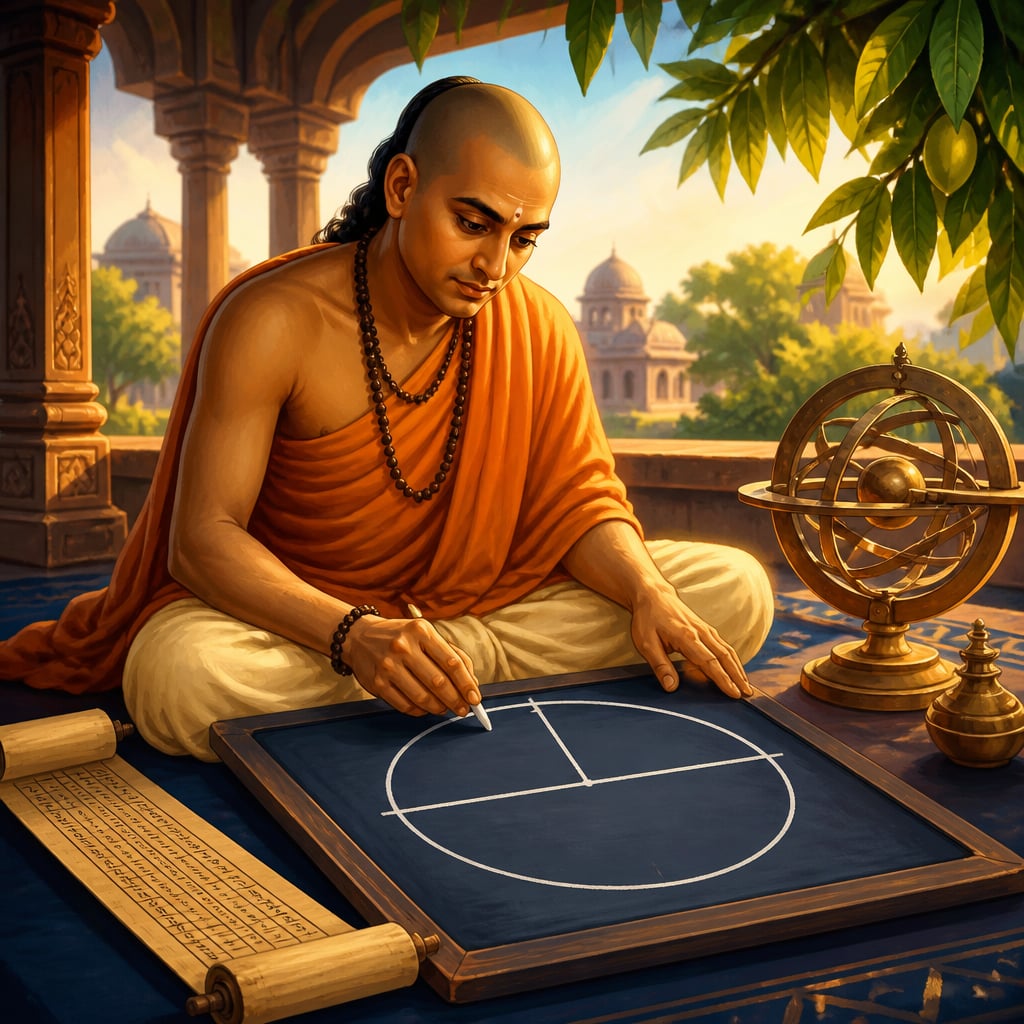
Imagine a bow. The curved arc is like a portion of a circle. The string connecting the bow's ends is the jyā. If you draw a line from the midpoint of the arc to the midpoint of the string, you have what Indian mathematicians called the śara (arrow). This bowstring geometry became the foundation of trigonometry, and the word "sine" preserves, through centuries of linguistic transformation, the original Sanskrit image.
The Astronomical Imperative
Why did Indian mathematicians develop trigonometry? The answer lies not in abstract curiosity but in the practical demands of astronomy.
Indian civilization required precise astronomical calculation for multiple purposes:
- Religious calendars: Festivals like Diwali and Holi depend on lunar phases and solar positions. Accurate prediction required mathematical models of celestial motion.
- Agricultural timing: Planting and harvesting seasons follow astronomical patterns. Getting them right meant survival.
- Astrological computation: Whether one believes in astrology or not, its cultural importance in ancient India drove sophisticated astronomical mathematics.
- Navigation: Sailors crossing the Indian Ocean needed to read the stars.
To predict where the Sun, Moon, and planets would appear at any given time, astronomers needed to convert between different celestial coordinate systems. These conversions required calculating relationships between angles and lengths, exactly what trigonometry provides.
From Chords to Half-Chords
Greek astronomers, particularly Hipparchus (c. 190-120 BCE) and Ptolemy (c. 100-170 CE), also developed trigonometric methods. But they worked with chords, the full string connecting two points on a circle, rather than half-chords.
For a chord of angle θ, the Greek method gives the length of the full bowstring. Indian mathematicians realized that working with the half-chord was more efficient. The half-chord of angle θ corresponds exactly to what we now call sin(θ/2) multiplied by the radius.
This shift from chord to half-chord was more than a minor adjustment. It simplified calculations, made interpolation easier, and produced tables that were more practically useful. Indian trigonometry was built on the jyā (later called ardha-jyā or half-chord), while Greek trigonometry used full chords. The Indian approach proved superior and eventually superseded the Greek method worldwide.
Āryabhaṭa's Sine Table
In 499 CE, the 23-year-old Āryabhaṭa compiled a sine table that would influence mathematics for over a millennium. His Āryabhaṭīya contains values of jyā for angles from 0° to 90° at intervals of 3.75° (that is, 3°45', one-quarter of 15°).
Āryabhaṭa used a circle of radius 3,438, a seemingly odd choice until you realize that this is approximately the number of minutes in a radian (the circumference divided by 2π, converted to minutes). This clever choice made angular calculations more convenient.
His table's first few values:
- jyā(3°45') = 225
- jyā(7°30') = 449
- jyā(11°15') = 671
- ...
- jyā(90°) = 3,438 (the radius itself)
The accuracy is remarkable. Converting to modern terms, Āryabhaṭa's value for sin(30°) corresponds to 0.5000, and his sin(90°) is exactly 1. Some entries are accurate to four decimal places, precision sufficient for naked-eye astronomical observation.
The Difference Formula
Āryabhaṭa didn't just tabulate values; he provided a method to generate them. His second-order difference formula for computing successive sine values anticipated techniques that wouldn't appear in Europe until the 17th century.
The formula can be written as: jyā(n+1) - jyā(n) = [jyā(n) - jyā(n-1)] - jyā(n)/225
This recursive relationship allowed astronomers to compute sine values without laboriously calculating each from first principles. It's a discrete approximation to the differential equation that defines the sine function, calculus in embryonic form, appearing in 499 CE.
The Sūryasiddhānta and Systematic Trigonometry
The Sūryasiddhānta ("Sun Treatise"), a foundational Indian astronomical text with versions dating from roughly 400-500 CE, systematized trigonometric methods. It defined all the basic trigonometric quantities:
- Jyā (sine): Half the chord of twice the angle
- Koṭi-jyā (cosine): The "complement sine", what we call cos(θ)
- Utkrama-jyā (versine): The "reverse sine", 1 - cos(θ) in modern terms
The text provided detailed procedures for interpolation, allowing astronomers to find sine values for any angle, not just those tabulated. It also explained how to use these functions to solve astronomical problems: computing eclipses, planetary positions, and the rising/setting times of celestial bodies.

From Jyā to Jība to Sinus
Here's where etymology becomes adventure.
When Arabic scholars translated Indian astronomical texts (8th-9th centuries CE), they encountered jyā and its variant jīvā. Arabic lacks the vowel sounds for this word, so translators wrote it as jība (جيب), using Arabic letters that approximated the sound.
But jība written without vowel marks (as Arabic typically is) looks identical to jayb (جيب), an Arabic word meaning "pocket" or "fold", like the fold of a garment.
Centuries later, when European scholars translated Arabic mathematical texts into Latin (12th century CE), they encountered jayb and, assuming it was a meaningful Arabic word, translated it as sinus, Latin for "bay," "fold," or "curve." Gerard of Cremona, the great translator working in Toledo, likely made this choice around 1150 CE.
Thus jyā (bowstring) → jība (transliteration) → jayb (misreading) → sinus (translation) → "sine."
The word "sine" preserves, through this remarkable chain of errors and approximations, the original Sanskrit concept of the bowstring.
Cosine, Tangent, and Beyond
The other trigonometric functions followed different paths:
Cosine comes from co-sinus (complementary sine), the sine of the complementary angle (90° - θ). The Sanskrit koṭi-jyā ("corner-sine" or "side-sine") expressed the same idea.
Tangent derives from Latin tangens (touching), referring to a line touching the circle. Indian mathematicians used the term sparśa-jyā ("touch-sine") or computed it as the ratio of sine to cosine.
Versine (versed sine or utkrama-jyā) was important in Indian astronomy but fell out of common use in modern mathematics. It equals 1 - cos(θ) and was useful for certain astronomical calculations.
Bhāskara I and Approximate Formulas
Bhāskara I (c. 600-680 CE), a commentator on Āryabhaṭa's work, developed a remarkably accurate approximate formula for the sine function:
sin(x°) ≈ 4x(180-x) / [40500 - x(180-x)]
For x between 0 and 180, this formula is accurate to within 1.8%, good enough for many practical calculations and far easier than consulting tables.
This rational approximation anticipated Taylor series approximations by a millennium. Bhāskara I knew the formula was approximate, not exact, and discussed its limits, a sophisticated understanding of mathematical approximation.
The Integration of Greek and Indian Methods
Indian and Greek trigonometry developed somewhat independently, though contact existed. By the classical period (500-1200 CE), Indian astronomers were aware of Greek astronomical models through texts that had reached India via trade routes and diplomatic exchanges.
But Indian trigonometry had distinctive features:
- Half-chords instead of chords: More efficient for calculation
- Algebraic formulas: Difference formulas, interpolation methods, rational approximations
- Integration with astronomy: Trigonometry wasn't abstract geometry but a tool for celestial computation
Arabic astronomers synthesized both traditions, selecting the most useful elements from each. The half-chord approach (Indian) combined with systematic geometric proofs (Greek) produced the trigonometry that eventually reached Europe.

Navigation and the Practical Impact
Trigonometry transformed navigation. Sailors could determine latitude by measuring the angle of the North Star or Sun above the horizon. With accurate sine tables, they could convert these angular measurements into positions on the globe.
The Indian Ocean trade networks, connecting India with East Africa, Arabia, and Southeast Asia, relied on navigational techniques that used trigonometric calculations. Arab navigators who traversed these routes carried Indian mathematical knowledge westward.
When European sailors began their age of exploration (15th-16th centuries), they used trigonometric tables descended from Āryabhaṭa's work. The sine function that helped Columbus cross the Atlantic and Vasco da Gama reach India traced back to Indian astronomers calculating lunar eclipses a thousand years earlier.
Modern Applications: From Music to Missiles
Today, the sine function is ubiquitous:
Physics: Simple harmonic motion, wave mechanics, and electromagnetic theory all build on sinusoidal functions. The equations governing everything from pendulums to light waves use sine and cosine.
Engineering: Signal processing, electrical circuits, and structural analysis require trigonometry. Your phone's display, audio system, and antenna design all depend on sine functions.
Computer Graphics: Rotations, projections, and animations use trigonometric calculations. Every video game character that turns, every 3D model that rotates, invokes sine and cosine thousands of times per second.
Music: Sound waves are sinusoidal. Digital audio sampling, synthesis, and processing work with sine functions directly. The music you stream is reconstructed through trigonometric computation.
GPS: Your phone determines its position by comparing signals from multiple satellites. The calculations involve spherical trigonometry, the extension of Āryabhaṭa's methods to the surface of a sphere.
The bowstring that Indian astronomers imagined sixteen centuries ago now vibrates through every electronic device, every satellite orbit calculation, every pixel on every screen.
Key figures
Āryabhaṭa
476-550 CE
Bhāskara I
c. 600-680 CE
Varāhamihira
c. 505-587 CE
Gerard of Cremona
c. 1114-1187 CE
Case studies
The Linguistic Journey: From Bowstring to Sine
[5th-12th Century CE] In 499 CE, Āryabhaṭa uses 'jyā' (bowstring) for sine values. Arab translators (8th-9th century) write it as 'jība.' Scribes later read it as 'jayb' (pocket/fold). Gerard of Cremona (12th century) translates 'jayb' as Latin 'sinus' (curve/bay). Today's 'sine' preserves, through four languages and three mistranslations, the original Sanskrit image of a bow's string.
This etymology reveals how mathematical knowledge travels through human hands, accumulating accidents and reinterpretations. The word 'sine' makes no sense in Latin - a 'bay' or 'fold' has nothing to do with triangles. But it perfectly describes a bowstring, if you know Sanskrit.
Software carries similar hidden histories. Why is 'cookie' used for web authentication tokens? Why 'spam' for unwanted email? Technical terminology accumulates accidents and jokes that become invisible as terms become standard.
Knowledge transmission involves human intermediaries who may not fully understand what they're passing along. The content survives, but context is lost. Etymology can reveal hidden histories that straightforward technical accounts obscure.
Technical terminology in software development follows similar translation chains. The word 'bug' (from an actual moth in a relay) and 'spam' (from a Monty Python sketch) obscure their origins entirely. Etymology reveals hidden histories that explain why our technical vocabulary looks the way it does.
499 CE - referenced in the context of The Linguistic Journey: From Bowstring to Sine.
Your Phone's Ancient Mathematics
When GPS calculates your position, it uses spherical trigonometry - the extension of planar trigonometry to curved surfaces. The satellites orbit Earth; your phone receives signals and computes distances. Converting these distances to latitude and longitude requires sine and cosine functions applied to Earth's sphere.
Āryabhaṭa computed sine tables to predict eclipses and planetary positions. The same mathematics now guides airplanes, ships, and billions of smartphones. The application changed; the underlying functions remain exactly as Indian astronomers defined them.
When developing foundational tools, design for generality. Specific applications will change, but well-designed fundamentals persist. Today's algorithms may power applications we can't yet imagine.
Fundamental mathematical concepts transcend their original applications. Āryabhaṭa couldn't have imagined GPS, but his mathematical framework was general enough to support technologies beyond his wildest dreams.
Your phone's GPS, music streaming compression algorithms, and medical imaging (MRI, CT scans) all rely on trigonometric functions. Every time a signal is decomposed into frequency components using Fourier transforms, the mathematical lineage traces back to ancient sine table computations.
Indian mathematical concepts, including the decimal system and zero, are used by over 7 billion people worldwide today.
How Star-Gazers Enabled Ocean Crossing
[5th-15th Century CE] Indian Ocean sailors needed to determine latitude at sea. By measuring the North Star's angle above the horizon and using sine tables, they could calculate their position. These tables descended from astronomical computations originally meant for predicting eclipses and festivals.
The transfer from astronomy to navigation shows how theoretical mathematics acquires practical applications. Āryabhaṭa computed sines to understand the heavens; merchants and sailors used those same tables to cross oceans. The mathematics was universal; applications expanded as needs arose.
Today's theoretical research - in quantum computing, abstract mathematics, or fundamental physics - may similarly enable applications we cannot currently envision. The argument for supporting basic research is historical as much as speculative.
Investment in 'pure' or theoretical knowledge often yields unexpected practical returns. Astronomers developing trigonometry for intellectual satisfaction accidentally created tools that transformed global trade.
Government funding for theoretical physics, pure mathematics, and basic science research faces constant budget pressure because returns are unpredictable. Yet historically, the biggest technological payoffs come from research that had no obvious application when conducted. CERN's particle physics research accidentally produced the World Wide Web.
Indian mathematical concepts, including the decimal system and zero, are used by over 7 billion people worldwide today.
Historical context
Classical Indian Astronomy (5th-12th Century CE)
Living traditions
Trigonometry is embedded in modern life beyond visibility. Every GPS calculation, every computer graphic rotation, every audio compression algorithm uses sine and cosine. The word 'sine' itself, distorted through Sanskrit, Arabic, and Latin, reminds us that mathematics is a human creation, passed through human hands, shaped by the accidents of transmission. When you calculate with trigonometric functions, you're using tools that Indian astronomers forged to understand the heavens, transmitted through Baghdad and Toledo, and now woven into the fabric of global technology.
- Jantar Mantar, Jaipur: The largest and best-preserved of Sawai Jai Singh II's observatories (1734). Its massive instruments physically embody trigonometric relationships, allowing naked-eye measurements accurate to arc-seconds.
- Ujjain Observatory: India's ancient 'Greenwich', the prime meridian reference point for Indian astronomy. The site has served astronomical functions for over 2,000 years.
- Nalanda Archaeological Site: The ancient university (5th-12th century CE) where astronomical and mathematical knowledge was taught, preserved, and transmitted across Asia.
Reflection
- The word 'sine' preserves, through multiple mistranslations, the original Sanskrit image of a bowstring. What other technical terms might hide forgotten origins? Does knowing the etymology change how you understand the concept?
- Indian astronomers developed trigonometry for religious calendars and astrology. Does the original motivation matter when evaluating mathematical achievement? Can knowledge be separated from its context?
- Āryabhaṭa's sine table and Bhāskara I's approximation formula represent two approaches: precise tabulation versus approximate calculation. When is precision essential, and when is a good approximation better?