Śulbasūtra: Geometry in Sacred Architecture

The Pythagorean theorem centuries before Pythagoras

Explore geometric constructions in the Śulbasūtras for altar building, including early statements of the Pythagorean theorem and sophisticated square root approximations.

Śulbasūtra: Geometry in Sacred Architecture

Long before Pythagoras was born in the Greek island of Samos, Vedic priests in northern India were applying his theorem to construct sacred altars. The Śulbasūtras, texts on the "rules of the cord", contain the earliest known statements of what we call the Pythagorean theorem, sophisticated approximations for √2, and elegant methods for geometric construction using nothing but ropes and pegs.
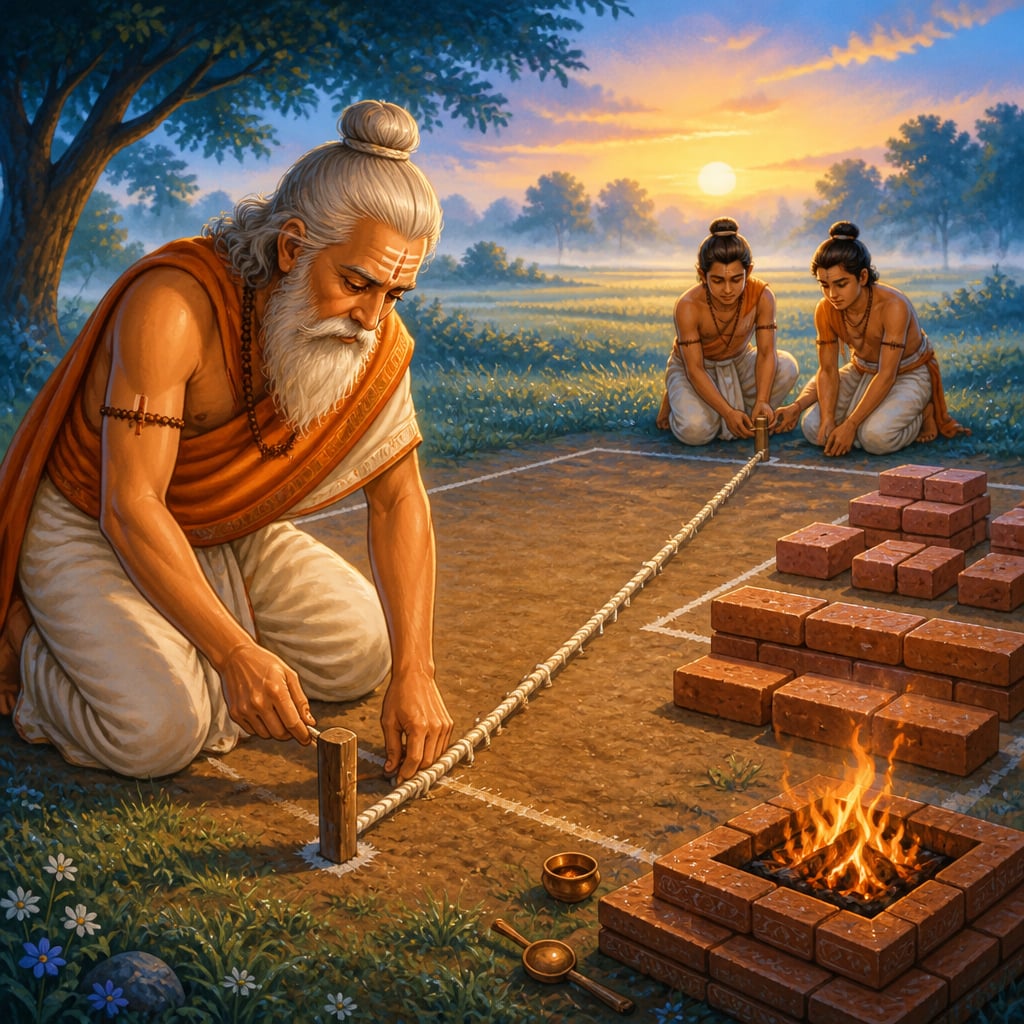
Baudhayana laying out a Vedic fire altar with rope and pegs

These were not abstract mathematical treatises. They were practical manuals for building yajña (sacrifice) altars with precise geometric specifications. The mathematics emerged from religious necessity, and achieved remarkable sophistication in service of sacred architecture.

What Are the Śulbasūtras?

The Śulbasūtras are appendices to the Vedas, specifically to the Kalpa Sūtras that govern ritual procedures. The word śulba (sometimes śulva) means "cord" or "rope", the primary measuring instrument used in altar construction. These texts explain how to lay out altars using cords stretched between pegs, achieving precise geometric relationships.

Four main Śulbasūtras survive:

The dates are approximate and contested, but the Baudhāyana Śulbasūtra is generally considered the oldest, predating Pythagoras (c. 570-495 BCE) by one to three centuries.

The Ritual Context: Why Altars?

Vedic religion centered on yajña, ritual sacrifice involving fire, offerings, and precise procedures. The altar (vedi) was the sacred space where humans communicated with deities. Its shape, size, and orientation weren't arbitrary but carried cosmic significance.

Different rituals required different altars:

The priests needed to construct these shapes with precision, often transforming one shape into another while preserving area. A square altar might need to be converted into a circular altar of the same area, requiring what we'd call π. An altar might need to be doubled in area while remaining the same shape, requiring √2.

These practical demands drove mathematical innovation.

The Pythagorean Theorem: Baudhāyana's Statement

The Baudhāyana Śulbasūtra contains the earliest known explicit statement of the relationship between the sides of a right triangle:

dīrghacaturaśrasyākṣṇayārajjuḥ pārśvamānī tiryaṅmānī ca yatpṛthagbhūte kurutaḥ tadubhayaṃ karoti

"The diagonal of a rectangle produces both [areas] which its length and breadth produce separately."

In modern terms: For a rectangle with sides a and b, the diagonal c satisfies a² + b² = c². This is exactly the Pythagorean theorem.

The Baudhāyana Śulbasūtra also lists specific Pythagorean triples:

These integer solutions were used for practical construction. A cord marked at intervals of 3, 4, and 5 units, stretched into a triangle, automatically produces a right angle.

Geometric proof of root two on a sand tray

The √2 Approximation: A Mathematical Marvel

The Śulbasūtras contain an astonishingly accurate approximation for the square root of 2:

√2 ≈ 1 + 1/3 + 1/(3×4) - 1/(3×4×34)

Working this out:

Sum: 1 + 0.333 + 0.0833 - 0.00245 ≈ 1.41421568...

The actual value of √2 is 1.41421356...

The approximation is accurate to five decimal places, a remarkable achievement for texts composed over 2,500 years ago, using only cord-and-peg geometry.

How did they derive this? Possibly through iterative refinement: starting with an estimate, computing a better estimate as the average of the estimate and 2/estimate, and repeating. This Babylonian method converges rapidly to √2.

Squaring the Circle: The π Problem

Converting a circular altar to a square of equal area requires knowing π. The Śulbasūtras provide practical approximations:

Circle to Square: To construct a square equal in area to a given circle, take 13/15 of the diameter as the side of the square.

This implies π ≈ 4×(13/15)² ≈ 3.004, not particularly accurate, but workable for ritual purposes.

Square to Circle: To construct a circle equal in area to a given square, take the side, add 1/3, then add 1/(3×4) minus 1/(3×4×34) of that third.

This more complex procedure yields a better approximation. The Śulbasūtra authors knew that their constructions were approximate, they used the term "as near as possible" (saviśeṣa) when describing these transformations.

Construction Techniques: Applied Geometry

The Śulbasūtras describe elegant construction methods using only cord and pegs:

Constructing a Right Angle: Fix one end of a cord at point A. Swing the cord to mark a circle. Without changing the cord length, fix at another point B on the circle and mark another circle. The two intersection points, connected to A and B, form right angles.

Doubling a Square's Area: Draw the original square. Its diagonal is the side of a square with double the area. This follows directly from the Pythagorean theorem: if the original side is s, the diagonal is s√2, and (s√2)² = 2s².

Constructing a Square Equal to Two Given Squares: For squares with sides a and b, the combined area a² + b² equals the area of a square with side c, where c is the hypotenuse of a right triangle with legs a and b. Again, the Pythagorean theorem in action.

Halving a Square: Draw diagonals; each of the four triangles has 1/4 the original area. Two adjacent triangles form a square with half the original area.

These constructions were practical algorithms, expressed step-by-step like modern computational procedures.

Completed Vedic falcon altar at twilight

The Falcon Altar: Geometric Artistry

The most remarkable altar design was the śyenaciti, the falcon-shaped altar. Used in the Agnicayana ritual (one of the most complex Vedic ceremonies), this altar was constructed from 200 bricks arranged in the shape of a bird with outstretched wings.

The mathematics required:

The falcon altar could be increased in area for subsequent rituals, each layer adding one unit of area while maintaining the bird shape. This required sophisticated area calculations and proportional scaling.

Beyond Pythagoras: Other Geometric Knowledge

The Śulbasūtras contain additional geometric insights:

Properties of Diagonals: The diagonals of a rectangle bisect each other. The diagonals of a square are equal and bisect each other at right angles.

Area Relationships: The area of a square equals the square of its side (obvious to us, but requiring recognition that area and length are related quantities).

Similar Triangles: Procedures for scaling figures while maintaining proportions implicitly use similar triangle properties.

Constructible Lengths: The texts work with lengths that can be constructed with compass and straightedge (in modern terms, algebraic numbers of degree ≤ 2).

No Proofs, But Understanding

The Śulbasūtras state results without proofs in the Greek sense. They don't explain why the Pythagorean theorem is true; they simply state it and use it.

Does this mean the authors didn't understand it? Not necessarily. The texts were practical manuals, not philosophical treatises. The audience was priests learning construction techniques, not mathematicians seeking justification.

Moreover, the constructions themselves demonstrate understanding. You can't reliably construct a square of double area by accident. The procedure works because the underlying mathematics is correct, and whoever devised it must have understood why.

The Śulbasūtras represent operational mathematics, mathematics as procedures for achieving results, rather than theoretical mathematics, mathematics as a system of proven propositions.

India, Babylon, and Greece: Three Traditions

The Pythagorean theorem appears in three ancient cultures:

Babylon (c. 1800-1600 BCE): Cuneiform tablets like Plimpton 322 list Pythagorean triples, showing Babylonians knew the relationship between sides of right triangles.

India (c. 800-600 BCE): The Śulbasūtras explicitly state and apply the theorem for practical construction.

Greece (c. 500-300 BCE): Pythagoras and later Euclid not only stated the theorem but proved it within a deductive system.

Each tradition approached geometry differently. Babylonians computed; Indians constructed; Greeks proved. The theorem itself transcends any single culture, it's a truth about triangles that humans discovered, in different ways, across civilizations.

Why "Pythagorean"?

If Indians knew the theorem before Pythagoras, why do we call it the "Pythagorean theorem"?

Historical accident, essentially. European mathematics built on Greek foundations, and Greek mathematics became the "standard" tradition through Islamic transmission and Renaissance recovery. The Indian contributions, preserved in Sanskrit texts that weren't translated into European languages until the 19th-20th centuries, remained unknown to Western mathematicians.

Some scholars suggest calling it the "Baudhāyana-Pythagoras theorem" or simply the "right triangle theorem." But names are sticky, and "Pythagorean" will likely persist.

What matters more than names is recognition: multiple civilizations independently discovered and applied this fundamental geometric relationship.

Legacy: From Altars to Architecture

The geometric traditions of the Śulbasūtras influenced later Indian architecture. Temple construction, particularly the precise proportions of South Indian gopurams and North Indian śikharas, drew on geometric principles that descended from Vedic altar mathematics.

The emphasis on precise measurement, proportional relationships, and geometric transformation appears in:

The mathematics born from religious necessity became embedded in India's architectural DNA.

Key figures

Baudhāyana

c. 800-600 BCE

Āpastamba

c. 600-500 BCE

Pythagoras

c. 570-495 BCE

Case studies

Building the Falcon Altar: Applied Geometry

[c. 800-200 BCE] The Agnicayana ritual required constructing a falcon-shaped altar (śyenaciti) from exactly 200 bricks, maintaining specific proportions while achieving a required total area. Each layer had to be larger than the previous by exactly one unit of area, while keeping the falcon shape.

This construction required: (1) dividing irregular shapes into computable areas, (2) scaling figures while maintaining proportions, (3) designing brick shapes that tile correctly, and (4) calculating how increased area translates to increased dimensions. The priests were doing practical geometry of considerable sophistication.

Modern CAD systems and architectural software solve similar problems: tiling irregular shapes, maintaining proportions while scaling, and converting between area and length requirements. The Vedic geometers did this with rope and bricks.

Complex practical requirements can drive mathematical innovation. The falcon altar's constraints forced geometers to solve problems that pure theoretical curiosity might not have posed.

Modern architectural firms use parametric design software (Rhino, Grasshopper) to solve geometric constraints automatically. But the underlying challenge is identical to the falcon altar: satisfy multiple conflicting geometric requirements simultaneously. Constraint-based design thinking is as relevant in 3D printing as it was in Vedic ritual construction.

Indian mathematical concepts, including the decimal system and zero, are used by over 7 billion people worldwide today.

The 3-4-5 Triangle: Ancient Surveying Technology

[Ancient through Medieval] A priest needs to construct a right angle for an altar corner. He takes a rope and marks it at intervals of 3, 4, and 5 units. Stretching this rope into a triangle, with the knots at the corners, automatically produces a right angle at the junction of the 3 and 4 sides.

This technique, sometimes called the 'Egyptian rope trick' (though it appears in multiple cultures), uses the Pythagorean identity 3² + 4² = 5². The beauty is that no calculation is needed in the field - the rope does the mathematics. It's a physical algorithm for producing right angles.

Modern tools similarly embed mathematical knowledge - a carpenter's square encodes right angles; a level encodes horizontal; GPS encodes spherical geometry. We use mathematical tools without always understanding their mathematics.

Encoding mathematical knowledge in physical tools makes it accessible even to those who don't understand the underlying theory. The knotted rope 'knows' the Pythagorean theorem without requiring its user to know it.

Construction workers today use laser levels and digital measuring tools, but the principle is the same: embed mathematical knowledge in tools so that practitioners don't need to derive theorems on the job. Software libraries and APIs serve the same function for programmers, encoding complex algorithms behind simple interfaces.

Indian mathematical concepts, including the decimal system and zero, are used by over 7 billion people worldwide today.

The √2 Approximation: Rational Approach to Irrational Numbers

[c. 800-600 BCE] The diagonal of a unit square is √2, an irrational number with infinite non-repeating decimals. To construct a square of double area (whose side is √2), priests needed a practical approximation: √2 ≈ 1 + 1/3 + 1/(3×4) - 1/(3×4×34) = 577/408 ≈ 1.41421568.

This approximation achieves five-decimal-place accuracy. It may derive from the iterative method: start with estimate x, compute new estimate (x + 2/x)/2, repeat. Starting with x=1, after four iterations you get approximately this value.

Numerical algorithms similarly trade theoretical completeness for practical utility. Machine learning models give useful predictions without providing complete causal understanding. Effectiveness often precedes theory.

Practical approximations can achieve remarkable precision without requiring understanding of irrational numbers as a theoretical concept. The priests needed a good value; they got one, whatever the underlying theory.

Engineers routinely use approximations that are 'good enough' for the task at hand. GPS calculations, weather simulations, and compression algorithms all use approximations of irrational or complex values. The art lies in choosing the right precision for the context, exactly as the Sulbasutra priests did.

Indian mathematical concepts, including the decimal system and zero, are used by over 7 billion people worldwide today.

Historical context

Late Vedic Period (800-200 BCE)

Living traditions

While few people construct Vedic altars today, the Śulbasūtra tradition influenced Indian architecture, town planning, and mathematical education. Modern Indian textbooks use Sanskrit terms like 'karṇa' (hypotenuse) descended from this tradition. The Śulbasūtras' rediscovery has enriched global history of mathematics, demonstrating that the Pythagorean theorem existed in multiple civilizations.

Reflection

More in Gaṇita: Mathematics That Changed the World

All lessons in Gaṇita: Mathematics That Changed the World · Bharatiya Vigyan: Inventions & Discoveries course