Parivarik Kosh: Family-Based Capital Pooling
Joint Family as Financial Unit
How the Hindu Undivided Family structure enabled capital accumulation and business continuity.
Parivarik Kosh: Family-Based Capital Pooling
In the year 1839, a young man named Jamsetji Tata was born into a family of Parsi priests in the small town of Navsari, Gujarat. The family had little wealth, but they possessed something more valuable: a tradition of pooling resources, sharing decisions, and thinking across generations. When Jamsetji broke with family tradition to enter business, he didn't abandon its principles. He built an empire not through individual genius alone, but through family capital, financial, social, and intellectual, accumulated and deployed across generations.
Today, the Tata Group is worth over $150 billion. But more remarkably, 65% of its holding company belongs to charitable trusts established by family members. The Tatas didn't just accumulate wealth; they created a system where family capital serves purposes beyond any individual lifetime.
This is parivarik kosh, family-based capital pooling, and it represents one of ancient India's most enduring financial innovations.
The Hindu Undivided Family: A Legal and Financial Architecture
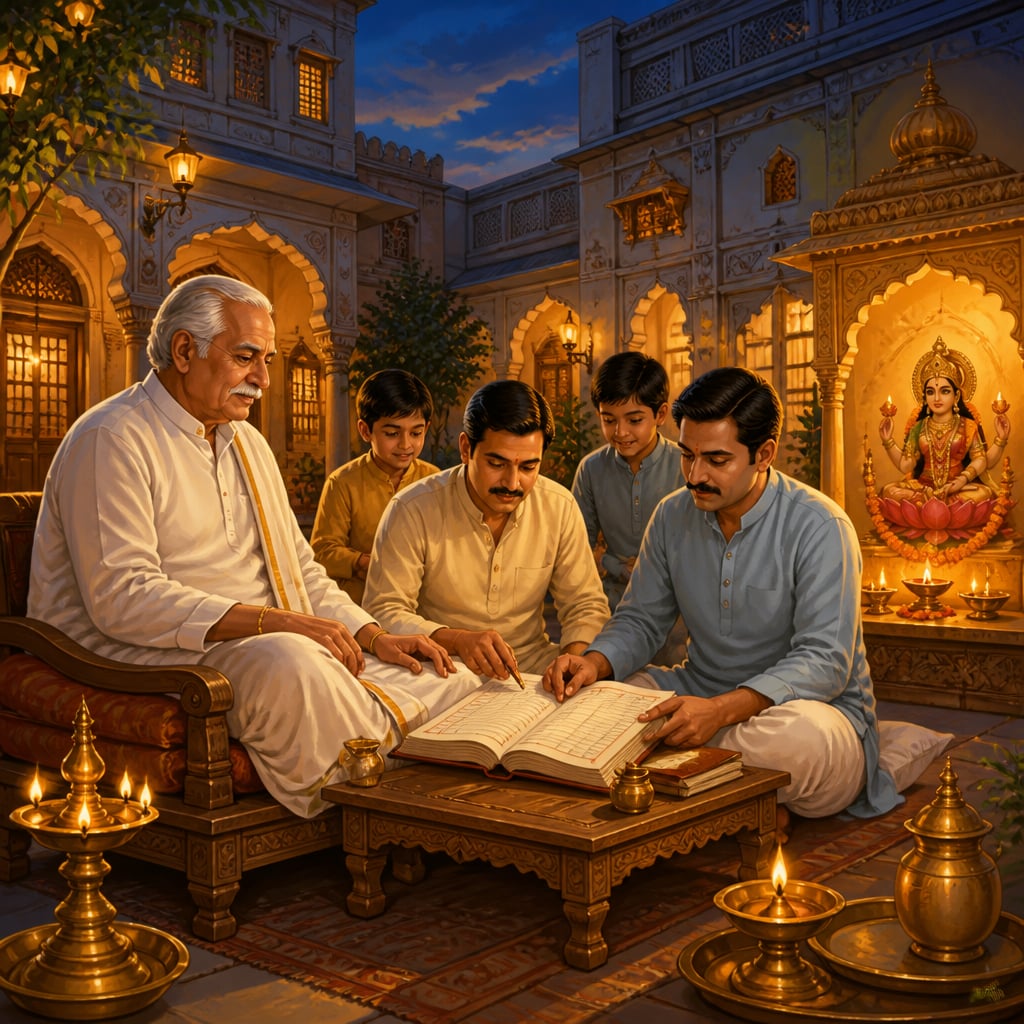
The Hindu Undivided Family (HUF) is unique in global legal history. Unlike corporations, which were invented for strangers to pool capital, or partnerships, which expire with their founders, the HUF created a perpetual financial entity based on kinship.
The core insight was revolutionary: the family, not the individual, is the fundamental economic unit. Property belonged to the family collectively. Income flowed into a common pool. Decisions were made by the Karta (head), but for the benefit of all members. The family continued across generations, with sons acquiring birthright in family property, an automatic stake in the collective enterprise.

The system was codified in the 11th-12th century by Vijnanesvara, whose commentary Mitakshara became the dominant legal framework across most of India. Under Mitakshara law, a son acquired rights in ancestral property by birth, not inheritance. He was a coparcener from the moment he was born, a shareholder in the family corporation before he could walk.
This wasn't merely a property system; it was a capital accumulation engine. When family resources remained undivided across generations, capital could grow without the fragmentation of partition. When multiple generations contributed to a single pool, the family could undertake projects no individual could attempt.
The Mathematics of Family Capital
Consider the economics of individual versus family capital accumulation:
Individual accumulation: A merchant starts at 20, accumulates for 40 years, dies at 60. His children start nearly from zero, repeating the cycle. Each generation begins the accumulation process anew.
Family accumulation: A merchant starts at 20, but his capital joins a pool accumulated by his father, grandfather, and great-grandfather. By 40, he's not managing his 20 years of savings, he's deploying four generations of accumulated capital. His contribution adds to what his children and grandchildren will inherit.
The compounding effect is dramatic. If each generation adds 50% to family capital and the pool remains undivided, after four generations, family capital is roughly 5 times what any individual could accumulate alone. After ten generations, the multiple exceeds 50 times.
This explains why India's great business communities, Marwaris, Chettiars, Gujaratis, built multi-generational dynasties while maintaining family cohesion. The HUF structure aligned individual incentives with collective benefit, making cooperation more profitable than division.
Governance: The Karta System
The HUF's genius extended to governance. The Karta (literally "doer" or "manager") held executive authority over family assets, but with significant constraints:
Fiduciary duty: The Karta managed family property for the benefit of all coparceners, not for personal gain. This dharmic obligation was legally enforceable, coparceners could challenge mismanagement.
No unlimited liability: Unlike a general partner in Western law, the Karta's personal assets were typically protected from family business debts. This encouraged entrepreneurial risk-taking.
Succession without disruption: When a Karta died, the next senior male member assumed leadership. The transition was automatic, requiring no legal proceedings or approval. Business continuity was built into the structure.
Democratic constraint: Major decisions, selling ancestral property, taking large debts, partition itself, required coparcener consent. The Karta was a steward, not an autocrat.
This governance model anticipated modern corporate structures by centuries. The separation of ownership (coparceners) and management (Karta), fiduciary duties, succession planning, and democratic oversight all emerged from dharmic principles applied to family economics.
The Medici Parallel: Family Banking in Florence

Halfway across the world, in 14th-century Florence, another family discovered similar principles. Giovanni di Bicci de' Medici founded the Medici Bank in 1397, and for nearly a century, it dominated European finance. The secret? Family.
The Medicis pooled family capital, placed family members in key positions across Europe, and maintained family control across generations. Their innovations, holding company structures, double-entry bookkeeping, branch banking, were deployed through family networks that non-family institutions couldn't replicate.
Like the HUF, the Medici model aligned family interests with business success. Branch managers in London, Rome, and Venice were often relatives, bound by loyalty beyond contract. Information flowed through family channels faster than competitors could manage. Trust was inherited, not negotiated.
The Medici Bank collapsed in 1494, but not because the family model failed, rather, successive generations neglected business for politics and patronage. The lesson: family capital requires continuous cultivation. Structure alone cannot substitute for dharmic commitment.
The Tata Model: Ancient Principles, Modern Application
When Jamsetji Tata built his business empire in the late 19th century, he drew on family capital traditions even as he adapted them for modern conditions. The Tata model demonstrates how parivarik kosh principles can scale beyond traditional HUF structures:
Pooled resources: Jamsetji reinvested profits into ambitious projects, steel mills, power plants, research institutions, that no individual could fund. He thought in generational timeframes.
Family governance: Leadership passed through family connections, but increasingly incorporated professional management. J.R.D. Tata, who led the group for 52 years (1938-1991), was Jamsetji's grand-nephew by marriage, not direct descent.
Purpose beyond profit: Jamsetji established charitable trusts that now own 66% of Tata Sons. The family's capital doesn't just accumulate, it serves society perpetually.
Structured succession: The transition from J.R.D. Tata to Ratan Tata (1991), and later to N. Chandrasekaran (2017), showed that family-originated groups can evolve into professionally managed institutions while retaining family values.
The Tata example shows that parivarik kosh isn't just about bloodline, it's about treating business as a multi-generational, purpose-driven enterprise where capital serves beyond individual lifetimes.
The Modern Relevance of Family Capital
The HUF remains legally recognized in India today (except Kerala), offering tax advantages and structural benefits for family businesses. But its deeper principles apply regardless of legal form:
Think in generations: Decisions that sacrifice long-term family prosperity for short-term individual gain violate the spirit of parivarik kosh. Whether you're building an HUF, a trust, or simply family wealth, generational thinking changes strategy.
Pool strategically: Combining family resources for major investments, education, real estate, business ventures, can generate returns impossible for individuals. The challenge is governance: who manages, who decides, who benefits?
Formalize governance: Traditional HUF governance worked in agrarian societies with clear hierarchies. Modern families need explicit agreements: investment policies, decision-making processes, conflict resolution mechanisms.
Separate ownership and management: The Karta model anticipated this need, but modern families must go further. Professional management, independent oversight, and clear role definitions prevent family disputes from destroying family capital.
Your Turn: Building Family Financial Architecture
Whether you operate within a formal HUF or simply manage family finances, the principles of parivarik kosh offer guidance:
- What financial decisions should be made individually versus collectively in your family?
- How does your family currently handle pooled resources (property, investments, education funds)?
- What governance mechanisms ensure fair treatment across family members?
- How might you structure assets to benefit generations not yet born?
- What dharmic principles guide your family's financial conduct?
The builders of the HUF system understood something fundamental: wealth that serves only the accumulator dies with them. Wealth structured to serve family across generations creates legacy. The choice of structure, individual, family, or charitable, reflects the deepest values we hold about what wealth is for.
Decisions made with only personal lifetime horizons systematically undervalue long-term assets and investments. Train yourself to evaluate financial decisions across generational timeframes: How will this affect your children? Grandchildren? This perspective naturally shifts priorities toward sustainable wealth creation over quick returns.
Family capital that grows without governance structures inevitably creates conflict. Before pooling resources with family members, establish clear agreements: Who decides? How are returns distributed? What happens in disputes? Modern families need formal mechanisms (family constitutions, councils, trustees) that traditional Karta authority provided informally.
Key terms
- Parivarik Kosh
- Family treasury or capital pool; the collective financial resources of a family unit managed for the benefit of all members and future generations.
- Hindu Undivided Family (HUF)
- A legal entity recognized under Indian law consisting of lineal descendants from a common ancestor, sharing rights in ancestral property and operating as a distinct tax and property-holding unit.
- Karta
- The head and manager of a Hindu Undivided Family, typically the senior male member, who holds executive authority over family assets with fiduciary duties to all coparceners.
- Coparcener
- A member of the HUF with birthright in ancestral property; under Mitakshara law, one who acquires rights by birth rather than inheritance, sharing joint ownership with other coparceners.
Key figures
Vijnanesvara
11th-12th century CE
Jamsetji Tata
1839-1904
Giovanni di Bicci de' Medici
1360-1429
Case studies
Mitakshara: Codifying Family Capital
In the 11th-12th century, India had diverse and sometimes conflicting traditions regarding family property. In Bengal and Assam, the Dayabhaga school held that sons inherit only after the father's death. Across most of India, the Mitakshara tradition held that sons acquire rights by birth. When Vijnanesvara wrote his commentary on the Yajnavalkya Smriti, he codified and systematized Mitakshara principles, creating the legal architecture for joint family property that would govern Indian business families for centuries.
Vijnanesvara's framework balanced multiple dharmic principles: the father's authority (pitru-dharma) with sons' birthright (putra-adhikara); family unity (kula-samuha) with individual rights; accumulated tradition (sampradaya) with practical needs of commerce and agriculture. The Karta's role embodied seva (service) and kartavya (duty), not ownership or control.
The Mitakshara became the dominant legal framework across most of India, governing family property for Hindus, Jains, Sikhs, and Buddhists. It enabled India's great merchant communities to build multi-generational business dynasties by keeping capital undivided. The framework was recognized and modified by British colonial courts, then by independent India's Hindu Succession Acts (1956, 2005). It remains legally operative today in HUF structures.
Legal frameworks shape economic behavior across centuries. Vijnanesvara's codification didn't invent family capital pooling, he systematized existing practices into a coherent framework that enabled scaling. Modern families can similarly benefit from formalizing their financial arrangements.
The Hindu Undivided Family (HUF) tax structure, rooted in Mitakshara law, remains one of India's most widely used tax planning tools. Over 900 million people's property rights are still governed by principles Vijnanesvara codified nearly a millennium ago.
Mitakshara law governs Hindu family property in all Indian states except Bengal and Assam, affecting the property rights of over 900 million people today.
Tata Trusts: Family Capital for Public Good
By the early 20th century, the Tata family had built substantial industrial enterprises. Jamsetji Tata's sons, Dorabji and Ratan, faced a choice: divide family wealth among descendants, or structure it for purposes beyond family benefit. Both brothers, dying without heirs, donated their wealth to charitable trusts. The Sir Dorabji Tata Trust (1932) and Sir Ratan Tata Trust (1919) together now own approximately 66% of Tata Sons, the holding company controlling the entire Tata Group.
The Tata model represents parivarik kosh taken to its dharmic conclusion: family capital serving not just family members, but society perpetually. The trusts embody dana (giving) at scale, while maintaining kartavya (duty) to build excellent institutions. The structure ensures that Tata companies serve purposes beyond shareholder returns, a dharmic orientation embedded in ownership structure.
The Tata Trusts have distributed over $100 billion in grants since inception, funding education (Tata Institute of Fundamental Research, Indian Institute of Science), healthcare (Tata Memorial Hospital), and rural development. The business group, motivated partly by the trusts' mission, has maintained ethical standards unusual in Indian industry. Leadership transitions, from JRD to Ratan to Chandrasekaran, have been remarkably smooth for a family-originated conglomerate.
Family capital can be structured to serve purposes beyond family members without abandoning family values. The Tata model shows how charitable trust ownership can preserve family ethos while enabling professional management and public benefit.
The Tata trust-ownership model is now studied at business schools worldwide as an alternative to the shareholder-primacy model. Patagonia's 2022 decision to transfer ownership to an environmental trust explicitly cited purpose-driven ownership structures as inspiration.
Tata Trusts are India's largest private philanthropic organization. The Tata Group employs over 935,000 people worldwide, with revenues exceeding $150 billion.
Living traditions
- Formal HUF Registration and Management: Hundreds of thousands of Hindu Undivided Families are registered as tax entities in India, managing family property, businesses, and investments with the Karta system of governance.
- Family Office Governance: Wealthy Indian families increasingly establish formal family offices with professional management, investment committees, and succession protocols, modernizing traditional Karta functions.
- Tata Central Archives: The repository of Tata Group's 150+ year history, documenting how family capital principles evolved into modern corporate governance. Contains correspondence of Jamsetji Tata, JRD Tata, and records of the family's transition from traditional business to charitable trust ownership.
- Birla House (Gandhi Smriti): G.D. Birla's Delhi residence where Mahatma Gandhi spent his final days. Represents the integration of Marwari family capital with national purpose, the Birla family's wealth serving the freedom movement, demonstrating how parivarik kosh can extend to public benefit.
- Birla Mandirs (Chain of Temples): The Birla family's chain of marble temples across India represents the dharmic use of parivarik kosh, family capital deployed for religious and public benefit across generations. The temples embody the principle that family wealth creates karmic merit through dana.
- Godrej Memorial Hospital Chapel: Part of the Godrej family's industrial township, representing how Parsi family capital traditions parallel Hindu parivarik kosh. The Godrej family has maintained multi-generational business continuity while channeling wealth into healthcare, education, and environmental conservation.
Reflection
- How does your family currently handle shared financial resources? What governance structures (formal or informal) guide decisions?
- What would change in your financial decision-making if you consistently thought across three generations rather than your own lifetime?