Gujarati Shroff: Masters of Indian Ocean Trade
The Monsoon Merchants
How Gujarat's merchant-bankers built the financial infrastructure of Indian Ocean trade, from Virji Vora who lent to the British East India Company, to diaspora networks stretching from Zanzibar to Singapore, to modern infrastructure empires that echo ancient port-building traditions.
The Merchant Who Bought All the Pepper
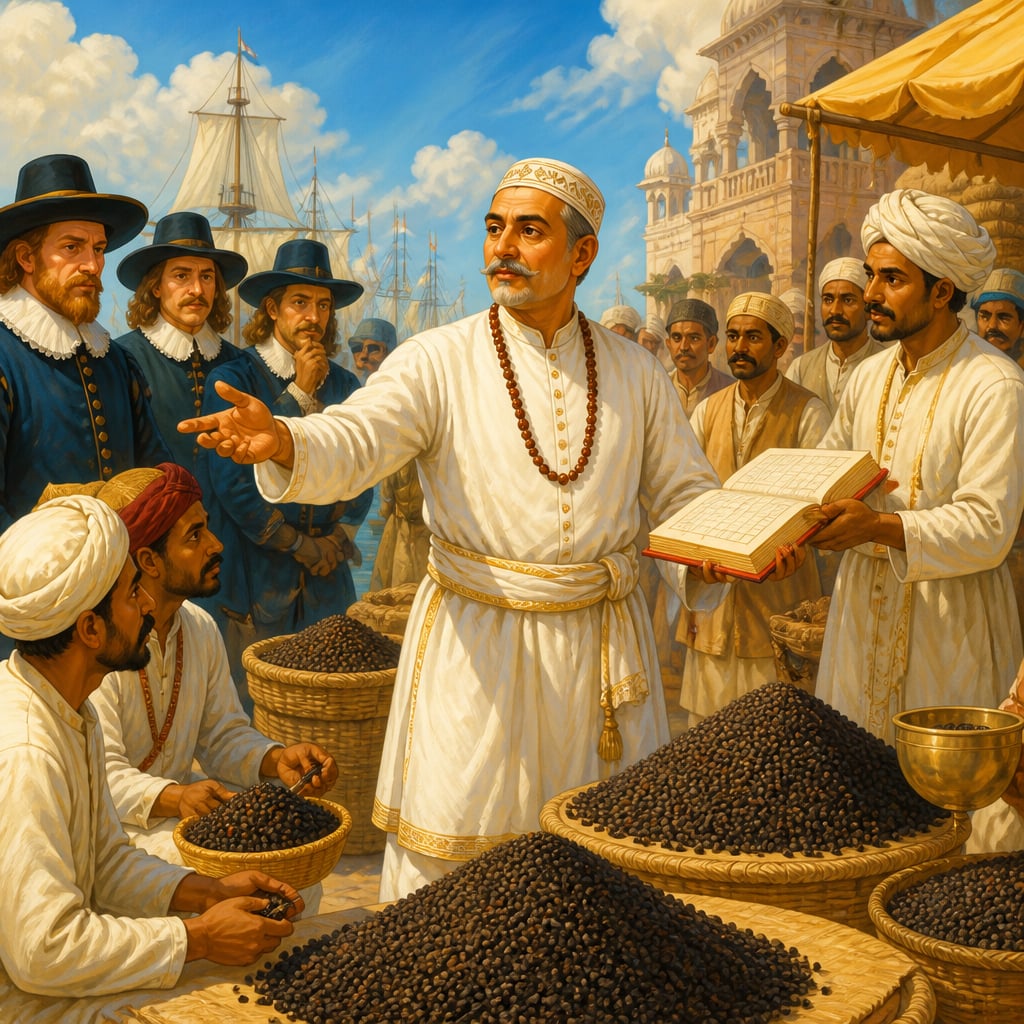
In 1625, the English East India Company's factors in Surat received troubling news. They had negotiated a price of 16 mahmudis per maund for 10,000 pounds of pepper, a fair rate that would yield handsome profits in London. But when they arrived to finalize the purchase, they discovered something astonishing: there was no pepper to buy.
A single merchant had purchased the entire stock, every grain of pepper that had arrived from the Dutch ships. His name was Virji Vora, and he was offering to sell at 16.25 mahmudis. A quarter mahmudi more per maund. The English had no choice but to pay.
This was not a one-time gambit. Virji Vora, described in British records as "the richest merchant in the world", routinely cornered markets, lent money to the English and Dutch East India Companies, and maintained branch offices across India, the Persian Gulf, and Southeast Asia. His personal worth was estimated at 8 million rupees at a time when entire kingdoms operated on less.
He was a shroff, a Gujarati merchant-banker, and he was merely the most visible representative of a trading culture that had dominated the Indian Ocean for millennia.
The Gujarat Advantage
Look at a map of the Indian Ocean and Gujarat's strategic genius becomes obvious. The peninsula juts into the Arabian Sea like a hand reaching toward Africa and Arabia. Its ports, Surat, Cambay (Khambhat), Bharuch, Mandvi, caught the monsoon winds that carried ships to Aden, Zanzibar, Malacca, and beyond.
But geography alone doesn't explain Gujarati dominance. The community developed institutional innovations:
The Hundi System: A merchant in Surat could deposit money with a shroff, receive a document (hundi), and cash it with that shroff's partner in Aden or Zanzibar. No gold needed to cross the ocean. Trust traveled instead.
The Pedhi System: Family firms (pedhis) operated as integrated networks. A son or nephew in Zanzibar, a brother in Muscat, a cousin in Malacca, each autonomous but connected through family capital and reputation.
Religious Diversity as Strength: Unlike some trading communities, Gujarat's merchants included Hindus, Jains, Muslims, and later Parsis, each specializing in different trade routes and commodities. Competition within the community prevented complacency; shared institutions prevented fragmentation.
The Principle: Trade as Dharma
Gujarati merchants drew on deep textual traditions that sanctified commerce:
"Vanijya dharma sanraksha, sanraksha vanijya dharma" "Commerce protects dharma, dharma protects commerce"
The relationship was reciprocal. Honest trading was itself dharmic action. And dharmic behavior, keeping commitments, fair dealing, contributing to community, protected commercial success.
European travelers repeatedly noted something that puzzled them: substantial Gujarati transactions happened without written contracts. Verbal agreements held because breaking them meant social death. A merchant who defaulted would find no partners, no credit, no place in the community gatherings that were essential for business intelligence.
The Jain tradition was particularly influential. Virji Vora himself held the title Sanghapati, leader of the religious community, reflecting how commercial success and religious leadership intertwined. The Jain principle of aparigraha (non-possession) paradoxically enabled wealth accumulation: merchants saw themselves as stewards, not owners, reducing the anxiety that drives short-term thinking.
Global Perspectives: Maritime Trading Republics

Gujarati dominance paralleled another maritime trading power: Venice.
Both Gujarat and Venice controlled strategic positions on major trade routes. Both developed sophisticated banking systems. Both used family firms as the basic unit of commerce. And both produced legendary merchant-explorers, Marco Polo from Venice, Gujarati traders who reached Zanzibar, Aden, and Malacca centuries before Europeans arrived.
| Aspect | Gujarat | Venice |
|---|---|---|
| Strategic Position | Gateway to Indian Ocean | Gateway to Mediterranean |
| Banking Innovation | Hundi system | Bill of exchange, early banks |
| Business Structure | Family pedhis | Family trading houses |
| State Relationship | Operated across multiple states | Merchant-controlled republic |
| Religious Commerce Link | Shroffs funded temples, dharamshalas | Merchants funded churches, palaces |
| Decline Trigger | European maritime power, colonialism | Atlantic trade routes, Ottoman pressure |
The key difference: Venice was a merchant republic, traders controlled the state. Gujarat's merchants operated across states, maintaining relationships with Mughal emperors, Rajput kings, Portuguese viceroys, and British factors simultaneously. This flexibility proved both strength and vulnerability.
The Diaspora: Kala Paani and Beyond
The Gujarati trading network extended far beyond India's shores.
The Zanzibar Connection: When the Sultan of Oman shifted his capital to Zanzibar in 1840, Gujarati merchants were already there. Families like Shivji Topan and Bhimji wielded such influence that the Sultan spoke Gujarati alongside Arabic and Swahili. By the 1960s, roughly 110,000 people of Indian origin, mostly Gujarati, lived in East Africa.
The Aden Hub: The ancient Yemeni port served as a staging ground. Young Gujarati men would arrive, apprentice with established merchants, then move on to opportunities across the Indian Ocean rim.
The Journey: Gujaratis called the sea passage Kala Paani, "Crossing the Black Waters", because so many never returned. Under favorable conditions, the 2,400-mile voyage from Kutch to Zanzibar took 26 days. Storms could extend it to months. Nasser Virji's 1875 passage took nine months.
Yet they went. The promise of opportunity outweighed the peril. And those who succeeded sent remittances home, funded community projects, and created pathways for the next generation.
The Modern Transformation
The Gujarati trading heritage didn't end with colonialism, it transformed.

From Trade to Infrastructure: The instinct that made Gujaratis excellent port traders made them natural infrastructure builders. The merchant who understood that controlling a port meant controlling trade flows naturally evolved into the industrialist who builds ports, airports, and power plants.
The Liberalization Dividend: When India liberalized in 1991, Gujarati entrepreneurs were positioned to seize opportunities. The same skills that had navigated Mughal bureaucracy and British regulations adapted to license-raj dismantling and global capital markets.
Diaspora Returns: Gujarati communities in East Africa, the UK, and the US maintained connections with the homeland. When India opened, diaspora capital and networks flowed back, funding everything from hospitals to tech startups.
Your Turn: The Trading Mindset in a Service Economy
What can the Gujarati shroff tradition teach us in 2025?
Position Over Transaction: Virji Vora didn't just trade pepper, he controlled the pepper supply. Gujarat's ports didn't just facilitate trade, they shaped trade routes. In any field, ask: what position gives you leverage over transactions?
Network as Asset: The pedhi system distributed family members across geographies, creating an information and trust network that competitors couldn't match. Your professional network isn't just for job hunting, it's a distributed intelligence system.
Religious and Commercial Integration: Gujarati merchants didn't separate dharma from business. Their temples, dharamshalas, and charitable works weren't PR, they were expressions of the same values that made them trustworthy partners. When your work and values align, both strengthen.
The monsoon winds that carried Gujarati ships to Zanzibar and Malacca have given way to container ships and fiber optic cables. But the principles endure: position yourself at the intersection of flows, build trust that travels, and understand that commerce conducted with dharma protects both.
From Virji Vora's pepper monopoly to modern ports and airports, the Gujarati shroff tradition continues, adapting methods while preserving the merchant wisdom of the Indian Ocean.
Modern platform theory describes how platforms that control intersections capture more value than participants who merely transact. Amazon controls the e-commerce platform; individual sellers transact on it.
Gujarati shroffs understood platform dynamics centuries before the term existed. Mundra Port, built by Adani, is a physical platform, controlling the intersection of shipping lanes, roads, and railways.
Mundra Port handles 15% of India's cargo, its value comes from its position as the intersection of Gujarat's industrial corridor with global shipping lanes.
Franchising, Federated Business, and Reputation Systems
Modern franchises operate on similar principles: unified brand and standards, distributed operations. What the pedhi added was actual family ties, ensuring alignment of incentives.
The pedhi system solved the principal-agent problem through kinship. A distant employee might cheat; a nephew in Zanzibar wouldn't, because his actions affected his own family's capital.
Key terms
- Shroff / Sarraf
- A traditional Indian banker and money-changer who provided credit, exchanged currencies, issued bills of exchange (hundis), and served as a trusted intermediary in commercial transactions.
- Pedhi
- A traditional Gujarati family business firm, typically with members stationed in different trading centers, sharing capital and reputation.
- Kala Paani
- Literally 'Black Waters', the term Gujaratis used for the perilous sea voyage from India to East Africa, so named because those who crossed it rarely returned.
- Dharamshala
- A rest house for pilgrims and travelers, typically funded by merchants as charitable works. Gujarati dharamshalas provided free or subsidized accommodation.
Key figures
Virji Vora
Gautam Adani
Venetian Merchants (The Polo Family)
Case studies
Gautam Adani: From Diamond Sorter to Infrastructure Emperor
In 1978, a 16-year-old school dropout from Ahmedabad arrived in Mumbai to sort diamonds. Gautam Adani had no capital, no connections, and no degree. But he had something his Gujarati merchant ancestors would have recognized: the ability to see where value flowed and position himself at the intersection. By 1985, he had moved from diamonds to commodities, trading polymers for small-scale industries. In 1988, he established Adani Exports. When India liberalized in 1991, he was positioned to capitalize. But his transformative insight came in 1995: instead of just trading through ports, he would own the ports themselves. Mundra Port started as a small jetty. Adani saw something others missed: Gujarat's industrial corridor was growing, but lacked adequate port infrastructure. He didn't just build a port, he built an ecosystem: special economic zones, power plants, railways connecting to the hinterland. By 2024, Mundra handled 15% of India's cargo traffic.
Adani's trajectory embodies the shroff principle of position over transaction: **1. Infrastructure as Platform:** Like Virji Vora who controlled pepper supply, Adani realized that controlling infrastructure means controlling trade flows. A port is a physical platform, whoever controls it captures value from every transaction passing through. **2. From Trading to Building:** The ancient shroffs financed trade; Adani finances and builds the infrastructure that enables trade. His airports, power plants, and data centers are modern versions of the trading posts Gujaratis established across the Indian Ocean. **3. Vertical Integration:** Adani's acquisition of cement companies, his moves into green hydrogen, and his data center investments echo the shroff pattern of controlling entire value chains rather than single transactions. The controversies surrounding Adani (2024 bribery allegations) also illustrate a perennial tension in the shroff tradition: the line between strategic positioning and unfair manipulation has always been contested.
Adani Group in 2024: - Mundra Port: India's largest commercial port (15% of cargo traffic) - 7 airports including Mumbai International - India's largest renewable energy company - Cement (Ambuja/ACC): $10.5 billion acquisition from Holcim - Net worth fluctuated from peak ~$150 billion to ~$64 billion (post-Hindenburg report) Despite controversies, the infrastructure built remains: ports that handle millions of containers, airports that process millions of passengers, power plants that generate gigawatts. The shroff built physical reality.
Adani's story shows the Gujarati shroff tradition adapting to the 21st century. The principle, control the intersections of trade, remains constant; the form evolves from pepper warehouses to container terminals. His story also shows the risks: the same positioning that creates leverage can attract scrutiny and opposition.
Modern infrastructure investors like Blackstone and Brookfield follow Adani's playbook: control logistics chokepoints (ports, pipelines, data centers) rather than the goods flowing through them. The principle of owning intersections rather than endpoints remains the highest-leverage investment thesis.
Mundra Port capacity: 320 million metric tonnes. Investment in infrastructure: $30+ billion across ports, airports, power, and renewables. The physical assets Adani built handle material flows worth hundreds of billions annually.
Dhirubhai Ambani: The Aden Apprentice Who Democratized Indian Capital
In 1958, a young man named Dhirubhai Ambani returned to India from Aden, Yemen, with ₹500 and an idea. He had spent years as a clerk at A. Besse & Co., the largest transcontinental trading firm east of Suez, watching ships from Europe, Africa, and Asia exchange goods at the world's second-busiest oil bunkering port. Aden was the traditional staging ground for Gujarati merchants, the same port where shroffs had operated for centuries. Dhirubhai had absorbed their lessons: understand trade flows, build relationships across geographies, move boldly when opportunity appears. Back in India, he rejected the family grocery shop. Instead, he contacted his Arabian connections and began exporting spices and commodities. Low margins, high volume. Reliance Commercial Corporation was born. By 1966, he had opened a textile mill. By 1977, he had taken Reliance public, at a time when Indian middle-class investors barely knew what stocks were. His pitch was audacious: 'Don't let your money sleep in bank deposits, make it work in Indian industry.'
Dhirubhai's journey embodies multiple Gujarati merchant principles: **1. Apprenticeship in the Trade Routes:** Like generations of Gujarati youth before him, Dhirubhai learned business in Aden, the traditional Indian Ocean trading hub. This wasn't MBA education; it was the shroff's apprenticeship in how goods and money actually move. **2. Position Over Transaction:** Dhirubhai didn't just trade textiles, he built mills. He didn't just manufacture, he controlled distribution through the Vimal brand. He continuously moved up the value chain, from trading to manufacturing to petrochemicals to refining. **3. Democratizing Capital:** The shroff tradition involved pooling community capital. Dhirubhai scaled this nationally, convincing millions of middle-class Indians to invest in equity markets. His famous statement, 'Think big, think fast, think ahead', echoes the shroff's willingness to act decisively.
Reliance Industries at Dhirubhai's death (2002): - Revenue: ₹75,000 crore (from ₹70 crore in mid-1970s) - India's biggest exporter - First privately-owned Indian company in Fortune 500 Reliance Industries today (2024): - Revenue: $100+ billion - Market cap: $200+ billion - Operations: petrochemicals, refining, retail, telecom (Jio) Dhirubhai created something unprecedented: mass participation in Indian equity markets. Before Reliance, stock investing was an elite activity. After, it became middle-class aspiration.
Dhirubhai's journey shows the continuity of Gujarati trading culture. The path from Aden apprenticeship to commodity trading to manufacturing to public markets echoes patterns centuries old. What was new was scale: Dhirubhai applied pedhi principles to a publicly-traded corporation, creating 'shareholder as family' relationships through consistent returns.
The retail investor boom during COVID-19 (Robinhood, Zerodha) echoes Dhirubhai's democratization of capital markets. When millions of first-time investors enter markets, the companies that educate and empower them build lasting franchises. Those that exploit them face regulatory backlash.
Reliance's 1977 IPO attracted 58,000 investors, unprecedented for the era. By the 1980s, Reliance AGMs drew over 50,000 shareholders. This mass participation in capital markets was a national-scale pedhi.
Historical context
Indian Ocean Trade Networks (Pre-1500 CE to Present)
Gujarat's maritime trading culture predates recorded history. Lothal, a Harappan site in Gujarat (2400 BCE), had docks suggesting organized maritime trade over 4,000 years ago. By the medieval period, Gujarat's ports dominated Indian Ocean commerce. When the Portuguese arrived in 1498, they found not a commercial vacuum but a sophisticated trading world.
Gujarat's trading culture parallels Venice in the Mediterranean, the Hanseatic League in the Baltic, and later Chinese merchants across Southeast Asia. All developed similar features: strategic port positions, banking innovations, family firm structures.
At its peak in the 17th century, Surat was the most important port in the entire Indian Ocean, handling more trade than any other single city.
The Gujarati shroff tradition demonstrates that sophisticated commercial and financial systems developed in India independently of European influence. Understanding this history corrects narratives that portray modern Indian business success as merely imitation of Western models.
Living traditions
- Vanyar/Shroff Community Gatherings: Traditional Gujarati merchant communities continue to hold gatherings combining religious observance with business networking, maintaining historic trust networks.
- Dhanteras Ledger Ceremonies: On Dhanteras (day before Diwali), Gujarati businesses open new account books with prayers to Lakshmi and Ganesha, symbolizing commerce's sacred dimension.
- Mandvi and Kutch Ports: The historic ports from which Gujarati merchants set sail for Aden, Zanzibar, and beyond. Mandvi still has traditional dhow-building yards.
- Surat Old City: Once the most important port in the Indian Ocean, containing remains of English, Dutch, and Armenian factories, as well as traditional merchant havelis.
- Stone Town, Zanzibar: The historic center where Gujarati merchants established their East African operations. UNESCO World Heritage site with Indian-influenced architecture.
- Shree Swaminarayan Mandir (Neasden Temple): Built by the Gujarati diaspora community, this is the largest Hindu temple outside India. Funded primarily by Gujarati business families in the UK, it represents the continuing tradition of shroff-funded temple construction, echoing how merchant wealth has supported religious institutions for millennia.
- Palitana Jain Temples: A complex of over 900 Jain temples on Shatrunjaya Hill, built primarily through donations from Gujarati Jain merchants over centuries. Virji Vora himself held the title Sanghapati (community leader), reflecting how Gujarati shroffs integrated commercial success with religious leadership.
Reflection
- Virji Vora held the title 'Sanghapati', leader of his Jain religious community, while simultaneously cornering markets and lending at high interest. How do you understand this integration of commerce and spirituality? Is it hypocrisy, or a different understanding of what dharmic life means?
- The shroffs understood 'position over transaction', controlling where trade flows creates compounding advantage. In your career, what 'positions' (roles, relationships, expertise) would give you leverage over transactions? Identify one position you could build toward this quarter.