Marwari Vyapara: From Shekhawati to Global Finance
The Marwari Business Network
How traders from Rajasthan's barren Shekhawati region built India's most powerful business community, financing the freedom movement, industrializing a nation, and producing dynasties like the Birlas, Bajajs, and Mittals that still dominate today.
The Boy Who Left the Desert
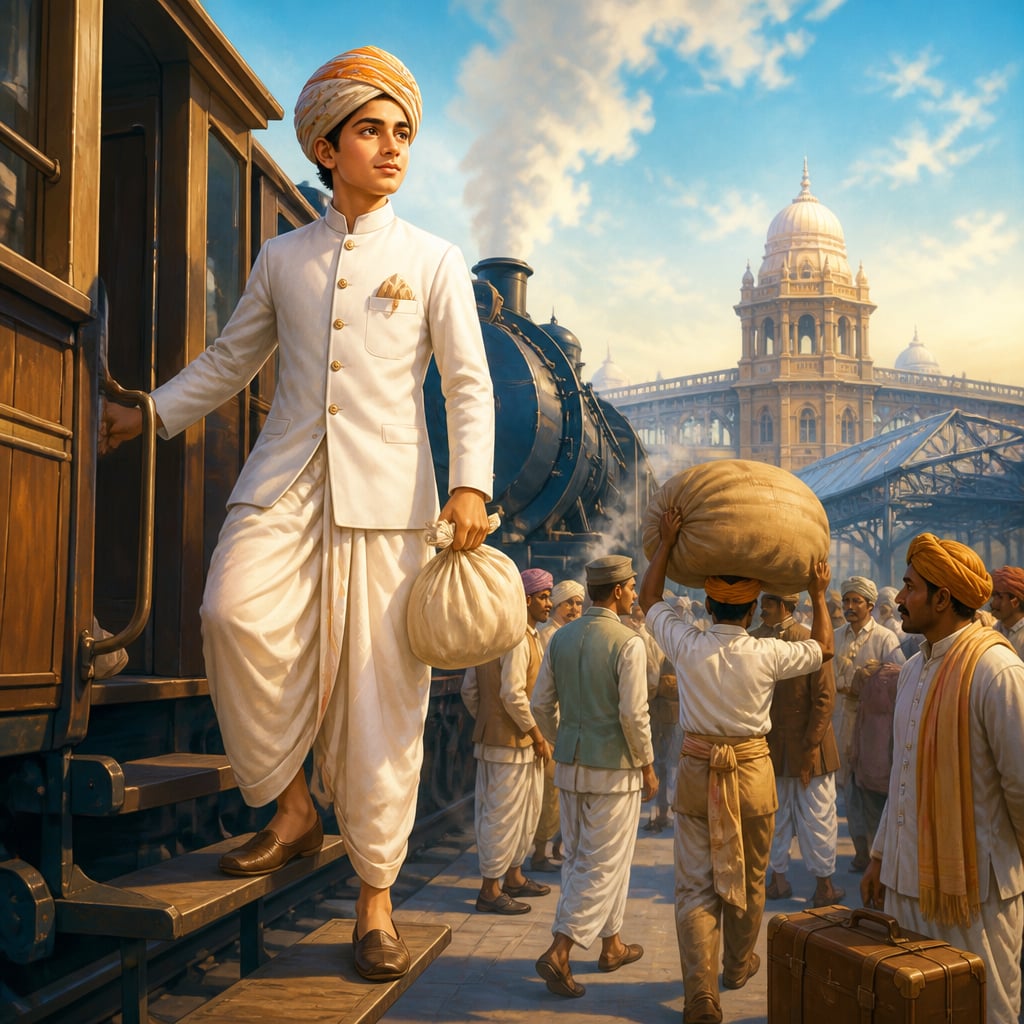
In 1911, a seventeen-year-old named Ghanshyam Das Birla stepped off a train in Calcutta carrying a small bundle and his father's blessing. Behind him lay Pilani, a dusty town in the Shekhawati desert where rain was rare and opportunities rarer. Before him lay the British Empire's commercial capital, where fortunes were made and lost in a single monsoon.
Young Birla had ₹2 million in family capital and one advantage: he was a Marwari. In Calcutta's trading houses, that single word opened doors that degrees and diplomas could not. It meant he came from a network, a web of traders, financiers, and agents that stretched from Rajasthan's painted havelis to Bengal's jute mills, bound not by contracts but by vishwasa (trust).
Within three years, World War I would begin. By its end, the Birla family fortune would quadruple to ₹8 million. Within a generation, Ghanshyam Das would be funding Mahatma Gandhi's freedom movement while building an industrial empire. The desert boy would transform India.
This is the story of how one of the world's harshest landscapes produced one of its most successful business communities.
The Shekhawati Crucible
Shekhawati, comprising modern Jhunjhunu, Sikar, and parts of Churu districts, is Rajasthan at its most unforgiving. Annual rainfall barely reaches 400mm. Agriculture was marginal at best. Yet from this barren land emerged the Birlas, Bajajs, Goenkas, Mittals, Poddars, Singhanias, and Dalmias, families that would collectively control one-third of India's top industrial assets.
How? The answer lies in what economists call adverse selection: when staying home offers no rewards, only the most ambitious leave. And when those who leave must rely entirely on trust networks rather than local land or assets, they build systems that travel.
The Marwaris developed two foundational innovations:
1. The Bahi Khata (बही खाता), handwritten ledgers covered in auspicious red cloth, considered sacred objects blessed by Goddess Lakshmi. These weren't just accounting books; they were moral documents. A neat script suggested integrity. Every entry was witnessed by karma itself.
2. The Hundi Network, like the Chettiars, Marwaris used bills of exchange that could be cashed anywhere in their network. A merchant in Calcutta could draw on a relative in Bombay, who could draw on a cousin in Pilani. Money moved through trust, not banks.
The Principle: Baniya Buddhi
The Marwaris operate on a principle they call baniya buddhi, literally "trader's wisdom." It encompasses:
"Vyapare dharma, dharma vyapare" "In business there is dharma, in dharma there is business"
This wasn't hypocrisy, it was integration. The ancient texts made clear that wealth-creation was itself a form of dharma when conducted ethically. The Yajnavalkya Smriti prescribed that merchants should earn profit but never through deception:
"Kutena labhyate artha dharmena rakshyate" "Wealth obtained through deceit cannot be protected by dharma"
Marwari families institutionalized this through the joint family system. Wealth belonged not to individuals but to the karta (family head) who managed it as trustee. This prevented fragmentation across generations and created patient capital that could outlast any individual.
Global Perspectives: Trust Networks Across Cultures
The Marwari diaspora model echoes across business history:

Warren Buffett (1930-2025) built Berkshire Hathaway on remarkably similar principles. Like the Marwaris, Buffett acquired quality businesses and let managers run them autonomously. His favorite holding period? "Forever." He granted managers his proxy vote immediately upon acquisition, signaling trust rather than control. Both the Marwari karta and Buffett understood: centralized capital, decentralized operations.
The Overseas Chinese (Huaqiao) built similar networks across Southeast Asia. The guanxi (relationship) networks that financed Chinese businesses from Singapore to San Francisco operated on the same trust-over-contracts principle.
| Aspect | Marwari Network | Buffett/Berkshire | Overseas Chinese |
|---|---|---|---|
| Trust Mechanism | Joint family, bahi khata | Handshake deals, manager autonomy | Guanxi relationships |
| Capital Structure | Family pooled capital | Float from insurance | Family associations |
| Geographic Spread | Rajasthan → All India | Omaha → Global | China → SE Asia, Americas |
| Holding Period | Generational | "Forever" | Generational |
| Management Style | Karta oversight, operational autonomy | CEO oversight, operational autonomy | Family oversight, operational autonomy |
What unites them all: patient capital, trust networks, and long-term thinking.
The Great Migration
The Marwari migration followed opportunity like water follows gravity:
Phase 1: Mughal Era (pre-1800)
- Marwaris served as bankers to Rajput kings and Mughal nobles
- Financed trade along caravan routes
- Developed expertise in currency exchange and moneylending
Phase 2: British Calcutta (1800-1900)
- By 1850, Marwaris dominated Calcutta's opium trade
- 1870: Controlled jute trade financing
- By 1900: 75,000 Marwaris in Bengal, Bihar, Orissa, Assam
- Built the painted havelis of Shekhawati with returning wealth
Phase 3: Industrial Transformation (1900-1947)
- Shifted from trading to manufacturing
- G.D. Birla: first jute mill (1919), cotton mills (1920s), sugar mills (1930s)
- Financed Congress and freedom movement
- By 1947: positioned to seize opportunities in independent India
Phase 4: Post-Independence Dominance (1947-present)
- Birlas, Tatas, and Marwari families built India's industrial base
- 1964: 13 Marwari families in top 50 business houses (26%)
- 1990: 14 families (28%)
- 2024: Aditya Birla Group alone: $67 billion revenue
The Painted Havelis: Wealth Made Visible

If you want to understand Marwari values, visit Shekhawati. The painted havelis of Nawalgarh, Mandawa, and Jhunjhunu were built between 1800-1900 with profits from Bengal and Bombay trade.
These weren't just houses, they were dharmic statements:
- Frescoes depicting Lakshmi (prosperity)
- Scenes of trade routes and steam trains (modernity welcomed)
- Religious imagery alongside commercial symbols
- Built with imported materials but in ancestral villages
The Marwaris made money in distant cities but built their monuments at home. This was intentional: it anchored the migrant to his roots, reminded him where his loyalty lay, and demonstrated success to the community that had vouched for him.
Your Turn: Patient Capital in an Impatient World
The Marwari model challenges modern business orthodoxy:
On Timeframes: While startups chase quarterly growth, Marwari families think in decades. The Birlas have operated for 150+ years across four generations. Warren Buffett's Berkshire has existed for 60+ years. What would you do differently if you planned for your grandchildren?
On Trust: In an age of contracts and compliance, Marwaris built empires on vishwasa. Their bahi khata was a moral document, not just an accounting one. When you make a business commitment, do you honor the letter or the spirit?
On Rootedness: The painted havelis remind us that success without connection to community is hollow. The Marwaris made money everywhere but built their legacy at home. Where is your "home", and what are you building there?
The desert taught the Marwaris that scarcity creates resourcefulness, that trust travels farther than gold, and that business conducted with dharma creates wealth that lasts.
From Shekhawati's painted walls to the boardrooms of Mumbai and London, the Marwari principle endures: Vyapare dharma, dharma vyapare.
Warren Buffett articulates this as 'compound interest is the eighth wonder of the world.' But Marwaris compound something more valuable than money: reputation. Each generation inherits not just capital but the trust relationships that enable deal flow.
The Hindu Undivided Family (HUF) structure legally enables generational continuity. While Western fortunes typically dissipate within three generations ('shirtsleeves to shirtsleeves'), Marwari families like the Birlas have maintained and grown wealth across four generations precisely because the karta system prevents fragmentation.
Aditya Birla Group: 150+ years of continuous operation across 4 generations. Revenue grew from trading profits to $67 billion. Berkshire Hathaway: 60+ years under Buffett, $1 trillion valuation. Both prove patient capital outperforms financial engineering.
Modern economics studies 'signaling', how parties communicate trustworthiness. Nobel laureate George Akerlof showed that information asymmetry destroys markets. The Marwari bahi khata was a pre-modern solution: meticulous records, open to community inspection, created verified transparency.
The religious dimension added enforcement. While Western accounting relies on auditors and regulators, the Marwari system relied on karmic consequences. Dishonest ledgers would invite Lakshmi's departure, not metaphorically but practically, as community discovery meant social death for the merchant.
Even in 2024, traditional Marwari businesses maintain parallel bahi khata alongside digital records. Finance Minister Sitharaman's 2019 decision to present the budget with a bahi khata symbolized this continuing tradition, a ledger representing 'the common man's account book.'
Key terms
- Marwari
- An Indo-Aryan ethno-linguistic community originating from the Marwar region of Rajasthan, renowned for business acumen and trust-based trading networks that dominated Indian commerce from the 19th century onward.
- Bahi Khata
- Traditional handwritten ledger books covered in red cloth, considered sacred objects blessed by Goddess Lakshmi. Used by Indian merchants for centuries to record financial transactions.
- Baniya Buddhi
- Literally 'trader's wisdom', the combination of frugality, risk assessment, relationship management, and long-term thinking that characterizes successful Marwari business practice.
- Karta
- The head of a Hindu Undivided Family (HUF) who manages family wealth as a trustee on behalf of all members. In Marwari business tradition, the karta holds authority but not ownership, the family's assets belong to the collective.
Key figures
G.D. Birla (Ghanshyam Das Birla)
Kumar Mangalam Birla
Warren Buffett
Case studies
The Birla Evolution: From Cotton Trading to $67 Billion Conglomerate
In 1870, Seth Shiv Narayan Birla launched a cotton and jute trading business in Pilani, Rajasthan. The family had no industrial infrastructure, no British connections, and operated in one of India's poorest regions. Yet 154 years later, the Aditya Birla Group is a $67 billion conglomerate operating across 36 countries in 20 sectors. The journey: G.D. Birla arrived in Calcutta (1911) → Jute trading during WWI (fortune 4x to ₹8 million) → First Indian-owned jute mill (1919) → Cotton mills, sugar mills (1920s-30s) → Hindustan Motors, Grasim, Hindalco post-independence → Aditya Birla's global expansion (1969, first Indian multinational) → Kumar Mangalam Birla's 60+ acquisitions including Novelis ($6 billion, 2007). Four generations maintained growth while keeping family control through the karta system. No hostile takeovers. No public family disputes. No dissipation of wealth.
The Birla evolution demonstrates multiple dharmic principles: **1. Vyapare Dharma (Dharma in Business):** G.D. Birla simultaneously built factories and funded Gandhi. His Birla House hosted Gandhi's final years. This wasn't contradiction, industrial self-sufficiency WAS the freedom movement's economic agenda. Business served dharma. **2. Karta Trusteeship:** Each generation received wealth as trustees, not owners. Kumar Mangalam Birla said: 'I inherited a responsibility, not a business.' This prevented the fragmentation that destroys most family fortunes by the third generation. **3. Patient Capital:** The Birlas didn't chase every opportunity. They built competencies in specific sectors (cement, textiles, metals) and dominated them. When Kumar Mangalam acquired Novelis in 2007 for $6 billion, India's largest outbound acquisition, it built on decades of aluminum expertise through Hindalco.
Aditya Birla Group 2024: - Revenue: $67 billion (33x growth under Kumar Mangalam Birla) - Employees: 200,000+ across 36 countries - Key companies: Hindalco (world's largest aluminum rolling company), Grasim, UltraTech Cement, Vodafone Idea - 60+ major acquisitions completed - Still family-controlled after 154 years Comparison: The average Fortune 500 company lasts 20 years. The average family business survives 3 generations. The Birlas have operated continuously for 4+ generations while growing from local trading to global industry.
The Birla case proves that traditional business principles, patient capital, karta trusteeship, dharmic purpose, and generational thinking, can compete with public corporations in the global economy. The key was adapting methods (from trading to M&A) while preserving values (family governance, long-term orientation). Modern doesn't mean abandoning tradition; it means applying timeless principles to contemporary contexts.
Family-controlled conglomerates like the Birlas outperform widely-held corporations in many emerging markets. Research from Harvard Business School shows that family firms with strong governance structures deliver better long-term returns than their publicly-managed peers, validating the karta trusteeship model.
Family fortune trajectory: ₹2 million (1911) → ₹8 million (1918) → $3.3 billion (1995) → $67 billion (2024). This represents approximately 33,500x growth over 113 years, roughly 9% compound annual growth maintained across a century and four generations.
The Marwari Migration: How a Community Captured Colonial Commerce
In 1800, Calcutta was the British Empire's eastern commercial capital. British agency houses controlled trade in opium, jute, and cotton. Indian merchants were marginal players. By 1914, Marwari merchants had captured: - The opium trade (complete control by 1860) - The jute trade (dominant position by 1870s) - Financing of Bengal's rice and grain markets - Position as primary intermediaries between British firms and Indian producers This wasn't military conquest or political power, it was commercial adaptation. The Marwaris offered something British banks couldn't: credit networks that reached into villages, trust relationships that reduced transaction costs, and cultural understanding of Indian producers.
The Marwari capture of colonial commerce illustrates several principles: **1. Arbitrage Through Trust:** British agency houses required collateral and contracts. Marwari merchants offered credit on reputation alone, verified through their community network. This lower-friction model won producers' loyalty. **2. Network Effects:** Each Marwari merchant strengthened the whole community. A trader in a Bengal village could draw on family capital in Bombay. This distributed capital structure was impossible for European firms to replicate. **3. Adaptation Without Assimilation:** The Marwaris worked within British commercial structures without becoming British. They maintained their own accounting (bahi khata), their own dispute resolution (community panchayats), and their own capital structure (family pooling). They took British opportunities while keeping Marwari identity.
By the 1930s: - 15,000+ Marwaris in Calcutta alone - 75,000+ across Bengal, Bihar, Orissa, Assam - Control of key commodity trades - Positioned to become industrialists post-independence The painted havelis of Shekhawati, built between 1800-1900 with returning wealth, stand as physical evidence of this commercial conquest. British firms came and went; the Marwari network remained.
The Marwari migration shows how trust networks can outcompete institutional capital. The community offered lower transaction costs, better local knowledge, and more flexible financing than colonial banks. This wasn't luck, it was systematic competitive advantage built on community institutions (bahi khata, family pooling, reputation systems) that took generations to develop.
Silicon Valley's Indian-origin CEO dominance (Google, Microsoft, Adobe, IBM) echoes the Marwari migration pattern. Community networks, shared cultural frameworks, and trust-based referrals continue to drive economic clustering, whether in 19th-century Calcutta or 21st-century California.
Colonial census (1911): 15,000 Marwaris in Calcutta. By 1986: Birlas, Singhanias, Modis, and Bangurs (all Marwari families) accounted for one-third of the total assets of India's top ten business houses.
Historical context
19th-20th Century Indian Commerce
The Marwaris emerged from Rajasthan's harshest terrain, the Thar Desert and Shekhawati region where agriculture was nearly impossible. This scarcity created a community specialized in trade and finance. Under Mughal rule, they served as bankers to Rajput kingdoms. Under British rule, they adapted to new commercial opportunities in Bengal and Bombay. Their migration pattern, sending young men to distant cities while maintaining family base in Rajasthan, created a diaspora network with unique competitive advantages.
The Marwari commercial diaspora parallels other trading minorities: Overseas Chinese (Huaqiao) in Southeast Asia, Gujarati merchants in East Africa, Armenian traders across the Ottoman Empire, and Jewish financiers in medieval Europe. All developed similar features: trust-based credit networks, family capital pooling, community dispute resolution, and cultural maintenance despite geographic dispersion. What distinguished Marwaris was their successful transition from trading to manufacturing, few diaspora communities achieved this at scale.
By 1964, 13 Marwari families were among India's top 50 business houses (26%). By 2000, 14 Marwari families represented 28% of the top tier. This share has remained remarkably stable despite economic liberalization, suggesting the community's adaptive capacity.
The Marwari story demonstrates that business success can be built on community institutions rather than formal education or inherited assets. Coming from one of India's poorest regions, without access to British networks or Western education, Marwaris built commercial empires through trust, patience, and networked capital. This model remains relevant: modern fintech (UPI, digital lending) operates on similar trust-network principles.
Living traditions
- Bahi Khata Tradition: Despite digital accounting, many Marwari businesses still maintain hand-written bahi khata ledgers. New ledgers are ceremonially opened on Diwali with prayers to Lakshmi. The red-covered books symbolize the integration of commerce and dharma.
- Joint Family Business Governance: The karta system of family trusteeship continues in major Marwari business houses. The Murugappa, Birla, and Bajaj families all use variations of collective decision-making with a designated family head managing on behalf of all members.
- Shekhawati Open-Air Art Gallery: The painted havelis built by Marwari merchants between 1800-1900 with profits from Bengal and Bombay trade. Featuring frescoes of Lakshmi, trade scenes, steam trains, and religious imagery. Many are now heritage hotels. The Poddar Haveli and Morarka Haveli museums offer guided tours explaining the merchant culture.
- Birla Temples: White marble temples built by the Birla family across India. The Delhi Birla Mandir (Lakshmi Narayan Temple) was inaugurated by Mahatma Gandhi in 1939. These temples represent the Marwari tradition of using commercial wealth for dharmic purposes.
- Gandhi Smriti (Birla House): The Delhi residence of G.D. Birla where Mahatma Gandhi spent the last 144 days of his life and where he was assassinated on January 30, 1948. Now a museum documenting Gandhi's life and the Birla family's role in the freedom movement.
- Birla Mandir (Lakshmi Narayan Temple): Built by the Birla family and inaugurated by Mahatma Gandhi in 1939, this temple exemplifies the Marwari tradition of using commercial wealth for dharmic purposes. The temple's construction was part of G.D. Birla's vision of integrating business success with national and spiritual service.
- Rani Sati Temple: One of the wealthiest temples in India, built and maintained primarily by Marwari merchant donations. The temple complex showcases the painted fresco tradition of Shekhawati and represents centuries of accumulated merchant wealth flowing back to the homeland.
Reflection
- The Marwaris came from one of India's harshest landscapes, a desert where agriculture was impossible. Rather than see this as a curse, they treated it as training for a different kind of cultivation: the cultivation of trust, networks, and patient capital. What apparent disadvantages in your own life might actually be training for capabilities others don't develop? How might scarcity in one area create abundance in another?
- The bahi khata was both an accounting tool and a moral document. Its users believed that neat, honest records invited prosperity while falsification invited ruin. This week, choose one area of your life where you've been 'keeping messy books', unclear commitments, vague promises, or untracked goals. Create your own 'bahi khata': write down specifically what you've committed to, to whom, and by when. Notice if the clarity changes your behavior.