Multani Shroff: Bankers of the Silk Road

The Overland Finance Masters

How bankers from Multan and Shikarpur financed trade across the Silk Road, funding Afghan emperors, maintaining agents from Astrakhan to Calcutta, and pioneering the hundi credit system that moved money without moving gold.

The Bankers Who Financed Empires
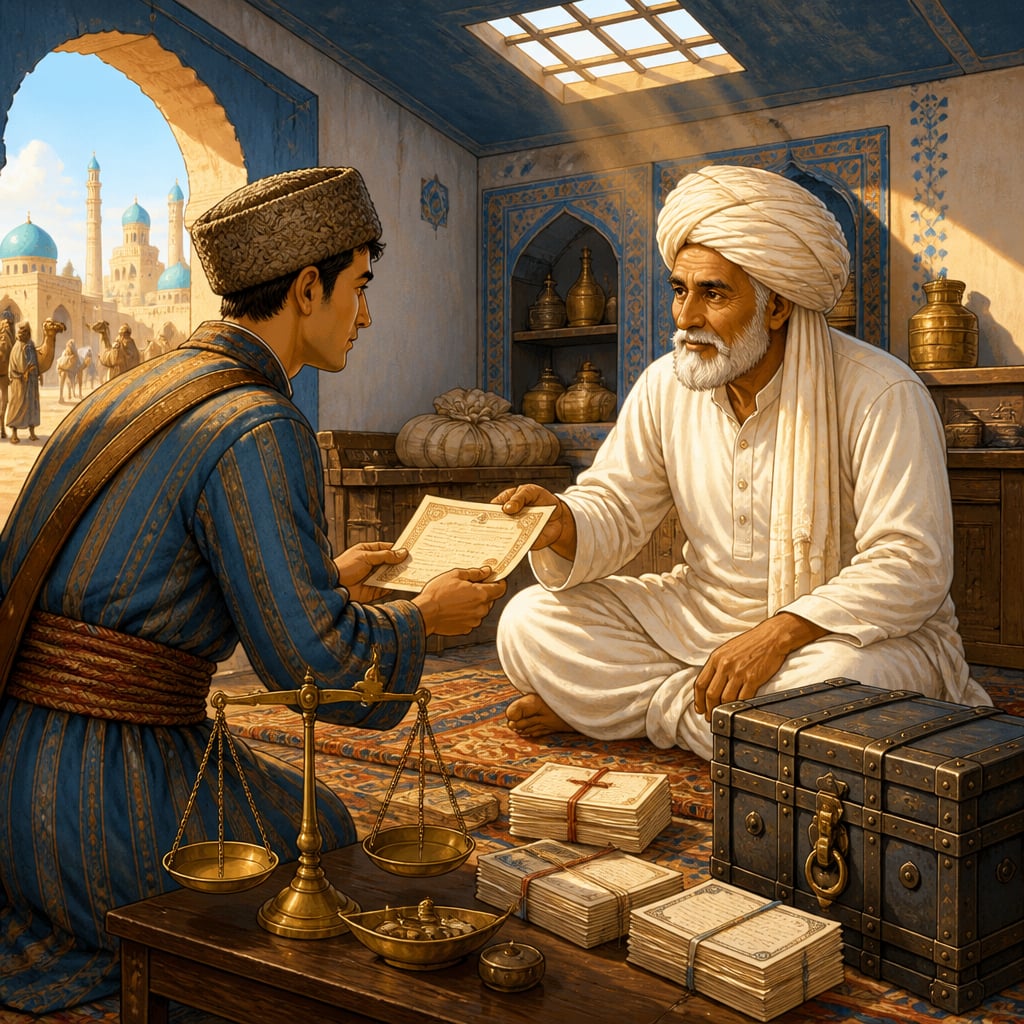
Shikarpuri shroff at Bukhara branch on the Silk Road

In 1557, the English explorer Anthony Jenkinson arrived at the gates of Bukhara after an epic journey across the Caspian Sea. He had come to mine the fabled Silk Road city's riches for London's Muscovy Company. What he discovered astonished him: Indian merchants had already beaten him there.

These weren't the Gujarati traders of the Indian Ocean. They were Multanis, merchant-bankers from the Punjab city of Multan, and later from Shikarpur in Sindh. While Gujaratis dominated the sea routes, Multanis controlled the overland Silk Road. Their hundis (bills of exchange) financed caravans from Delhi to Bukhara. Their agents sat in Kandahar, Kabul, Isfahan, and even Astrakhan on the Russian steppe.

The 17th-century French jeweler Tavernier observed that Indian money-changers "surpassed the Jews in their shrewdness." He wasn't exaggerating. The Multani and Shikarpuri shroffs had built a financial network spanning three continents, and they did it without armies, navies, or colonial backing.

The Multan Advantage

Multan sits at a critical junction: where the Punjab plains meet the passes leading to Afghanistan and Central Asia. The 10th-century Arab historian Al-Masudi noted that Central Asian caravans from Islamic Khorasan assembled at Multan before continuing into India.

This geography created opportunity. Multanis became:

1. Currency Specialists: They exchanged the dozens of currencies circulating across the Mughal, Afghan, Persian, and Central Asian economies. A merchant arriving from Bukhara with Uzbek tangas needed someone who could convert them to Mughal rupees.

2. Credit Providers: Caravan trade required credit. A merchant couldn't carry enough gold for months of travel. Multani shroffs issued hundis that could be cashed in distant cities, Kabul, Kandahar, Meshad, Bukhara, wherever their agents operated.

3. Trade Financiers: They advanced supplies to armies and merchants in exchange for a share of profits or loot. When Ahmad Shah Durrani's Afghan forces sacked Delhi in 1748, Multani bankers transformed hoarded Mughal treasure into "high velocity money for trading and investment."

The community was religiously mixed, both Hindu and Muslim merchants operated under the "Multani" name. What united them was function, not faith.

The Shikarpur Rise

As Multan suffered repeated invasions in the 17th century, its merchant community relocated en masse to Shikarpur in Sindh. This small town became what one historian called "the banking capital of Central Asia."

The Shikarpuri Hundi became legendary. By 1830, Shikarpur was less a center of trade than of finance, its hundis financed the caravan trade, internal commerce, and even the needs of rulers. The town's influence extended from "Bombay, Punjab, Sindh, Khorasan, parts of Persia and Russia."

Critically, the Shikarpuris operated differently from other trading communities:

Men-Only Migration: Only the menfolk traveled; families remained in Shikarpur. A young man might spend 10-12 years in Bukhara or Kandahar, then return home to marry and be replaced by a younger relative. This rotation maintained both the network and the community.

No Permanent Settlement: Unlike Gujaratis in Zanzibar or Chettiars in Burma, Shikarpuris rarely settled permanently abroad. They remained agents of family firms headquartered in Sindh, ensuring capital and loyalty flowed home.

Government Financing: The Shikarpuris went beyond trade finance. During the Durrani Afghan Empire (1747-1826), they financed military campaigns, supplied armies, redistributed war booty, and controlled government revenue circulation. When Britain's East India Company invaded Afghanistan (1838-1842), they paid their troops with Shikarpuri loans.

The Principle: Credit Without Borders

The Multani-Shikarpuri innovation was money that moved without moving.

"Vishwasa-patra gatih, na suvarna gatih" "Trust travels, not gold"

Multani caravan crossing Hindu Kush with hundis

A merchant in Delhi could deposit rupees with a Multani shroff, receive a hundi, and cash it with that shroff's partner in Bukhara, weeks or months of travel away. No gold crossed the bandit-infested mountain passes. Only paper, backed by reputation.

The system worked because:

1. Reputational Stakes: A shroff who dishonored a hundi would lose everything, not just business but social standing. In tight-knit trading communities, reputation was life.

2. Family Networks: The branches in distant cities were typically family members. A nephew in Bukhara wouldn't cheat his uncle in Shikarpur because his own inheritance, marriage prospects, and community standing depended on family honor.

3. Information Advantage: The network exchanged more than money, it exchanged intelligence. Price movements, political changes, caravan arrivals, information flowed through the hundi network faster than any government's messengers.

Global Perspectives: Financing Emperors

The Shikarpuri role in Central Asian finance parallels the Fugger family of Augsburg, Germany.

Jakob Fugger financing Holy Roman Emperor Charles V

Jakob Fugger "the Rich" (1459-1525) financed Holy Roman Emperors, controlled Europe's copper and silver trade, and accumulated wealth estimated at 2% of Europe's GDP. He famously wrote to Emperor Charles V: "It is well known that Your Imperial Majesty could not have obtained the Roman crown without my help."

Replace "Charles V" with "Ahmad Shah Durrani" and the statement applies equally to the Shikarpuris.

Aspect Shikarpuri Shroffs Fugger Banking House
Geographic Reach Astrakhan to Calcutta Antwerp to Rome
Primary Clients Afghan emperors, Mughal nobles Holy Roman Emperors, Popes
Core Business Trade credit, currency exchange Mining finance, loans to rulers
Trust Mechanism Family networks, reputation Family networks, written contracts
Peak Influence 1747-1850 1480-1560
Decline Cause Russian annexation, partition Sovereign defaults, Thirty Years' War

Both understood: whoever controls the money controls the state, even without holding formal power.

The Great Decline

The Shikarpuri network collapsed for geopolitical reasons:

1. Russian Annexation (1860s-1880s): Russia conquered Central Asia and banned British-Indian goods. The Bukhara-Shikarpur trade route died.

2. Afghan Protectionism: Afghan rulers experimented with restricting foreign merchants, disrupting traditional patterns.

3. Partition (1947): The creation of Pakistan and India severed Shikarpur from both its traditional hinterland (India) and its northern routes (Afghanistan, Central Asia).

4. Soviet Closure: The Soviet Union sealed Central Asian borders entirely. The Silk Road became a memory.

By the mid-20th century, the Shikarpuri financial network that had operated for centuries existed only in historical records, and in the DNA of communities that had learned its lessons.

Your Turn: Credit in a Fragmented World

The Multani-Shikarpuri story holds lessons for 2025:

Trust Networks vs. Institutions: In regions where formal banking is weak or states are unstable, trust-based credit networks still function. Hawala, the informal value transfer system across the Middle East and South Asia, operates on principles the Shikarpuris would recognize.

Information as Infrastructure: The Shikarpuris' real product wasn't money, it was information. They knew prices, politics, and people across a vast geography. In any field, information advantage compounds over time.

Geopolitics Matters: The most sophisticated financial system is vulnerable to political disruption. Russian annexation didn't just close markets, it erased centuries of accumulated relationships. No amount of commercial skill can overcome hostile geography.

The caravans that once assembled at Multan have given way to container ships and cryptocurrency. But the principle endures: money is trust made portable, and the network that moves trust controls wealth.

From the gates of Bukhara to the streets of London, the Multani shroff tradition continues, transformed but not extinguished, in communities that still understand that finance is fundamentally a social technology.

Modern financial systems still struggle with this problem. SWIFT transfers move billions daily through a network of correspondent banks, essentially formalized trust relationships. Cryptocurrency attempts to replace trust with cryptographic verification.

The hundi system solved cross-border value transfer centuries before electronic banking. It worked because the community enforced consequences for dishonor: a shroff who defaulted lost not just business but marriage prospects, social standing, and family honor.

By 1830, Shikarpur's hundis financed trade across a network spanning from Bombay to Bukhara to Astrakhan, three continents connected by paper and reputation.

Modern multinationals struggle with expatriate management: how to maintain presence in foreign markets while retaining institutional knowledge and loyalty. The Shikarpuri rotation model solved this through family structure.

The model prevented the problems that plagued other trading communities: local entanglement, divided loyalties, wealth leakage to foreign locations. Capital and families remained in Shikarpur while agents rotated through foreign posts.

Mir Izzat Ullah observed in 1813 that Shikarpuris 'go there for trade, live for a year or two, and return, never settling permanently.' This deliberate non-permanence was strategic, not accidental.

Key terms

Multani
A merchant-banker originating from or associated with Multan (in modern Pakistan). The term applied to both Hindu and Muslim merchants who specialized in overland trade finance, currency exchange, and credit provision along the Silk Road routes.
Shikarpuri
A merchant-banker from Shikarpur in Sindh (now Pakistan), who became the dominant financiers of Central Asian trade after Multan declined. The Shikarpuri hundi financed trade from Bombay to Bukhara.
Hundi
A bill of exchange or promissory note used to transfer money without physical movement of cash. The bearer could present it to the issuer's agent in a distant city and receive payment.
Caravanserai
A roadside inn where caravans could rest, resupply, and conduct business. Caravanserais across the Silk Road served as the physical infrastructure for Multani/Shikarpuri operations.

Key figures

The Shikarpuri Shroffs (Collective)

Hinduja Family

Jakob Fugger 'the Rich'

Case studies

Financing the Afghan Empire: Shikarpuris and the Durranis

In 1747, Ahmad Shah Durrani established the Afghan Empire, with his capital at Kandahar. He needed money, for armies, administration, and the campaigns that would take him to Delhi, Lahore, and across Central Asia. He turned to the Shikarpuri shroffs. The arrangement was mutually beneficial. Shikarpuris advanced supplies to Afghan armies, provided loans for military campaigns, and redistributed war booty. In exchange, they received a share of the loot, tax farming rights, and control over government revenue circulation. When Ahmad Shah sacked Delhi in 1748, Shikarpuri bankers converted the hoarded Mughal treasure into 'high velocity money', liquid capital that fueled trade and investment across Central Asia. This wasn't a one-time transaction. Throughout the Durrani Empire (1747-1826), Shikarpuris were 'most noticeable among the Indian merchants and bankers who financed military campaigns, supplied armies in the field, conveyed luxury goods to the court, loaned money to khans, served as revenue farmers, and as a result controlled government income and the circulation of money throughout the kingdom.'

The Shikarpuri-Durrani relationship illustrates a complex dharmic calculus: **1. Artha Without Kshatra:** The Shikarpuris achieved power through wealth (artha) rather than force (kshatra). They controlled the Afghan state's finances without holding political office, an alternative path to influence. **2. Neutrality as Strategy:** By financing multiple rulers and factions, Shikarpuris maintained commercial access regardless of who held power. This neutrality was both pragmatic and dharmic, they served commerce, not particular rulers. **3. The Danger of Dependence:** When rulers depend on bankers, both become vulnerable. The Shikarpuris' power lasted only as long as the trade routes that made their credit valuable. Geopolitical shifts could (and did) destroy centuries of accumulated relationships.

The Shikarpuri-Durrani relationship persisted for nearly 80 years. At its peak: - Shikarpuris controlled revenue circulation throughout the Afghan Empire - They had agents in every major Central Asian city - Their hundis were accepted from Bombay to Bukhara The system collapsed not through commercial failure but geopolitical disruption: Russian annexation of Central Asia, British-Afghan conflicts, and eventually the partition of India severed the trade routes that made Shikarpuri credit valuable.

Financial power is real but contingent. The Shikarpuris achieved influence that rivals struggled to match through military means. But their power depended on trade routes they didn't control. When geopolitics closed those routes, no amount of commercial skill could compensate. Financial infrastructure requires political stability to function.

Modern defense contractors and sovereign wealth funds play the Shikarpuri role today, financing governments while remaining officially neutral. The risk remains identical: when geopolitical alignments shift, financial intermediaries tied to specific trade corridors face existential threats.

When Britain invaded Afghanistan (1838-1842), they paid their troops using Shikarpuri loans. The same bankers had financed Afghan resistance to earlier invaders. The Shikarpuris served commerce, not causes.

The Hinduja Journey: From Shikarpur to Britain's Richest Family

In 1914, Parmanand Deepchand Hinduja was trading in Shikarpur, the same town that had served as the banking capital of Central Asia. His business followed traditional patterns: commodities trading, credit provision, family-based operations. By 1919, Parmanand had established international operations in Iran, echoing the Shikarpuri tradition of extending networks into Persia. His four sons, Srichand, Gopichand, Prakash, and Ashok, expanded the business across the Middle East. The 1979 Islamic Revolution in Iran forced a pivot. The Hindujas relocated their headquarters to London, transforming from regional traders into global industrialists. Key acquisitions followed: Gulf Oil (1984), Ashok Leyland (1987), IndusInd Bank (1994). By 2025, the family had topped the UK Sunday Times Rich List with £35.3 billion, Britain's wealthiest family.

The Hinduja trajectory shows Shikarpuri principles adapted to the modern era: **1. Family Unity as Asset:** The four brothers operated as a unit, each managing a different region (London, Geneva, Mumbai). This echoes the Shikarpuri pattern of family members stationed across geographies while maintaining unified capital and strategy. **2. Crisis as Catalyst:** The 1979 Iran revolution, like earlier disruptions that forced Multanis to Shikarpur, became opportunity. The Hindujas converted regional expertise into global capability. **3. Finance to Industry:** Unlike their ancestors who remained in pure finance, the Hindujas moved into manufacturing (Ashok Leyland, Gulf Oil) and banking (IndusInd). This vertical integration echoes how successful merchant communities evolve from trading to production. The family motto, 'My dharma is to work so that I can give', explicitly connects commercial success to dharmic purpose.

Hinduja Group 2024: - Net worth: £35.3 billion (UK's richest family) - Presence in 38 countries across 11 sectors - IndusInd Bank: one of India's major private banks - Major holdings in automotive, oil, banking, healthcare, media From a trading firm in Shikarpur to Britain's wealthiest family in four generations, a trajectory that validates both the Shikarpuri heritage and its adaptation to modern conditions.

The Hinduja story shows how traditional merchant community principles, family unity, geographic distribution, crisis adaptation, remain viable in the global economy. The family succeeded not by abandoning their heritage but by applying Shikarpuri wisdom (trust networks, family operations, geographic diversification) to contemporary opportunities.

The Hinduja trajectory from Shikarpur to London's richest family mirrors how modern immigrant entrepreneur networks (Israeli tech founders, Nigerian fintech entrepreneurs) leverage diaspora connections to build global businesses from small-market origins.

Four generations: Parmanand in Shikarpur (1914) → Iran expansion (1919) → London headquarters (1979) → UK's richest family (2025). The Shikarpuri tradition didn't die with the Silk Road, it adapted.

Historical context

Silk Road Finance (1200s-1900s)

Multan's position at the junction of Punjab and the Central Asian passes made it a natural hub for overland trade finance. When Multan declined due to invasions, the community relocated to Shikarpur in Sindh, maintaining commercial functions while changing location. This pattern, maintaining function while adapting to geography, characterized the Multani/Shikarpuri tradition.

The Multani/Shikarpuri role in Central Asian finance parallels the Fuggers in Europe, the Rothschilds later, and Jewish financiers in medieval Islamic lands. All operated as religious minorities providing financial services that majority populations either couldn't or wouldn't provide. All developed similar mechanisms: family networks, reputation-based credit, and careful neutrality in political conflicts.

At their peak, Shikarpuri hundis financed trade across a network spanning from Bombay through Punjab, Sindh, Khorasan, parts of Persia, and into Russia, arguably the most geographically extensive pre-modern banking network in the world.

The Multani/Shikarpuri story demonstrates that financial sophistication existed in India independent of European influence. While European banking was developing in the Renaissance, Indian shroffs were already operating continent-spanning credit networks. Understanding this history corrects assumptions about the origins of modern finance.

Living traditions

Reflection

More in Trading Community Banks: Chettiars, Marwaris & Beyond

All lessons in Trading Community Banks: Chettiars, Marwaris & Beyond · Banking & Finance Heritage of Bharat course