Nattukotai Chettiar: Bankers of Southeast Asia
From Chettinad to the World
How a small community from Tamil Nadu built a banking empire spanning Burma, Malaya, Ceylon, and Vietnam, controlling 80% of all lending in colonial Burma and pioneering financial innovations still used today.
The Decision That Built an Empire
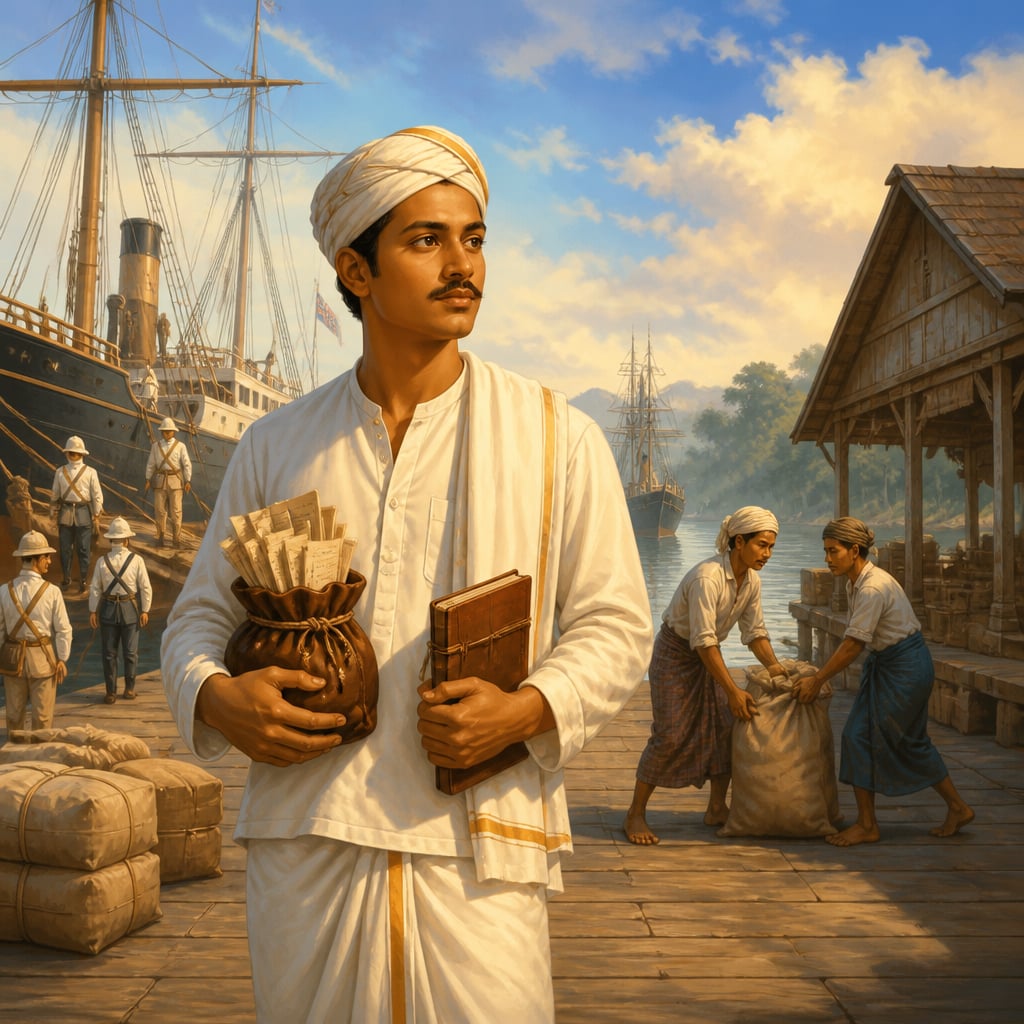
In 1824, a young man named Arunachalam stood on the docks of Moulmein, Burma, watching British ships unload soldiers and supplies. The East India Company had just annexed the territory, and where others saw chaos, Arunachalam saw opportunity. He was a Nattukotai Chettiar from Chettinad, a region so arid that farming was impossible, so his ancestors had learned to farm something else entirely: money.
Arunachalam carried no weapons, no goods, only a leather pouch containing promissory notes and a small ledger. Within three years, he would be financing rice farmers across the Irrawaddy Delta. Within a generation, his community would control 80% of all lending in Lower Burma.
This is the story of how a tiny Tamil community became the bankers of Southeast Asia.
The Chettinad Crucible
Chettinad, located in southeastern Tamil Nadu's Sivaganga district, is one of India's most inhospitable regions. Annual rainfall barely reaches 850mm. Agriculture is nearly impossible. But this very scarcity created something remarkable: a community that understood that capital itself could be cultivated.
The Nattukotai Chettiars, also called Nagarathars, developed sophisticated financial practices centuries before European banks arrived in Asia. They pioneered their own double-entry bookkeeping system with terms still used today:
- Pattru (debit)
- Varavu (credit)
- Selavu (expenditure)
- Laabam (profit)
- Nashtam (loss)
- Iynthogai (trial balance), a unified document reflecting the business's financial status at any given moment
They are considered the pioneers of modern banking in South and Southeast Asia, introducing concepts that predated or developed parallel to European accounting innovations.
The Principle: Trust as Capital
The Chettiars operated on a principle embedded in their dharmashastra traditions:
"Vishwasa eva parama dharma" "Trust itself is the highest dharma"
This wasn't mere sentiment, it was economic strategy. The ancient texts recognized that trust reduces transaction costs. The Narada Smriti, a juridical text from the Dharmashastra tradition, extensively covered debt, interest, and lending, establishing that repaying debts was not just a legal obligation but a moral one with karmic consequences.

The Chettiars institutionalized trust through the kittangi, communal lodging houses in every city where they operated. A Chettiar arriving in Rangoon, Singapore, or Colombo would stay at the kittangi, where his creditworthiness was already known through the community network. No credit checks needed. No collateral required for community members. The network was the collateral.
Global Perspectives: The Diaspora Banking Model
The Chettiar model wasn't unique in concept, but its scale and sophistication were remarkable.

Mayer Amschel Rothschild (1744-1812) built Europe's most powerful banking dynasty using a strikingly similar strategy. He sent his five sons to five European capitals, Frankfurt, London, Paris, Vienna, and Naples, creating a network where family trust replaced institutional verification. The Rothschilds could move capital across borders faster than any competitor because a letter from one brother to another was as good as gold.
The Chettiars operated identically, but across a different geography. Young men from Chettinad were sent to Burma, Malaya, Ceylon, and Cochin China (Vietnam). They worked in family firms, maintained meticulous accounts, and reported back to the main family in India. Cross-border transfers happened through hundis, bills of exchange that functioned like modern wire transfers.
| Aspect | Rothschild Network | Chettiar Network |
|---|---|---|
| Hub | Frankfurt | Chettinad, Tamil Nadu |
| Nodes | 5 European capitals | Burma, Malaya, Ceylon, Vietnam |
| Trust Basis | Family (5 brothers) | Community (~10,000 families) |
| Peak Capital | £4.3 million (1815) | Rs. 1,200 million (1929-30) |
| Primary Clients | European governments | Colonial commodity producers |
Both networks understood that diaspora is infrastructure.
The Empire's Reach
By the 1920s, Chettiar capital flowed across Southeast Asia like monsoon waters across rice paddies:
Burma (70% of Chettiar investments):
- Rs. 750-800 million invested
- 25% of all cultivated land in Lower Burma held as collateral by 1936
- Financed the transformation of Burma into the "rice bowl of Asia"
- Paddy prices at peak: Rs. 202/100 baskets (1926)
Malaya & Straits Settlements:
- Rs. 200-250 million invested
- Financed rubber plantations and tin mining
- Market Street in Singapore housed 7 kittangis and 300-400 Chettiar firms
- "More than half of the smaller estates which belonged to Chinese and others passed to Chettiar hands" during the Depression
Ceylon (Sri Lanka):
- Rs. 100-150 million invested
- Introduced the pawning business before commercial banks existed
- Mahatma Gandhi visited Colombo, Kandy, and Jaffna in 1927, organized by the Nagarathar Society of Colombo
- Led indirectly to the establishment of the Bank of Ceylon (1939)
Cochin China (Vietnam):
- Rs. 50 million invested
- Financed rice cultivation in the Mekong Delta
The Great Unwinding
The global Depression of the 1930s broke the Chettiar system. Paddy prices collapsed by over 50% between 1926 and 1933. Borrowers defaulted. The Chettiars found themselves holding land they never wanted, 25% of Burma's cultivated acreage.
This created a tragic irony: moneylenders became landlords. The very communities they had financed now resented them. The 1938 anti-Indian riots in Burma targeted Chettiar properties. Japanese occupation during World War II disrupted their networks. And decolonization delivered the final blow: Burma's 1962 military coup led to nationalization, forcing over 300,000 ethnic Indians, including most Chettiars, to leave with nothing.
Your Turn: The Trust Economy Today
The Chettiar story holds lessons for 2025:
UPI as Digital Kittangi: India's Unified Payments Interface processes over 10 billion transactions monthly. Like the Chettiar network, it succeeds because participants trust the system, not necessarily each other. Trust is the infrastructure.
The Diaspora Advantage: The Indian diaspora remitted $125 billion in 2023, the world's largest remittance flow. Modern Chettiars? Perhaps. But without the community accountability that made the original system work.
Consider: In your own financial life, where does trust reduce transaction costs? In family loans made without paperwork? In business deals sealed with a handshake? The Chettiars understood that trust is not the opposite of profit, it's the foundation of it.
The kittangis are gone. Market Street is now the Golden Shoe Complex. But the principle remains: wealth flows fastest through networks of trust.
Ronald Coase's transaction cost economics (1937) explains why firms exist: to reduce the costs of market transactions. Nobel laureate Oliver Williamson extended this to show how trust reduces 'opportunism' costs.
The Chettiars operationalized this centuries earlier. Their community network reduced transaction costs so dramatically that they outcompeted colonial banks, who required collateral, contracts, and courts. The Chettiars needed only a word.
Chettiars charged 12-36% annual interest vs. 6-8% for colonial banks, yet dominated lending, proving their value proposition was speed and accessibility, not price.
Modern fintech companies obsess over 'customer lifetime value' (CLV), the total revenue a customer generates over their entire relationship. This is exactly what the Chettiars optimized for.
The Chettiars structured loans so farmers could repay after harvest and borrow again for the next planting. Their disaster came when external shocks (the Depression) made the 'tree' (commodity prices) itself unproductive, a systemic risk they couldn't control.
Chettiar two-thirds of agricultural loans were secured by mortgage, conservative enough to survive minor defaults, but insufficient for a 50% collapse in commodity prices.
Key terms
- Nattukotai Chettiar
- Literally 'Chettiars of the inland fort'; a Tamil banking community from the Chettinad region who became the dominant financiers of Southeast Asia during the colonial era.
- Kittangi
- A communal lodging house and business center where Chettiar merchants stayed, conducted business, and verified creditworthiness through the community network.
- Hundi
- A bill of exchange or promissory note that could be cashed at a distant location by a different merchant, enabling safe transfer of value across geographies.
- Iynthogai
- The Tamil term for 'trial balance', a unified document showing a business's complete financial position at any given moment.
Key figures
Sir Annamalai Chettiar
Murugappa Family
Mayer Amschel Rothschild
Case studies
The Murugappa Pivot: From Burma to Billion-Dollar Conglomerate
In 1937, the Murugappa family faced a crisis that had destroyed many Chettiar fortunes. The Great Depression had collapsed rice prices. The 1938 anti-Indian riots in Burma targeted their properties. And whispers of Japanese expansion threatened everything. A.M.M. Arunachalam Chettiar, second-generation leader of the family, made a decision that went against every Chettiar instinct: abandon Burma. Rather than waiting for conditions to improve, as most Chettiars did, the Murugappas began systematically transferring assets to India. They didn't just move money; they diversified into manufacturing, starting with Coromandel Engineering in 1947 and TI Cycles in 1949 (partnering with UK's Tube Investments). When Burma's 1962 coup nationalized all private enterprises, the Murugappas had already rebuilt in India while others lost everything.
From a dharmic perspective, the Murugappas demonstrated *viveka* (discernment) over *lobha* (greed). Many Chettiar families stayed in Burma hoping to recover their massive landholdings, the very land they never wanted but had acquired through foreclosures. The Murugappas recognized that clinging to past success could destroy future potential. They also maintained *kula dharma* (family duty) through the 'Kartha' system, collective decision-making where the eldest active male serves as trustee rather than owner. This prevented the family fragmentation that destroyed other business dynasties. Today, 4th and 5th generation members still operate under this system.
The Murugappa Group in 2024-25: - ₹90,200 crore ($10.1 billion) revenue across 29 businesses - Ranked #26 on Forbes India's 100 richest families - Brands include BSA & Hercules cycles, Chola Finance (one of India's largest NBFCs), Coromandel fertilizers - Acquired Germany's Hubergroup for $310 million in 2024-25 - Still family-managed after 125 years with zero major scandals The contrast is stark: Chettiars who stayed in Burma lost 100% of their capital. The Murugappas preserved and multiplied theirs a thousand-fold.
Strategic retreat is not defeat. The Murugappas showed that preserving capital to fight another day, especially when external forces are beyond your control, is often wiser than stubborn persistence. They also proved that traditional governance systems (Kartha) can work in modern conglomerates when applied with flexibility.
Modern investors face the Murugappa decision constantly. Knowing when to exit a position, a market, or a strategy before external forces make the choice for you is the difference between portfolio managers who survive downturns and those who are wiped out.
In 1962, Burma's nationalization seized an estimated Rs. 500+ crore in Chettiar assets. The Murugappas had moved their capital out by 1942, protecting wealth that would grow to $10+ billion over the next 80 years.
The Burma Rice Boom and Bust: A Cautionary Tale
Between 1856 and 1930, Lower Burma transformed from subsistence agriculture to the world's largest rice exporter. The Chettiars were the financial engine of this transformation. British colonial administration provided legal frameworks and infrastructure (ports, railways); the Chettiars provided credit to Burmese farmers who needed capital for each planting season. The system seemed perfect: farmers borrowed before planting, repaid after harvest. Chettiars earned 24-36% interest. Land was collateral. Everyone prospered as rice prices rose. By 1929, Chettiar capital in Burma totaled Rs. 750-800 million, 70% of all their overseas investments.
The system violated the honeybee principle in one crucial way: it was entirely dependent on external prices the Chettiars couldn't control. When paddy prices collapsed from Rs. 202/100 baskets (1926) to under Rs. 100 (1933), farmers couldn't repay. The Chettiars had to foreclose. But a moneylender holding rice land is a farmer, and Chettiars had no farming skills. By 1936, they held 25% of Lower Burma's cultivated land and 50% of non-cultivable land. They'd become what they never wanted to be: absentee landlords in a foreign country. This concentration of land ownership turned the local population against them. The 1938 anti-Indian riots specifically targeted Chettiar properties. The community that had financed Burma's prosperity became a scapegoat for its collapse.
The Burma chapter ended in complete loss: - 1938: Anti-Indian riots destroy Chettiar properties - 1942: Japanese invasion disrupts remaining operations - 1962: Military coup; nationalization of all private enterprises - 1964: Forced expulsion of 300,000+ ethnic Indians, including most Chettiars Rs. 800 million in 1929, equivalent to billions today, vanished entirely. The community that had controlled 80% of Burma's lending owned nothing by 1965.
Concentration risk can destroy even the most successful system. The Chettiars were masters of credit risk (individual borrower default) but blind to systemic risk (commodity price collapse affecting all borrowers simultaneously). Modern portfolio theory would call this 'undiversification.' The Chettiars called it catastrophe.
The 2008 subprime crisis replicated the Burma pattern exactly: concentrated lending in a single asset class (housing), ignoring systemic risk while managing individual credit risk, followed by catastrophic losses when the underlying market collapsed. Diversification remains the most undervalued risk management tool.
Paddy price drop: Rs. 202 (1926) → Rs. 75 (1933) = 63% decline. Loan default rate rose from <5% (1920s) to >50% (1933). Recovery rate on foreclosed land: near zero after 1962 nationalization.
Historical context
Colonial Southeast Asia (1820s-1960s)
The Chettiars emerged from one of India's least agriculturally productive regions, Chettinad in Tamil Nadu. With farming impossible, the community developed financial services as their primary occupation. Their expansion to Southeast Asia coincided with British colonial expansion, which provided the legal and physical infrastructure (courts, ports, railways) that made their operations viable.
Contemporary with the Chettiars' rise, the Rothschild family dominated European finance using remarkably similar methods: family trust networks, diaspora distribution, and bills of exchange. The Parsee merchant families of Bombay (Tata, Wadia) also operated internationally but focused more on trade and manufacturing than pure finance.
At peak (1929-30): Total Chettiar overseas capital = Rs. 1,200 million (~$400 million at contemporary exchange rates). Burma alone: Rs. 750-800 million. This made the Chettiars one of the largest pools of private capital in the entire British Empire.
The Chettiar story demonstrates both the power and the limits of community-based finance. Trust networks can outcompete formal institutions in speed and accessibility, but they cannot survive systemic shocks that affect all borrowers simultaneously. Modern financial inclusion efforts (microfinance, UPI) face the same challenge: how to scale trust while managing systemic risk.
Living traditions
- Kartha Governance System: Still used by families like the Murugappas, the Kartha system appoints the eldest capable male as trustee of family wealth. He manages on behalf of all family members, with decisions made collectively. This prevents fragmentation across generations.
- Chettiar Cuisine and Hospitality: The elaborate Chettinad cuisine, known for its 64-spice blends, developed partly as a display of wealth and hospitality. Many heritage hotels now offer cooking classes and traditional meals.
- Chettinad Heritage Town: The original homeland features over 10,000 heritage mansions built with wealth from Burma and Malaya. Many are now heritage hotels. The Chettinadu Palace and Athangudi tiles showcase the wealth that flowed back from Southeast Asia.
- Indian Bank Heritage Museum: Co-founded by Sir Annamalai Chettiar in 1907, Indian Bank maintains a heritage display documenting its Chettiar origins and the community's banking innovations.
- Sri Thendayuthapani Temple (Chettiars' Temple): Built in 1859 by Singapore's Chettiar community, this temple hosted the annual Thaipusam festival and served as a gathering point for the community. Still active and open to visitors.
- Karpaga Vinayagar Temple, Pillayarpatti: One of the most important Chettiar temples, this rock-cut cave temple features a 6-foot Ganesha carved from a single granite boulder. Chettiar merchants traditionally sought blessings here before embarking on overseas trading ventures, and donated generously from Burma and Malaya profits.
- Sri Thendayuthapani Temple: Built in 1859 by Singapore's Chettiar community, this temple served as both a spiritual center and informal business hub where Chettiar merchants gathered, establishing the trust networks that powered their Southeast Asian banking empire.
Reflection
- The Chettiars built their empire on community trust, yet this same trust network couldn't save them from systemic collapse. In your own life, where do you rely on trust networks, and what systemic risks might you be blind to? Consider: family support, professional networks, community institutions. What would break if an external shock affected everyone simultaneously?
- The Murugappa family survived by diversifying out of Burma before the collapse. Identify one area of concentration risk in your own finances or career, whether a single income source, one industry skill, or dependence on a single market. What one concrete step could you take this month to diversify?