Wisdom of Restraint

The Hardest Lesson

The ultimate strategic wisdom - knowing that the power not used is often the greatest power of all.

The Emperor Who Could Have Conquered
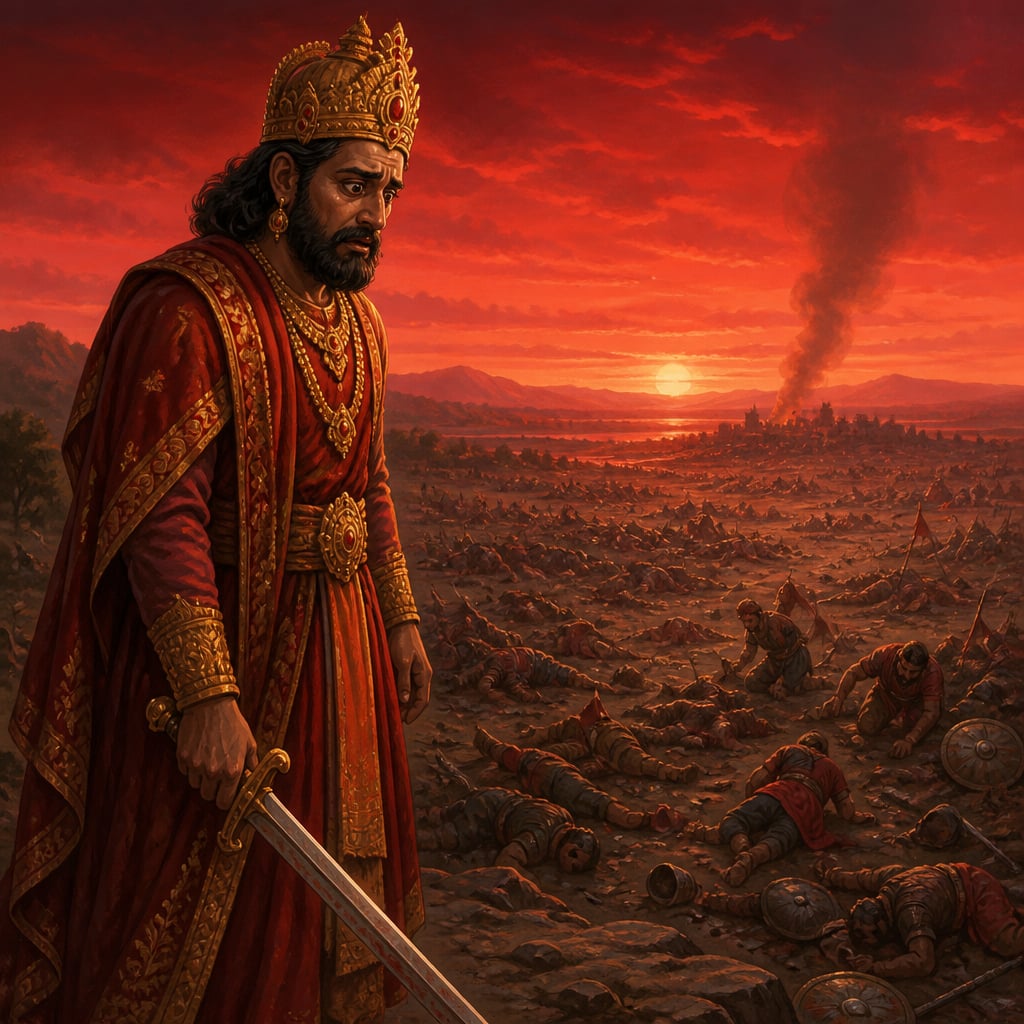
Ashoka standing in grief above the Kalinga battlefield at dusk

Ashoka, after the bloody Kalinga War, ruled an empire stretching from Afghanistan to Bangladesh. He had the largest army in the world, overflowing treasuries, and no rival capable of stopping him. He could have conquered the entire subcontinent, perhaps gone further.

He chose not to.
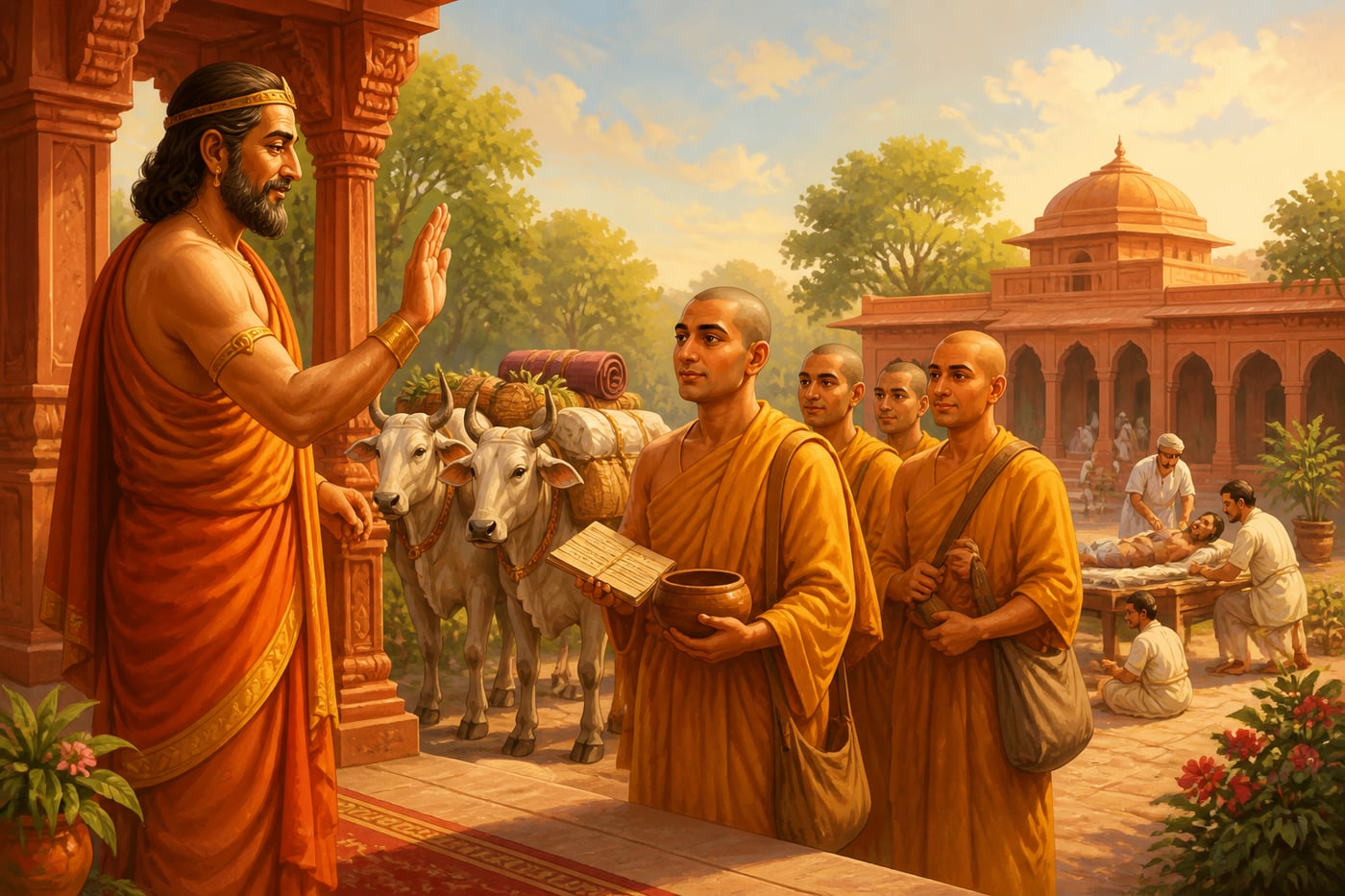
Ashoka blessing Buddhist missionaries setting off from his palace

Instead, Ashoka turned from conquest to governance, from war to dharma. He built hospitals and roads. He sent missionaries instead of armies. He is remembered not for the territories he could have taken but for the restraint he showed in not taking them.

"The greatest power," Kautilya writes, "is the power held in reserve."

The Paradox of Power

We have studied throughout this course how to acquire power, project it, and win conflicts. Now we confront the ultimate lesson: the strategic value of not using power even when you have it.

This seems contradictory. Why acquire power if not to use it? Why build strength if it remains unused?

But consider: the army that fights depletes. The treasury spent is gone. The alliance called upon is tested. Every use of power costs something. The power that remains unused retains all its potential.

Moreover, potential power often achieves more than actual power. The kingdom that could attack, but doesn't, maintains both the capability and the goodwill. The moment it attacks, it loses one or both.

The Economics of Unused Power

Kautilya provides an economic framework for understanding restraint:

The cost of action: Every use of power has direct costs (resources expended) and indirect costs (opportunities foreclosed, enemies created, allies concerned).

The value of potential: Unused power retains 100% of its potential. Used power converts potential into actual effects, but the conversion is never complete. Something is always lost.

The decay calculation: All power eventually decays. The question is whether the decay rate of unused power exceeds the cost of using it. Often, restraint preserves more than action would gain.

The deterrence dividend: Power known to exist but not used creates deterrence. This deterrence often achieves objectives without requiring actual deployment.

When we calculate carefully, restraint often proves more valuable than action.

Types of Strategic Restraint

Restraint takes many forms:

Military restraint: Not attacking despite capability. Not pursuing a retreating enemy. Not conquering territory that could be conquered. Not using maximum force when minimum would suffice.

Economic restraint: Not extracting maximum revenue from subjects. Not exploiting monopoly power fully. Not demanding all that could be demanded from weaker parties.

Political restraint: Not humiliating defeated rivals. Not eliminating potential challengers. Not pressing advantages to their ultimate extent.

Personal restraint: Not reacting to every provocation. Not responding to insults. Not seeking revenge when it is within reach.

Each form of restraint preserves options, builds reputation, and maintains the potential for future action.

The Psychology of Restraint

Why is restraint so difficult? Kautilya identifies the psychological challenges:

The action bias: Humans are wired to respond to threats with action. Restraint feels passive, weak, even cowardly. Overcoming this requires mental discipline.

The sunk cost trap: Having invested in building power, we feel compelled to use it. The army trained must fight; the treasury filled must be spent. This logic leads to unnecessary action.

The demonstration imperative: Power unexpressed seems unreal. We feel the need to prove our strength by displaying it. But every display diminishes what remains.

The moment's passion: In the heat of conflict, restraint is hardest. The enemy's insult, the adviser's urging, the crowd's expectations, all push toward action.

Mastering restraint requires mastering these psychological forces.

When Restraint Strengthens

Strategic restraint builds power in several ways:

Reputation for moderation: The ruler known for restraint is treated differently than one known for aggression. Others cooperate more readily, resist less strongly, and fear less intensely.

Preservation of resources: The army not expended remains available. The treasury not spent compounds. Resources preserved through restraint fund future opportunities.

Intelligence gathering: While restraining from action, you can observe, learn, and prepare. Action often forecloses learning; restraint enables it.

Moral authority: The power that could punish but doesn't earns gratitude and loyalty. The conqueror who could plunder but restrains wins hearts.

Option preservation: Unused power keeps all options open. Once power is deployed in one direction, other directions become harder to pursue.

When Restraint Weakens

Not all restraint is wise. Kautilya warns against restraint that weakens:

When interpreted as weakness: If restraint is seen as inability rather than choice, it invites aggression. Restraint should be clearly a decision, not a necessity.

When opportunity passes: Some moments require action. The restrained king who misses the decisive moment has failed as surely as the hasty one who acted prematurely.

When enemies are emboldened: If your restraint convinces enemies that you will never act, they become bolder. Restraint must be balanced with occasional demonstration of will to act.

When allies doubt commitment: Those who depend on you need assurance. If your restraint suggests you won't defend them, they may seek other protectors.

The art is knowing which situation you face, one calling for restraint or one calling for action.

The Cultivated Pause

Between stimulus and response, there is space. In that space lies choice. Kautilya recommends cultivating this pause:

Before responding to provocations: The insult that demands immediate response rarely does. Wait. Let passion cool. Often the best response is no response.

Before deploying force: Once force is used, events take their own course. Before that point, you control events. Pause to ensure action is truly necessary.

Before major decisions: Important choices deserve time. The urgency that pressures immediate action is often manufactured or temporary.

After victories: The moment of victory is dangerous. The impulse to press advantage often leads to overreach. Pause to consolidate before extending.

This pause is not hesitation, it is deliberate space for wisdom to operate.

Restraint as Strategy

Kautilya offers examples of restraint as active strategy:

A Mauryan army arrayed at a border showing strength without crossing

Showing strength, not using it: The army that marches to the border but does not cross demonstrates capability without incurring costs. The threat achieved the objective; the war was unnecessary.

Sparing defeated enemies: The enemy destroyed becomes a permanent loss. The enemy spared may become a future ally or at least a neutral party. Restraint in victory can convert loss into gain.

Leaving something for others: The conqueror who takes everything provokes united resistance. The one who leaves something for subordinate powers creates grateful dependencies.

Delayed punishment: The punishment threatened but not delivered creates anxiety that actual punishment would end. Sometimes the threat is more powerful than the act.

The Limits of Conquest

Kautilya's most profound teaching on restraint concerns conquest itself. He asks: What is the point of unlimited expansion?

Every territory conquered must be governed, defended, and integrated. The costs increase with distance from the center. Eventually, the costs of holding territory exceed its benefits. The wise conqueror stops before reaching this point.

Moreover, the empire that seems to threaten everyone unites everyone against it. The power that expands without limit creates the very coalition that destroys it. Restraint in expansion is strategic wisdom, not timidity.

Ashoka understood this. After Kalinga, he could have continued. He chose restraint, and his empire lasted generations. Those who couldn't stop, Alexander, Napoleon, Hitler, saw their conquests dissolve.

Integrating the Lessons

As we conclude this chapter and this course, we integrate restraint with all we have learned:

Power and restraint: Build power not to use indiscriminately but to have choices. The strongest are those who can act but choose when.

Strategy and restraint: Strategic wisdom includes knowing when not to compete, when not to fight, when not to win. The victory not sought can be more valuable than the one achieved.

Action and restraint: Action is necessary; so is inaction. The complete strategist masters both, knowing when to move and when to be still.

Ambition and restraint: Ambition drives progress, but unrestrained ambition destroys. Channel ambition with discipline; temper drive with wisdom.

The Restrained Mind

Ultimately, strategic restraint begins with mental restraint:

Restraint of judgment: Not every situation requires your opinion. Not every action requires your response. Practice withholding judgment until you have complete information.

Restraint of speech: Words once spoken cannot be recalled. The strategist speaks less and listens more, reveals less and observes more.

Restraint of desire: Wanting everything leads to overreach. The disciplined mind knows what it truly needs versus what it merely wants.

Restraint of ego: The need to be right, to be recognized, to dominate, these egoic drives lead to strategic errors. The restrained ego serves strategy rather than demanding that strategy serve it.

The Final Teaching

Kautilya's Arthashastra is filled with teachings about power, how to acquire it, wield it, and maintain it. But his final and perhaps deepest teaching is about the wisdom to not use power.

The king who must use all his power is already weak. The king who has power in reserve is truly strong. The king who can achieve objectives without deploying power has mastered the art.

This is the hardest lesson because it contradicts every instinct. We want to act, to prove ourselves, to demonstrate strength. Restraint feels like failure.

But the wisest know: the power not used is often the greatest power of all. The victory not sought is sometimes the truest victory. The word not spoken can say more than volumes.

This is the wisdom of restraint, and it is, indeed, the hardest lesson.

Verses

अप्रयुक्तं बलं श्रेष्ठं

Aprayuktaṃ balaṃ śreṣṭhaṃ

Unused power is the greatest power

Power retained has 100% of its potential. Power deployed loses something in the deployment.

संयमेन जयति सर्वं

Saṃyamena jayati sarvaṃ

Through restraint, one conquers all

The greatest conquest is self-conquest. The one who can restrain impulse, delay gratification, and hold back unnecessary action has achieved a victory that outlasts any territorial gain.

न सर्वं वक्तव्यं न सर्वं कर्तव्यं

Na sarvaṃ vaktavyaṃ na sarvaṃ kartavyaṃ

Not everything should be said, not everything should be done

Wisdom lies in knowing what to withhold, words, actions, reactions. The complete strategist knows when silence is more powerful than speech, when stillness is more effective than movement.

Case studies

Google's Strategic Patience in China

In 2010, Google faced attacks on its infrastructure from within China and pressure to censor results. It could have quietly complied (as competitors did), publicly fought (risking total exclusion), or engaged in endless negotiation. Instead, Google chose strategic restraint, it withdrew from mainland China while maintaining presence in Hong Kong, neither fully fighting nor fully surrendering.

This restraint preserved Google's options and reputation. It avoided complete exclusion while also avoiding complete capitulation. The company retained the ability to return if conditions changed while maintaining its stated principles. It was neither war nor peace but strategic positioning through restraint.

Google maintained its global reputation for not fully surrendering to censorship demands while competitors faced ongoing criticism. When conditions changed, Google had options that companies who had fully committed lacked. The restraint preserved strategic flexibility.

Sometimes the best response is neither to fight nor to submit but to step back strategically. Restraint can preserve options that either extreme would foreclose.

Companies regularly face decisions about whether to operate in markets that require compromising their values. Airbnb's exit from China, Apple's ongoing tension between Chinese manufacturing and human rights concerns, and Meta's struggles with content moderation in authoritarian countries all echo Google's dilemma. Strategic withdrawal, when executed thoughtfully, can preserve long-term brand value better than compromised participation.

Google's exit from China left an opening that Baidu filled, growing to a $50 billion market cap. Meanwhile, Google's global brand value arguably increased because the exit reinforced its 'Don't Be Evil' reputation during a critical growth period.

Ashoka's Transformation

After the Kalinga War (c. 261 BCE), Ashoka ruled the largest empire India had ever seen. His armies had proven unstoppable. The treasuries overflowed with conquest's spoils. Every indicator suggested continuing expansion. Instead, Ashoka publicly renounced conquest and turned toward dharma.

Ashoka recognized that continued conquest would create mounting resistance, endless military expenditure, and governance challenges. His empire was already at the limits of practical administration. Restraint preserved what had been won rather than risking it in pursuit of more.

Ashoka's empire remained stable for generations. His cultural and religious influence spread across Asia through peaceful means. He is remembered as one of history's greatest rulers, not for conquest but for the wisdom to stop conquering. His edicts and monuments remain; the territories of other conquerors are forgotten.

There comes a point where further conquest destroys more than it creates. The wisdom to recognize that point, and to stop, is the ultimate strategic achievement.

The most admired companies today, from Patagonia to Costco to Berkshire Hathaway, are led by people who recognized when to stop optimizing for growth and start optimizing for sustainability. In careers, the parallel is knowing when promotion-chasing should give way to meaningful contribution. The wisdom to stop conquering and start building something lasting is rare, and it is the mark of genuine strategic maturity.

Ashoka's edicts, carved on rocks and pillars across the subcontinent, are found in over 30 locations spanning modern India, Pakistan, Nepal, and Afghanistan. His voluntary shift from conquest to dharma is virtually unprecedented among rulers at the height of their power.

Reflection

More in Strategic Patience

All lessons in Strategic Patience · Arthashastra: Art of Strategy course