The Power of Waiting

Kshama - Strategic Patience

Time changes everything. How patience can be your greatest strategic weapon.

The Siege That Lasted Thirteen Years
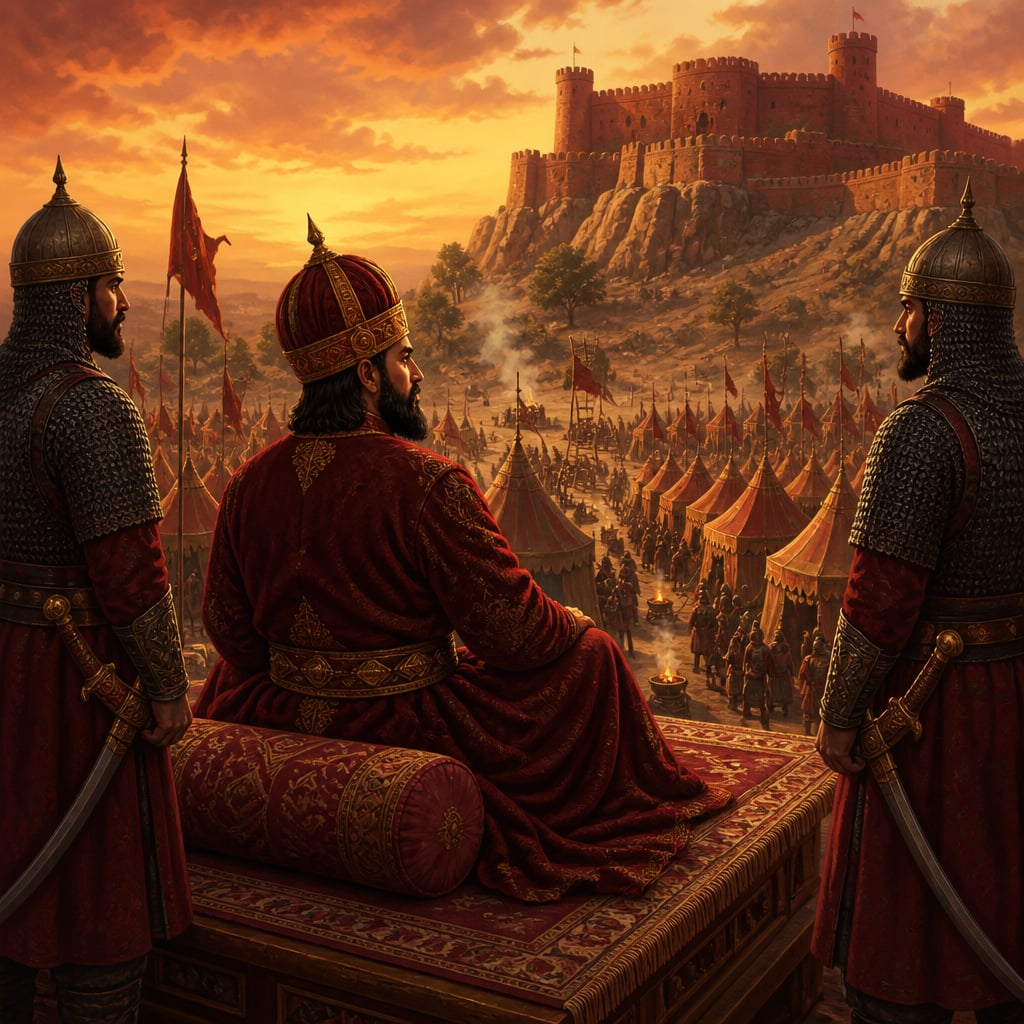
Alauddin Khilji patiently observing the Ranthambore fortress during the long siege

In 1296 CE, Alauddin Khilji looked upon the mighty fortress of Ranthambore and laughed at those who advised a direct assault. The fortress had never fallen to a frontal attack in its history. Instead of wasting his army against impregnable walls, Khilji settled in for a siege that would test both sides' patience.

But the true master of strategic patience was elsewhere. In the forests of Vijayanagar, the brothers Harihara and Bukka watched as the Delhi Sultanate seemed invincible. They didn't rebel, didn't fight, didn't even protest. They waited. They built. They prepared. For over a decade, they gathered resources, made alliances, and planned. When the moment came, when the Sultanate was weakened by internal conflicts, they struck, founding an empire that would last over two centuries.

"The patient hunter," Kautilya writes, "catches more prey than the swift one."

Kshama: The Most Misunderstood Virtue

The Sanskrit term kshama is often translated simply as "patience" or "forgiveness." But in strategic context, it means something far more powerful, the deliberate cultivation of waiting as a weapon.

Kautilya distinguishes between passive patience (simply enduring) and active patience (using time strategically). The fool waits because he has no choice. The wise king waits because time itself is fighting on his side.

Consider the economics of waiting. An aggressor must maintain an army in the field, pay soldiers, feed horses, keep supply lines open. A defender behind strong walls merely needs to survive. Every day that passes drains the attacker while the defender conserves strength. This is why Kautilya writes that in siege warfare, "time is the defender's greatest ally."

The Mathematics of Patience

The Arthashastra provides remarkably specific calculations about when patience pays. Kautilya analyzes scenarios:

When to Wait: If your enemy's strength is expected to decline by one-sixth each month due to desertions, expenses, or internal conflicts, then waiting six months transforms a dangerous opponent into a manageable one, without losing a single soldier.

When Not to Wait: If your own resources are declining faster than your enemy's, or if delay allows an enemy to form alliances, then patience becomes poison.

This mathematical approach strips romance from patience and reveals it as pure calculation. The question is never "Can I be patient?" but "Does patience serve my strategic goals?"

Patience as Deception

One of the most sophisticated uses of strategic patience is as a form of deception. When you appear patient and peaceful, enemies relax. They redirect resources elsewhere. They stop watching you closely.

Kautilya advises the weak king to show extreme patience toward powerful neighbors, not from genuine acceptance of subordination, but as a mask while building strength in secret. "Let your enemy think you are a lake," he writes, "while you become an ocean."

Young Shivaji bowing in apparent submission before a Mughal noble

This was the strategy of Shivaji's early career. For years, he appeared to accept Mughal supremacy, even serving them nominally. All the while, he was building fortresses, training soldiers, creating a navy. When he finally revealed his true power, the Mughals were stunned by what had grown under their very noses.

The Psychology of Strategic Waiting

Patience is perhaps the hardest strategic discipline because it fights against human nature. We are wired to act, to respond to threats immediately, to demonstrate strength through motion. The king who waits while enemies gather appears weak. His own advisors question him. His subjects wonder if he has lost courage.

Kautilya acknowledges this challenge: "The patient king must be patient with impatient advisors." Managing internal pressure while executing a patient strategy requires exceptional political skill.

He offers techniques:

The Danger of Infinite Patience

If patience is a virtue, is more patience always better? Kautilya warns emphatically: no.

"Excessive patience becomes cowardice," he writes. "The king who waits forever is not patient, he is paralyzed."

The strategic patient must define clear triggers that end the waiting period:

Without such triggers, patience becomes procrastination, and procrastination in statecraft leads to disaster.

Reading the Moment

The ultimate skill in strategic patience is recognizing when the waiting should end. Kautilya describes this as kala-gyana, knowledge of the right moment.

How do you know when the moment has arrived? He provides indicators:

The patient strategist maintains constant vigilance even while appearing inactive. They have scouts watching, spies reporting, analysts calculating. The waiting is never passive, it is coiled potential, ready to strike.

Patience in Different Domains

Kautilya applies the principle of strategic patience across multiple domains:

Military patience: Waiting for advantageous terrain, weather, or enemy mistakes rather than forcing battle on unfavorable terms.

Economic patience: Building treasury reserves slowly rather than dramatic measures that provoke resistance.

Harihara I overseeing the quiet construction of Vijayanagara above the Tungabhadra

Diplomatic patience: Letting alliances develop naturally rather than forcing premature commitments that create resentment.

Political patience: Allowing reforms to take root gradually rather than revolutionary changes that provoke backlash.

In each domain, the principle remains: let time do the work that force cannot.

The Patient Mind

Ultimately, strategic patience must be cultivated as a mental discipline. Kautilya recommends specific practices:

Study history: Those who know how previous kingdoms rose and fell see that time transforms everything. What seems permanent today will change.

Practice delay: Before every decision, ask whether it would benefit from waiting. Make delay a habit before action.

Observe nature: The seasons teach patience. The farmer cannot rush the harvest. Neither can the strategist.

Keep perspective: The crisis that seems urgent today often resolves itself tomorrow. Most problems are smaller than they appear in the moment.

The strategist who masters patience achieves something remarkable: they make time itself their ally. While others exhaust themselves in frantic activity, the patient one grows stronger with each passing day.

Verses

कालेन सर्वं साध्यते

Kālena sarvaṃ sādhyate

Through time, all things are accomplished

Time itself is a strategic tool. What cannot be achieved through force can often be achieved simply by waiting for circumstances to change.

क्षमा शस्त्रं यस्य बलिनो हन्ति

Kṣamā śastraṃ yasya balino hanti

Patience is the weapon that defeats even the powerful

The mighty opponent who cannot be defeated in battle can be defeated by time. All power eventually weakens, all advantages eventually fade.

प्रतीक्षते यो विजयी भवेत्

Pratīkṣate yo vijayī bhavet

The one who waits shall become victorious

Victory often goes not to the strongest or fastest, but to those who can outlast their opponents through strategic patience.

Case studies

Amazon's Decade of Patience

From 1994 to 2001, Amazon lost money almost every quarter, and its stock lost 90% of its value in the dot-com crash. Critics declared the company a failure. Jeff Bezos could have pivoted to immediate profitability by cutting investments, but instead practiced extreme strategic patience, continuing to invest in infrastructure and customer experience.

Bezos understood that the internet's impact would unfold over decades, not quarters. He accepted short-term losses to build advantages that would compound over time. His patience was not passive, he was actively building while others retreated.

Amazon became one of the most valuable companies in history. The infrastructure built during the 'losing' years, warehouses, logistics, cloud computing, created moats that competitors still cannot cross. Patient waiting created trillion-dollar value.

Strategic patience works when: (1) you understand how time will change the landscape, (2) you use waiting time productively, and (3) you have the resources to survive the waiting period.

Tesla followed the same arc: years of skepticism, production delays, and near-bankruptcy before becoming the world's most valuable automaker. SpaceX endured three consecutive rocket failures before its fourth launch succeeded. The pattern repeats across industries: transformative companies almost always endure a long period of apparent failure before their strategic patience pays off.

Amazon did not post a consistent annual profit until 2003, nine years after its founding. Jeff Bezos reinvested every dollar into infrastructure while competitors optimized for quarterly earnings reports.

The Vijayanagara Foundation

In the early 14th century, the brothers Harihara and Bukka served the Delhi Sultanate after their kingdom was conquered. Rather than rebellion or dramatic resistance, they waited. For over a decade, they accumulated resources, built relationships with local chieftains, and planned in secret.

Their patience was active, not passive. Every year of apparent submission was used to prepare for eventual independence. They studied their masters' weaknesses, built their own strengths, and waited for the Sultanate to be distracted by other problems.

When Muhammad bin Tughlaq's campaigns elsewhere weakened Sultanate control in the south, the brothers struck. The Vijayanagara Empire they founded became the major power of South India for over two centuries, a direct result of patient preparation.

Patient preparation while appearing submissive can lead to outcomes that direct resistance could never achieve. Time spent in apparent weakness can become strength if used wisely.

Modern entrepreneurs in restrictive environments use the same strategy. Founders in heavily regulated industries build expertise and relationships within existing systems before launching ventures that transform those industries. The pattern appears in fintech founders who worked at banks, health-tech founders who trained as doctors, and ed-tech founders who taught in schools. Time spent inside the system becomes the foundation for changing it.

The Vijayanagara Empire lasted over 300 years and became one of the wealthiest states in the world. At its peak, the capital city had an estimated population of 500,000, larger than contemporary Paris or London.

Reflection

More in Strategic Patience

All lessons in Strategic Patience · Arthashastra: Art of Strategy course