Strategic Retreat

Knowing When to Withdraw

Retreat is not defeat. Knowing when and how to withdraw strategically.

The March That Saved an Empire

In 1303 CE, Alauddin Khilji marched an immense army toward Chittor. The Rajput king Ratan Singh had two choices: meet the vastly superior force in open battle and face almost certain destruction, or retreat behind his fortress walls. He chose the walls.
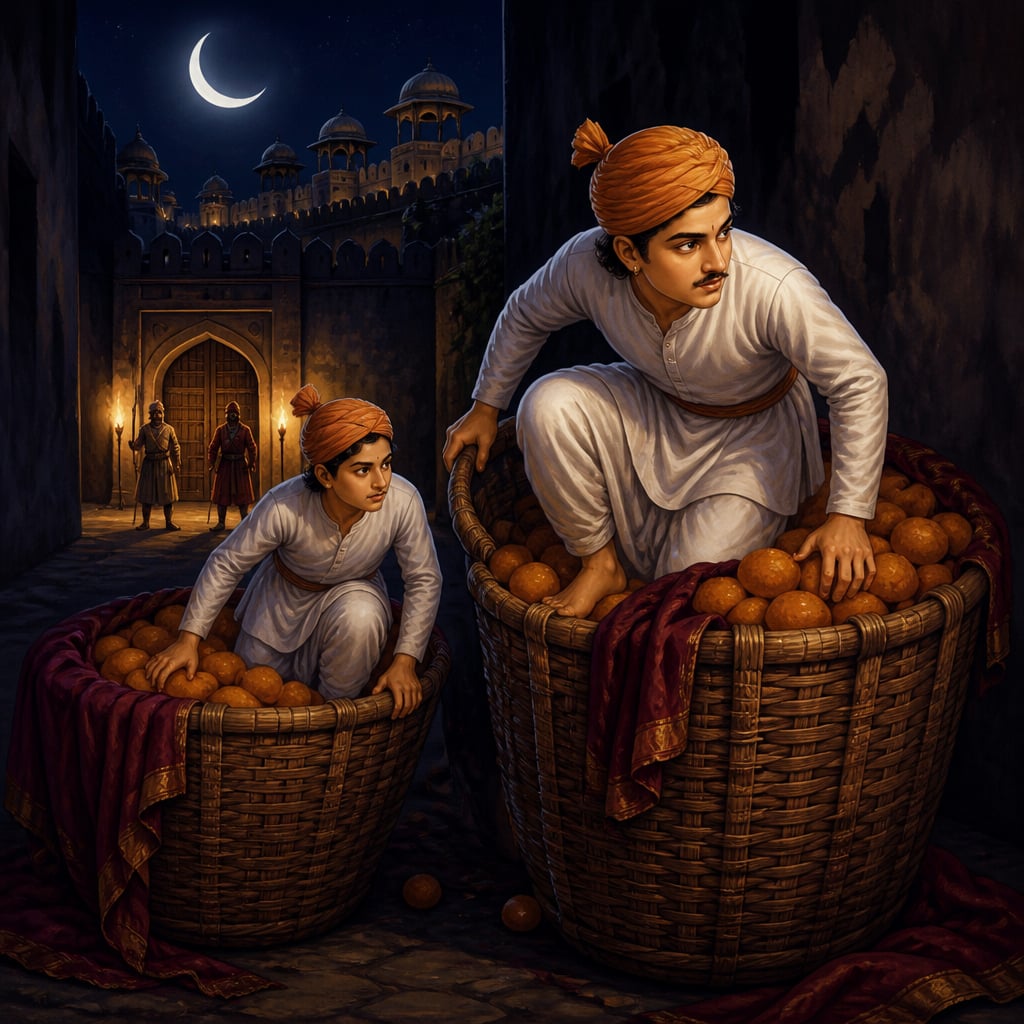
Shivaji escaping from Agra hidden in baskets of sweets at midnight

But the most instructive retreat in Indian history came later. In 1659, when Shivaji found himself trapped at Panhala fort by Siddi Jauhar's besieging army, he did what many would consider unthinkable, he negotiated, gave ground, and escaped through the mountains at night while a brave commander stayed behind to delay pursuit. This "retreat" preserved the Maratha cause and eventually led to the founding of an empire.

"The king who knows when to retreat," Kautilya writes, "preserves both his army and his options."

The Philosophy of Strategic Withdrawal

Modern culture often treats retreat as shameful, synonymous with cowardice or failure. Kautilya disagrees entirely. In the Arthashastra, retreat is presented as one of the six fundamental foreign policy options (shadgunya), alongside peace, war, waiting, alliance, and double policy.

Why is retreat listed as a legitimate strategy? Because Kautilya understands a truth many leaders refuse to accept: resources expended in a losing cause are gone forever. The army destroyed in a pointless last stand cannot fight tomorrow's winnable battles. The treasury emptied in hopeless defense cannot fund future opportunities.

Strategic retreat is not the opposite of courage, it is courage's complement. It takes courage to fight; it takes a different and often greater courage to acknowledge unfavorable odds and live to fight another day.

When to Retreat: The Kautilyan Calculus

How does a leader know when retreat is the right choice? Kautilya provides specific criteria:

Resource comparison: If the enemy has overwhelming advantage in troops, treasury, or allies, and there is no prospect of changing this balance before engagement, retreat preserves assets for better opportunities.

Terrain analysis: If you cannot choose the battlefield and the enemy holds favorable ground, retreat to find better terrain or force them to extend their supply lines.

Time calculation: If delay favors you (enemy's resources depleting, allies approaching, seasons changing), retreat to buy time.

Stakes assessment: If total defeat means complete destruction, but retreat means losing only territory that can be regained, retreat to preserve the ability to continue.

The key insight: retreat should be evaluated like any other strategic option, not treated as moral failure. What matters is the overall trajectory toward your goals, not the direction of any single movement.

The Art of Retreating Well

If retreat is sometimes the right choice, how should it be executed? Kautilya provides detailed guidance:

Maintain cohesion: A retreat that becomes a rout is far more costly than the original battle would have been. The army must withdraw in good order, maintaining discipline and formation.

Protect the rear: The retreating force is vulnerable to pursuit. A strong rearguard, preferably with cavalry, must slow pursuers and allow the main force to escape.

Destroy useful assets: Anything that cannot be carried away should be destroyed rather than left for the enemy, supplies, equipment, fortifications. Give the enemy a wasteland, not a prize.

Prepare the destination: Have a fortified position ready to receive the retreating force. The retreat should end somewhere defensible, not in open country where pursuit can continue.

Control the narrative: The political aspect of retreat matters. Frame it as strategic repositioning, not flight. Maintain the morale of your forces and the confidence of your allies.

Retreat as Trap

One of Kautilya's most sophisticated teachings is using retreat as a tactical weapon. A feigned retreat can:

Draw enemies into pursuit: When enemies pursue, they extend their lines, outpace their supply, and become vulnerable to counterattack.

Separate enemy forces: Eager units pursue faster than cautious ones, breaking enemy cohesion.

Lure into ambush: The "retreating" force draws pursuers into terrain where hidden forces wait.

Exhaust the enemy: Pursuit is tiring. The force that retreats in good order while the enemy chases often arrives fresher for the eventual confrontation.

A feigned cavalry retreat luring pursuers into a hidden ambush in a narrow pass

The great Mongol armies used feigned retreat as their signature tactic. They would engage, appear to flee, and when enemies pursued in disorder, wheel and destroy them. Many armies that thought they were winning were actually being led to slaughter.

The Psychology of Retreat

For the leader, ordering retreat is psychologically difficult. It requires:

Overcoming ego: The leader must care more about actual outcomes than appearance. This is harder than it sounds, many leaders have destroyed their forces rather than accept the shame of withdrawal.

Managing perception: Both your own people and allies must understand that retreat is tactical, not terminal. Communication is crucial.

Timing courage: The hardest moment is deciding when to retreat. Too early wastes opportunities; too late wastes forces. The leader must make this call under pressure with incomplete information.

Maintaining authority: After retreat, the leader must prevent demoralization and maintain the organization's belief in eventual victory.

Kautilya addresses each of these challenges, recognizing that retreat's difficulty is primarily psychological, not tactical.

Retreat in Non-Military Contexts

Kautilya's retreat principles apply beyond warfare:

Economic retreat: Sometimes a business must abandon a product line or market that is consuming resources without adequate return. This "retreat" preserves resources for more promising ventures.

Political retreat: A policy that faces overwhelming opposition might be withdrawn and reintroduced when conditions are more favorable. This is not weakness, it is recognition that success requires appropriate conditions.

Diplomatic retreat: Sometimes territorial or positional concessions create the space for broader agreements that serve longer-term interests.

Personal retreat: Abandoning a career path, relationship, or commitment that isn't working preserves energy and time for better opportunities.

In each case, the principle is the same: recognize when current investment is yielding inadequate returns and redirect resources toward more promising directions.

The Retreat That Enables Return

A Maratha army withdrawing in disciplined order at twilight

The most strategic retreats are those that preserve the capacity for return. Kautilya emphasizes:

Maintain your core: Even in retreat, protect your essential capabilities, your best troops, your key advisors, your treasury reserves. The periphery can be sacrificed; the core must survive.

Stay connected: Retreat to where you can maintain alliances and communications. Isolated retreat often becomes permanent exile.

Keep options open: Don't retreat into a dead end. Always maintain multiple paths forward.

Signal intentions: When appropriate, make clear that retreat is temporary. "I will return" can be a powerful strategic message that shapes enemy behavior.

The retreat that preserves these elements is not an ending, it is a transition to a new phase of competition.

When Retreat Is Wrong

Not every difficult situation calls for retreat. Kautilya warns against retreating when:

You face pursuit into worse positions: Sometimes standing is better than fleeing into disadvantage.

Allies depend on your presence: If your retreat enables enemy attack on allies, you may need to hold for their sake.

Morale cannot survive withdrawal: If the psychology of your forces requires a stand, even a costly one, that may be necessary.

The strategic cost exceeds the tactical benefit: Sometimes what you would lose by retreating exceeds what you would lose by fighting.

The strategic mind evaluates retreat the same way it evaluates any option, by its consequences, not by its emotional resonance.

Learning to Retreat

Like any strategic skill, the art of retreat must be practiced. Kautilya recommends:

Study historical retreats: Learn from those who withdrew well, and those who withdrew poorly. History is full of instructive examples.

Practice in small matters: Before you must make major retreat decisions, practice releasing smaller commitments that aren't working.

Develop criteria in advance: Decide before a crisis what conditions would trigger retreat. Pre-commitment reduces the influence of ego in the moment.

Build retreat into plans: Every campaign plan should include retreat contingencies. The army that has planned its withdrawal route executes it well.

The strategist who can retreat well has a capability that the strategist who can only advance lacks. It is, paradoxically, a source of strength.

Verses

अपक्रमः सिंहस्य लक्षणं

Apakramaḥ siṃhasya lakṣaṇaṃ

Strategic retreat is the mark of the lion

Even the mighty lion retreats when conditions are unfavorable. Retreat is not the mark of weakness but of strategic intelligence, the lion retreats not from fear, but from calculation.

पलायनं जीवनस्य मार्गः युद्धस्य च

Palāyanaṃ jīvanasya mārgaḥ yuddhasya ca

Retreat is the path to both survival and future victory

The force that retreats today can fight tomorrow. The force destroyed in pointless last stands cannot.

सर्वं त्यक्त्वा आत्मानं रक्षेत्

Sarvaṃ tyaktvā ātmānaṃ rakṣet

Abandon everything to preserve yourself

Territory, wealth, position, all can be regained. But the core capability, whether army or organization or self, once destroyed, is gone forever.

Case studies

Netflix's DVD Retreat

Netflix built its business on DVD-by-mail rental, becoming enormously successful. But CEO Reed Hastings saw that streaming would eventually dominate. In 2011, Netflix announced plans to separate its DVD business, effectively beginning a retreat from the core business that had made them successful.

This retreat was strategic, not forced. Netflix was winning the DVD business. But Hastings understood that winning a dying business was ultimately losing. The retreat from DVDs freed resources and focus for streaming, the actual future.

The retreat was initially painful, stock dropped, customers complained, media mocked. But by 2020, Netflix was a streaming giant worth over $200 billion. The DVD business they 'retreated' from was nearly gone. Strategic retreat from success enabled even greater success.

Sometimes you must retreat from winning positions if the game itself is ending. The ability to leave success for better opportunities distinguishes strategic leaders from those who ride success to irrelevance.

Companies today face the same dilemma when legacy revenue streams decline. Adobe's shift from packaged software to cloud subscriptions caused a 35% stock drop before tripling in value. Microsoft's pivot from Windows licensing to cloud services followed the same painful but necessary arc. The ability to retreat from a winning position before it becomes a losing one separates visionary leaders from caretakers.

Netflix lost 800,000 subscribers and 77% of its stock value in 2011 during the DVD-to-streaming transition. By 2024, it had over 260 million subscribers and a market cap exceeding $250 billion.

The Maratha Retreat from Panipat

After the devastating Third Battle of Panipat (1761), the Maratha forces were shattered. The Confederacy could have collapsed entirely. Instead, leaders like Mahadji Shinde and others conducted a strategic retreat, consolidating remaining forces, securing core territories, and beginning the slow process of rebuilding.

The retreat from Panipat was painful but necessary. Rather than throwing remaining forces into futile counterattacks, Maratha leaders preserved their core capabilities. They retreated territorially but maintained organizational coherence.

Within two decades, the Marathas had recovered much of their power. By the 1780s, Mahadji Shinde was the de facto ruler of the Mughal emperor himself. The strategic retreat after catastrophic defeat enabled eventual resurgence.

Even after devastating defeat, strategic retreat preserves the capacity for return. Organizations that retreat well from disaster often recover; those that don't rarely do.

Organizations that recover from catastrophic failures, whether Boeing after the 737 MAX crisis or Samsung after the Galaxy Note 7 recall, do so by retreating to core strengths while preserving institutional capability. The companies that panic-pivot after disaster rarely recover, while those that methodically regroup and rebuild from their foundations consistently do.

The Marathas recovered from Panipat so effectively that by 1771, just ten years later, Mahadji Shinde reinstalled the Mughal emperor in Delhi. The Confederacy's decentralized structure proved more resilient than any single dynasty.

Reflection

More in Strategic Patience

All lessons in Strategic Patience · Arthashastra: Art of Strategy course