Playing the Long Game

Multi-Generational Thinking

The greatest victories take generations. Thinking beyond your own lifetime.

The Temple That Took Centuries
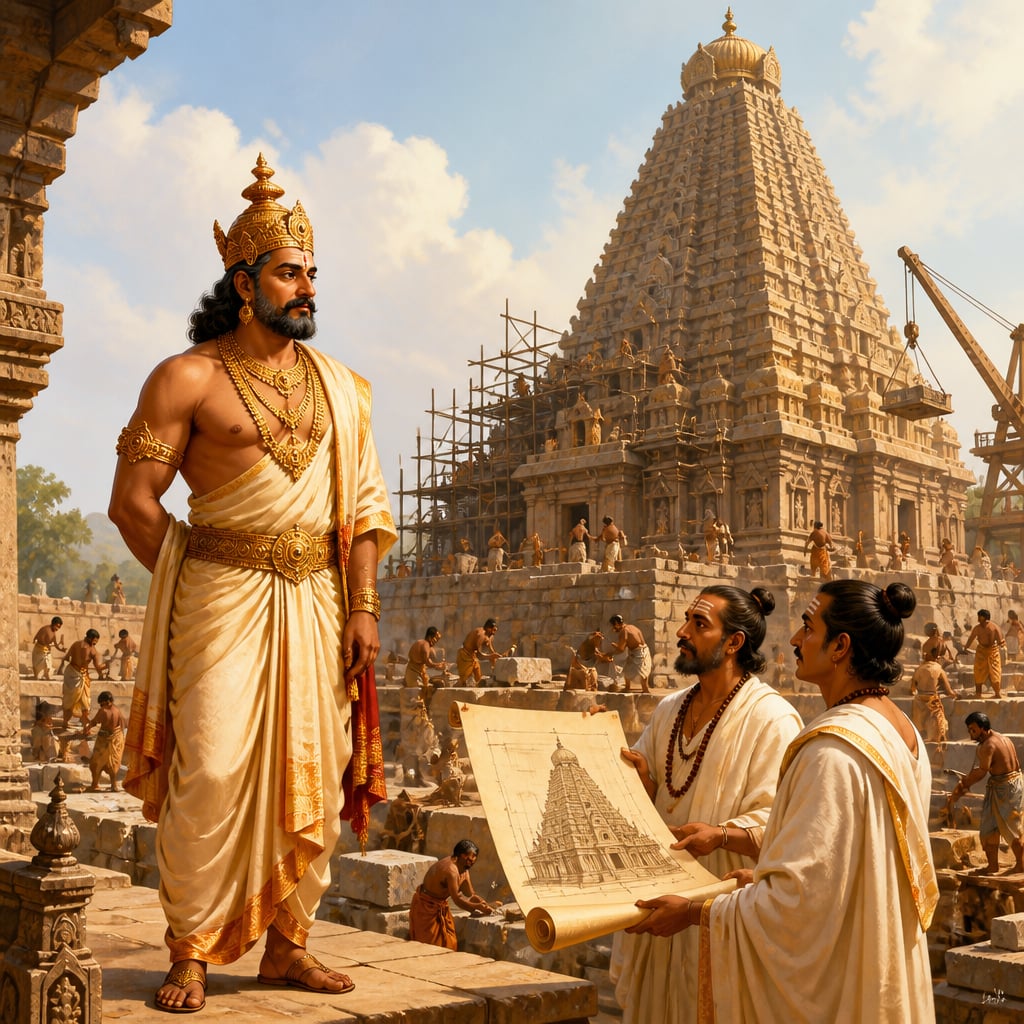
Raja Raja Chola I overseeing the construction of the Brihadeeswara Temple

Construction on the Brihadeeswara Temple in Thanjavur began around 1003 CE under Raja Raja Chola I. But the temple was not simply his creation, it was the culmination of Chola power built over generations. His father, Sundara Chola, had stabilized the kingdom. His grandfather, Parantaka II, had laid foundations. The temple that we see today represents not one king's ambition but a dynasty's centuries-long project.

Across India, the greatest temples, forts, and institutions share this characteristic: they were built across generations. The Chola navy that dominated the Indian Ocean, the Vijayanagara irrigation systems, the great fortresses of the Marathas, none were created by one leader in one lifetime. They represent multigenerational strategic thinking.

"The tree planted today gives shade to children not yet born," Kautilya writes. "So too with kingdoms."

Beyond the Lifetime Horizon

Most people plan within their own lifetime, and most leaders plan for even shorter periods. The quarterly report. The election cycle. The current crisis. But Kautilya argues that true strategic thinking must extend beyond the individual lifetime.

Why think in generations?

Some goals require it: Building institutions, establishing trade networks, changing cultures, creating lasting peace, these simply cannot be accomplished in years. They require decades or centuries.

Compounding effects: Small actions that compound over time produce results impossible to achieve quickly. The kingdom that plants trees, educates children, and builds infrastructure creates advantages that accelerate over generations.

Stability against chaos: Empires that think only short-term oscillate wildly, expanding and contracting based on individual rulers. Those that maintain generational consistency create lasting power.

Meaning beyond mortality: The leader who thinks generationally connects their work to something larger than themselves, creating legacy that outlives personal ambition.

The Generational Mindset

How does one think in generations? Kautilya offers principles:

Plant trees you won't harvest: Invest in projects whose returns exceed your own lifespan. The king who builds only what he can enjoy is building for himself; the king who builds for descendants is building a dynasty.

An older Chola king training his successor son with palm-leaf registers

Train successors rigorously: Generational success requires exceptional succession. Each generation must be prepared not just to maintain but to extend the work of previous generations.

Create institutions, not just policies: Policies die with their makers. Institutions persist. The great dynasties created systems that could survive transitions between rulers.

Maintain core principles across changes: While tactics must adapt, fundamental principles should persist across generations. What does the dynasty stand for? What are its non-negotiable values?

Document wisdom: Each generation learns lessons. If these lessons are not captured and transmitted, every generation starts from zero. Create systems for preserving and teaching accumulated wisdom.

The Challenge of Succession

Multigenerational strategy lives or dies on succession. Kautilya devotes extensive attention to this challenge:

Selection: The successor must be capable enough to carry the burden. This may or may not be the eldest child. The strategic mind evaluates capability, not birth order.

Preparation: The successor must be trained across all aspects of rulership, administration, military, diplomacy, economy, culture. This training takes years and cannot be rushed.

Transition: The handover of power is dangerous. Too abrupt, and the successor lacks experience. Too gradual, and power centers divide. Kautilya recommends structured transitions with clear milestones.

Preventing conflict: Multiple potential successors create competition that can destroy dynasties. Manage succession clearly to prevent fratricidal struggles.

The dynasty that masters succession can persist for centuries. The one that fails at it rarely survives three generations.

What Compounds Across Generations

Not all investments compound generationally. Kautilya identifies what grows over time:

Infrastructure: Roads, irrigation, ports, fortifications, physical infrastructure benefits every subsequent generation. The kingdom that builds infrastructure creates permanent advantages.

Institutions: Administrative systems, courts, educational establishments, these create capabilities that persist beyond any individual. Strong institutions can even survive weak rulers.

Reputation: A dynasty known for justice attracts talent. One known for treachery repels it. Reputation, once established, tends to persist and influence future interactions.

Alliances: Relationships between ruling families deepen over generations. The alliance formed today may be renewed by children and grandchildren, creating reliable bonds.

Culture: The culture of a court or a kingdom shapes everything within it. Cultures that value learning, courage, or innovation produce those qualities generation after generation.

Skills and knowledge: Expertise passed from master to apprentice, from parent to child, creates capabilities that rivals cannot quickly replicate.

The Trap of Short-Term Thinking

Why do so many leaders fail to think generationally? Kautilya identifies the traps:

The tyranny of the urgent: Immediate crises demand attention. It takes discipline to invest in the future while managing the present.

Personal ambition: The leader who wants glory for themselves may not invest in projects that will benefit successors more than themselves.

Uncertainty about succession: If you don't know who will inherit your work, investing in the long term feels pointless. Uncertainty breeds short-termism.

Impatience: Generational returns are slow. Many leaders prefer quick wins even when long-term investments would yield more.

Political pressure: Advisors, allies, and subjects often demand immediate results. Resisting this pressure requires exceptional leadership.

Overcoming these traps requires conscious commitment to generational thinking as a strategic principle.

Case Studies in Generational Thinking

History provides examples of generational success:

A Chola naval fleet at sea at sunset

The Chola Dynasty: Over three centuries, the Cholas built from a regional power to an empire controlling the Indian Ocean. Each generation extended what the previous had built. The result was unmatched maritime power.

The Rothschild Banking Network: Mayer Amschel Rothschild placed his sons in five European capitals. The resulting network, maintained across generations, created financial power that lasted centuries.

The Chinese Imperial Examination System: Created over generations, this system produced educated administrators for centuries. It was an investment in institutional capability that paid returns for over a millennium.

In each case, the key was continuity, each generation building on the previous rather than starting fresh.

Generational Strategy in a Fast World

Modern life seems to accelerate constantly. Can generational thinking still apply?

Kautilya's principles suggest yes, perhaps more than ever:

Speed of change increases value of stability: When everything changes rapidly, the institution that maintains continuity has advantage over those that must constantly reinvent.

Long-term investments become rarer: As short-termism increases, the few who invest generationally face less competition.

Compounding accelerates in connected worlds: Knowledge, relationships, and reputation now compound faster than ever due to global connectivity.

Sustainability demands it: Environmental challenges require thinking in generations. Short-term resource extraction creates long-term collapse.

The strategist who can maintain generational perspective in a short-term world has a significant competitive advantage.

Personal Generational Thinking

Generational thinking applies not just to kingdoms and companies but to families and individuals:

What are you building that your descendants will inherit? This might be financial capital, but also includes education, values, relationships, and reputation.

What habits and disciplines are you establishing? The patterns you set will likely be repeated by your children and their children.

What knowledge are you preserving and transmitting? Every family has accumulated wisdom. Are you capturing it for future generations?

What relationships are you cultivating? Friendships between families can persist for generations, creating mutual support networks.

The individual who thinks generationally lives differently than one who thinks only of their own lifetime.

Building for Permanence

What separates temporary achievements from permanent ones? Kautilya suggests:

Depth over breadth: The empire that expands rapidly but shallowly rarely lasts. The one that builds deep institutional roots persists.

Legitimacy over force: What is maintained by force requires constant force. What is accepted as legitimate persists naturally.

Systems over individuals: Achievements that depend on exceptional individuals fade when those individuals die. Achievements built into systems persist.

Adaptation within continuity: The dynasty that cannot change dies. But so does the one that changes so completely it loses identity. Balance adaptation with core continuity.

The Ultimate Long Game

Kautilya's final teaching on generational strategy concerns legacy itself. What matters when you think in centuries?

Not conquest but creation: The territories conquered by Alexander did not remain his; the cities he founded still exist. Creation outlasts conquest.

Not power but contribution: The kings who held power are mostly forgotten. Those who built, taught, and created are remembered.

Not fame but effect: What matters is not whether you are remembered but whether your work persists in affecting the world.

The strategist who truly thinks generationally lets go of personal glory in favor of permanent effect. This is the ultimate long game, playing not for your own lifetime but for time itself.

Verses

वृक्षं रोपयति पुत्रार्थं

Vṛkṣaṃ ropayati putrārthaṃ

One plants a tree for the sake of children

The wisest investments yield returns beyond the investor's lifetime. The tree takes decades to mature; the planter may never sit in its shade.

पूर्वैः आरब्धं उत्तरैः साध्यते

Pūrvaiḥ ārabdhaṃ uttaraiḥ sādhyate

What is begun by predecessors is completed by successors

The greatest achievements span generations. Those who begin may not complete; those who complete did not begin.

शतं वर्षाणि चिन्तयेत्

Śataṃ varṣāṇi cintayet

One should think in terms of a hundred years

The century timeframe captures multigenerational thinking while remaining imaginable. When evaluating choices, ask: What will matter in a hundred years?

Case studies

The Tata Family and Indian Industry

Jamsetji Tata began building an industrial empire in the 1870s with a vision that extended beyond his lifetime. He planned a steel mill, a hydroelectric company, and a research university, all of which were completed only after his death by his successors. The Tata Group continued building across five generations, creating India's largest conglomerate with explicit commitment to multigenerational values.

The Tata family maintained generational continuity through clear values (ethical business, national development), strong succession (each generation prepared the next), and institutional strength (the Tata Trusts provided continuity beyond individuals). They thought in terms of building India, not just building a business.

Today Tata Group spans steel, software, automobiles, and more. The Tata Trusts, established across generations, hold majority control and direct profits to philanthropy. The multigenerational vision created both enduring business success and lasting social impact.

Multigenerational success requires: vision that transcends individuals, succession planning across generations, institutional structures that persist beyond people, and values that unite different generations in common purpose.

Family businesses and multigenerational enterprises like Walmart (Walton family), BMW (Quandt family), and Samsung (Lee family) demonstrate the same principle. Success across generations requires institutional structures, succession planning, and a vision that transcends any individual leader. The families that build governance systems outlast those that rely on the genius of a single generation.

Tata Group's combined revenue exceeds $150 billion annually across over 100 operating companies. The Tata Trusts, which hold 66% of Tata Sons equity, have donated over $100 billion to philanthropic causes since their founding.

The Chola Naval Empire

The Chola control of Indian Ocean trade developed across centuries. Early Cholas focused on land power. Later generations built ports. Subsequent generations built ships. Raja Raja I created naval infrastructure. Rajendra I used that infrastructure to project power across the Indian Ocean. No single generation could have created this maritime empire.

Each Chola generation built on what predecessors had created while adding new capabilities. There was continuity of purpose (regional and maritime dominance) while tactics evolved (from land-based to naval power). Institutional strength meant that even weaker rulers in between didn't destroy accumulated advantages.

At its peak, Chola naval power dominated trade routes from East Africa to Indonesia. The empire lasted over four centuries, a remarkable achievement requiring sustained multigenerational effort. When the empire eventually declined, it left permanent cultural and commercial imprints across Asia.

Great achievements often require multiple generations building on each other's work. Strategic consistency across time, while allowing tactical adaptation, creates cumulative advantages impossible to achieve in single lifetimes.

Long-term infrastructure projects like India's space program (ISRO), Japan's bullet train network, and China's Belt and Road Initiative all require multigenerational strategic consistency. Each generation builds on the previous one's foundation. The organizations and nations that maintain strategic direction across leadership transitions consistently achieve outcomes that no single generation could accomplish alone.

The Chola navy conducted the largest overseas military expedition in Indian history when Rajendra Chola I attacked the Srivijaya Empire in 1025 CE. Chola trade networks stretched from China to the Arabian Peninsula.

Reflection

More in Strategic Patience

All lessons in Strategic Patience · Arthashastra: Art of Strategy course