When NOT to Act
The Wisdom of Restraint
Sometimes doing nothing is the smartest move. Kautilya's wisdom on recognizing when restraint is the greatest strategy, saving action for when it can succeed.
The Battle That Never Happened
General Pushyamitra received the message at dawn: the enemy had crossed the river. His scouts reported thirty thousand soldiers moving toward the mountain passes, a force twice his size. His officers gathered, expecting the order to march.
"We fight," declared his cavalry commander. "Honor demands it."
"We defend the passes," urged the infantry general. "Better ground favors us."
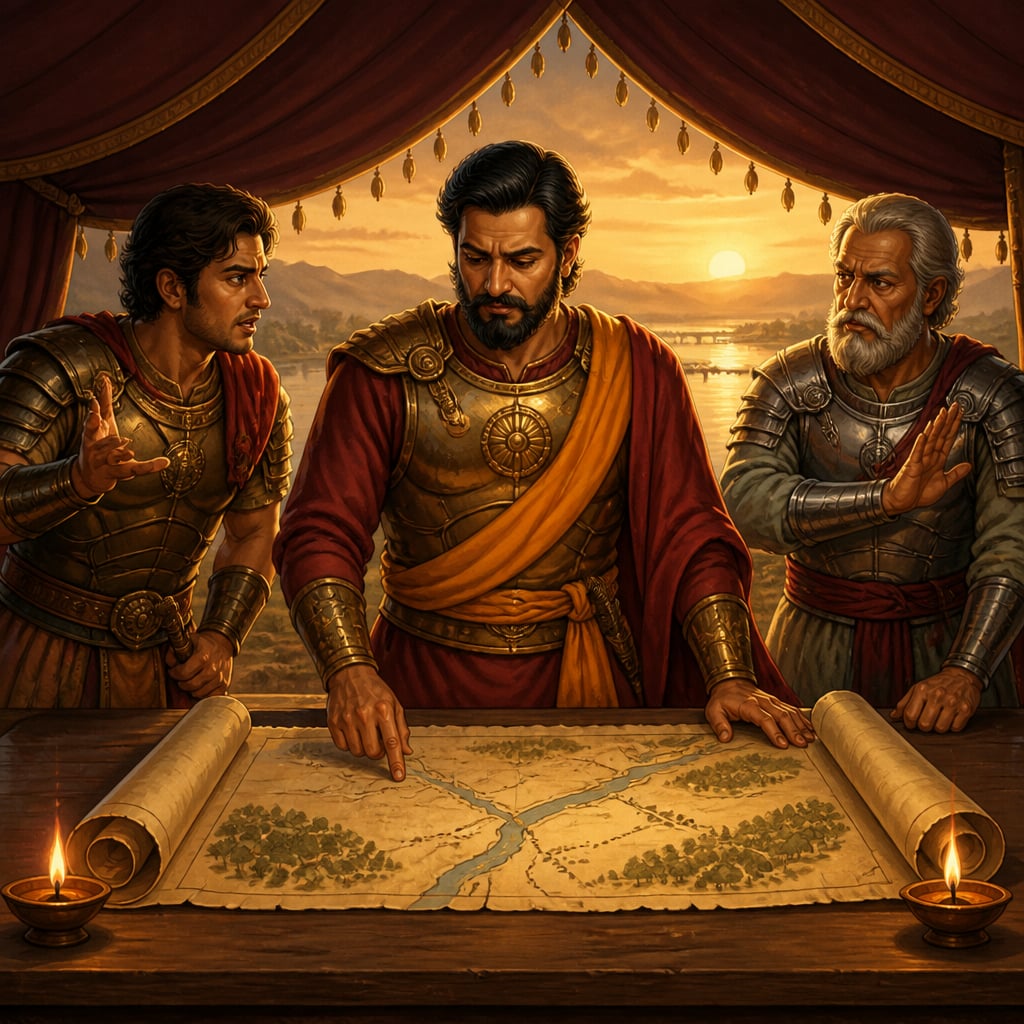
Pushyamitra studied the map in silence. Then he rolled it up.
"We do nothing."
The officers stared. "Nothing, General?"
"The monsoon arrives in twelve days. Their supply lines stretch across flooded plains. Their path leads through territory where villagers hide their grain and flee to the hills. They march toward a battle we don't need to fight."
He quoted Kautilya: "Avikrameṇa yateta, One should strive without initiating action." He pointed toward the mountains. "Let them come. Let the rains come. Let hunger come. We will be here, rested and fed, when what remains of their army limps home."

Two months later, the enemy retreated, not defeated in battle, but destroyed by circumstances. Pushyamitra's restraint had accomplished what combat could not.
This was Kautilya's profound insight: sometimes the greatest strategic wisdom is knowing when NOT to act.
Why Inaction Matters
Western strategic tradition often emphasizes action, initiative, aggression, momentum. Kautilya understood something subtler: action is costly, action is risky, and action is often unnecessary.
Action Has Costs:
- Resources consumed (money, materials, energy)
- Attention diverted from other priorities
- Relationships strained or broken
- Reputation committed and potentially damaged
- Precedents set that limit future options
Action Has Risks:
- Outcomes are never guaranteed
- Enemies react in unpredictable ways
- Allies may not support as expected
- Conditions may change during execution
- Success may create new problems
Action May Be Unnecessary:
- Problems sometimes resolve themselves
- Enemies sometimes defeat themselves
- Time often changes circumstances favorably
- Allies may act in your interest without request
- Patience may achieve what force cannot
Kautilya's strategic calculus always asked: what is the cost of action versus the cost of inaction? Often, inaction was the better bargain.
The Six Conditions for Inaction
Kautilya identified specific situations where restraint was strategically superior:
1. When You Cannot Win
"Asamarthasya karmaṇi na pravartet, The incapable should not initiate action," Kautilya taught. If analysis shows you cannot achieve objectives, acting anyway is foolishness, not courage.
This requires honest assessment. Ego wants to believe success is possible; wisdom recognizes when it isn't. The general who fights unwinnable battles destroys armies. The executive who pursues unachievable goals destroys organizations.
2. When Victory Costs More Than It's Worth
Even winnable battles may not be worth fighting. Pyrrhic victories, named for the Greek king who "won" himself to ruin, consume more than they gain.
Kautilya calculated costs comprehensively: not just immediate resources but long-term consequences. A war that could be won but would exhaust the treasury was worth avoiding. A conflict that would create permanent enemies was worth resolving differently.
3. When Time Favors You
If circumstances are shifting in your direction, patience may achieve what action cannot. The enemy whose alliances are crumbling, whose resources are depleting, whose internal conflicts are growing, this enemy may defeat themselves if you simply wait.
"Kālaṃ pratīkṣeta, Wait for the right time," Kautilya advised. Acting prematurely wastes resources on problems that time would solve.
4. When Action Would Unite Enemies
Sometimes inaction preserves divisions that action would heal. Enemies who quarrel among themselves may unite against common threat. Acting aggressively may create the coalition that defeats you.
Kautilya's intelligence analysis specifically watched for situations where restraint maintained enemy divisions while action would consolidate opposition.
5. When Better Opportunities Exist
Resources committed to one action are unavailable for others. If better opportunities exist or may emerge, restraint in one arena preserves capacity for action in another.
Strategic selectivity, choosing where to act, required willingness not to act in many places. The strategist who acted everywhere acted effectively nowhere.
6. When Information Is Insufficient
Action based on inadequate information risks catastrophic error. When the situation is unclear, waiting for better intelligence may be wiser than acting on partial knowledge.
"Better to wait and see clearly," Kautilya taught, "than to act and err blindly."
The Psychology of Restraint
Inaction is psychologically difficult:
Ego Demands Action: We want to feel in control, to demonstrate capability, to respond to challenges. Restraint can feel like weakness or passivity.
Culture Rewards Action: Organizations and societies often celebrate doers, rewarding initiative regardless of wisdom. The person who "did something" may be praised even when doing nothing would have been better.
Uncertainty Is Uncomfortable: Action creates the illusion of control. Even if the action fails, at least we tried. Inaction means accepting uncertainty we cannot control.
Pressure from Others: Allies, subordinates, and observers expect response. "What are you doing about it?" is harder to answer with "nothing" than with plans and activities.
Kautilya recognized these pressures and counseled resistance: "Dhairyeṇa pālayed rājyam, Govern the kingdom with courage." The courage of restraint was often greater than the courage of action.
Distinguishing Inaction from Passivity
Strategic inaction is not passive acceptance:

Active Waiting: The general who doesn't fight still prepares, gathering intelligence, training troops, positioning forces, building alliances. Inaction regarding combat doesn't mean inaction in all things.
Deliberate Choice: Strategic inaction is chosen after analysis, not default from inability. The difference between "choosing not to act" and "failing to act" is the presence of thought.
Continued Monitoring: The strategist who waits watches constantly. Conditions that favor inaction may change; the moment for action may arrive. Restraint includes readiness.
Communication: Sometimes inaction must be explained, to allies who expect support, to subordinates who expect direction, to observers who might misinterpret. Strategic inaction may require active communication.
Preparation for Action: Inaction now may prepare for action later. The resources conserved, the intelligence gathered, the alliances built, all position for action when conditions favor it.
Modern Applications
Kautilya's restraint principles apply broadly:
In Business:
- Not entering markets where you cannot compete effectively
- Not responding to every competitive move
- Not pursuing opportunities that don't align with strategy
- Not acting on incomplete market research
- Waiting for better timing on major decisions
In Career:
- Not taking promotions you're not ready for
- Not engaging in every workplace conflict
- Not accepting opportunities that don't serve long-term goals
- Not reacting to every criticism or slight
- Waiting for the right role rather than any role
In Relationships:
- Not responding to provocation with escalation
- Not making major decisions during emotional states
- Not intervening in others' conflicts unnecessarily
- Not offering advice when listening is needed
- Waiting for the right moment for difficult conversations
In Investment:
- Not chasing every market trend
- Not panic-selling during downturns
- Not investing in what you don't understand
- Not timing markets based on incomplete information
- Waiting for clear opportunities rather than forcing action
The Cost of Unnecessary Action
History is filled with actions that would have been better left untaken:
Napoleon's Invasion of Russia (1812): Victory was impossible; the campaign destroyed the Grande Armée. Restraint would have preserved French power.
The Vietnam War Escalation: Each escalation made the situation worse. Early recognition that the war wasn't winnable could have saved decades of suffering.
Overreaction to Minor Threats: Companies that destroyed themselves fighting insignificant competitors. Politicians who created crises responding to non-problems. Individuals who damaged relationships reacting to imagined slights.
The pattern: action that felt necessary in the moment proved catastrophic in retrospect. Restraint would have been the wiser choice.
Learning to Not Act
Developing the wisdom of restraint requires practice:
1. Question the Impulse to Act: When you feel urged to do something, pause. Ask: Why do I feel compelled to act? Is this strategic necessity or emotional reaction?
2. Calculate Inaction's Cost: What happens if you do nothing? Sometimes the answer is "nothing bad", the problem resolves, conditions change, others act.
3. Identify Who Benefits from Your Action: Sometimes pressure to act serves others' interests, not yours. Those who urge action may not bear its costs.
4. Consider Time Horizons: Immediate pressure to act may obscure long-term wisdom of restraint. What seems urgent now may seem trivial in a year.
5. Prepare to Explain: Strategic inaction may require justification. Prepare to articulate why restraint serves better than action.
Pushyamitra's Wisdom
When the enemy finally retreated, hungry, diseased, diminished, Pushyamitra's officers celebrated the victory.
"But General," one asked, "was it truly victory? We never fought."
Pushyamitra smiled. "We achieved our objective, the enemy is gone. We preserved our resources, our army is intact. We demonstrated capability, they know we could have fought. What battle could have achieved more?"
He quoted Kautilya once more: "Vijayo hi kṣatriyasya dharmam, Victory is the duty of the warrior. But victory without battle is the highest victory of all."
This was Kautilya's deepest teaching about restraint: the goal is not action but achievement. If achievement comes without action, so much the better. The wise strategist asks not "What should I do?" but "What do I need to achieve, and what is the most efficient path to achieving it?" Often, that path is simply to wait.
Strategic Restraint - The principle that not acting is often the best action.
Modern strategy includes concepts like 'strategic patience' and 'watch and wait.' In business, 'fast follower' strategies let others bear pioneering costs. In military affairs, defensive strategies preserve force. The principle is universal: action has costs.
Kautilya made restraint an explicit strategic principle rather than fallback. This elevated 'doing nothing' from weakness to wisdom when circumstances warranted.
The Cold War's 'containment' strategy, avoiding direct confrontation while waiting for Soviet internal collapse, demonstrated strategic restraint at civilizational scale. Patient non-action achieved what war might not have.
Strategic Timing - The recognition that when you act matters as much as how you act.
Military doctrine emphasizes timing: the attack launched when the enemy is unprepared succeeds; the same attack against a prepared enemy fails. Business strategy considers market timing. The principle is universal: timing matters.
Verses
अविक्रमेण यतेत।
avikrameṇa yateta |
One should strive without initiating aggressive action.
This sutra captures Kautilya's preference for achieving objectives without costly action. The wise strategist accomplishes goals through positioning, patience, and circumstance rather than force.
Book 7, Chapter 1, Verse 12 (R.P. Kangle)
असमर्थस्य कर्मणि न प्रवर्तेत।
asamarthasya karmaṇi na pravartet |
The incapable should not initiate action.
Honest assessment of capability must precede commitment. Acting when you cannot succeed wastes resources and creates worse outcomes than restraint.
Book 7, Chapter 15, Verse 3 (R. Shamasastry)
कालं प्रतीक्षेत।
kālaṃ pratīkṣeta |
One should wait for the right time.
Timing is often more important than action itself. The same action that fails at one moment succeeds at another.
Book 7, Chapter 1, Verse 25 (Patrick Olivelle)
Case studies
Fabius Against Hannibal
After Hannibal's devastating victory at Cannae (216 BCE), Rome faced destruction. Every Roman army sent against Hannibal had been destroyed. The conventional response, raise another army, fight again, seemed doomed to repeat previous disasters.
Fabius Maximus applied Kautilyan restraint: (1) Recognition that direct action could not succeed, 'asamarthasya karmani na pravartet.' (2) Strategic patience, waiting for conditions to change. (3) Indirect approach, harassing supplies, avoiding battle. (4) Time as ally, Hannibal's position weakened while Rome's position strengthened through waiting.
Fabius's 'delaying' strategy, initially mocked as cowardice, preserved Roman power until conditions changed. Eventually, Rome developed the capability to defeat Hannibal. Strategic restraint saved Rome when action would have destroyed it.
When direct action cannot succeed, restraint is not cowardice but wisdom. The 'Fabian strategy' became a recognized approach: avoiding decisive engagement when the enemy is superior, waiting for conditions to favor you.
The Fabian strategy appears constantly in modern business. When a startup faces a better-funded competitor, the worst response is a direct confrontation. Companies like Mailchimp survived against larger rivals by refusing decisive battles, focusing instead on steady improvement and customer loyalty until the competitive landscape shifted in their favor.
Fabius's delaying strategy preserved Roman power for over 14 years against Hannibal. Rome eventually won the Second Punic War, while Carthage, which had won every major battle, lost the war entirely.
Berkshire's Cash Position
Warren Buffett's Berkshire Hathaway regularly maintains enormous cash reserves, sometimes exceeding $100 billion. Critics argue this cash could be invested for returns. Markets pressure action: invest, acquire, do something.
Buffett embodies Kautilyan restraint: (1) Strategic patience, waiting for exceptional opportunities rather than chasing average ones. (2) Honest capability assessment, acknowledging that most investment opportunities don't merit action. (3) Recognition that inaction is itself a choice, cash preserves optionality. (4) Timing sensitivity, cash positions for action when conditions favor it.
Buffett's restraint positions Berkshire for crisis opportunities, when others must sell, Berkshire can buy. His long-term returns validate the restraint strategy. Patience and selectivity outperform constant activity.
Kautilya's restraint applies to investment: not acting is often the best action. Maintaining capacity for future action while waiting for optimal conditions produces better long-term results than constant activity.
Cash-rich companies like Apple, Google, and Berkshire Hathaway maintain massive reserves not from timidity but from strategic discipline. During the 2020 pandemic crash, companies with cash reserves acquired distressed assets at steep discounts while cash-poor competitors scrambled for survival. The capacity to act decisively depends on the discipline to wait patiently.
Berkshire Hathaway's cash position exceeded $157 billion by late 2023. During the 2008 financial crisis, this war chest allowed Buffett to invest $26 billion in distressed companies at highly favorable terms.
Historical context
c. 4th century BCE
Indian strategic thought valued both action (karma) and restraint (tyaga). The warrior's duty included knowing when not to fight. Kautilya systematized this tradition, providing analytical framework for determining when restraint was appropriate.
Kautilya's restraint doctrine challenges action-oriented assumptions. His teaching that sometimes the best strategy is no strategy, or rather, that restraint is itself a strategy, remains counterintuitive and valuable.
Reflection
- Kautilya taught striving 'without aggressive action.' Can you identify situations where your impulse to act might have been better served by restraint?
- Kautilya emphasized waiting for the right time. Think of important decisions you've made: was timing optimal, or did impatience lead you to act before conditions favored success?