Siege Warfare
Taking Fortified Positions
Patience and pressure. Kautilya's systematic approach to siege warfare reveals how sustained effort, combined with psychological insight, can overcome even the strongest defenses.
The Waiting Game
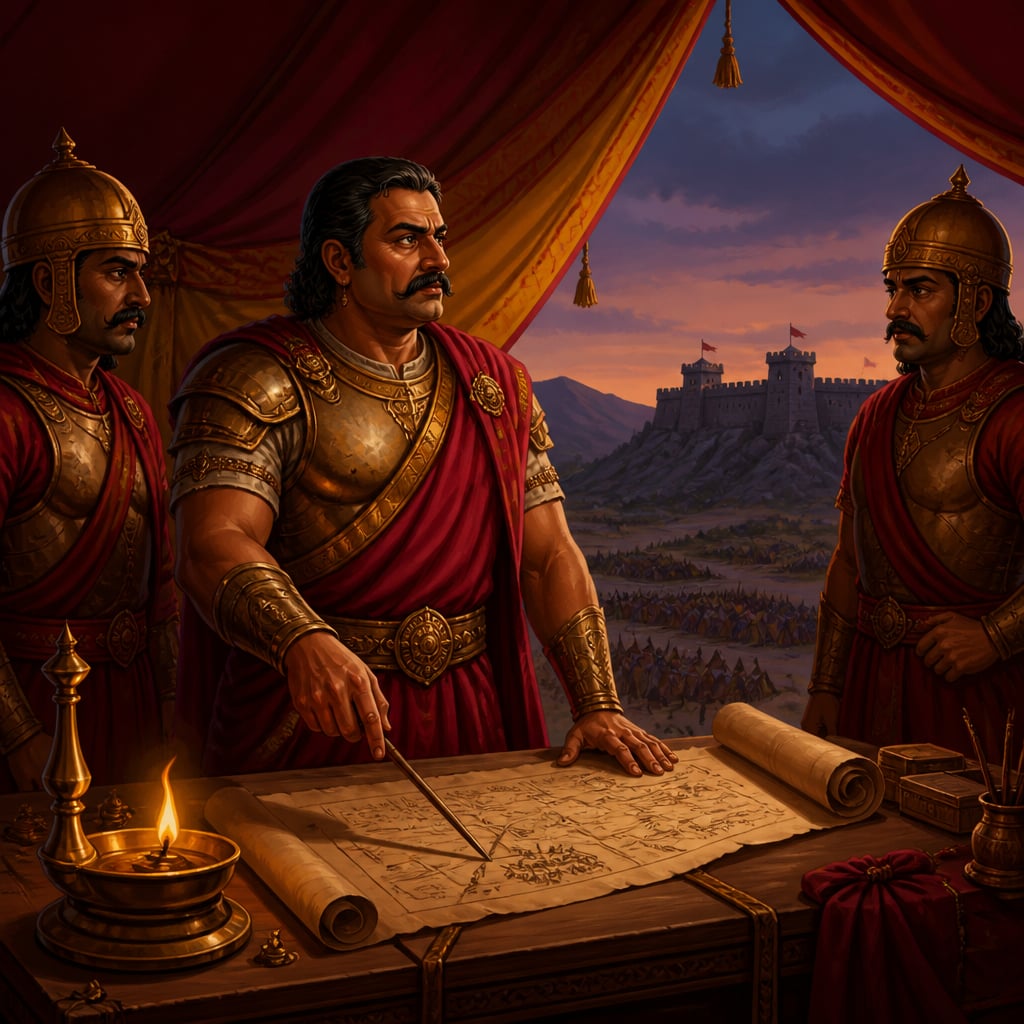
General Pushpamitra surveyed the fortress of Vidisha from his command tent. Three months. Three months his army had surrounded these walls, and still the gates held. His officers grew restless, soldiers grumbled, and supplies dwindled. The monsoon was coming.
"Storm the walls," urged his cavalry commander. "We have the numbers. Take the casualties and be done with it."
Pushpamitra shook his head slowly. "And if we fail? If they throw back our assault and kill three thousand men? We'll be weaker, they'll be emboldened, and we'll face another three months, with fewer soldiers and less spirit."
He unrolled a scroll, Kautilya's treatise on siege craft. "The master wrote: 'Upāyena vyayānena vijetuṃ yateta, One should strive to conquer through stratagem with minimal expenditure.' The goal is victory, not heroic slaughter."
This was Kautilya's fundamental insight about siege warfare: time is usually the besieger's ally, not enemy. The fortress that seems impregnable today becomes vulnerable tomorrow, if you understand how to apply pressure while conserving strength.
Why Sieges Matter
In ancient warfare, fortified cities represented concentrations of political power, economic wealth, and military capability. Capturing them wasn't just tactical victory, it was often decisive. A kingdom whose capital fell typically surrendered entirely.
But fortresses existed precisely because they were hard to take. The same walls that made cities valuable made them dangerous to attack. Direct assault against prepared defenses produced catastrophic casualties. Yet bypassing strong points left enemies in your rear, threatening supply lines and eventual counterattack.
Kautilya understood this dilemma and developed systematic approaches to resolving it. His siege doctrine balanced patience with pressure, force with psychology, and direct action with indirect subversion.
The Economics of Siege
Before any tactical consideration, Kautilya emphasized calculation: is this siege worth fighting?
"Na sarvaṃ durgaṃ grahītavyam, Not every fort should be captured," he wrote. The costs of siege, time, supplies, casualties, opportunities foregone elsewhere, must justify the prize. A minor fortress containing little wealth and threatening no critical position might be better bypassed, contained, or neutralized through diplomacy.
For sieges worth pursuing, Kautilya calculated resource requirements methodically:
Time: How long can the fortress hold? Internal supplies, water sources, morale, and potential for relief forces all determined duration. Underestimating time required was catastrophic, armies that exhausted supplies before victory achieved neither.
Supplies: Besieging armies needed more provisions than defenders. They couldn't forage effectively (enemies destroyed crops before withdrawal), couldn't hunt (game fled), and faced disease from encampments. Supply lines stretching back to home territory required protection.
Opportunity Cost: While your army besieges one fortress, enemies elsewhere act freely. The siege that ties down your strength while rivals expand elsewhere loses strategically even if it succeeds tactically.
Modern business parallels are direct: Amazon's strategy of sustained losses to capture market share was a commercial siege, burning resources to starve competitors into surrender. The calculation required was identical to Kautilya's: can we outlast them?
Preparation Before Assault
Kautilya devoted extensive sections to siege preparation, recognizing that work before assault determined outcomes:
Intelligence Gathering:
- Map water sources, wells, cisterns, rivers. Can any be cut, diverted, or poisoned?
- Identify supply routes, how does food enter? Who supplies them?
- Assess walls, where are weak points, repairs, gates, sally ports?
- Understand command, who leads? What are their relationships, rivalries, weaknesses?
- Count defenders, how many, how trained, how motivated?
Surrounding and Isolation:

Complete encirclement prevented reinforcement and resupply. "Samantat parivārya, Having surrounded from all sides," Kautilya specified. Gaps in siege lines allowed hope; complete encirclement crushed it.
Camp Fortification:
Besiegers needed their own defenses, against sorties from the fortress and relief forces from outside. The siege army that neglected camp security invited disaster. Kautilya specified fortified camps with watch rotations, clear sightlines, and prepared responses to attack.
Logistics Establishment:
Supply depots, hospitals, repair facilities, replacement weapons, all required before sustained siege. The army that began siege without logistics preparation would fail before walls fell.
The Four Pressures
Kautilya identified four simultaneous pressures that wore down defenders:
Starvation:
Most fortresses fell to hunger, not assault. Complete blockade prevented resupply; time did the rest. As granaries emptied, morale collapsed. Hungry soldiers desert; hungry populations riot against defenders. "Kṣudhā sarvāṇi jīvanti, All living beings submit to hunger," Kautilya observed.
The calculation was simple but unforgiving: defenders must eat every day. If supplies entering equaled zero and initial stores were finite, surrender became mathematical certainty. Patience was the besieger's primary weapon.
Thirst:
Water was more urgent than food. Cutting water sources produced faster surrender, or forced defenders to sortie under unfavorable conditions. Poisoning wells was prohibited under dharma-yuddha (ethical warfare), but diverting rivers or destroying aqueducts was legitimate.
Fear:
Psychological pressure accelerated material pressure. Visible siege preparations, building towers, constructing rams, positioning catapults, demonstrated inevitability of assault. Even if assault never came, the threat sapped morale.
Kautilya specified psychological operations: allowing some civilians to leave (spreading terror about siege conditions), displaying captured messengers (proving isolation), making examples of those caught attempting escape (deterring others).
Division:
Defender unity was their greatest asset; division was fatal. Spies within walls spread rumors, bribed officials, inflamed existing grievances. Different factions, military vs. civilian, nobility vs. common soldiers, ethnic or religious groups, could be turned against each other.
"Bhedopāyena vijayaḥ, Victory through creating division," Kautilya wrote. The fortress that fought itself fell faster than one that only fought besiegers.
Assault Techniques
When patience proved insufficient or circumstances demanded speed, Kautilya detailed assault methods:
Escalade:
Scaling walls using ladders, towers, or ramps. Attackers were maximally exposed; casualties were severe. But if surprise achieved or defenses overwhelmed at specific points, escalade could end sieges rapidly.
Kautilya specified: attack at night, at multiple points simultaneously, with diversions drawing defenders away from main assault. Never attack where defenders expect; always attack where they're weakest.
Sapping and Mining:
Tunneling beneath walls to cause collapse. Slower than assault but safer for attackers. Defenders countered by placing pots of water near walls, ripples revealed digging, and by counter-mining. Underground combat in dark tunnels was brutal.
Battering:
Rams against gates, catapults against walls. Required getting heavy equipment close despite arrow fire. Kautilya specified mantlets (mobile shields), pavises (large standing shields), and covered galleries protecting engineers.
Fire:
Incendiary arrows, fire pots, burning materials launched or placed against wooden structures. Fire panicked defenders, destroyed supplies, and created chaos that assault could exploit. But fire was difficult to control, it could spread to besiegers or destroy what they sought to capture.
The Human Element
Beyond material calculations, Kautilya emphasized psychology:
Defender Morale:
The same walls with the same supplies could hold for years or surrender in days depending on defender psychology. Leadership, unity, hope, and purpose determined endurance more than physical resources.
Defenders needed to believe three things: the walls would hold, relief would come, and surrender meant death. Attack any of these beliefs, demonstrate wall vulnerability, intercept relief messages, offer generous surrender terms, and resistance crumbled.
Besieger Patience:
Equally, besieging armies required psychological management. Boredom, disease, desertion, and frustration destroyed more siege armies than defender sallies. Commanders needed to maintain discipline, demonstrate progress, and sustain belief in eventual victory.
Kautilya specified regular activity, drilling, improvement works, limited assaults on outworks, to maintain readiness without exhausting troops. The army that simply waited passively deteriorated; the army that assaulted constantly was destroyed.
Civilian Populations:
Fortresses contained non-combatants whose suffering created political pressure on defenders. Allowing some civilians to leave reduced mouths to feed while spreading fear. Preventing departure concentrated misery that could turn populations against military leadership.
The ethics were complex. Kautilya prohibited deliberate civilian massacre but recognized that siege inherently harmed non-combatants. The strategic question was whether civilian pressure would accelerate surrender or strengthen resistance through shared suffering.
Negotiation and Surrender
Kautilya devoted careful attention to siege termination:
Terms of Surrender:
Generous terms encouraged earlier surrender, reducing siege costs. Harsh terms prolonged resistance, defenders who expected massacre fought to the death. "Satya-saṃrākṣaṇena vijayaḥ, Victory through protection of truth/promise," Kautilya emphasized. Commanders who honored surrender terms built reputation that made future sieges easier.
Timing of Offers:
Surrender offers at wrong moments showed weakness; at right moments, they offered face-saving exit. After a failed assault, offers seemed desperate. After a successful limited action, offers seemed generous. Reading psychological moment was crucial.
Implementation:
Surrender wasn't simply opening gates. Disarmament procedures, treatment of leaders, disposition of troops, handling of treasury, and civilian protection all required specification. Violated surrender terms created permanent enemies; honored terms created potential subjects.
Modern Siege Principles
Kautilya's siege wisdom applies beyond military contexts:
Business Competition:
Price wars, market share battles, and competitive positioning often follow siege logic. The company with deeper resources outlasts competitors, if it has patience to sustain losses. Uber's extended battle against taxi industries worldwide was commercial siege warfare.
Negotiations:
Difficult negotiations resemble sieges. The party that can walk away (outlast siege) holds advantage. Pressure over time, deadlines, accumulated costs, public pressure, creates momentum toward settlement. Division among opposing parties accelerates resolution.
Personal Challenges:
Major goals often require siege-like patience. The degree that takes years, the career change that requires months of preparation, the health transformation that demands sustained effort, all follow Kautilyan logic: calculation, preparation, sustained pressure, patience.
Institutional Change:
Organizational transformation resembles siege. Entrenched interests resist like fortress defenders. Change requires: isolation from reinforcement (preventing coalition-building), supply pressure (budget control), psychological operations (narrative management), and sometimes direct assault (executive action). Patience usually matters more than force.
The Siege of Taxila
Consider how Kautilya himself applied these principles.
When Chandragupta moved against Taxila, the city was formidable, a major center of learning and commerce, well-fortified, with experienced military leadership. Direct assault would have been costly.
Kautilya's approach was comprehensive:
Intelligence: Years of placement provided detailed understanding of Taxilan politics, military capability, and supply situation.
Isolation: Diplomatic pressure prevented potential allies from supporting Taxila. Neighboring kingdoms were warned, bribed, or threatened into neutrality.
Division: Internal factions within Taxila were cultivated. Scholars resented military control; merchants wanted peace for trade; some military officers sought advancement through defection.
Pressure: Chandragupta's approach demonstrated capability without committing to assault. Visible strength combined with unclear intentions created maximum uncertainty.

Generous Terms: When Taxila's leadership calculated odds, surrender seemed preferable to siege. Terms allowed leadership to retain dignity while transferring allegiance.
The result: Taxila fell without prolonged siege or major battle. Kautilya's preparation made the siege unnecessary, the culmination of siege strategy is making siege itself obsolete.
Patience as Strategy
Kautilya's siege doctrine culminated in a paradox: the best siege is one that never happens.
The besieger who prepares completely, demonstrates capability clearly, isolates the target thoroughly, and offers reasonable terms often finds the fortress surrendering before prolonged siege begins. Defenders who calculate inevitable defeat choose early surrender over extended suffering.
This required reputation. Commanders known for taking fortresses, honoring terms, and sustaining sieges indefinitely faced faster surrenders. Those known for impatience, brutality, or failed sieges faced extended resistance.
The principle extends beyond warfare: demonstrated capability to sustain effort often achieves goals without requiring full effort. The company known for winning price wars faces less competition. The negotiator known for patience extracts better terms. The person known for persistence achieves goals others abandon.
Pushpamitra, studying Kautilya in his command tent, understood. He didn't need to storm the walls. He needed to outlast them, and to make that outcome obvious to defenders before it became necessary to prove it.
Strategic Selectivity - The principle that choosing which battles to fight matters as much as how you fight them.
Michael Porter's competitive strategy emphasizes focus, companies can't compete effectively everywhere. Warren Buffett's circle of competence limits investments to areas of understanding. Sun Tzu taught that victorious warriors win first, then fight. The pattern is universal: selection before engagement.
Kautilya provided explicit calculation framework, weighing siege costs against captured value, considering opportunity costs elsewhere, assessing probability of success. This systematic approach guards against emotional commitment to objectives that rational analysis would reject.
Napoleon's invasion of Russia (1812) violated this principle catastrophically. The 'siege' of Moscow, capturing an empty city that the Russians simply evacuated, consumed the Grande Armée while achieving nothing strategic. Calculating before committing would have prevented disaster.
Strategic Patience - The recognition that time and sustained pressure often accomplish objectives that force cannot.
Amazon's strategy of sustained losses to capture market share exemplifies commercial siege warfare, patient pressure rather than direct assault. Venture capital's tolerance for extended unprofitability reflects siege economics. The principle applies broadly: those who can sustain pressure longest often prevail regardless of initial position.
Verses
उपायेन व्ययानेन विजेतुं यतेत।
upāyena vyayānena vijetuṃ yateta |
One should strive to conquer through stratagem with minimal expenditure.
This sutra captures Kautilya's economic approach to warfare. Victory matters, but so does the cost.
Book 13, Chapter 4, Verse 12 (R.P. Kangle)
न सर्वं दुर्गं ग्रहीतव्यम्।
na sarvaṃ durgaṃ grahītavyam |
Not every fort should be captured.
This principle of strategic selectivity is crucial. Resources are finite; time is limited; opportunities elsewhere exist.
Book 13, Chapter 1, Verse 3 (R. Shamasastry)
भेदोपायेन विजयः।
bhedopāyena vijayaḥ |
Victory comes through creating division.
Division among enemies achieves what force often cannot. The united defense that seems impregnable collapses when defenders fight each other.
Book 7, Chapter 8, Verse 31 (Patrick Olivelle)
Case studies
Amazon's Commercial Siege
When Amazon entered retail markets, books, then everything else, it faced entrenched competitors with established positions, loyal customers, and profitable operations. Barnes & Noble, Borders, and countless smaller retailers occupied 'fortified positions' in the commercial landscape. Direct confrontation seemed unfavorable.
Amazon's strategy embodied Kautilya's siege principles: (1) Patient pressure over extended time, accepting losses for years while competitors exhausted resources. (2) Supply line advantage, deeper capital reserves (Amazon's 'granary') outlasted competitors' profitability. (3) Isolation, capturing customers gradually, cutting competitors off from market. (4) Psychological pressure, demonstrating inevitability of eventual dominance.
Borders filed bankruptcy (2011). Barnes & Noble shrank to fraction of former size. Countless smaller retailers closed. Amazon achieved market dominance through siege economics, sustained losses that competitors couldn't match. The 'fortress' of traditional retail fell not to assault but to patient, relentless pressure.
Kautilya's siege wisdom applies to commercial competition. The competitor with deeper resources, greater patience, and willingness to sustain losses can outlast 'fortified' incumbents. Victory goes to those who can endure longest, not necessarily those who are strongest at any moment.
Venture-backed startups use the same siege strategy when they enter established markets with below-cost pricing funded by investor capital. Uber, DoorDash, and WeWork all attempted to outlast incumbents through sustained losses. The strategy works when the attacker truly has deeper reserves and the defender has no alternative supply lines. It fails when incumbents find creative ways to sustain themselves, as many local taxi companies and restaurants eventually did.
Amazon operated at a loss for its first nine years while systematically undercutting competitors on price. Borders, which had 1,200 stores at its peak, filed for bankruptcy in 2011 owing $350 million.
The Berlin Blockade
In June 1948, Soviet forces blocked all land and water access to West Berlin, a Western enclave deep within Soviet-controlled East Germany. The blockade aimed to force Western powers to abandon Berlin or accept Soviet terms. Two million people faced siege conditions.
The Berlin situation demonstrated siege dynamics in modern context. Soviets applied classic siege pressure: isolation, supply deprivation, psychological pressure. But the Western response, the Berlin Airlift, broke siege logic by creating supply line that couldn't be cut. For 11 months, aircraft delivered supplies, demonstrating that 'starvation' could be defeated through alternative means.
The Soviet blockade failed. The airlift delivered over 2 million tons of supplies. Soviets lifted the blockade in May 1949, having achieved none of their objectives while strengthening Western resolve and alliance. The 'siege' failed because besiegers couldn't actually isolate the 'fortress.'
Kautilya's siege principles require actual isolation. When supply lines cannot be cut, through air power, alternative routes, or external support, siege logic fails. Modern technology and alliances can break isolation that ancient sieges depended upon. The lesson: verify that siege conditions actually exist before committing to siege strategy.
Economic sanctions today face the same challenge the Soviets encountered with Berlin. When targeted nations find alternative trade routes, develop domestic substitutes, or receive support from third parties, sanctions fail to achieve isolation. Russia's response to Western sanctions after 2022, redirecting trade toward China and India, demonstrates that siege strategies require complete encirclement to succeed.
The Berlin Airlift delivered 2.3 million tons of cargo on 278,000 flights over 15 months. At its peak, a plane landed in West Berlin every 30 seconds, turning a Soviet siege into a Western propaganda victory.
Historical context
c. 4th century BCE
Ancient Indian warfare featured sophisticated siege traditions. Major cities were expected to withstand prolonged sieges; campaigns often revolved around capturing fortified positions. Kautilya systematized existing practices while adding psychological and economic analysis. His emphasis on stratagem over force reflected Indian philosophical traditions valuing wisdom over mere strength.
Kautilya's siege doctrine influenced Indian military thinking for centuries and anticipated modern understanding of siege dynamics. His emphasis on psychology, economics, and patience over pure force remains relevant. The principles translate directly to modern competitive contexts, business, negotiation, institutional change, where sustained pressure often succeeds where direct confrontation fails.
Reflection
- Kautilya taught that not every fort should be captured, some objectives aren't worth their cost. Can you identify situations where you committed to objectives that, in retrospect, didn't justify the resources consumed?
- Kautilya emphasized that patience often achieves what force cannot, sustained pressure over time breaks resistance. Where in your life might patience be more effective than intensified immediate effort?