Fort Design and Defense
Durga - The Stronghold
A strong defense enables freedom. Kautilya's principles of fortress design demonstrate how strategic preparation protects prosperity and prevents conflicts before they begin.
The Mountain That Spoke
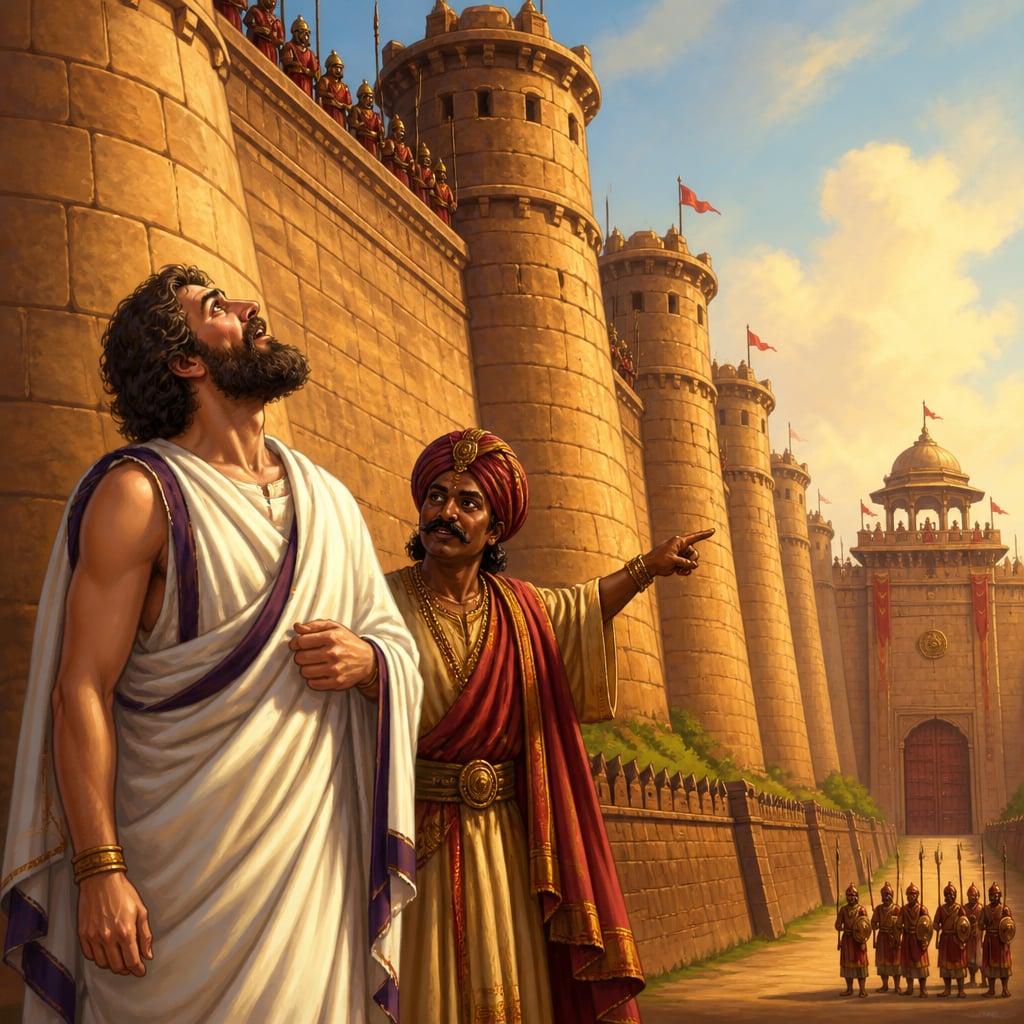
Megasthenes, the Greek ambassador, stood at the base of Pataliputra's walls and stared upward in disbelief. He had seen Babylon's legendary walls, walked through Persepolis, surveyed Greek fortifications from Athens to Syracuse. But nothing had prepared him for this.
The walls rose seventy feet, punctuated by 570 towers. A moat 600 feet wide surrounded the city, deep enough to swallow an army. Behind the outer defenses, inner walls created killing zones. Arrow slits allowed defenders to rain death on attackers while remaining protected. The geometry was flawless, every angle calculated to eliminate blind spots, every tower positioned to provide crossfire support.
"Who designed this?" Megasthenes asked his guide.
"Kautilya," came the answer. "He said a king without a fort is like a serpent without fangs, feared by none."
Why Forts Matter
Kautilya devoted extensive sections of the Arthashastra to fortress design, not from architectural interest but from strategic necessity. His reasoning was characteristically practical:
A strong fort prevents wars. Potential enemies who see impregnable defenses choose diplomacy over destruction. The investment in walls saves vastly more than it costs by deterring attacks that would devastate the kingdom.
A fort multiplies force. Ten thousand men behind strong walls can defeat fifty thousand attackers. The mathematics of siege warfare favor defenders dramatically, provided the defenses are properly designed.
A fort protects prosperity. Cities concentrate wealth, skilled craftsmen, administrators, and traders. Without protection, this concentration invites plunder. Strong defenses allow prosperity to flourish without fear.
As Kautilya wrote: "Durgāśrayo balavatāṃ rājñāṃ jayaḥ, Victory belongs to powerful kings who have the support of forts." This wasn't just tactical wisdom; it was economic logic. The cost of building strong defenses was trivial compared to losses from a single successful invasion.
The Six Types of Forts
Kautilya identified six fundamental types of fortifications, each suited to different terrain and purposes. Understanding these distinctions reveals his systematic approach to defense:
Audaka-durga (Water Fort): Surrounded by water, rivers, moats, or ocean. Islands, river peninsulas, and coastal positions gained natural protection. Singapore today occupies terrain Kautilya would have recognized as ideal audaka-durga.

Parvata-durga (Mountain Fort): Built on heights difficult to approach. Attackers must climb while defenders strike from above. The forts of Rajputana, Chittorgarh, Kumbhalgarh, Mehrangarh, embody this principle across centuries.
Dhanvana-durga (Desert Fort): Protected by vast waterless expanses that exhaust and scatter attacking armies. The approach itself becomes a killing ground as supply lines stretch beyond sustainability.
Vana-durga (Forest Fort): Hidden within dense jungle, difficult to locate and harder to assault. The terrain favors defenders who know the paths while attackers struggle through hostile wilderness.
Mahi-durga (Earthen Fort): Built from earth and clay, often on artificial mounds. These could be constructed anywhere and were particularly valuable for protecting agricultural heartlands.
Nara-durga (Human Fort): Perhaps most interesting, fortification through loyal populations. A kingdom whose people will fight for it possesses the ultimate defense. Enemies cannot occupy what populations resist.
Kautilya recommended combining multiple types when possible. A mountain fort surrounded by water, with loyal populations inside, presented nearly insurmountable challenges to attackers.
Design Principles
Beyond type selection, Kautilya specified detailed design requirements that revealed sophisticated understanding of siege warfare:

Depth of Defense: Multiple walls created redundancy. If attackers breached one wall, they faced another. Each layer extracted casualties and time, while defenders could retreat to fresh positions. The psychological effect was equally important, seeing more walls ahead crushed attacking morale.
Overlapping Fields of Fire: Every section of wall should be covered by arrows from multiple towers. No attacker should reach any point without being exposed to cross-fire. This geometry required careful calculation, spacing towers too far apart created vulnerable gaps; too close wasted resources.
Moats and Obstacles: Water-filled moats prevented tunneling (a common siege technique) and forced attackers to cross under fire. Kautilya specified crocodiles be kept in moats, psychological warfare through literal terror. Obstacles before walls slowed attackers while defenders struck from above.
Internal Resources: A fort must be self-sufficient during siege. Wells for water (never rely solely on external sources that could be poisoned or diverted), granaries for food (enough for years, not months), armories for weapons, and workshops for repair. The fort that could outlast any siege won without fighting.
Escape Routes: Secret passages allowed communication during siege and evacuation if necessary. These required careful concealment, discovered escape routes became enemy entry points.
The Economics of Defense
Kautilya's genius was connecting military engineering to economic reality. He calculated optimal investment in fortification:
Defense should cost less than what it protects. Obvious, but requiring systematic valuation of kingdom's assets and realistic assessment of threat levels.
Deterrence saves more than walls cost. The wars that don't happen because enemies see strong defenses represent pure savings. A kingdom that never faces invasion because it appears impregnable has infinitely returned its fortification investment.
Forts concentrate economic activity. Protected cities attract merchants, craftsmen, and capital. The walls pay for themselves through increased prosperity they enable.
Consider modern parallels: Switzerland's neutrality is backed by terrain that makes invasion catastrophically expensive. Israel's Iron Dome missile defense costs millions but protects billions in infrastructure and productivity. Apple invests heavily in security architecture protecting intellectual property worth hundreds of billions. The logic is identical to Kautilya's, defense enables prosperity.
Defense as Strategy
Kautilya saw fortress defense not as passive waiting but as active strategy. Defenders had options beyond sitting behind walls:
Sallies and Raids: Defenders could strike out, attacking siege works, supply lines, or enemy camps. Nighttime raids disrupted enemy sleep and morale. The besieging army, spread thin around long walls, was vulnerable to concentrated strikes.
Internal Subversion: Spies among attacking forces could spread dissension, arrange accidents, or facilitate defections. Siege armies, far from home and suffering, were vulnerable to psychological operations.
Relief Force Coordination: Strong forts bought time for relief forces to arrive. Defenders communicated via signals, messengers through secret passages, or carrier pigeons. The fort that held until reinforcement arrived won completely.
Negotiation from Strength: Defenders who could outlast siege possessed leverage. They could negotiate favorable terms, the attacker, having invested heavily without success, often preferred compromise to continued bleeding.
The Modern Fort
Kautilya's principles translate directly to modern contexts, though the forms have changed:
Cybersecurity Architecture: Modern organizations face constant attack from hackers, competitors, and state actors. Layered defenses (firewalls, encryption, authentication, monitoring) mirror Kautilya's multiple walls. Defense in depth remains essential.
Financial Reserves: Companies and individuals holding cash reserves can weather crises that destroy those living paycheck-to-paycheck. Warren Buffett's famous "cash moat" at Berkshire Hathaway is pure Kautilyan defense, resources that allow survival when competitors fail.
Legal Protections: Contracts, patents, and corporate structures create defensive barriers against competitors and predators. The company with strong IP protection is the modern equivalent of the fort with good walls.
Reputation and Relationships: The organization with loyal stakeholders, employees, customers, suppliers, communities, possesses Kautilya's "human fort." When crisis comes, these relationships provide protection no contract can guarantee.
Building Your Defenses
Kautilya's fortress wisdom applies to personal strategy:
Identify what you're protecting. Career, family, health, financial security, reputation, what matters enough to defend? Clarity about priorities enables appropriate investment.
Build appropriate defenses. Emergency funds protect against financial siege. Skills and credentials protect career. Health maintenance protects against physical breakdown. Relationships protect against isolation.
Create depth. Don't rely on single defenses. Multiple income streams, diverse skills, varied relationships, redundancy survives what concentration cannot.
Maintain your walls. Defenses require upkeep. Savings must grow to match inflation. Skills must update to match changing markets. Relationships require ongoing investment.
Remember the purpose. The fort exists to protect prosperity, not to imprison it. Defense that prevents risk-taking becomes self-defeating. The goal is security that enables flourishing, not security that prevents living.
The Unbreached Wall
Kautilya's fortification wisdom culminated in a paradox: the best defense is one never tested.
Pataliputra's walls were never successfully breached during the Mauryan era. This doesn't mean they failed, it means they succeeded completely. Potential attackers saw those 570 towers and chose other targets. The walls that prevented war accomplished more than walls that won wars.
Modern deterrence theory echoes this: nuclear weapons succeed when never used, cybersecurity succeeds when breaches never occur, financial reserves succeed when emergencies never exhaust them. The defense that prevents the test is superior to the defense that passes the test.
Megasthenes returned to Greece and wrote of Pataliputra's wonders. His accounts reached Alexander's successors, who absorbed the lesson: some targets aren't worth attacking. A kingdom that appeared invincible avoided the costs of proving it.
This is Kautilya's deepest teaching on defense: strength visible is conflict avoided. Build your fort not for the battles you'll fight, but for the battles you'll never need to fight because no one dares begin them.
Defensive Investment - The principle that spending on security enables greater returns by protecting assets and deterring threats.
Modern portfolio theory includes 'defensive investments' that protect against downside risk. Switzerland's military neutrality, backed by defensive terrain, enabled it to become Europe's financial center. Israel's Iron Dome protects economic infrastructure. The pattern is universal: security enables prosperity.
Kautilya integrated defensive economics systematically rather than treating security as separate from economic planning. His calculation of optimal fortification investment relative to protected assets anticipates modern risk management frameworks. Defense wasn't expense but investment with calculable returns.
Singapore's transformation from colonial port to financial center required massive defense investment despite having no natural resources or strategic depth. Lee Kuan Yew explicitly built deterrent capability, conscript army, advanced weapons, to enable economic development. The defensive investment returned prosperity many times over.
Visible Deterrence - The principle that defensive capability must be observable to prevent conflict, not just capable of winning it.
Nuclear deterrence theory emphasizes 'credible threat', capability that adversaries can see and believe in. Weak signals invite probing; strong signals prevent aggression. Thomas Schelling's 'Strategy of Conflict' analyzes how visible commitment deters. The principle extends from nuclear weapons to corporate positioning.
Verses
दुर्गाश्रयो बलवतां राज्ञां जयः।
durgāśrayo balavatāṃ rājñāṃ jayaḥ |
Victory belongs to powerful kings who have the support of forts.
Kautilya establishes that military power alone doesn't guarantee victory, it must be backed by strong defensive infrastructure. The fort multiplies the effectiveness of military force, allows smaller forces to defeat larger ones, and provides the security necessary for economic prosperity.
Book 2, Chapter 3, Verse 1 (R.P. Kangle)
दुर्गं विना नृपो निर्विषसर्प इव।
durgaṃ vinā nṛpo nirviṣasarpa iva |
A king without a fort is like a serpent without poison, feared by none.
The vivid metaphor captures a crucial truth: the serpent's danger lies in its poison, not its size. Similarly, a kingdom's security depends on its defensive capability, not just its army.
Book 7, Chapter 12, Verse 24 (R. Shamasastry)
षाड्गुण्यं दुर्गमास्थाय प्रयुञ्जीत।
ṣāḍguṇyaṃ durgamāsthāya prayuñjīta |
Having taken refuge in the fort, one should employ the sixfold policy.
This sutra reveals the strategic relationship between defense and diplomacy. The fort provides the security from which a king can negotiate, ally, or wait.
Book 2, Chapter 4, Verse 17 (Patrick Olivelle)
Case studies
Singapore: The Modern Durga
When Singapore gained independence in 1965, it faced existential vulnerability, a tiny island (700 sq km) surrounded by larger, potentially hostile neighbors. No strategic depth, limited natural resources, and a population of 2 million. Conventional wisdom suggested the nation couldn't survive independently.
Singapore's strategy embodied Kautilya's durga principles: (1) Maximized natural advantages, island position (audaka-durga). (2) Built visible deterrence, conscript army, advanced weapons, air superiority. (3) Created internal resources, strategic reserves, food stockpiles, water security. (4) Developed 'human fort', national identity, educated population, citizen soldiers. (5) Made defense enable prosperity, security attracted investment.
Singapore transformed from vulnerable city-state to prosperous, secure nation. GDP per capita exceeds $60,000. Military capability deters larger neighbors. The investment in defense created conditions for economic miracle, foreign investment flowed to secure, stable environment. Kautilya's formula validated: defensive investment returned prosperity many times over.
Defense isn't expense but investment. Singapore proved that visible, credible defense enables prosperity by creating security that attracts capital, talent, and trade. Small scale doesn't preclude security, it requires smarter defense. Kautilya's principles applied to nation-building in modern context.
Israel follows the same model today: heavy defense investment creating the security environment that enables a thriving tech sector. In the corporate world, companies like Apple invest billions in security, privacy, and IP protection precisely because these defensive investments create the trust that drives premium pricing and customer loyalty.
Singapore spends roughly 3% of GDP on defense despite having no external enemies. Its military reserves can mobilize 300,000 trained personnel within 72 hours for a nation of only 5.5 million people.
Apple's IP Fortress
Apple Inc. faces constant attempts to copy its innovations, steal its designs, and exploit its ecosystem. Competitors, counterfeiters, and hackers continuously probe for weaknesses. The company's market capitalization exceeds $2 trillion, making it perhaps the largest 'city' requiring defense in commercial history.
Apple's defensive strategy mirrors Kautilya's fortress principles: (1) Multiple walls, patents, trademarks, trade secrets, encryption, physical security. (2) Visible deterrence, aggressive litigation against infringers sends message. (3) Defense in depth, even if one protection breached, others remain. (4) Internal resources, massive cash reserves enable extended 'siege' (legal battles, market downturns). (5) Human fort, employee loyalty, customer devotion.
Apple maintains market leadership despite constant attack. Patents protect innovations; encryption protects users; legal team deters infringers; cash reserves enable strategic patience. The fortress enables rather than constrains innovation, knowing innovations will be protected encourages R&D investment.
Kautilya's fortress wisdom applies to intellectual property protection. Multiple defensive layers, visible deterrence, and internal resources enable the prosperity that makes the company worth attacking. Defense enables the innovation it protects.
Every technology company now treats intellectual property as a fortress. Google, Amazon, and Microsoft file thousands of patents annually, build layered cybersecurity defenses, and invest in legal teams as strategic assets. The lesson applies to individuals too: protecting your reputation, credentials, and professional network creates the secure foundation from which you can take bold creative risks.
Apple holds over 75,000 active patents worldwide. Its legal team spends an estimated $500 million annually defending intellectual property, treating IP protection as a core strategic investment rather than an overhead cost.
Historical context
c. 4th century BCE
Ancient Indian warfare featured sophisticated siege techniques and correspondingly advanced fortification. Cities were expected to withstand sieges; forts in difficult terrain provided refuge against invasion. Kautilya systematized existing practices while adding rigorous analysis of costs, designs, and strategic implications. His specifications influenced Indian military architecture for centuries.
Kautilya's fortification principles influenced Indian military architecture from Mauryan through Mughal periods. His six-type classification, specifications for defense in depth, and economic analysis of defensive investment represent sophisticated strategic thinking that anticipated modern military engineering by two millennia. The principles remain relevant, translated into cybersecurity, financial reserves, and institutional resilience.
Reflection
- Kautilya taught that a king without a fort is like a serpent without poison, feared by none. What are your 'walls' that protect what matters to you? What would it take to breach them, and how could you strengthen them?
- Kautilya emphasized that the best defense is one never tested, Pataliputra's walls succeeded by deterring attack, not defeating armies. Can you identify situations where visible strength prevented conflicts you didn't need to fight?