After Victory
Immediate Post-Conquest Actions
Winning is just the beginning. Kautilya's systematic approach to the critical hours and days after conquest, when victory can still become defeat if mishandled.
The Moment After
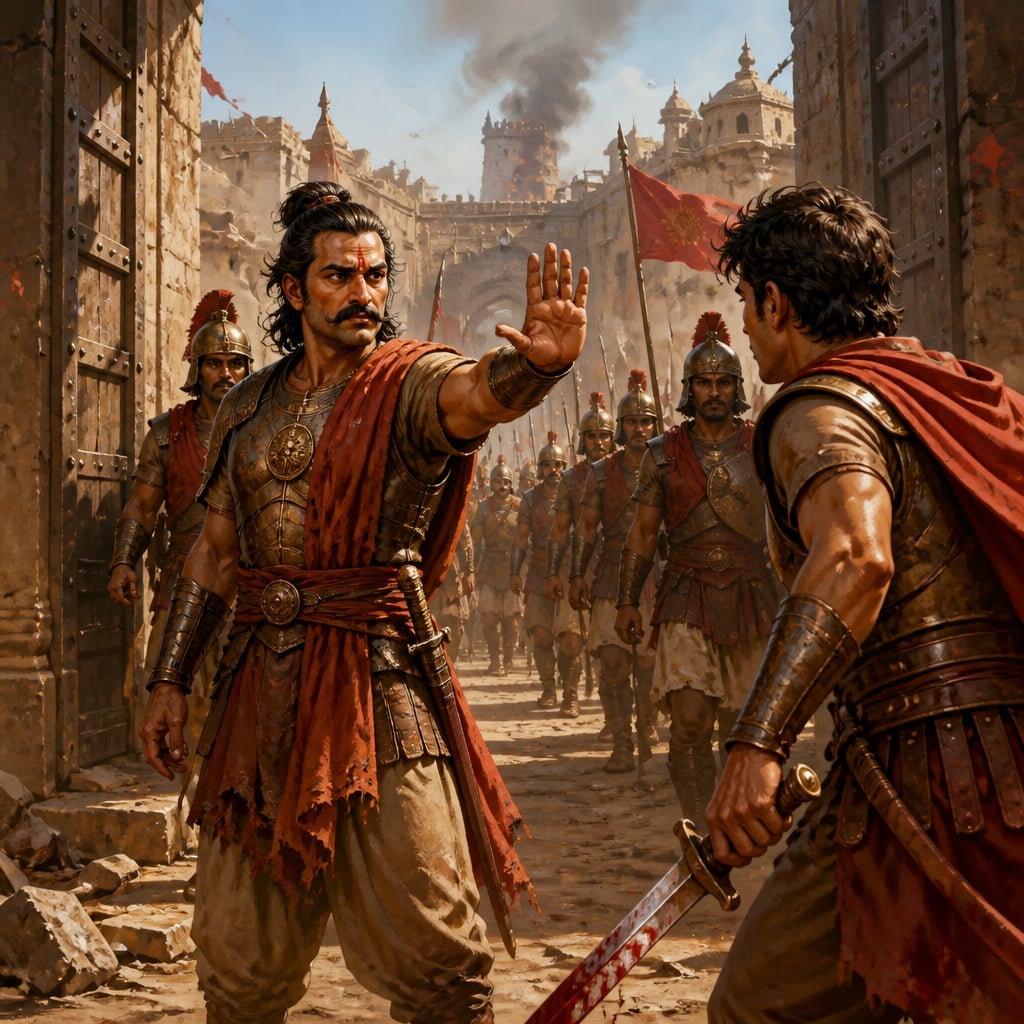
Commander Vishakhadatta stood in the breach, watching his soldiers pour through shattered gates. The fortress of Vaishali had fallen. Three months of siege, two failed assaults, and finally, treachery had opened the walls. Victory.
A lieutenant ran up, sword still bloody. "The men are ready to sack the city, Commander. They've earned their rewards."
Vishakhadatta raised his hand. "Stop. Stop all of them."
"But Commander, "
"Every soldier plundering is a soldier not securing the perimeter. Every burning building is resources we needed. Every civilian murdered is a relative who will resist us forever." He quoted Kautilya: "Vijitaṃ rakṣayet, Protect that which has been conquered."
He turned to his officers. "This is not the end. This is the beginning. What we do in the next three hours will determine whether we've won a territory or created a permanent wound. Secure the gates. Protect the granaries. Guard the treasury. And for the sake of everything we've fought for, no atrocities."
This was Kautilya's profound insight: the moment of victory is the moment of maximum danger. Everything can still be lost. The transition from warfare to governance requires more discipline, not less.
Why the First Hours Matter
The immediate aftermath of conquest presents unique challenges:
Chaos Prevails: Command structures have collapsed. The defeated garrison is disorganized but potentially dangerous. Civilians are panicked. Your own troops are exhausted, emotional, and expecting rewards. In this chaos, anything can happen.
Expectations Clash: Soldiers expect plunder. Civilians hope for mercy. Defeated defenders await their fate. Each group's expectations must be managed, meeting some, disappointing others, but preventing any from spiraling into disaster.
Information Is Incomplete: You don't know what you've captured. Where are the hidden treasures? Who are the key administrators? What supplies exist? What threats remain? Acting without knowledge risks critical errors.
Enemies Watch: Other kingdoms observe how you treat conquered peoples. Brutality invites future desperate resistance. Clemency encourages future surrenders. Your immediate actions become your reputation.
Kautilya devoted extensive sections to these first critical hours because he understood: many victories have been lost after they were won.
First Priority: Security
Before anything else, secure the conquest:
Control Entry Points: Gates, walls, and any breach must be manned immediately. This prevents defenders from escaping to organize resistance elsewhere, stops outside reinforcements from entering, and controls movement of people and goods.

Disarm the Defeated: Systematic disarmament of garrison and population. Weapons collected, stored, and inventoried. Armed civilians become insurgents; disarmed civilians become subjects. This must be thorough but not brutal, collection, not slaughter.
Secure Critical Infrastructure: Granaries (food supply), wells (water), armories (weapons), treasury (payment for your army and new administration), temples (centers of social organization), and government buildings (records, administration).
Establish Command Post: Visible center of authority where orders originate and reports arrive. The new rulers must be visibly present and in control. Absence invites chaos.
Patrol and Presence: Visible military presence throughout the city reassures civilians and deters both looting (by your soldiers) and resistance (by theirs). Visibility is control.
Kautilya's principle: in the first hours, prevent disaster rather than seek advantage. Stabilization precedes exploitation.
Second Priority: Discipline
Your army is your greatest asset and greatest risk:
The Plunder Problem: Soldiers expect rewards for risk and suffering. Denying them entirely risks mutiny or desertion. Allowing free plunder destroys what you've captured and creates atrocities that guarantee future resistance.
Kautilya's solution was systematic reward:
- Promise defined rewards to be distributed after inventory
- Assign specific high-value targets for controlled acquisition
- Severely punish unauthorized looting
- Pay bonuses from treasury, not from random plunder
The Atrocity Problem: Exhausted, traumatized soldiers with weapons, surrounded by civilians who were recently enemies, the conditions for atrocity are perfect. Once atrocities begin, they're nearly impossible to stop and create permanent resistance.
Prevention required:
- Clear orders before and immediately after breach
- Officers personally responsible for their units' conduct
- Swift, visible punishment for violations
- Protected zones (temples, hospitals, refuges) where civilians are safe
The Fatigue Problem: Exhausted soldiers make poor decisions. But the first hours require maximum alertness. Kautilya specified rotation: fresh units for critical security, exhausted units to rear positions, systematic rest schedules.
Third Priority: Information
Before governing, understand what you've acquired:
Inventory Everything:
- Treasury: How much wealth? What form?
- Granaries: How much food? How long will it last?
- Armories: What weapons? How many?
- Population: How many people? What skills?
- Records: Tax rolls, land documents, contracts
- Infrastructure: Condition of walls, buildings, roads
Identify Key People:
- Former administrators who know how things work
- Religious leaders who influence populations
- Merchants who control economic activity
- Military officers who command residual loyalty
- Potential troublemakers who might lead resistance
Understand the Situation:
- Why did the fortress fall? Internal weakness? Betrayal? Exhaustion?
- What grievances exist? Against former rulers? Against you?
- What expectations do people have? What do they fear?
- What external threats remain? Relief forces? Allied kingdoms?
This intelligence gathering must happen immediately, while witnesses are still available and records haven't been destroyed.
Fourth Priority: Communication
Messages must go in multiple directions:
To Your Troops: Clear orders about conduct, expectations about rewards, and reminder that victory comes with responsibility. The message: we have won; don't lose it through indiscipline.
To Defeated Defenders: Their fate depends on their cooperation. Guarantee safety for those who surrender fully. Clear consequences for continued resistance. The message: your war is over; choose peace.

To Civilian Population: New authority is established. Normal life should resume. Basic security is guaranteed. Justice will be administered. The message: cooperate and prosper; resist and suffer.
To Neighboring Kingdoms: The conquest is complete. Intentions are peaceful (or threatening, as strategy requires). The message: adjust your calculations accordingly.
To Your Own Kingdom: Victory achieved. Reinforcements/administrators needed. Resources secured. The message: prepare for integration.
Kautilya specified that messengers should depart within hours of conquest, before rumors and exaggerations spread their own narratives.
Fifth Priority: Initial Governance
Governance begins immediately, even if temporarily:
Establish Basic Order: Courts for disputes, mechanisms for complaints, visible administration. People need to know that authority exists and functions. Absence of authority invites chaos and self-help.
Continue Essential Services: Food distribution (if existing systems functioned), water supply, sanitation. Collapse of basic services creates suffering that turns populations against new rulers.
Visible Justice: Public punishment of looters (your own soldiers) and public protection of compliant civilians demonstrates that new rule means order, not chaos. Justice must be swift and visible in the first days.
Religious Respect: Temples, priests, and religious observances should continue undisturbed. Religious persecution creates martyrs and permanent resistance. Kautilya specifically prohibited disturbing religious practice.
Economic Continuity: Markets should reopen quickly. Trade should flow. Normal economic life reassures populations and generates resources. Prolonged economic disruption creates desperation.
The Conquered Leadership
Decisions about defeated leaders have lasting consequences:
The Former Ruler:
- Execution creates a martyr and rallying point for resistance
- Imprisonment creates ongoing risk and responsibility
- Exile creates potential external threat
- Incorporation (if terms were negotiated) creates potential ally
Kautilya's preference was incorporation when possible: the ruler who surrendered on terms and was treated honorably became advertisement for future surrenders. But he recognized that some rulers, those who violated oaths, committed atrocities, or would never accept subordination, required permanent removal.
Military Officers:
- Those who surrendered honorably might be incorporated into your forces
- Those who resisted to the end might be dangerous in any role
- Key officers who switched sides provided intelligence but might switch again
Administrators:
- Knowledge of local systems was invaluable
- But loyalty to former regime was uncertain
- Systematic vetting, keeping those who cooperated, replacing those who resisted
The principle: new rulers need competent subordinates, but subordinates need supervision until loyalty is proven.
Common Mistakes
Kautilya catalogued errors that turned victory into defeat:
Premature Celebration: Feasting and relaxation when security remains uncertain. Counterattacks have destroyed armies that celebrated too soon.
Excessive Brutality: Massacre of defenders, abuse of civilians, destruction of property. Each atrocity creates ten future resisters. The terror intended to cow populations instead hardens them.
Excessive Leniency: Failure to disarm, failure to establish authority, failure to punish violations. The population that sees weakness exploits it. Clemency must come from strength, not inability to enforce.
Ignoring Local Knowledge: Imposing unfamiliar systems when existing ones worked. Every change creates friction; unnecessary changes create unnecessary resistance.
Delayed Administration: Leaving power vacuum that local factions fill. The longer administration waits, the harder to establish. Move quickly to visible governance.
Overextension: Conquering more than you can hold. The fortress taken but not garrisoned reverts to enemy control. Better to consolidate thoroughly than expand superficially.
Modern Parallels
Kautilya's post-conquest principles apply wherever transitions require management:
Corporate Acquisitions:
The first days after acquisition are critical:
- Secure key assets (talent, IP, customers)
- Communicate clearly to all stakeholders
- Prevent "looting" (departures, data theft)
- Establish visible new leadership
- Maintain operational continuity
- Integrate systematically, not hastily
Political Transitions:
New administrations face similar challenges:
- Secure institutions and processes
- Communicate intentions and expectations
- Prevent disruption of essential services
- Establish visible authority
- Balance change with continuity
- Build new coalitions without alienating previous supporters
Project Completions:
Launching new systems or completing major projects:
- Secure the achievement (documentation, training)
- Communicate to all stakeholders
- Prevent regression to old methods
- Establish ownership and responsibility
- Maintain what was built
- Transition smoothly to operations
Personal Transitions:
Major life changes (new jobs, moves, relationships):
- Secure the new position (understand expectations)
- Communicate your intentions
- Prevent erosion of gains
- Establish your presence
- Learn local systems before changing them
- Build relationships that sustain the new situation
The Three-Day Framework
Kautilya's recommendations can be summarized as a three-phase approach:
Day One: Secure
- Military security: gates, walls, infrastructure
- Disarmament: systematic, thorough, non-brutal
- Communication: basic messages to all stakeholders
- Discipline: prevent looting, atrocities, chaos
Days Two-Three: Stabilize
- Intelligence: inventory, key people, situation analysis
- Initial governance: courts, services, visible authority
- Economic: markets reopen, trade resumes
- Leadership: decisions about defeated rulers, officers, administrators
Days Four-Seven: Systematize
- Permanent administration: officials appointed, systems established
- Integration: connections to home kingdom
- Long-term: planning for governance, development, security
The timeline was aggressive, Kautilya knew that delay invited complications. But the sequence was essential: security before stabilization, stabilization before systematization.
Victory That Lasts
Vishakhadatta's discipline at Vaishali became legendary. While other commanders' conquests dissolved into insurgency and occupation, his territories became peaceful, productive, and loyal.
The difference wasn't luck or softer enemies. It was systematic attention to the critical hours after victory:
- He prevented atrocities that would create permanent enemies
- He established order quickly, filling the power vacuum
- He treated defeated populations fairly, earning cooperation
- He communicated clearly, managing expectations
- He incorporated what worked, changed only what needed changing
Years later, when he faced new campaigns, his reputation preceded him. Fortresses that might have resisted to the death surrendered on terms, they knew that Vishakhadatta's victory meant fair treatment, not massacre.
"The conquest," Vishakhadatta told his officers, "determines who enters the gates. The first hours determine who stays."
This was Kautilya's deepest teaching about victory: winning the battle is simple; winning the peace is complex. The fortress falls in a day; governance continues for generations. Those who remember this in the chaos of victory build empires. Those who forget build only ruins.
Stewardship of Gains - The principle that achievements must be protected and developed, not merely celebrated.
Modern acquisition integration emphasizes that the transaction is just the beginning, value is created or destroyed in post-merger integration. Sports dynasties require defending championships, not just winning them. The principle is universal: gains require ongoing investment to sustain.
Kautilya connected protection to the moment of conquest itself, not as afterthought but as immediate priority. Modern frameworks often treat acquisition and integration as separate phases; Kautilya recognized them as continuous process requiring unified strategy.
The Iraq War (2003) demonstrated failure to protect conquests. Military victory was swift, but inadequate post-war planning led to chaos, insurgency, and strategic failure. The 'conquest' was never protected; therefore it was never truly won.
Enlightened Self-Interest - The recognition that treating others well often serves your own interests.
Modern stakeholder theory argues that serving customers, employees, and communities ultimately serves shareholders. Win-win negotiation seeks outcomes beneficial to all parties. The insight is universal: sustainable relationships require mutual benefit.
Verses
विजितं रक्षयेत्।
vijitaṃ rakṣayet |
One should protect that which has been conquered.
This fundamental principle establishes that conquest creates responsibility, not just opportunity. The territory won through battle can be lost through mismanagement.
Book 13, Chapter 5, Verse 15 (R.P. Kangle)
जितप्रकृतीनां प्रियहितमाचरेत्।
jitaprakṛtīnāṃ priyahitamācaret |
One should do what is dear and beneficial to the conquered subjects.
This sutra articulates the principle of enlightened self-interest in governance. Treating conquered populations well isn't just ethics, it's strategy.
Book 13, Chapter 5, Verse 3 (R. Shamasastry)
स्वदेशवद्भोगयेत्।
svadeśavadbhogayet |
One should govern [the conquered territory] as if it were one's own country.
The conquered territory should be integrated, not exploited. Governing it 'as one's own country' means investing in its prosperity, protecting its people, developing its resources.
Book 13, Chapter 5, Verse 8 (Patrick Olivelle)
Case studies
The Occupation of Japan
In August 1945, Japan surrendered after atomic bombings and Soviet declaration of war. The United States faced the challenge of occupying a nation of 70 million with distinct culture, recent history of militarism, and complete devastation. General Douglas MacArthur was appointed Supreme Commander.
MacArthur's occupation followed Kautilyan principles remarkably: (1) Security, immediate disarmament but through Japanese government, maintaining order. (2) Communication, clear messages about intentions, respect for Emperor (key institution). (3) Governance, maintaining Japanese administration while directing reforms. (4) Integration, treating Japan as potential ally, not permanent enemy. (5) Benefit, economic aid, democratic reforms genuinely improving Japanese lives.
Japan transformed from militaristic enemy to democratic ally within a decade. Economic recovery led to 'Japanese miracle.' No significant insurgency despite complete defeat. Contrast with post-WWI Germany: punitive treatment created conditions for WWII. MacArthur's Japan occupation became model for successful post-conflict reconstruction.
Kautilya's post-conquest principles validated at scale: protection rather than exploitation, service to conquered population, integration rather than perpetual occupation. 'Vijitam rakshayet' and 'priyahitam acaret' proved strategically sound as well as ethically defensible.
Post-merger integration in business faces identical challenges. When Disney acquired Pixar, it preserved Pixar's creative culture rather than imposing Disney's corporate structure. When Amazon acquired Zappos, it maintained the company's distinctive customer service culture. The acquirers that protect and serve what they acquire build lasting value; those that strip and exploit destroy it.
Japan's GDP grew at an average rate of 9.7% annually from 1950 to 1970, a period known as the 'economic miracle.' By 1968, Japan had become the world's second-largest economy, just 23 years after total defeat.
LinkedIn's Acquisition by Microsoft
In 2016, Microsoft acquired LinkedIn for $26.2 billion, Microsoft's largest acquisition ever. Tech acquisitions frequently fail: cultural clashes, talent departures, product neglect. Microsoft itself had struggled with previous acquisitions (Nokia, Danger). The stakes were enormous.
Microsoft's post-acquisition approach reflected Kautilyan wisdom: (1) Protect, maintained LinkedIn's independent operation, brand, and culture. (2) Communicate, clear messages to employees, customers, partners about intentions. (3) Govern, light touch, allowing LinkedIn leadership to continue directing operations. (4) Integrate, gradual connection to Microsoft systems (Office 365, Dynamics) without forcing immediate changes. (5) Serve, invested in LinkedIn's growth rather than extracting resources.
LinkedIn thrived under Microsoft ownership. Revenue tripled. User base grew significantly. Talent remained. Integration proceeded smoothly. By 2020, LinkedIn was considered Microsoft's most successful major acquisition. The approach, protect what you've won, serve the acquired, integrate gradually, created enormous value.
Corporate acquisitions require the same wisdom Kautilya taught for territorial conquest: protect, communicate, govern wisely, serve the acquired organization's interests, and integrate as 'svadeshavat', as if it were your own from the beginning.
Microsoft's acquisition of LinkedIn has become the gold standard for tech acquisitions precisely because it followed these principles. Preserving LinkedIn's brand, culture, and leadership autonomy while providing Microsoft's resources created more value than either company could have generated alone. The pattern is clear: acquisitions succeed when the acquirer acts as a patron, not a conqueror.
LinkedIn's revenue tripled from $3 billion to over $10 billion within five years of Microsoft's acquisition. Employee retention remained above 90%, unusual for major tech acquisitions where talent typically flees.
Historical context
c. 4th century BCE
Ancient Indian conquest traditions included elements of integration, victorious kings often retained local rulers as subordinates, respected religious institutions, and maintained administrative continuity. Kautilya systematized these practices into explicit doctrine, connecting military conquest to administrative transition.
Kautilya's post-conquest doctrine anticipated modern stabilization and reconstruction operations by millennia. The challenges he identified, security, communication, governance, integration, remain central to military planning, corporate acquisitions, and political transitions. His solutions, systematic protocols, clear sequencing, attention to human factors, remain applicable.
Reflection
- Kautilya taught that 'one should protect that which has been conquered.' Think of achievements in your life: have you protected and developed them, or have some been lost through neglect?
- Kautilya taught doing 'what is dear and beneficial' to those under your authority. When you've gained influence over others, have you served their interests or primarily your own?