Governing Conquered Lands
Integration Strategies
Conquest without governance is waste. Kautilya's systematic approach to administering newly acquired territories, building institutions that transform hostile subjects into productive citizens.
The Governor's Dilemma
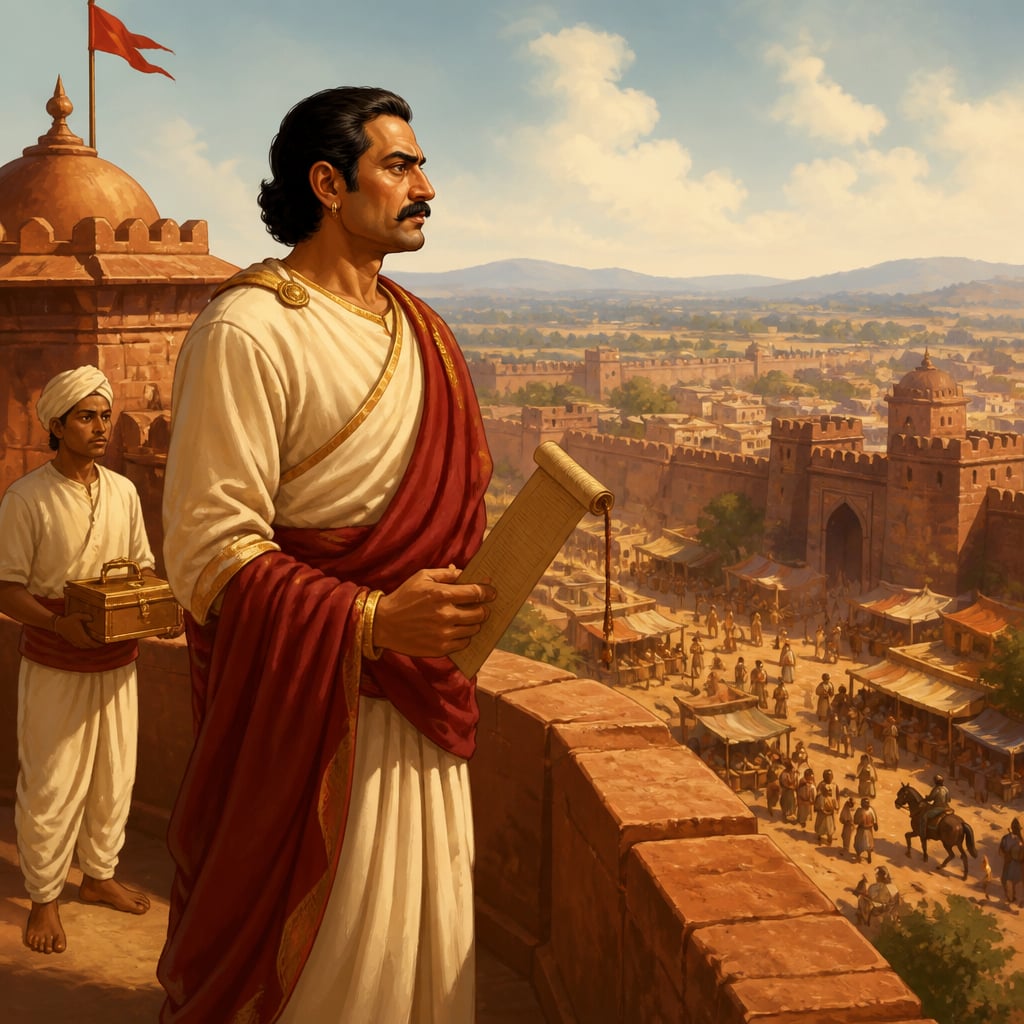
Radhagupta surveyed his new domain from the citadel of conquered Avanti. Six months ago, this had been enemy territory. Now it was his responsibility.
The challenges seemed endless: tax collection disrupted, courts in chaos, bandits in the countryside, merchants fleeing, priests resentful, nobles plotting. His predecessor, a general who'd led the conquest, had focused on military matters. The transition to governance had been... difficult.
"The problem," Radhagupta wrote to Kautilya, "is that everyone still thinks of us as invaders. How do I make them think of us as their government?"
Kautilya's reply was characteristically practical: "Svadeshe yathā tathā, As in your own country, so here. Don't ask them to think differently. Make their experience indistinguishable from proper governance. When the courts work, when the markets thrive, when bandits are punished, when religion flourishes, then you are not invaders. You are the state."
This captured Kautilya's philosophy of territorial governance: legitimacy comes from performance, not proclamation.
The Foundation: Law and Order
Before anything else, establish basic order:

Courts Must Function: Disputes don't pause for conquest. Property conflicts, contract enforcement, crime, all continue. Courts that function create expectation of order; absence of courts creates chaos.
Kautilya specified rapid court establishment:
- Appoint judges (from local notables if trustworthy, from home if not)
- Announce where and when courts operate
- Handle initial cases visibly and fairly
- Publicize just outcomes
Crime Must Be Punished: Bandits, looters, and opportunists exploit transitions. Visible, swift punishment established that law applied. The message: we are order, not chaos.
Property Must Be Secure: Uncertainty about ownership paralyzes investment. Clear resolution of property questions, generally favoring continuity, allowed economic life to resume.
Administrative Continuity
Kautilya preferred continuity over innovation:
Keep What Works: Existing tax systems, administrative divisions, legal traditions, change only what requires changing. Each change creates friction; unnecessary changes create unnecessary friction.
Retain Local Officials: Knowledge of local systems was invaluable. Officials who cooperated should be retained, supervised, and gradually integrated. Mass replacement with outsiders guaranteed failure.
Respect Local Customs: "Deśācāram anuvartet, Follow the customs of the region," Kautilya advised. Different regions had different traditions. Imposing uniformity when diversity functioned was waste.
Maintain Religious Institutions: Temples, priests, and religious observances should continue undisturbed. Religious persecution created martyrs. Kautilya specifically protected religious endowments.
The principle: the goal is governance, not transformation.
Provincial Structure
Kautilya specified administrative structure:
The Governor (Samaharta): Chief administrator with sufficient authority. The governor who lacked power couldn't respond to crises.
District Officers (Sthanika): Regional administrators, mix of appointees and vetted locals. They knew conditions; appointees ensured loyalty.
Village Headmen (Gramika): Local leaders maintaining order at village level. Usually retained from previous regime if cooperative.
Intelligence Network: Spies monitoring for resistance, measuring sentiment, watching for failures. The governor who didn't know what subjects thought couldn't govern effectively.
Garrison Commander: Separate from civil administration to prevent military interference while ensuring security support.
Revenue and Development
Conquered territories must eventually produce returns:
Initial Relief: Immediate post-conquest taxation destroys goodwill. Kautilya recommended temporary tax relief, demonstrating that new rule brought benefits.
Assessment: Before taxing, understand what exists. Land surveys, population counts, trade inventories. Arbitrary demands created resentment.
Moderate Rates: "Karoti bahu kṣīram iti dhenuṃ na piparti, One does not milk the cow dry wanting much milk," Kautilya advised. Sustainable taxation required leaving subjects prosperous.
Investment: Some revenue should return, infrastructure, public works, disaster relief. Investment created perception of legitimate governance.
Trade Development: Open markets, secure routes, fair regulations. Restoring commerce benefited both subjects and treasury.
The calculation: territories that prospered produced more than territories that suffered.
Managing Local Elites
Local nobles, merchants, and religious leaders retained influence:
Identify Power Centers: Who actually controls local society? Formal officials might matter less than informal influencers.
Co-opt Where Possible: Elites who accepted new rule became allies. Land grants, honorific titles, administrative appointments bound local leaders to new regime.
Watch for Threats: Not everyone could be co-opted. Identifying irreconcilables required intelligence; neutralizing them required removal or marginalization.
Create New Elites: Elevate new leaders who owed position to you. Promoted commoners, rewarded loyalists, these created independent power base.
Balance Factions: Different groups competed. Balancing prevented any from becoming powerful enough to challenge governance.
Security Calibration
Military presence required careful calibration:
Sufficient Force: Too few soldiers invited rebellion. Calculate based on population, terrain, and resistance likelihood.
Strategic Placement: Position for rapid response to trouble, road junctions, borders, known trouble spots.
Integration Over Time: Initial heavy garrison could be reduced as stability increased. Gradual reduction signaled normalization.
Intelligence Priority: Knowing about resistance before it erupted was worth more than troops to suppress it.
Civilian Separation: Soldiers who abused civilians created resistance. Clear rules, visible punishment for violations.
Phases of Integration
Kautilya recognized governance evolved over time:
Phase One (Months 1-6): Stabilization
- Establish security
- Create basic administration
- Restore economic activity
- Signal intentions through actions
Phase Two (Months 6-24): Normalization
- Transition from military to civilian governance
- Develop local leadership
- Begin systematic taxation
- Integrate into kingdom's system
Phase Three (Years 2-5): Integration
- Reduce garrison to normal levels
- Remove 'conquered' distinction
- Full participation in political life
- Normal development pace
Phase Four (5+ Years): Assimilation
- Territory indistinguishable from other regions
- Political allegiance secure
- Full contribution to kingdom
Common Failures
Kautilya catalogued errors that made governance fail:
Excessive Extraction: Treating territory as resource to exploit. Short-term gains destroyed long-term value.
Cultural Insensitivity: Imposing alien customs. Every imposition created resentment.
Corrupt Officials: Administrators who abused position destroyed legitimacy.
Neglecting Justice: Disputes unresolved, crimes unpunished. Without justice, no reason to cooperate.
Military Excess: Garrisons that abused civilians, occupation mentality that never ended.
Insufficient Investment: Taking without giving. Subjects needed visible benefits.
Modern Applications
Corporate Acquisitions:
- Don't immediately impose parent company systems
- Retain talent and institutional knowledge
- Invest in acquired entity, don't just extract
- Integrate gradually based on performance
New Leadership Roles:
- Understand before changing
- Retain what works
- Establish credibility through performance
- Build relationships with stakeholders
Political Transitions:
- Maintain essential services
- Respect institutional continuity
- Build coalitions including previous power holders
Radhagupta's Success

Two years later, Avanti had transformed. Tax revenues exceeded pre-conquest levels. Trade flourished. The garrison had been reduced.
Most remarkably, when a neighboring kingdom tested the border, local levies fought alongside Mauryan troops. Subjects who'd resisted conquest now defended the kingdom.
Radhagupta reported: "They don't think of us as conquerors anymore. They complain about taxes like everyone else. They argue cases in our courts. They are subjects."
Kautilya's response: "This was always the goal. Not conquest, that's the beginning. Governance. Make their lives better; make their interests align with yours; make the distinction disappear. Then you haven't conquered a territory. You've expanded a kingdom."
The goal is not submission but integration. Conquered peoples who become participating subjects create value; conquered peoples who remain subjugated require permanent occupation.
Cultural Adaptation - Effective governance requires adapting to local conditions rather than imposing uniform systems.
Modern management recognizes that 'best practices' succeeding in one context may fail in another. Effectiveness requires contextual adaptation.
Kautilya made cultural respect an explicit governance principle, preventing the assumption that home practices should automatically apply elsewhere.
British administration in India, regions where existing systems were respected remained more stable than those subjected to aggressive reform.
Sustainable Extraction - Maximum short-term extraction often destroys long-term value.
Modern sustainability thinking echoes this: fishing that exhausts populations, business practices that burn out employees, all sacrifice long-term for short-term.
Verses
देशाचारं अनुवर्तेत।
deśācāraṃ anuvartet |
One should follow the customs of the region.
This principle of cultural respect was strategic. Imposed uniformity created resistance; respected diversity enabled governance.
Book 13, Chapter 5, Verse 5 (R.P. Kangle)
करोति बहु क्षीरमिति धेनुं न पिबति।
karoti bahu kṣīramiti dhenuṃ na pibati |
One does not milk the cow dry because it produces much milk.
This metaphor captures sustainable extraction. The territory that could be heavily taxed should not be, because excessive taxation destroyed productive capacity.
Book 5, Chapter 2, Verse 70 (R. Shamasastry)
स्वदेशे यथा तथा लब्धे।
svadeśe yathā tathā labdhe |
As in one's own country, so in what has been conquered.
Conquered territory should receive the same governance as home territory. Same investment, same protection, same justice.
Book 7, Chapter 16, Verse 27 (Patrick Olivelle)
Case studies
The European Union
After World War II, European nations faced integrating historically hostile territories into cooperative union. The project required balancing sovereignty with common institutions, respecting diverse cultures while building unity.
EU integration applied Kautilyan principles: (1) Cultural respect, member states retained languages and autonomy. (2) Sustainable extraction, wealth transferred to poorer regions. (3) Equal treatment, common standards across membership. (4) Gradual integration, phased harmonization.
Historically warring nations achieved decades of peace. However, strains reveal limits: national identities persist, wealth transfers create resentment. The EU demonstrates both success and difficulty of integration.
Kautilya's principles apply to voluntary integration as well as conquest. Cultural respect, sustainable development, and equal treatment enable unity across diversity.
The challenge of integrating diverse entities while respecting local autonomy applies to every multinational corporation. Companies like Unilever and Nestle operate across dozens of countries, balancing global standards with local adaptation. The organizations that get this balance right, allowing genuine local autonomy within shared frameworks, consistently outperform those that impose rigid centralized control.
The European Union grew from 6 founding members in 1957 to 27 member states governing 450 million people. Intra-EU trade increased from 40% to over 60% of members' total trade volume.
Google's Acquisition of YouTube
In 2006, Google acquired YouTube for $1.65 billion. Google had its own video platform. The challenge: how to govern this acquisition without destroying what made it valuable?
Google followed Kautilyan wisdom: (1) Cultural respect, YouTube retained independent brand and culture. (2) Sustainable extraction, invested in growth rather than immediately monetizing. (3) Local expertise, YouTube leadership continued. (4) Gradual integration, slowly connected to Google systems.
YouTube became world's dominant video platform, generating tens of billions annually. The light-touch governance preserved YouTube's culture while providing resources for growth.
Kautilya's principles apply to corporate acquisitions: respect existing culture, invest rather than extract, retain expertise, integrate gradually. The territory that retains identity while gaining resources creates value.
Google's YouTube strategy has become the template for successful tech acquisitions. Invest in the acquired platform's strengths, integrate gradually, retain key talent, and resist the urge to over-standardize. The same principle applies to corporate mergers of all sizes: cultural respect and patient integration consistently outperform rapid assimilation.
Google acquired YouTube for $1.65 billion in 2006. By 2023, YouTube generated over $31 billion in annual advertising revenue alone, making it one of the most successful acquisitions in business history.
Historical context
c. 4th century BCE
Kautilya wrote during an era of empire-building when governing diverse conquered territories was central challenge. His governance doctrine addressed practical problems of integration at scale.
Kautilya's governance doctrine anticipated challenges that empires, nations, and organizations have faced throughout history. His principles remain applicable wherever diverse territories or units must be integrated.
Reflection
- Kautilya taught following 'the customs of the region.' When entering new environments, have you learned local norms before trying to change them?
- Kautilya warned against 'milking the cow dry.' In your relationships, do you extract sustainably or push to the maximum?