Why Material Welfare Comes First

Artha as Foundation

Kautilya's revolutionary insight: spiritual and ethical growth requires material security first. Artha enables Dharma.

The Scholar Who Couldn't Teach
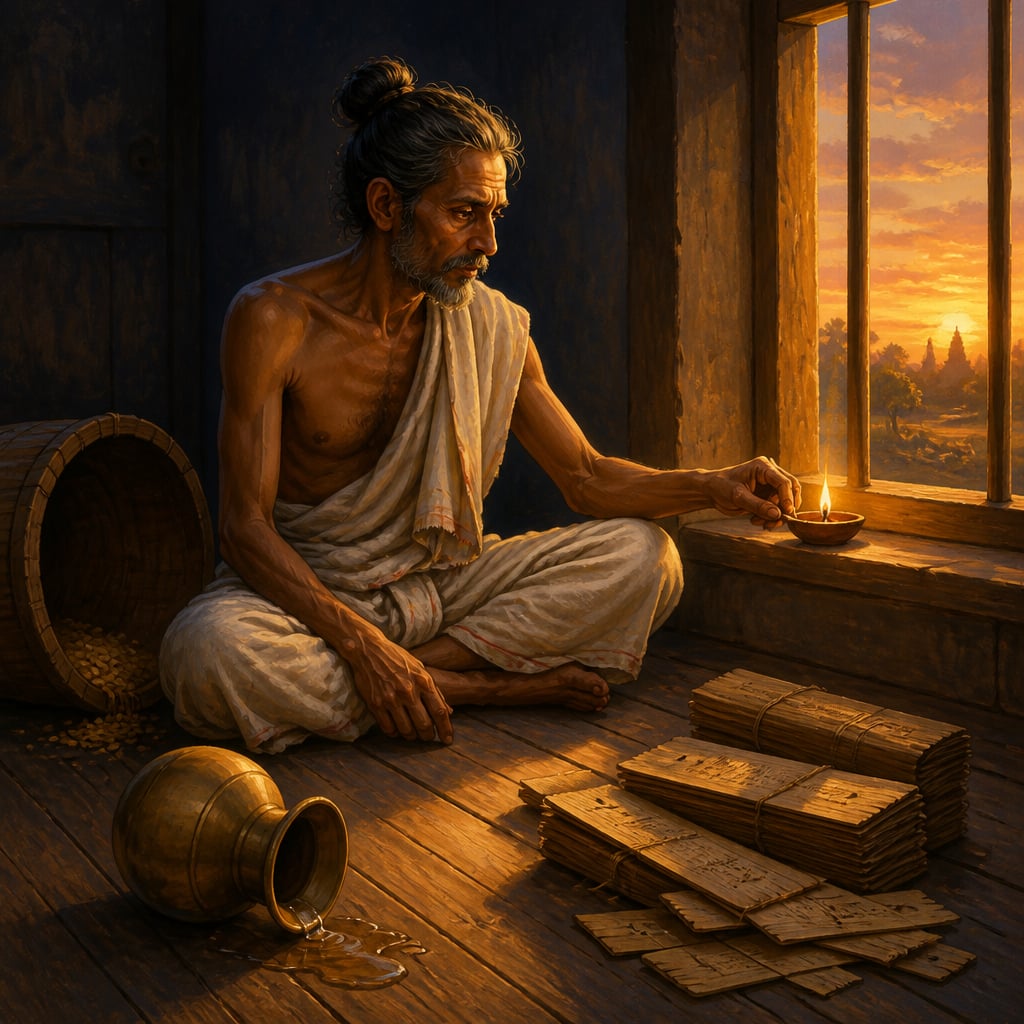
Bhrigu the scholar in his emptied Pataliputra home after the tax raid

Bhrigu was the finest Sanskrit scholar in Pataliputra. His commentaries on the Vedas were legendary. Students traveled from across the sixteen kingdoms to study at his feet.

But when the Nanda tax collectors came, Bhrigu could offer nothing. His scrolls wouldn't feed their horses. His wisdom wouldn't fill their sacks. They took his copper vessels, his bronze lamp, even the small gold ornament his wife wore.

"I am a Brahmin," Bhrigu protested. "I serve dharma."

The head collector laughed. "Dharma doesn't pay the army. Gold does."

After they left, Bhrigu sat in his emptied room. Tomorrow, his students would arrive for lessons. But what would he teach them? That righteousness leads to poverty? That wisdom offers no protection?

His neighbor, a grain merchant, sent over rice and oil. "You fed my mind for years," the merchant said. "Now I feed your body."

Bhrigu understood something that day: his dharma depended on someone else's artha.

The Foundation Argument

Kautilya observed this pattern everywhere. The temple priest depended on merchant donations. The scholar depended on royal patronage. The philosopher depended on farmers growing food.

Even the greatest spiritual achievements required material foundation. The Buddha himself abandoned extreme asceticism because a starving mind cannot achieve enlightenment.

Kautilya formulated this as a principle:
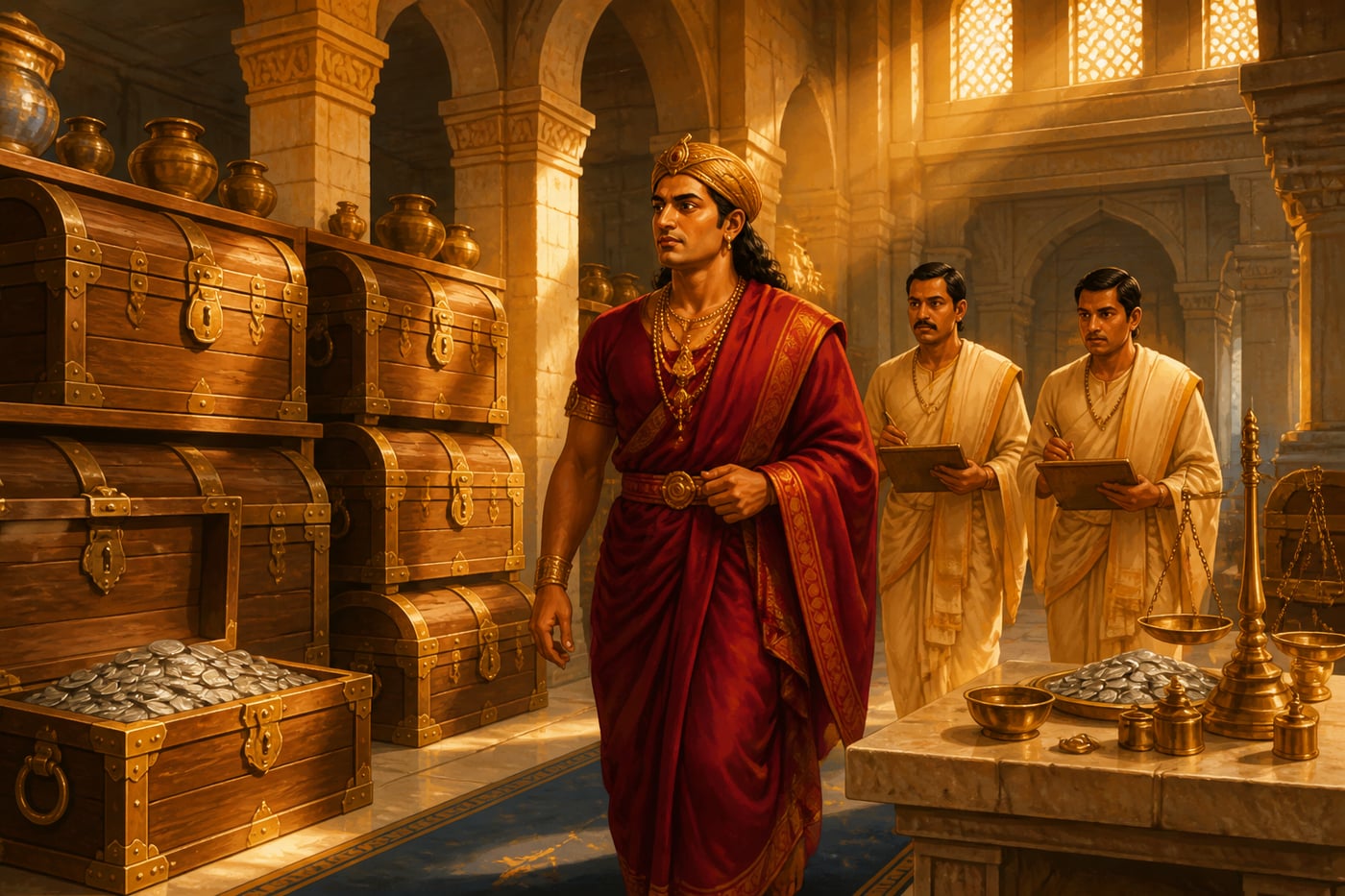
Chandragupta walking through the Mauryan treasury hall with his ministers

"Kośa-mūlo daṇḍaḥ."

"The treasury is the root of the army."

And behind that:

"Dharmasya mūlam arthaḥ."

"The root of righteousness is material welfare."

This wasn't materialism. It was realism about causation. Ask a starving person to contemplate truth, and they'll contemplate food. Ask a refugee to consider justice, and they'll consider survival. The mind consumed by material desperation has no space for higher reflection.

The Causal Chain

Kautilya traced the chain of dependencies:

Treasury enables army, a kingdom needs resources to maintain defense.

Army enables security, without protection, no property or life is safe.

Security enables production, people can only work when they feel safe.

Production enables wealth, economic activity generates prosperity.

Wealth enables leisure, abundance frees time from survival labor.

Leisure enables culture, arts, philosophy, and religion require free time.

Culture enables dharma, ethical reflection needs contemplative space.

Break any link, and the chain above it collapses. A kingdom without treasury cannot defend itself. A kingdom under attack cannot prosper. A poor kingdom cannot support temples or universities.

Modern example: When Venezuela's economy collapsed in the 2010s, crime rates soared, hospitals ran out of medicine, and educated professionals fled. Material collapse undermined every other social good.

The State as Enabler

This insight shaped Kautilya's political philosophy. The state exists not to impose virtue but to create conditions where virtue becomes possible.

"You cannot legislate dharma," Kautilya argued. "You can only create conditions where people are free to pursue it."

The ideal ruler focuses first on:

With these foundations, dharma flourishes naturally. Without them, even the most virtuous intentions fail.

Singapore under Lee Kuan Yew followed exactly this sequence: security first, then prosperity, then gradually expanding freedoms. The result was transformation from Third World to First World in a single generation.

The Poverty Trap

Kautilya understood what modern economists call the poverty trap. Poverty isn't just lacking things, it's lacking the capacity to escape lacking things.

The poor person cannot invest because they have nothing to invest. They cannot take risks because any failure means catastrophe. They cannot think long-term because tomorrow's meal is uncertain. They cannot be generous because they have nothing to give.

Poverty constrains not just material possibilities but moral possibilities. The desperate parent is pushed toward actions they would never choose in abundance.

Research confirms this: A 2013 study in Science found that financial worry literally reduces cognitive capacity, the equivalent of losing 13 IQ points. Scarcity creates a "bandwidth tax" that leaves less mental space for anything beyond survival.

This is why Kautilya insisted that a ruler's first duty is ensuring prosperity, not because wealth is the highest value, but because its absence prevents all higher values.

Against False Spirituality

Kautilya had no patience for spiritual teachers who preached renunciation while depending on others' prosperity.

A forest sage meditating above a Mauryan valley of farmers and soldiers

"The sage meditating in the forest," he observed, "depends on farmers growing food, traders bringing cloth, and rulers maintaining the peace that allows meditation."

Renunciation is possible only because others haven't renounced. The monastery requires donations, donations that can only come from productive economy.

This doesn't diminish spiritual pursuits, it contextualizes them. Acknowledging material dependencies isn't materialism; it's honesty about what makes spiritual practice possible.

Even Mother Teresa's missions in Calcutta ran on donations from prosperous Catholics worldwide. Artha enabling dharma.

The Happy King, Happy Kingdom

Kautilya made the political implication explicit:

"Prajā-sukhe sukhaṃ rājñaḥ."

"In the happiness of the people lies the king's happiness."

This isn't sentiment, it's strategic wisdom. A prosperous people pay taxes willingly. A secure people don't rebel. A happy people defend their kingdom enthusiastically.

Conversely, the ruler who extracts too much undermines the foundation of his own power. Oppression isn't just immoral, it's stupid.

Dhana Nanda learned this the hard way. His treasury overflowed while his people starved. When Chandragupta came, the people welcomed the revolution.

The Synthesis

Kautilya wasn't saying artha is the highest value, he was saying it's the foundational value. The distinction matters.

A foundation isn't a building's purpose, but without it, no building stands. Similarly, material welfare isn't life's purpose, but without it, no higher purpose can be pursued.

This creates a virtuous cycle: pursue artha to enable dharma, which guides the pursuit of artha, which enables more dharma. The relationship is reinforcing, not competing.

The wise person understands both the priority and the limit of material welfare. It comes first in time but not in ultimate value. It is necessary but not sufficient. It is the foundation, not the temple, but without the foundation, no temple can be built.

Consider: Is your own dharmic aspiration on solid artha foundation? Or are you trying to build a temple on sand?

Thomas Hobbes argued that without security, life is 'solitary, poor, nasty, brutish, and short' - chaos prevents civilization. Kautilya goes further: not just order but prosperity is needed for ethical living. The difference: Hobbes emphasized state power creating order; Kautilya emphasized economic policy creating prosperity. Both saw material conditions as foundational, but Kautilya's focus on prosperity rather than mere order was more sophisticated.

While Western social contract theorists focused on preventing violence, Kautilya recognized that mere peace without prosperity still constrains ethical development. His framework explains why stable but poor societies still struggle with corruption - security without prosperity is insufficient. Both order AND material welfare are needed.

When the Nanda dynasty's oppressive taxation impoverished merchants and farmers, corruption flourished - officials took bribes because their salaries were inadequate, merchants cheated because fair dealing didn't cover costs, farmers stole because they couldn't feed families. Chandragupta's moderate taxation restored prosperity, which restored ethical commerce. The proof: lower tax rates eventually yielded higher revenues as the economy recovered.

Modern behavioral economics (Mullainathan & Shafir, 'Scarcity') demonstrates that poverty creates 'cognitive bandwidth tax' - financial stress literally reduces IQ and impulse control. Kautilya observed the same phenomenon behaviorally: the poor make 'irrational' decisions because desperation changes rational calculation. A 2013 study found poverty reduces cognitive capacity equivalent to losing 13 IQ points.

Kautilya didn't just observe the poverty trap psychologically - he built a political economy around escaping it. His policies focused on breaking the cycle: moderate taxation preserves productive capacity, infrastructure investment enables trade, fair courts protect small merchants. He understood that you cannot moralize people out of poverty; you must create structural pathways out.

During the Bengal Famine of 1943, even wealthy, educated people resorted to desperate measures as circumstances deteriorated. Starvation eroded social norms - theft, abandonment of children, breakdown of traditional ethics. This validated Kautilya's observation: ethical behavior is constrained by material conditions. Post-independence agricultural development (Green Revolution) restored prosperity, and ethical norms recovered. Material foundation enables moral superstructure.

Friedrich Hayek's concept of 'spontaneous order' argues that prosperity emerges from individuals pursuing their own goals within stable rules, not from central planning. Kautilya anticipated this: the state provides security, property rights, contract enforcement, and infrastructure - then prosperity emerges organically. Both rejected the hubris of thinking rulers can design happiness; both emphasized creating conditions where happiness emerges naturally.

While Hayek emphasized negative liberty (freedom from interference), Kautilya balanced this with positive conditions (security, infrastructure, educated officials). His framework is more complete: the state must provide more than non-interference, but less than total provision. The sweet spot is enabling infrastructure with freedom of action - precisely what modern successful states do.

Lee Kuan Yew's Singapore focused on creating conditions - rule of law, corruption-free administration, excellent infrastructure, strong education - while allowing citizens wide economic freedom. The result: transformation from Third World to First World in one generation. Contrast with Soviet attempts to mandate prosperity through central planning - creating conditions works; mandating outcomes fails. Kautilya would have predicted both outcomes.

Verses

कोशमूलो दण्डः

kośa-mūlo daṇḍaḥ

The army has the treasury as its root

Kautilya identifies the treasury (kośa) as the root (mūla) of military power (daṇḍa). This simple statement captures the entire chain of causation - without economic resources, there can be no defense, and without defense, there can be no prosperity.

Book 8, Chapter 1, Verse 1 (R.P. Kangle)

सुखस्य मूलं धर्मः। धर्मस्य मूलम् अर्थः

sukhasya mūlaṁ dharmaḥ | dharmasya mūlam arthaḥ

The root of happiness is dharma. The root of dharma is artha.

This powerful sutra traces causation backward from the goal (happiness) to its ultimate foundation (material welfare). Happiness requires living ethically (dharma), but ethical living requires material security (artha).

Book 1, Chapter 7, Verse 6-7 (R. Shamasastry)

प्रजासुखे सुखं राज्ञः

prajā-sukhe sukhaṁ rājñaḥ

In the happiness of subjects lies the happiness of the king

The ruler's welfare is inseparable from the people's welfare. This isn't idealistic sentiment but practical political wisdom.

Book 1, Chapter 19, Verse 34 (L.N. Rangarajan)

Case studies

Singapore's Kautilyan Development

When Singapore gained independence in 1965, Lee Kuan Yew faced Kautilya's challenge: how to build a prosperous society from almost nothing. A tiny island with no natural resources, surrounded by larger hostile neighbors, with a diverse population of Chinese, Malay, and Indian immigrants.

Lee explicitly prioritized economic development first - attracting investment, building infrastructure, ensuring security - following essentially Kautilyan principles. Only after material prosperity was established did Singapore gradually expand social and political freedoms. The sequence was deliberate: artha first, then dharma.

Within one generation, Singapore went from Third World to First World. Today it has one of the highest per capita incomes in the world, excellent healthcare and education, low corruption, and a stable society. Critics call Lee's approach authoritarian; defenders call it realistic.

Getting the sequence right matters. Singapore built material foundation first, then expanded freedoms. Countries that tried the reverse - democracy before prosperity - often got neither. Kautilya's causal chain played out exactly as he predicted.

The sequencing debate is alive in development economics today. China's approach of economic liberalization before political liberalization mirrors Kautilya's artha-first framework, while critics argue that nations like Botswana prove democracy and development can advance simultaneously.

Singapore's home ownership rate reached 90% by the 2000s, one of the highest in the world, achieved through government-built public housing that now houses over 80% of the population.

The Failure of Imposed Virtue

The Soviet Union attempted to build a society based on ideological virtue without material foundation. Citizens were expected to sacrifice present prosperity for future utopia, to work for collective good without individual reward.

Kautilya would have predicted the Soviet failure. You cannot build dharma on denial of artha. When people's material needs are unmet, ideological appeals lose their power. The system that ignores human material motivation creates not virtue but corruption and cynicism.

The result was not just economic failure but moral failure - black markets, corruption, and cynicism became endemic precisely because the system denied human material needs. The foundation was missing, so the superstructure collapsed.

Systems that demand virtue while denying material welfare create the opposite of what they intend. People don't become selfless when their needs are ignored; they become cynical survivors. Material foundation isn't opposed to moral development - it enables it.

North Korea's current economic dysfunction mirrors this pattern exactly. Citizens navigate an elaborate shadow economy to meet basic needs while the state demands ideological loyalty. Every command economy that ignores material welfare creates the same gap between official rhetoric and daily survival.

By the late 1980s, the Soviet black market economy was estimated at 12-20% of GDP, with over 83% of citizens reporting they had engaged in informal economic activity to meet basic needs.

Historical context

c. 4th century BCE

Kautilya wrote during a period when India was emerging from the political fragmentation that followed Alexander's invasion. The Nanda dynasty, which preceded the Mauryas, demonstrated both the power and the corruption that great wealth could bring. Kautilya observed first-hand how material resources could build an empire (the Nandas' legendary treasury) and how their misuse could destroy legitimacy (the Nandas' oppressive taxation).

Kautilya's emphasis on artha as foundation rather than as goal reflects his historical lesson - wealth is necessary but not sufficient for good governance. This insight shaped how subsequent Indian thinkers understood the relationship between economics, politics, and ethics.

Reflection

More in What is Artha?

All lessons in What is Artha? · Arthashastra: Philosophy of Power course