The World Before Kautilya

Chaos, Conquest, and the Need for Order

In the 4th century BCE, India was a land of chaos. Sixteen great kingdoms warred endlessly, Alexander's armies had just retreated, and the corrupt Nanda dynasty squeezed the people dry. Into this world came a scholar with a revolutionary idea: that prosperity and freedom require not less government, but better government - one that serves rather than rules.

The Insult That Changed History
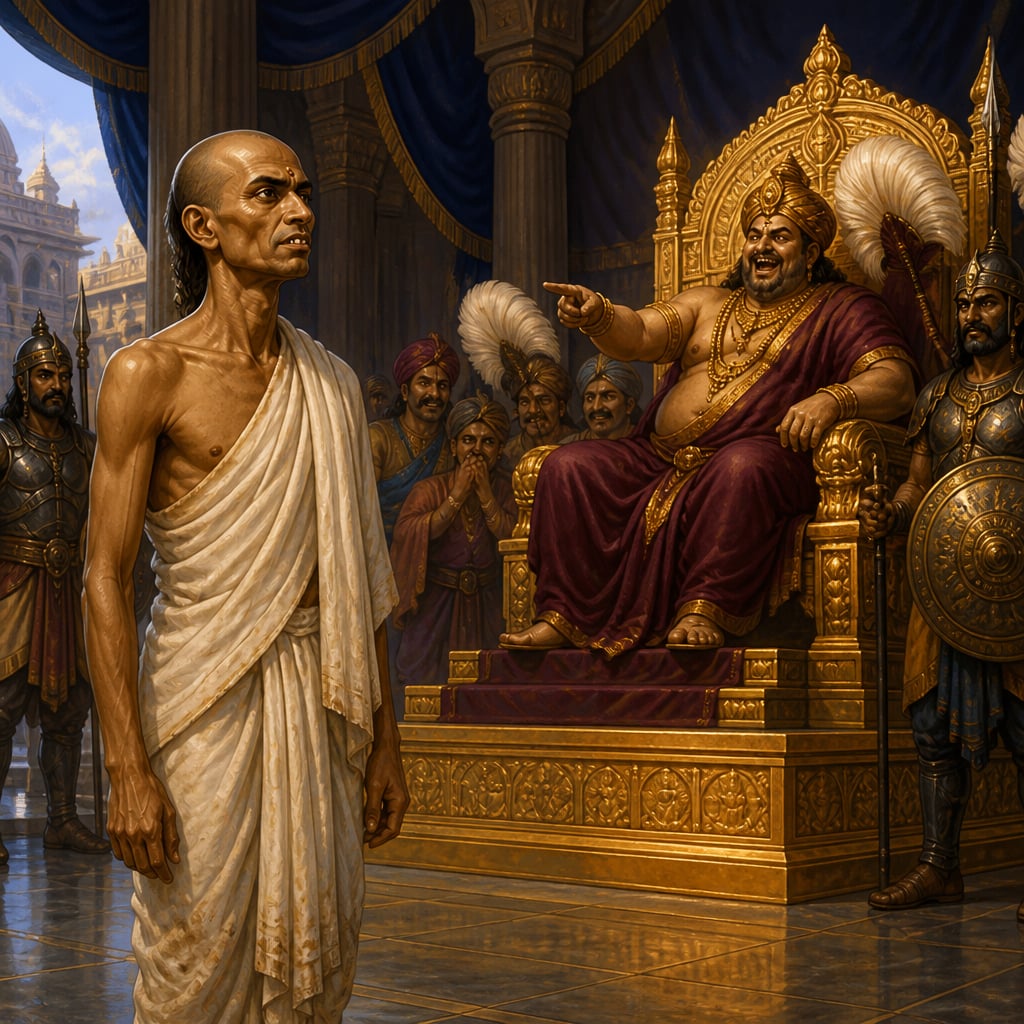
Vishnugupta humiliated before Dhana Nanda at the Pataliputra court

Vishnugupta stood before the royal court in Pataliputra, his dark weathered face expressionless. The scholars had gathered for what should have been a routine ceremony, the distribution of gifts to learned Brahmins. But Dhana Nanda, the last emperor of the mighty Nanda dynasty, had other ideas.

"Look at this ugly creature," the king laughed, pointing at Vishnugupta's twisted frame and protruding teeth. "What wisdom can come from such a face? Remove him from my sight."

The guards dragged the Brahmin scholar from the hall. But as they threw him into the dusty street, Vishnugupta made a vow that would echo through the centuries. He untied his shikha, the sacred topknot that marked him as a Brahmin, and declared: "I will not tie this again until I have uprooted the Nanda dynasty from the earth."

This humiliated scholar would become Kautilya, author of the Arthashastra, and architect of the largest empire India had ever seen.

A World Devouring Itself
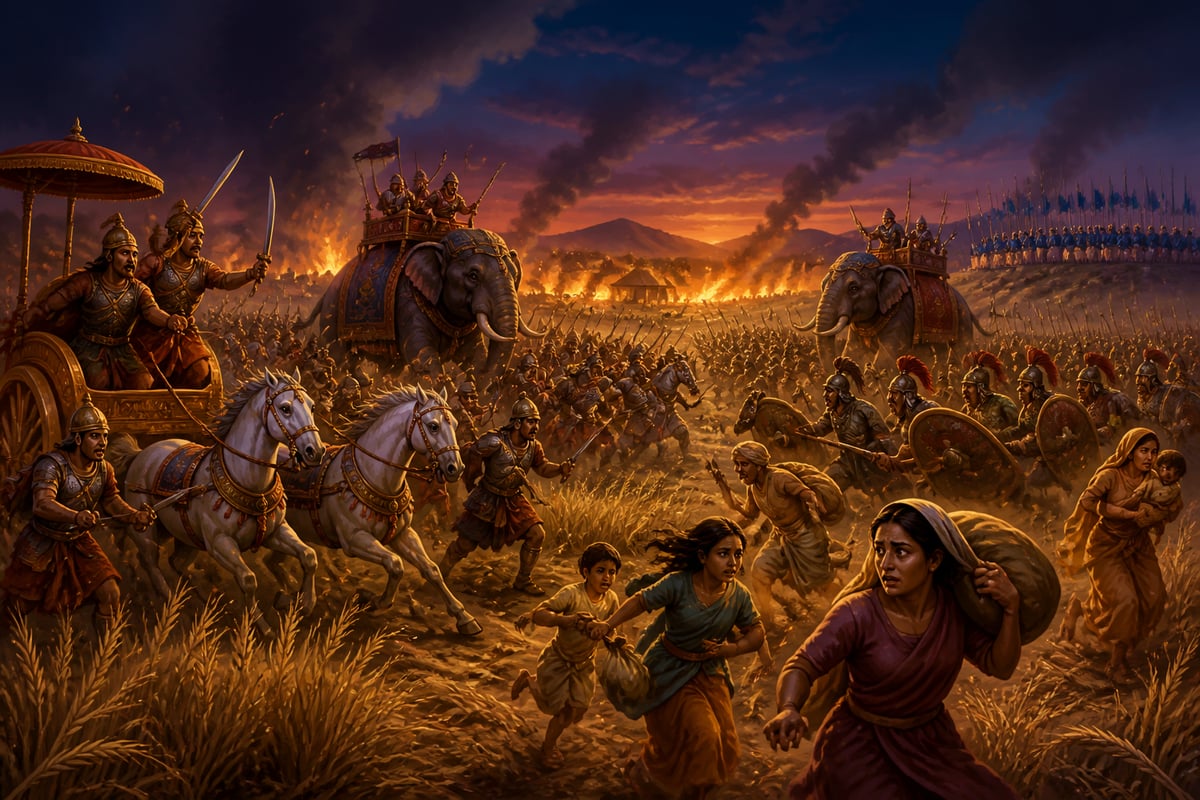
Mahajanapada armies clashing as villages burn in matsya nyaya chaos

The India of 326 BCE was a land eating itself alive. Sixteen great kingdoms, the Mahajanapadas, had been slaughtering each other for generations. Borders changed with every monsoon. Merchants traveled in armed caravans. Farmers fortified their villages.

Kautilya described this chaos with a vivid metaphor:

"Matsya nyāyam abhāve hi daṇḍasya balavān abalaṃ grasate."

"In the absence of governance, the law of the fish prevails, the strong devour the weak."

This wasn't philosophy. It was daily reality. A weaver in Vaishali might wake to find his kingdom conquered by Magadha. His taxes would double. His sons would be conscripted. His rights, whatever they were, would vanish with the old regime.

Alexander of Macedon had just invaded from the northwest, sweeping through kingdoms like wind through wheat. His exhausted army stopped at the Beas River, terrified by rumors of Nanda war elephants and limitless gold. Alexander turned back, but the message was clear: India was fragmented, vulnerable, ripe for conquest by anyone with sufficient ambition.

The Tyranny That Broke the Land

The Nandas had unified much of northern India, but their rule was a curse. Dhana Nanda's treasury overflowed with gold while villages starved. His tax collectors extracted levies on vegetables, on jewelry, even on funeral pyres.

"The king takes the farmer's seed," went a bitter saying, "then punishes him for having no harvest."

This was the fundamental problem Kautilya would spend his life solving: How do you create a state that protects people rather than preying on them?

The Nandas proved what happens when power has no limits. Prosperity dies. Trade withers. The talented flee. Eventually, even the army, the instrument of oppression, grows weak, because soldiers drawn from impoverished families cannot fight well.

The Scholar's Revolution

Kautilya retreated to Takshashila, the great university city in the northwest, ancient India's Harvard and Oxford combined. Here, students from as far as Babylon and Greece came to study mathematics, medicine, and governance.

But Kautilya didn't come to learn. He came to create.

In the shadowed halls of the university, he developed a systematic science of governance. Not merely tactics for seizing power, but principles for wielding it justly. He wrote:

"Prajā-sukhe sukhaṃ rājñaḥ prajānāṃ ca hite hitam."

"In the happiness of the people lies the king's happiness. In their welfare, his welfare."

This was revolutionary. Most political texts of the ancient world, from China to Greece, treated power as an end in itself. Kautilya argued that power was merely instrumental: it existed to create prosperity and protect freedom.

The Student Who Would Be King

Young Chandragupta learning strategy from Kautilya at Takshashila

A great vision needs a vehicle. Kautilya found his in Chandragupta, a young man of the Maurya clan, burning with ambition but lacking direction.

Chandragupta was everything Kautilya was not: handsome, athletic, charismatic. Some accounts say he was a minor noble; others claim humbler origins. What mattered was his combination of courage and teachability.

Kautilya transformed the young man into an instrument of revolution. He taught statecraft and military strategy. He drilled economics and ethics. Most importantly, he instilled a vision: the ruler exists to serve the ruled.

"You will not be another Dhana Nanda," Kautilya told his student. "You will be the king the people deserve."

The Fall of the Nandas

Around 321 BCE, Chandragupta struck. The details remain disputed, some say assassination, others open battle, but the result was clear. The Nanda dynasty collapsed. Dhana Nanda fled or died. And a new empire rose from the ashes.

The Mauryan Empire would become the largest in Indian history, stretching from Afghanistan to Bengal, from the Himalayas to the Deccan. But its significance wasn't mere size. It was the first systematic attempt to implement Kautilya's principles of governance.

Roads were built, not for conquest, but for commerce. Weights and measures were standardized. Merchants could travel without armed guards. Farmers knew what taxes they owed and could plan accordingly.

The Foundation of Freedom

Kautilya's central insight seems simple but remains radical: prosperity requires order, and order requires limited but effective government.

Without government, you get matsya nyaya, the strong devouring the weak. But with unlimited government, you get the Nandas, the state devouring everyone.

The solution wasn't no state or total state. It was the right kind of state: one powerful enough to maintain order and enable commerce, but constrained by principles that prevented it from becoming the predator rather than the protector.

"Sukhasya mūlaṃ dharmaḥ. Dharmasya mūlaṃ arthaḥ. Arthasya mūlaṃ rājyam."

"The root of happiness is righteousness. The root of righteousness is prosperity. The root of prosperity is proper governance."

This chain of causation is the foundation of everything that follows. You cannot have ethical society without material security. You cannot have material security without good governance. Therefore, the most important question is: what makes governance good?

Your Turn

The world Kautilya faced, constant conflict, predatory rulers, insecurity for ordinary people, isn't ancient history. Millions today live under governments that extract rather than enable, that prey rather than protect.

Kautilya's question remains urgent: How do we move from chaos to order, from tyranny to justice, from poverty to prosperity?

His answer begins with a surprising claim: that material wellbeing isn't opposed to spiritual growth or ethical life, it enables them. In our next lesson, we explore the Trivarga, the three goals of human life, and why economics comes before ethics.

Maslow's hierarchy of needs places physiological and safety needs before self-actualization. Marx argued that material conditions determine consciousness. Hobbes saw security as the first purpose of the state.

Kautilya provides a more nuanced chain than Maslow (adding governance as the mechanism) and is less deterministic than Marx. He sees material foundation as enabling, not determining, higher pursuits.

The Nanda dynasty's oppressive taxation destroyed the material foundation that enabled ethical life. Farmers forced to steal to survive couldn't practice dharma, demonstrating Kautilya's causal chain in reverse.

Hobbes argued the state of nature is 'war of all against all.' Locke emphasized property rights requiring state protection. Modern libertarians debate whether any state or minimal state best protects freedom.

Kautilya avoids both anarchist naivety and authoritarian overreach. He recognizes that order is necessary but insists the state must be limited by dharma and serve the people's welfare.

The period of the Mahajanapadas, sixteen kingdoms in constant warfare, demonstrated matsya nyaya. Merchants needed armed caravans, farmers fortified villages, and no one could plan beyond the next season.

Robert Greenleaf's 'servant leadership' emerged in 1970. Modern stakeholder theory argues businesses must serve all constituents. Peter Drucker emphasized that the purpose of business is to create a customer.

Kautilya grounds service in enlightened self-interest, not just morality. The king who serves his people serves himself because happy subjects pay taxes willingly, fight bravely, and don't rebel.

Dhana Nanda extracted wealth while his people starved. When Chandragupta came, the people welcomed revolution. The Nandas' legendary treasury couldn't save them from the consequences of betraying this principle.

Verses

सुखस्य मूलं धर्मः। धर्मस्य मूलं अर्थः। अर्थस्य मूलं राज्यम्।

sukhasya mūlaṃ dharmaḥ | dharmasya mūlaṃ arthaḥ | arthasya mūlaṃ rājyam |

The root of happiness is righteousness (dharma). The root of righteousness is material welfare (artha).

This chain of causation is revolutionary. Kautilya argues that spiritual and ethical life (dharma) doesn't come from renouncing the world - it requires material security first.

Book 1, Chapter 1, Verse Opening (R.P. Kangle)

मत्स्यन्यायमभावे हि दण्डस्य बलवान् अबलं ग्रसते।

matsya-nyāyam abhāve hi daṇḍasya balavān abalaṃ grasate |

In the absence of state authority (danda), the law of the fish prevails - the strong devour the weak.

This is Kautilya's version of Hobbes's 'state of nature' - but predating Hobbes by 2,000 years. Without ordered governance, there is no freedom - only the freedom of the powerful to exploit the powerless.

Book 1, Chapter 4, Verse 3 (R. Shamasastry)

प्रजासुखे सुखं राज्ञः प्रजानां च हिते हितम्। नात्मप्रियं हितं राज्ञः प्रजानां तु प्रियं हितम्॥

prajā-sukhe sukhaṃ rājñaḥ prajānāṃ ca hite hitam | nātma-priyaṃ hitaṃ rājñaḥ prajānāṃ tu priyaṃ hitam ||

In the happiness of the subjects lies the happiness of the king; in their welfare, his welfare. What pleases himself is not good for the

This is perhaps the most important sutra in the entire Arthashastra - and the foundation of the libertarian interpretation. The king is not the master but the servant.

Book 1, Chapter 19, Verse 34 (L.N. Rangarajan)

Case studies

Singapore: Modern Kautilyan Governance?

When Singapore gained independence in 1965, it was a small, poor city-state with no natural resources, surrounded by potentially hostile neighbors. Under Lee Kuan Yew's leadership, it transformed into one of the world's most prosperous nations through systematic governance, rule of law, and pragmatic economics.

Lee Kuan Yew's approach echoes Kautilya in several ways: (1) Focus on material welfare as the foundation for everything else; (2) Strong but not unlimited state authority; (3) Rule of law and low corruption; (4) Pragmatic rather than ideological policymaking; (5) Understanding that the government's legitimacy depends on delivering results for citizens.

Singapore went from third-world to first-world in one generation. However, critics point to restrictions on political freedom, raising the question of whether Kautilya would approve of the trade-offs made.

Good governance can create remarkable prosperity even with few natural advantages. But the balance between order and freedom remains contested. Kautilya's framework provides tools for analysis but doesn't give easy answers.

Countries like Rwanda and Estonia are replicating Singapore's playbook today, proving that small nations with disciplined governance can leapfrog larger, resource-rich competitors. The debate over how much political freedom to sacrifice for rapid development remains central to governance in the Global South.

Singapore's GDP per capita rose from $516 in 1965 to over $65,000 by 2023, making it one of the top 5 wealthiest nations per capita despite having zero natural resources.

Historical context

c. 350-321 BCE

India in the 4th century BCE was a land of competing kingdoms (Mahajanapadas), with the Nanda Empire being the most powerful. The northwest had just experienced Alexander's invasion, leaving Greek successor states in its wake. Trade routes connected India to Persia, Central Asia, and beyond. It was an age of intellectual ferment, with Buddhism and Jainism challenging traditional Brahminical authority.

The chaos of this period - constant war, rapacious taxation, arbitrary justice - created the conditions for Kautilya's revolutionary ideas. He wasn't theorizing in a vacuum but responding to real suffering and real failures of governance. His solutions were shaped by what he witnessed.

Reflection

More in What is Artha?

All lessons in What is Artha? · Arthashastra: Philosophy of Power course