The Science of Prosperity
Economics as Discipline
Kautilya approached economics systematically - the first to treat wealth creation as a science with principles that can be studied and applied.
The Treasury Inspector's Discovery
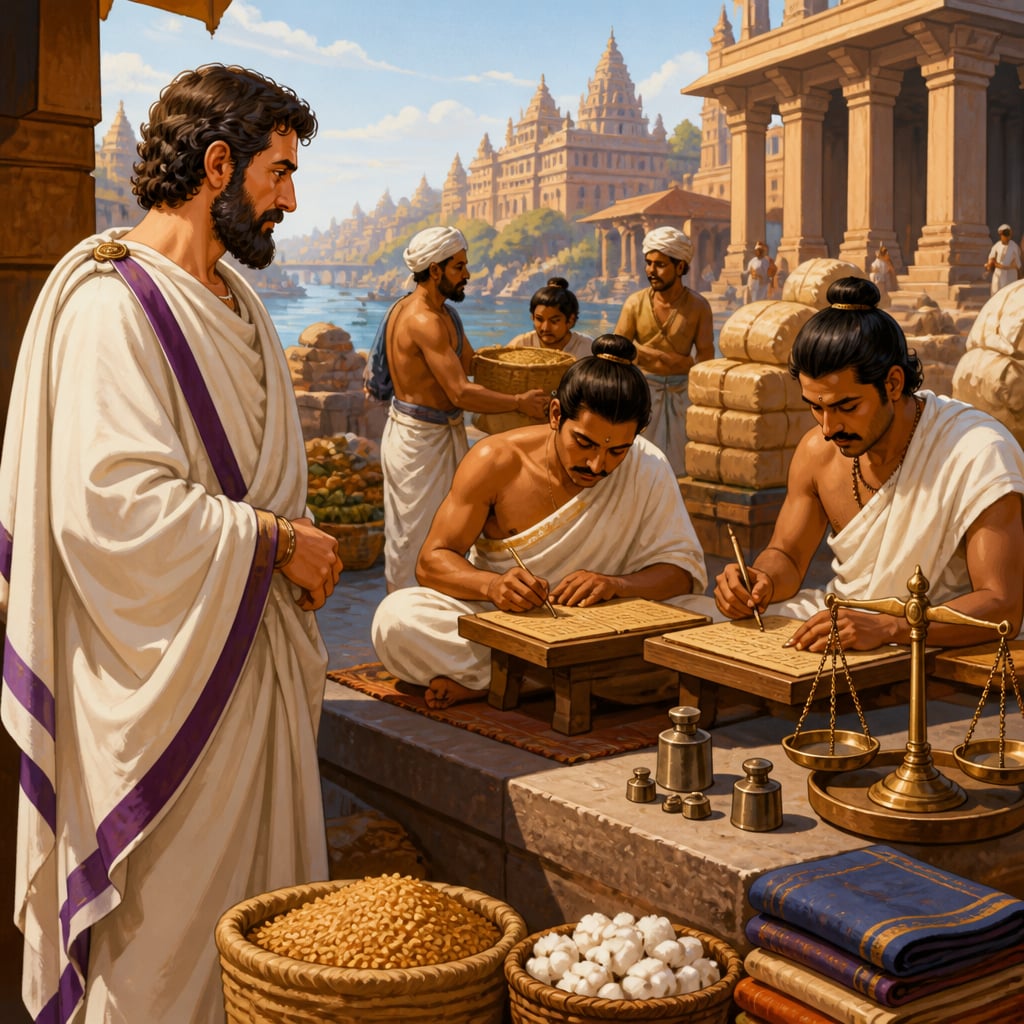
Megasthenes, the Greek ambassador to Chandragupta's court, had seen many wonders in India. But what impressed him most wasn't the palaces or elephants, it was the bureaucracy.
"Every transaction is recorded," he wrote to his superiors in Babylon. "Every weight and measure is standardized. Officials are trained, audited, and held accountable. The Indians have turned governance into a science."
What Megasthenes witnessed was Kautilya's revolution in action. Before the Arthashastra, wealth was often viewed as a matter of luck, divine favor, or brute force. Kautilya transformed it into something unprecedented: a teachable, testable discipline with discoverable principles.
What Makes a Science
The word shastra implies specific things:
- Systematic knowledge, organized principles that relate coherently, not random observations
- Teachable discipline, knowledge that can be transmitted and learned
- Verifiable claims, principles that can be tested against reality
- Practical application, knowledge meant to be used, not just contemplated
Kautilya's approach embodied all these. He didn't just describe what worked; he explained why it worked and how others could apply it.
"Vārttāyāṁ hi jagataḥ sthitiḥ."
"On economics indeed depends the existence of the world."
The Four Sciences
Kautilya identified four disciplines that together constitute the science of prosperity:
Anvikshiki (Philosophy/Logic): The lamp that illuminates all sciences. Without logical reasoning, economic analysis descends into superstition. Anvikshiki provides tools for distinguishing correlation from causation, for testing claims against evidence.
Trayi (Ethics/Tradition): The moral framework within which economics operates. It determines what kinds of prosperity are worth pursuing and what methods are acceptable.
Vārttā (Economics): The science of wealth creation, agriculture, animal husbandry, and trade. These productive activities generate the material foundation for everything else.
Daṇḍanīti (Governance): The science of protecting and enabling economic activity. Without security of property and enforcement of contracts, production cannot flourish.
These four are interdependent. Philosophy without economics is impractical. Economics without ethics is dangerous. Governance without philosophy becomes arbitrary.
Focus on Production
At the heart of Kautilya's economics is a radical focus on production:
"Vārttā kṛṣi-pāśupālya-vāṇijyā ca."
"Economics consists of agriculture, animal husbandry, and trade."

Wealth comes from creating things of value, growing food, raising animals, making goods, providing services. Everything else is secondary.
This has profound implications:
Producers are essential. Farmers, craftsmen, merchants, these are the people who actually create wealth. Their protection is governance's primary function.
Extraction is parasitic. Those who take without creating, corrupt officials, predatory rulers, are enemies of prosperity.
Trade multiplies wealth. When producers exchange goods, both parties benefit. Trade is positive-sum, it creates value that didn't exist before.
Modern parallel: Singapore has no natural resources. South Korea was poorer than Ghana in 1960. Both focused relentlessly on production and trade. Both became wealthy. Meanwhile, Venezuela sits on the world's largest oil reserves, and its people starve.
The Gardener's Wisdom
Kautilya understood something modern economists call the Laffer Curve: there's an optimal tax rate beyond which revenue decreases.
He put it memorably:

"The king should collect taxes like a bee collects honey, enough to sustain itself without destroying the flower. Or like a gardener who harvests fruit without killing the tree."
The ruler who overtaxes is like a farmer who pulls up his crops to check the roots. Short-term gain, long-term destruction.
Dhana Nanda maximized extraction. His treasury overflowed, briefly. Then his economy collapsed, his people revolted, and Chandragupta swept him away.
Chandragupta kept taxes moderate. The economy grew. His treasury eventually dwarfed the Nandas'. The sustainable approach won.
Institutions Matter
Perhaps Kautilya's most sophisticated insight: economic outcomes depend on institutions, the rules, norms, and enforcement mechanisms that structure human interaction.
- Property rights enable investment, no one improves land they might lose arbitrarily
- Contract enforcement enables trade, no one makes agreements that can't be enforced
- Predictable law enables planning, no one invests in futures they can't predict
- Corruption-free administration enables trust, no one deals fairly with cheaters
These foundations are invisible but essential. A kingdom with rich resources but poor institutions will be poor. A kingdom with modest resources but strong institutions will prosper.
Modern proof: In 2024, the Nobel Prize in Economics went to Daron Acemoglu, Simon Johnson, and James Robinson for demonstrating exactly what Kautilya argued 2,300 years ago: institutions determine prosperity more than resources do.
The Treasury as Metric
Kautilya used the royal treasury (kośa) as his primary economic indicator. The treasury grows when the economy grows. If productive activity increases, taxable activity increases, and revenue increases.
"Kośa-mūlo daṇḍaḥ."
"The army has the treasury as its root."
But he warned against mistaking the indicator for the goal. Maximizing short-term revenue destroys long-term productive capacity. The ruler who maintains moderate taxes on a growing economy will ultimately collect more than the ruler who extracts heavily from a stagnant one.
Human Capital
Kautilya understood that wealth isn't just physical resources, it's the skills and capabilities of people.
A skilled population is more productive than an unskilled one. Training craftsmen, educating merchants in accounting, developing administrators who understand both philosophy and economics, these investments multiply productive capacity.
This is why Kautilya devoted so much attention to the education of princes. The quality of governance determines whether human potential flourishes or withers. The educated ruler enables prosperity; the ignorant ruler destroys it through well-meaning incompetence.
Modern parallel: South Korea's transformation from agricultural poverty to technological powerhouse was built on massive investment in education. Human capital, not natural resources, created their miracle.
Science Applied Today
Kautilya's economic science resonates across millennia:
- Growth theory: His focus on production, investment, and human capital anticipates modern understanding of what drives economic growth
- Institutional economics: His emphasis on property rights and rule of law matches Nobel Prize-winning research
- Public choice theory: His awareness that rulers pursue their own interests anticipates modern political economy
Kautilya was practicing economics two millennia before Adam Smith. The science of prosperity he founded continues to develop, but its foundations were laid in ancient India.
Your Turn
Consider your own economic life through Kautilyan lenses:
- Are you producing or extracting? Do you create value, or capture value others create?
- Are your institutions sound? Do you keep commitments, deal fairly, maintain trust?
- Are you investing in capability? Skills and knowledge compound over time.
Kautilya would tell you: treat prosperity as a science. Study its principles. Apply them systematically. Test what works. The person who understands how wealth is created can create it deliberately, rather than hoping for luck.
Adam Smith's 'Wealth of Nations' (1776) argued that wealth comes from productive labor, not from hoarding gold. Jean-Baptiste Say's Law states that 'supply creates its own demand' - production is primary. Both echo Kautilya's insight 2,000+ years later. The difference: Kautilya integrated this into governance philosophy, showing how state policy should enable production rather than merely tax it. Smith focused on individual action; Kautilya on institutional framework.
Kautilya understood that production requires institutional support - property rights protecting farmers' land, contract enforcement enabling trade, infrastructure connecting markets. His framework: individual producers create wealth, but state must create conditions where production flourishes. This integration of micro (individual production) and macro (institutional framework) was more complete than Smith's focus on individual action alone.
Mauryan Empire's agricultural productivity came from irrigation systems (state investment), land tenure security (property rights), and road networks (enabling trade). Chandragupta didn't just encourage farming - he created infrastructure enabling farmers to produce more and traders to distribute output. Result: agricultural revolution that supported India's largest empire. The sequence: state investment in production capacity generated prosperity that generated tax revenue. Production-focused policy proved self-sustaining.
Modern network theory and institutional economics recognize that prosperity is systemic, not merely individual. Robert Putnam's 'social capital' research shows that community trust affects economic outcomes. Elinor Ostrom's work (Nobel 2009) demonstrated how communities manage commons through institutional arrangements. Both validate Kautilya's insight: individual prosperity requires healthy systems. The difference: Kautilya integrated this into comprehensive governance philosophy 2,300 years earlier.
While modern economics often models individuals as isolated optimizers, Kautilya always saw individuals embedded in systems - families, communities, markets, kingdoms. His framework: optimize individual action AND systemic health simultaneously. This prevents the fallacy of composition (what's rational individually may be destructive collectively). Systems thinking was built into his economics from the start, not added later as correction.
The Great Depression showed how individual rational actions (saving more, spending less) collectively caused economic collapse. Keynesian economics 'discovered' this paradox in the 1930s. Kautilya understood it 2,300 years earlier: the merchant who hoards during crisis feels prudent but if all hoard, trade stops and everyone suffers. His policy response: state spending during downturns to maintain demand. The insight: optimize for system health, not just individual rationality.
Douglass North (Nobel 1993) pioneered institutional economics: property rights, contract enforcement, and rule of law determine prosperity more than natural resources. Daron Acemoglu's 'Why Nations Fail' (2012) argues that institutions explain all economic divergence. Both won Nobel recognition for insights Kautilya articulated 2,300 years earlier. His framework: rājya (governance) is the mūla (root) of artha (prosperity). Institutions are foundational, not incidental.
Kautilya didn't just theorize about institutional importance - he specified what institutions matter: secure property rights enabling investment, fair courts enforcing contracts, predictable taxation enabling planning, corruption-free administration enabling trust. Modern institutional economics rediscovered these specifics. Kautilya's advantage: he provided both theory (why institutions matter) and practice (which specific institutions and how to implement them).
Singapore has no natural resources - tiny island, no minerals, no oil. Yet it became one of world's richest nations through institutional excellence: rule of law, property protection, contract enforcement, educated bureaucracy, corruption-free administration. Meanwhile Venezuela sits on world's largest oil reserves but its people starve due to institutional failure: property seized arbitrarily, contracts unenforced, courts politicized, administration corrupt. The comparison: institutions trump resources completely. Kautilya predicted this outcome 2,300 years before these nations existed.
Verses
वार्त्ता कृषि-पाशुपाल्य-वाणिज्या च
vārttā kṛṣi-pāśupālya-vāṇijyā ca
Economics consists of agriculture, animal husbandry, and trade
Kautilya defines vārttā (economics) as the three productive activities that generate material wealth. This definition emphasizes that economics is fundamentally about production - creating goods and services of value.
Book 1, Chapter 4, Verse 1 (R.P. Kangle)
वार्त्तायां हि जगतः स्थितिः
vārttāyāṁ hi jagataḥ sthitiḥ
On economics indeed depends the existence of the world
This sutra establishes the primacy of economic activity for human survival and flourishing. Without production, there is nothing to distribute, no surplus for culture, no resources for defense.
Book 1, Chapter 4, Verse 3 (R. Shamasastry)
तस्मात् प्रजानाम् अर्थ-चिन्ता नित्यं कुर्यात्
tasmāt prajānām artha-cintā nityaṁ kuryāt
Therefore, one should always think about the material welfare of the people
Kautilya makes economic thinking a duty of governance. Not occasional attention when problems arise, but constant consideration of how to enable prosperity.
Book 1, Chapter 19, Verse 35 (L.N. Rangarajan)
Case studies
The East Asian Miracle
South Korea, Taiwan, Singapore, and Hong Kong transformed from poverty to prosperity in a single generation - the most rapid economic development in human history. These small nations with few natural resources became economic powerhouses.
Their success embodied Kautilyan principles: focus on production and export (vārttā), investment in human capital (education as foundation), strong institutional foundations with rule of law and property rights (daṇḍanīti), and pragmatic governance that enabled rather than controlled economic activity. The sequence matters: they built institutional foundations first, then production capacity.
These societies demonstrated that economic science, properly applied, can create prosperity even without natural resources. What matters is production, institutions, and governance - exactly what Kautilya identified as the determinants of prosperity.
Prosperity is created, not found. Nations without resources can become rich through production and good governance. Nations with resources can remain poor through extraction and bad governance. Kautilya's economic science explains why.
Vietnam, Bangladesh, and Ethiopia are the current generation attempting this transformation. Each is investing heavily in manufacturing, education, and infrastructure with limited natural resources, testing whether the East Asian miracle can be replicated in different cultural and geopolitical contexts.
South Korea's GDP per capita grew from $158 in 1960 to over $33,000 by 2023, a 200-fold increase in real terms within a single lifetime.
The Resource Curse
Countries rich in oil and minerals often remain poor while resource-poor countries prosper. Venezuela, Nigeria, and others discovered that natural resource wealth can be a curse rather than a blessing.
This 'resource curse' illustrates Kautilya's insights about institutions mattering more than resources. Resource wealth often corrupts governance, creating incentives for extraction rather than production, for fighting over existing wealth rather than creating new wealth. Without strong institutions, even abundant resources become a source of conflict rather than prosperity.
Resource-rich countries without institutional foundations often experience conflict, corruption, and stagnation. The wealth is captured by elites rather than enabling broad prosperity. Meanwhile, resource-poor countries with strong institutions (like Singapore) prosper.
Kautilya would recognize this pattern: without daṇḍanīti (good governance) and vārttā (productive focus), even material abundance fails to create prosperity. Institutions and production trump resources every time.
The Democratic Republic of Congo sits on an estimated $24 trillion in mineral wealth yet ranks among the world's poorest nations. Meanwhile, resource-poor South Korea and Japan dominate global technology markets, reinforcing that institutional quality matters far more than geological luck.
Venezuela's GDP per capita fell from $16,054 in 2012 to $3,404 by 2020, despite holding the world's largest proven oil reserves at 303 billion barrels.
Historical context
c. 4th century BCE
Kautilya wrote during a period of significant economic development in India. The Gangetic plain was being transformed by iron tools, intensive agriculture, and expanding trade networks. Cities were growing, merchant guilds were forming, and coinage was standardizing exchange. This economic dynamism provided both the data and the motivation for systematic economic thinking.
Kautilya's approach - treating economics as a science with discoverable principles - anticipates modern economics by over two millennia. His insights about production, trade, institutions, and governance remain relevant because he identified genuine patterns in economic reality, not just culturally contingent observations.
Reflection
- What do you produce that others value? How could you increase your productive contribution to the economy you're part of?
- Think about the institutions - rules, norms, enforcement mechanisms - that enable your economic life. Which ones do you take for granted? What would happen if they failed?
- How do your economic decisions affect the broader system? Are you contributing to conditions that enable prosperity, or extracting from them?