Kautilya's Revolutionary Vision
A New Science of Statecraft
How Kautilya synthesized philosophy, economics, and governance into a comprehensive framework that would influence millennia of statecraft.
The Moment of Integration
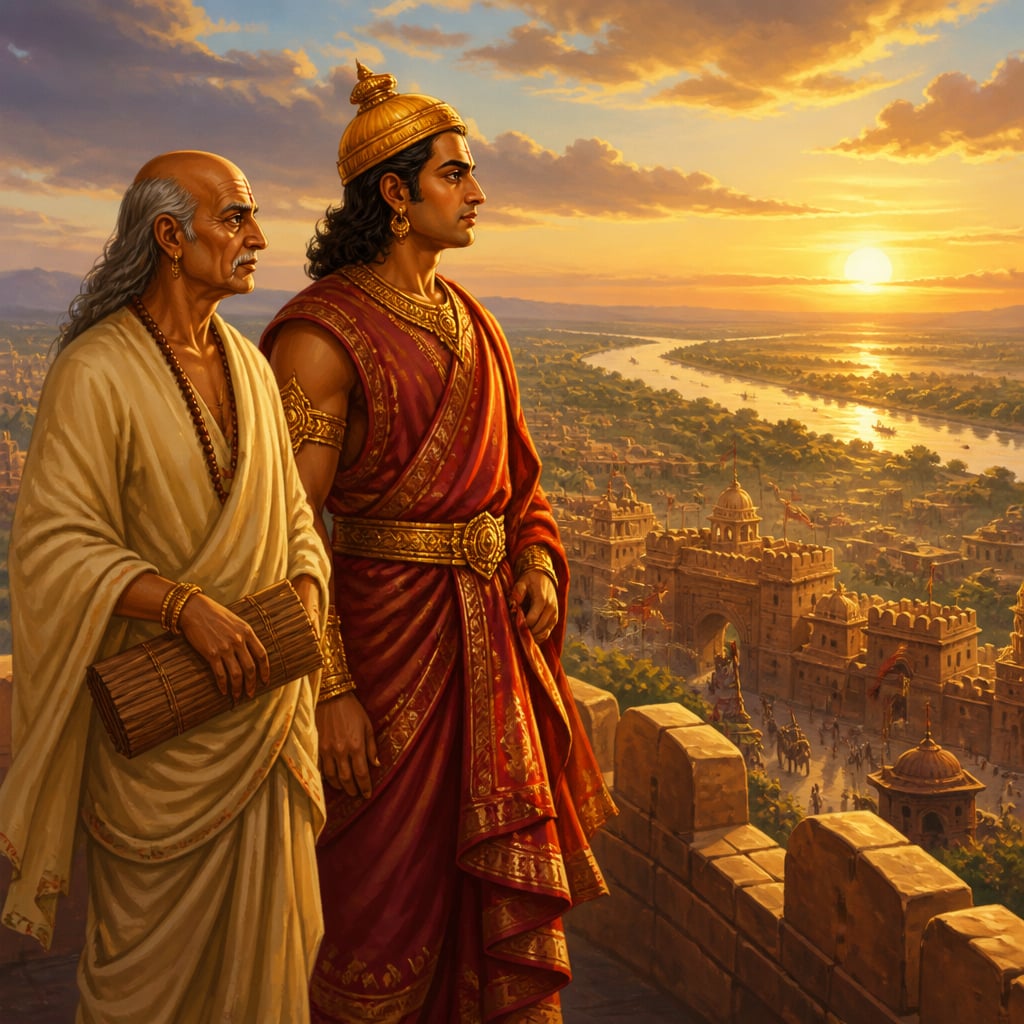
Chandragupta Maurya stood on the walls of Pataliputra, surveying the empire he had just won. Beside him, his teacher Kautilya watched the sunrise paint the Ganges gold.
"We have the kingdom," Chandragupta said. "What now?"
Kautilya's answer was characteristically practical: "Now the real work begins. Conquest is easy. Governance is hard. We must build something that lasts."
This moment captures Kautilya's revolutionary vision. Not just seizing power, any warlord can do that, but creating a system that enables human flourishing for generations. Philosophy, economics, ethics, and governance integrated into a coherent whole.
The Integration
Most thinkers specialize. Philosophers contemplate abstract truths. Economists analyze production. Politicians pursue power. Moralists prescribe virtue.
Kautilya refused this fragmentation:
"Ānvīkṣikī trayī vārttā daṇḍanītiś ca iti vidyāḥ."
"Philosophy, tradition, economics, and governance, these are the sciences."
All four are necessary. Philosophy without economics is impractical. Economics without ethics is dangerous. Governance without philosophy becomes arbitrary. Remove any element, and the whole system fails.
This is why the Arthashastra covers everything from tax policy to elephant training, from spy networks to building standards. Kautilya understood that governance is a unified problem requiring integrated solutions.
The Vision of Human Flourishing
At the center of Kautilya's vision stands a comprehensive concept of human flourishing:
Material welfare (Artha): People need security, sustenance, and resources to pursue anything higher. Prosperity isn't the goal but the foundation.
Ethical living (Dharma): Material welfare finds purpose in dharmic life, living according to one's proper role, contributing to social and cosmic order.
Legitimate pleasure (Kama): Human beings need joy, beauty, love, and satisfaction. A system that denies these creates rebellion or despair.
Ultimate liberation (Moksha): Beyond worldly goals lies the possibility of transcendence.
Kautilya doesn't reduce human life to any single dimension. He shows how each supports and enables the others.
The Limited State
In Kautilya's vision, the state exists to enable human flourishing, not to define, mandate, or provide it directly.
"Yoga-kṣema-vāho hi rājā."
"The king is the bearer of the people's welfare and security."
The state's functions are essential but limited:
- Protection: Defending citizens from external threats and internal violence
- Order: Establishing predictable rules that enable coordination
- Justice: Enforcing fair dealing, protecting property, honoring agreements
- Enablement: Creating conditions where productive activity can flourish
Notice what's missing: the state doesn't decide what citizens should value, how they should live, or what constitutes the good life. It creates conditions where citizens can make those decisions themselves.
This is fundamentally limited government, not because Kautilya was naive about state capacity, but because he understood that overreach inevitably backfires.
The Responsible Individual
If the state enables, individuals choose. Kautilya places enormous responsibility on individuals:
- Self-development: Cultivate virtues, acquire skills, master your senses. No one can do this for you.
- Duty fulfillment: Each person has a dharma, a role and set of responsibilities.
- Legitimate pursuit: Within ethical constraints, pursue prosperity, pleasure, and ultimately liberation.
- Community contribution: Those who benefit have obligations to maintain and improve the conditions that enabled their success.
This isn't modern Western individualism, Kautilya sees individuals embedded in families, communities, and cosmic order. But it is a vision where individual choices matter decisively.
The Servant Leader

The ruler occupies a unique position, enormous power with enormous responsibility:
"Prajā-sukhe sukhaṃ rājñaḥ prajānāṃ ca hite hitam."
"In the happiness of the people lies the king's happiness. In their welfare, his welfare."
Kautilya's ideal ruler is:
- Self-mastered: conquering the six internal enemies before governing others
- Constantly learning: studying philosophy, economics, and governance throughout life
- Servant-oriented: existing for the ruled, not vice versa
- Pragmatically realistic: seeing the world as it is, not as ideology claims
- Ethically constrained: understanding that even rulers can't justify all means
Lee Kuan Yew of Singapore embodied much of this ideal, self-disciplined, constantly learning, focused on people's welfare, ruthlessly pragmatic, operating within ethical constraints. The result was transformation from Third World to First World in one generation.
Revolutionary Elements
What made Kautilya's vision revolutionary?
Merit over birth: He evaluated people by capability, not caste or lineage. The competent low-born person should be preferred to the incompetent noble. Radical then. Radical now.
Pragmatism over ideology: He cared about what works, not what sounds good. He would change policies based on results. This flexibility is rare in political thought.
Systems thinking: He saw everything as connected. Policies have unintended consequences. Incentives shape behavior. Institutions matter more than intentions.
Limited government: Despite his focus on the state, Kautilya's ideal government does less than most actual governments. It focuses on essential functions and avoids overreach.
Individual freedom: Within dharma and law, citizens are remarkably free, choosing livelihoods, beliefs, life paths. The state protects this freedom rather than directing it.
Timeless Principles
From ancient specifics, we can extract timeless insights:
- Human nature is constant. People respond to incentives, pursue interests, fear loss, seek gain. Systems that ignore human nature fail.
- Institutions matter. Rules shape outcomes more than intentions. Good institutions make good outcomes more likely.
- Material foundation is essential. Higher pursuits require material security. Ignoring economics undermines everything.
- Ethics provide constraints. Unlimited pursuit of any goal becomes destructive. Dharma provides necessary limits.
- Leadership requires virtue. Those with power must master themselves first.
- Freedom enables flourishing. People thrive when allowed to make choices within reasonable constraints.
The Living Legacy
Kautilya's vision shaped Indian statecraft for centuries. Even after the text was lost for over a millennium, rediscovered only in 1905, its principles persisted in tradition.
Today, Indian strategic thinkers invoke Kautilya in foreign policy debates. Business leaders apply his frameworks to corporate strategy. The National Security Advisory Board has explicitly drawn on Arthashastra principles.
Globally, comparisons with Machiavelli, Hobbes, and other Western thinkers reveal remarkable parallels. Whether through direct influence or independent discovery, Kautilyan insights appear worldwide.
Your Inheritance

You have now received an inheritance, 2,400 years of wisdom about how individuals, organizations, and societies can flourish:
- A framework for thinking about human goals and their proper relationship
- Principles that explain how prosperity is created
- Insights that distinguish good institutions from bad
- Guidance on leadership that applies at every scale
- Warnings about internal enemies that destroy from within
This inheritance doesn't tell you exactly what to do, circumstances vary, and wisdom requires judgment. But it provides conceptual tools for thinking clearly about eternal questions.
The Torch Passes
Kautilya wrote the Arthashastra not as historical document but as practical guide. He expected readers to use it, apply principles, test claims, refine insights based on experience.
This chapter has introduced his thought. But introduction is only the beginning. The real work is application:
- Examining your own life through Kautilyan lenses
- Analyzing institutions around you with his frameworks
- Making decisions informed by his principles
- Testing his claims against your experience
Kautilya's vision is not sacred text to be believed but scientific theory to be tested. Where it illuminates, use it. Where it fails, improve it. Where it's incomplete, extend it.
In the next chapter, we'll explore the Saptanga, the seven limbs of the state. How should government be structured? What makes some states flourish while others collapse? Kautilya's answers remain startlingly relevant.
The torch passes to you.
Modern academia fragments knowledge into disciplines - economists ignore ethics, philosophers ignore economics, political scientists ignore both. The Renaissance ideal of the 'polymath' who mastered multiple fields has largely disappeared. Kautilya represents an older, more integrated approach where the statesman must master all relevant domains. Leonardo da Vinci exemplified this integration in the West, but it became rare. Kautilya made it systematic and teachable.
While Western thought increasingly specialized after the Enlightenment, gaining depth but losing breadth, Kautilya's framework maintained integration. His advantage: showing not just that integration matters but HOW to integrate - the four vidyas have specific relationships and dependencies. This provides a map for comprehensive education, not just an ideal. Modern 'interdisciplinary' approaches try to reconnect what specialization separated; Kautilya never separated them.
Ashoka the Great exemplified integrated wisdom - military leader who became dharmic ruler without abandoning strategic realism. His rock edicts show philosophical sophistication, his governance reforms show economic understanding, his diplomatic strategy shows political acumen, his Buddhist conversion shows ethical commitment. All four vidyas integrated in one ruler. Result: one of history's most successful and enduring empires. The integration wasn't accidental - it was Kautilyan education applied.
Peter Drucker emphasized 'knowledge workers' needing continuous learning. Clayton Christensen's 'Innovator's Dilemma' shows how past success blinds organizations to necessary adaptation. Both validate Kautilya's insight: static knowledge becomes obsolete; learning capacity endures. The difference: Kautilya prescribed specific curriculum (the four vidyas) and method (anvikshiki as foundation). Western thought recognized the need; Kautilya provided the framework.
Kautilya didn't just advocate learning but specified WHAT to learn and HOW. The four vidyas provide comprehensive curriculum; anvikshiki provides method. This moves beyond platitudes ('learn more!') to practical program. Moreover, his framework shows how different domains illuminate each other - philosophy improves economic thinking, economic understanding improves governance, governance experience raises philosophical questions. Learning becomes self-reinforcing when properly integrated.
Akbar the Great (1542-1605) exemplified continuous learning - despite illiteracy, he held regular scholarly debates in his court, engaged with multiple religious traditions, studied administration and military strategy, experimented with policy innovations. His 'Ibadat Khana' (House of Worship) brought together scholars from different traditions for dialogue. Result: one of the most successful Mughal emperors, synthesizing diverse insights into effective governance. His learning compensated for lack of formal education through systematic engagement with knowledge across domains.
Karl Popper's philosophy of science emphasizes falsifiability - theories must be testable and potentially disprovable. The scientific method (hypothesis, experiment, observation, revision) embodies this. Kautilya anticipated this empirical approach for governance 2,000+ years before Popper. The parallel: both insisted on testing claims against reality rather than accepting authority or tradition. The difference: Kautilya applied this to statecraft systematically while Western scientific method remained largely confined to natural sciences until recently.
Kautilya integrated theory and practice from the start. The Arthashastra contains both principles and their application - not just 'what' but 'how.' Moreover, he explicitly acknowledged uncertainty and prescribed experimentation: try different approaches, observe outcomes, adapt based on results. This pragmatic empiricism was more sophisticated than dogmatic systems (accepting tradition uncritically) or pure theory (ignoring practical constraints). Test everything; keep what works; discard what fails.
The Mauryan administration under Chandragupta and Chanakya exemplified applied wisdom - systematic experimentation with agricultural techniques, trade policies, taxation rates, administrative structures. They didn't just theorize; they implemented, measured outcomes, and adjusted. The empire's prosperity validated their methods empirically. When Ashoka later adopted Buddhist principles, he didn't just preach dharma - he tested specific policies (animal welfare, medical services, public works) and inscribed outcomes on rock edicts as evidence. This empirical approach to governance was revolutionary.
Verses
योगक्षेमवाहो हि राजा
yoga-kṣema-vāho hi rājā
The king is indeed the bearer of the people's welfare and security
This sutra captures the essential purpose of rulership in Kautilya's vision. The king bears (vāho) responsibility for both prosperity (yoga - literally 'acquisition') and security (kṣema - 'protection').
Book 1, Chapter 19, Verse 34 (R.P. Kangle)
आन्वीक्षिकी त्रयी वार्त्ता दण्डनीतिश्च इति विद्याः
ānvīkṣikī trayī vārttā daṇḍanītiś ca iti vidyāḥ
Philosophy, the three Vedas, economics, and political science - these are the sciences
Kautilya's integration of all essential knowledge into four sciences represents his comprehensive vision. Philosophy provides the tools of thought, tradition provides ethical foundation, economics provides material understanding, and political science provides governance wisdom.
Book 1, Chapter 2, Verse 1 (R. Shamasastry)
प्रदीपः सर्वविद्यानाम् आन्वीक्षिकी
pradīpaḥ sarva-vidyānām ānvīkṣikī
Philosophy is the lamp that illuminates all sciences
This sutra establishes philosophy (anvikshiki) as foundational to all other knowledge. Without the ability to think clearly, analyze arguments, and test claims, all other sciences descend into dogma and superstition.
Book 1, Chapter 2, Verse 10 (L.N. Rangarajan)
Case studies
India's Independence Movement
When India's founders crafted their new nation after 1947, they consciously engaged with their civilizational inheritance. Some embraced Kautilyan themes; others rejected them. The debates shaped modern India's institutions and continue today.
Nehru's economic planning reflected some Kautilyan themes (state as enabler) while rejecting others (skepticism of markets). Sardar Patel's integration of princely states showed Kautilyan strategic thinking. The debates between different visions - Gandhian simplicity vs. industrial development, socialist planning vs. market economy - can all be read through Kautilyan lenses.
Modern India represents an ongoing experiment in governance, still debating questions Kautilya raised: the proper role of the state, the balance between material and spiritual goals, the relationship between individual freedom and collective welfare.
Kautilya's questions remain relevant even when his specific answers may not. What enables human flourishing? How should governance be structured? What balance between freedom and order? These questions don't have final answers - each generation must engage them anew.
India's ongoing constitutional debates about federalism, reservations, and fundamental rights are direct descendants of these founding conversations. Every Supreme Court ruling that reinterprets the Constitution is a continuation of Kautilya's question: how should a diverse society govern itself?
India's Constituent Assembly debated for 2 years, 11 months, and 17 days across 165 sessions before adopting the Constitution on November 26, 1949, producing the world's longest national constitution at 146,385 words.
The Synthesis in Practice
Consider successful organizations and nations that have integrated the elements of Kautilya's vision: clear thinking, ethical foundation, economic competence, and good governance. What distinguishes them from those that excel in one dimension while neglecting others?
The most enduring institutions - whether businesses, universities, or nations - tend to exhibit Kautilya's integration. They have philosophical clarity about their purpose, ethical constraints that prevent self-destruction, economic competence that provides resources, and governance structures that enable coordination. Those that excel in one dimension while neglecting others eventually fail.
Enron had economic sophistication but lacked ethical constraint. The Soviet Union had ideological clarity but lacked economic realism. Many startups have innovation but lack governance. Sustainable success requires integration across all four domains.
The synthesis isn't just philosophy - it's a description of what actually works. Organizations and individuals that integrate philosophical clarity, ethical grounding, economic competence, and sound governance outperform those that excel in one dimension while neglecting others. Integration is a practical strategy, not just an ideal.
Companies that score highly on both ethical governance and financial performance, like Microsoft under Satya Nadella or Costco under Craig Jelinek, consistently demonstrate this integrated approach. The organizations that treat ethics, economics, and governance as inseparable outperform those that optimize for any single dimension.
A 2017 McKinsey study found that companies in the top quartile for both ethical standards and financial performance outperformed their peers by 36% in long-term shareholder returns.
Historical context
c. 4th century BCE
Kautilya's synthesis emerged at a unique historical moment. Multiple Indian philosophical schools were competing for influence. Greek philosophy was making contact with Indian thought through Alexander's invasion. The Nanda dynasty's corruption and Alexander's withdrawal created a power vacuum. In this context, Kautilya crafted a vision that drew on multiple traditions while remaining distinctively practical.
The Mauryan Empire Kautilya helped create became the largest in Indian history, demonstrating that his synthesis was not merely theoretical but could transform political reality. His vision provided a template that influenced Indian governance for centuries, even after the text itself was lost.
Reflection
- Looking at your own life, where do you see fragmentation between different domains (work, ethics, relationships, goals)? How might greater integration improve your flourishing?
- Which of the four sciences - philosophy, tradition, economics, governance - do you know least about? How might strengthening that knowledge improve your decision-making?
- If you were to apply one principle from this course to a current challenge in your life, which would it be and why? What would application look like?