The Trivarga

Three Goals of Life

What do humans need to flourish? Indian philosophy answers with the Trivarga - dharma (righteousness), artha (prosperity), and kama (pleasure). But Kautilya's revolutionary insight was about their relationship: these aren't competing goals but complementary ones, with material welfare as the essential foundation.

The Merchant's Dilemma
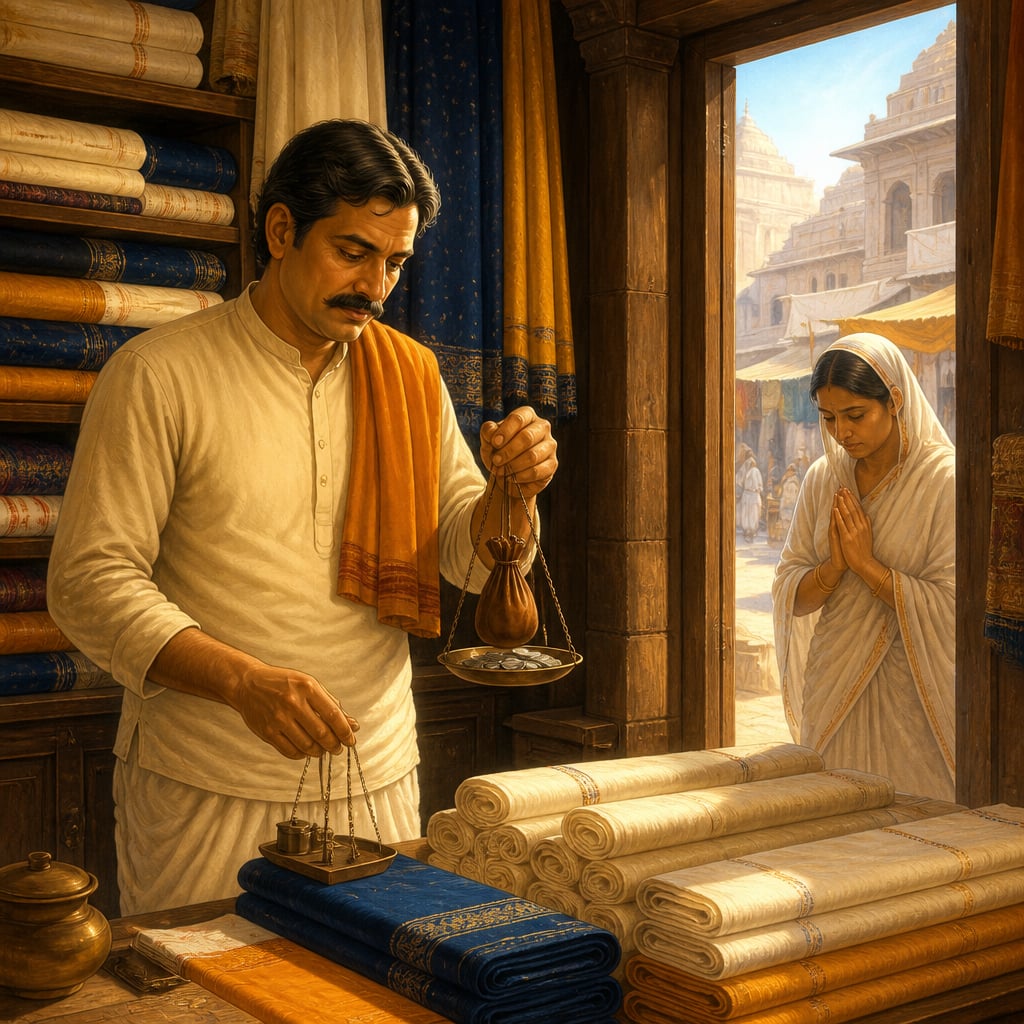
Dhanapati the cloth merchant facing his widowed cousin at the shop threshold

Dhanapati had a problem. The wealthy grain merchant sat in his counting house in Pataliputra, ledgers spread before him, calculating his options.

His cousin's widow had come begging for help. Her husband had died owing money to dangerous creditors. Without intervention, she and her three children would be sold into bondage.

Dhanapati could pay the debt easily, his granaries overflowed from a record harvest. But doing so would anger powerful men who expected repayment in kind. His business relationships would suffer. His competitors would smell weakness.

What should he do? Follow dharma, righteousness, duty to family? Or protect artha, his material security, the foundation of his family's prosperity? And what about kama, the pleasure of a clear conscience versus the pleasure of continued luxury?

This was the Trivarga in action, the three goals of human life, pulling in different directions.

India's Ancient Answer

Every great civilization has asked: What is the good life?

The Greeks spoke of eudaimonia, flourishing through virtue and reason. The Chinese debated the proper way, dao. The Hebrews sought to walk with God.

India's answer was distinctive: not one goal, but three. Not hierarchy, but harmony.

Traditional teaching placed dharma first. "Be righteous," the priests taught, "and material blessings will follow. Seek pleasure only within ethical bounds."

Kautilya disagreed.

The Revolutionary Inversion
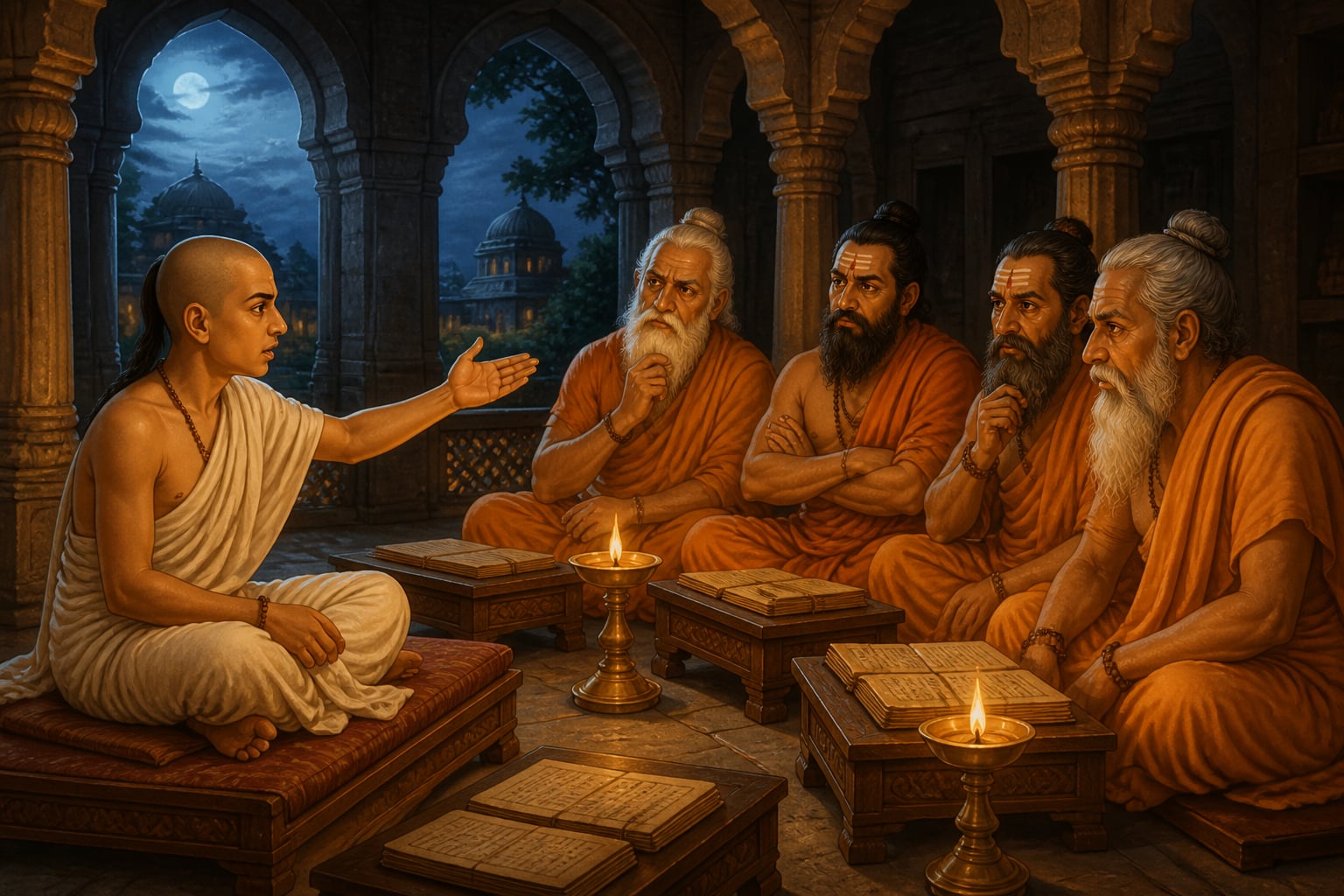
Young Kautilya debating senior scholars at Takshashila by night

In the halls of Takshashila, where scholars debated philosophy late into the night, Kautilya proposed something scandalous:

"Artha eva pradhānaḥ. Arthamūlau hi dharmakāmau."

"Artha alone is chief. For dharma and kama are rooted in artha."

His fellow scholars were outraged. "You place wealth above righteousness? This is the teaching of demons, not Brahmins!"

Kautilya's reply was characteristically blunt: "Can a starving man practice dharma? Can a desperate father refuse to steal for his children? Can a destitute widow pursue any pleasure at all?"

He wasn't claiming wealth was morally superior to virtue. He was making a practical observation about causation. Material security is the foundation that makes everything else possible.

The Chain of Causation

Kautilya made his logic explicit:

"Sukhasya mūlaṃ dharmaḥ. Dharmasya mūlaṃ arthaḥ. Arthasya mūlaṃ rājyam."

"The root of happiness is righteousness. The root of righteousness is prosperity. The root of prosperity is proper governance."

Read this chain carefully:

  1. Everyone seeks happiness (sukha)
  2. Lasting happiness comes from ethical living (dharma)
  3. Ethical living requires material security (artha)
  4. Material security requires good governance (rajya)

This wasn't atheism or materialism. It was realism. Kautilya had seen what poverty did to ethics. He had watched the Nanda regime's extortion destroy the moral fabric of society. Farmers who couldn't feed their families stole. Merchants who feared robbery cheated. Officials who weren't paid fairly took bribes.

Fix the foundation, and the superstructure becomes possible.

The Modern Parallel

In 1943, American psychologist Abraham Maslow proposed his famous "hierarchy of needs", a pyramid with physiological needs at the base and self-actualization at the top.

Maslow's insight was simple: hungry people don't philosophize. People fearing for their safety don't pursue creative fulfillment. You must secure lower needs before higher ones become relevant.

Kautilya said the same thing 2,300 years earlier. And he went further: understanding this hierarchy has political implications.

If individual flourishing requires material security, and material security requires good governance, then the state's primary purpose is enabling prosperity, not enforcing virtue, not maximizing pleasure, but creating the conditions where citizens can pursue all three goals themselves.

The Balance Required

Kautilya wasn't advocating greed. He insisted on integration:

"An excess of any one is harmful."

The merchant who pursues only wealth becomes Dhana Nanda, hoarding gold while his kingdom crumbles. The pleasure-seeker who neglects prosperity ends in ruin. The moralist who ignores practical reality becomes ineffective.

Consider Dhanapati's dilemma again. Kautilya's framework suggests:

Why This Matters Today

Kautilya's Trivarga framework remains startlingly relevant:

For individuals: Don't feel guilty about building financial security. It's not opposed to spiritual growth, it enables it. The person on firm material ground can afford to be generous, honest, and principled.

For parents: A family stressed about money struggles to transmit values. Stability comes first, then everything else.

For governments: Policies that impoverish citizens don't make them more virtuous, they make them desperate. Economic development isn't opposed to cultural development; it's the foundation.

Jeff Bezos and Bill Gates practice philanthropy after building material empires. The monks of Nalanda could pursue enlightenment because the monastery handled their material needs. Even Mother Teresa's charitable work depended on donations, artha enabling dharma.

The Freedom Connection

From a libertarian perspective, Kautilya's insight is profound:

This is why Kautilya focused so intensely on commerce, property rights, and rule of law. These weren't distractions from higher values, they were the foundations that made higher values achievable.

Your Turn

Look at your own life through the Trivarga lens:

Kautilya would tell you: don't feel guilty about material concerns. Handle them well, and everything else becomes possible.

In our next lesson, we explore what artha really means, not mere wealth accumulation, but the creation of prosperity that serves higher purposes.

Maslow's hierarchy of needs (1943) places physiological and safety needs at the base, self-actualization at the top. Kautilya's framework predates this by millennia, arguing that artha (material security) enables dharma (ethical/spiritual pursuits) and kama (legitimate pleasure). Both recognize that deprivation constrains human potential.

While Maslow described individual psychology, Kautilya extended this insight to political economy: the state's primary duty is enabling prosperity because prosperity enables everything else. He connected individual flourishing to governance through material foundation.

The Mauryan Empire under Chandragupta prioritized economic development - agricultural productivity, trade routes, stable currency. This material foundation enabled Ashoka's later dharmic rule. His famous edicts promoting ethical governance were possible only because his grandfather secured the economic base.

Aristotle's concept of the 'golden mean' - virtue as the balance between extremes - parallels Kautilya's warning. Both recognized that extremes become vices. However, Aristotle focused on individual virtues while Kautilya applied this to life goals and governance, showing how imbalance in one domain cascades into failure in others.

Kautilya provided a systematic framework (Trivarga) showing how different life goals support each other when balanced but undermine each other when pursued excessively. This systems thinking - seeing relationships rather than isolated elements - remains ahead of much modern thought.

Dhana Nanda accumulated legendary wealth but his greed led to oppressive taxation, destroying the very prosperity he sought to capture. His subjects' resentment enabled Chandragupta's revolution. Excessive focus on artha, divorced from dharma, destroyed his kingdom. Balance wasn't just ethical - it was strategic.

Max Weber's 'Protestant Ethic' argued that Calvinist theology paradoxically encouraged wealth creation through the concept of worldly vocation. Kautilya's framework is more direct: material success isn't a suspicious side-effect of virtue but an enabler of it. This represents a healthier integration than Weber's anxious Protestants who accumulated wealth while feeling guilty about it.

Kautilya avoided both the materialism that makes wealth the ultimate goal and the spiritualism that treats material concerns as shameful distractions. His framework honors both dimensions: pursue prosperity vigorously, but within ethical constraints and for purposes beyond mere accumulation. This integration is psychologically healthier than traditions creating guilt about necessary activities.

The great Buddhist university of Nalanda thrived for centuries precisely because wealthy merchants and kings endowed it generously. Monks could pursue enlightenment because donors had pursued prosperity. The monastery's spiritual achievements rested on others' material success. Artha enabled dharma - exactly as Kautilya predicted.

Verses

धर्मार्थौ यत्र विरुध्येते तत्रार्थमेव श्रेयः। धर्मकामौ चार्थमूलौ।

dharmārthau yatra virudhyete tatrārtham eva śreyaḥ | dharmakāmau cārthamūlau |

Where dharma and artha conflict, artha is to be preferred. For both dharma and kama are rooted in artha.

This is Kautilya's most controversial statement. He's not saying wealth is morally superior to ethics - he's saying that without material foundation, ethics cannot be sustained.

Book 1, Chapter 7, Verse 3-7 (R.P. Kangle)

अर्थस्य मूलं राज्यं। राज्यमूलं इन्द्रियजयः।

arthasya mūlaṃ rājyam | rājyamūlam indriyajayaḥ |

The root of material welfare is proper governance. The root of proper governance is self-mastery.

Kautilya extends the chain further: prosperity requires good governance, and good governance requires leaders who have conquered their own senses. This connects individual virtue to social prosperity through the institution of the state.

Book 1, Chapter 7, Verse 1 (R. Shamasastry)

अर्थ एव प्रधानः इति कौटिल्यः। अर्थमूलौ हि धर्मकामाविति।

artha eva pradhānaḥ iti kauṭilyaḥ | arthamūlau hi dharmakāmāv iti |

Artha alone is chief, says Kautilya. For dharma and kama are both rooted in artha.

Kautilya explicitly claims this view as his own, distinguishing it from other schools. He's not saying artha is the only goal or the highest goal - he's saying it's the 'chief' (pradhana) in the sense of being foundational.

Book 1, Chapter 7, Verse 6 (L.N. Rangarajan)

Case studies

The Green Revolution: Artha Enabling Dharma

In the 1960s, India faced severe food shortages. The Green Revolution introduced high-yield crops and modern farming techniques. Within two decades, India went from importing food to becoming food-secure. This material transformation changed society in multiple ways.

Kautilya would see the Green Revolution as artha enabling dharma and kama. Food security (artha) allowed farmers to think beyond survival, invest in children's education (dharma), and improve quality of life (kama). The material foundation made other goods possible.

Food-secure families could send children to school, participate in democracy, and plan for the future. Material security enabled social progress that food insecurity had prevented.

Sometimes the most ethical intervention is the most practical one. Preaching values to hungry people is less effective than feeding them. Once material needs are met, higher values become achievable.

Global food security programs like the Gates Foundation's agricultural initiatives in Sub-Saharan Africa follow the same logic: solve material scarcity first, and social progress follows. India's own experience shows that states with higher agricultural productivity consistently score better on education and health metrics.

India's wheat production rose from 12.3 million tonnes in 1965 to 95.9 million tonnes by 1999, turning the country from a famine-prone food importer into a net food exporter within two decades.

Historical context

c. 4th century BCE

The Trivarga framework was well-established by Kautilya's time, appearing in earlier Dharmasutras and epic literature. But different schools emphasized different goals. Brahmanical tradition emphasized dharma; merchant communities emphasized artha; aesthetic traditions emphasized kama. Kautilya synthesized these into a practical hierarchy.

The Trivarga debate wasn't merely academic - it had real policy implications. If dharma comes first, the state should enforce religious duties. If artha comes first, the state should focus on prosperity. Kautilya's position justified a state focused on economic enablement rather than religious enforcement.

Reflection

More in What is Artha?

All lessons in What is Artha? · Arthashastra: Philosophy of Power course