What Government Should NOT Do
Limits of State Action
Government should do some things and not others. Learn Kautilya's principles for where state power should stop.
The merchant Vasubandhu stood before the royal court of Pataliputra, trembling with indignation rather than fear. His family had traded textiles for seven generations. Now, a new edict proposed that the state take over all cloth production, for the people's benefit, the proclamation declared.
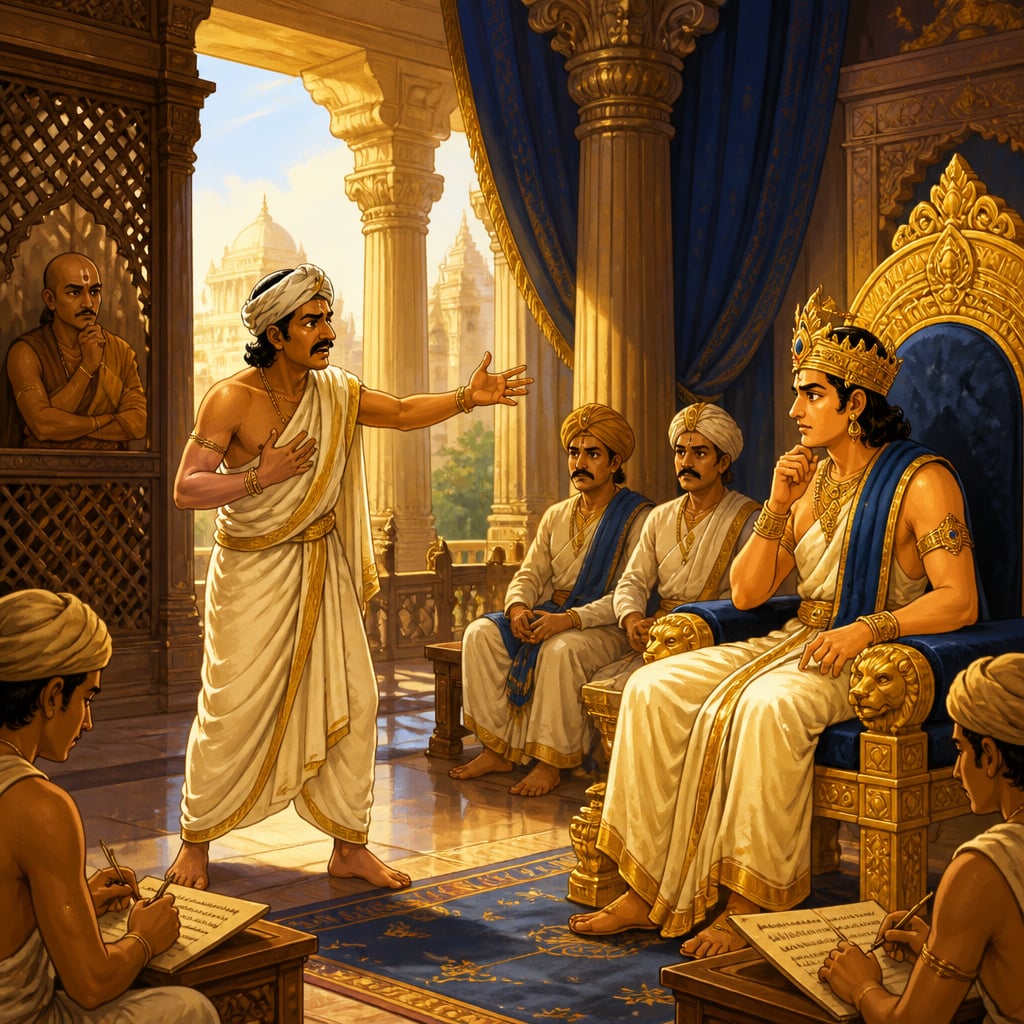
"If the king makes cloth," Vasubandhu argued, "who will innovate new patterns? Who will travel to distant lands seeking rare dyes? The state can command, but it cannot create."
Kautilya, observing from behind a latticed screen, nodded silently. Here was the essential question: what should government not do?
The Arthashastra addresses this question with remarkable sophistication. Kautilya understood that a king who does too much weakens his kingdom as surely as one who does too little. The temptation to expand state control is eternal, but wise governance requires knowing when to step back.
Kautilya writes in the Arthashastra: "राजा प्रजानां न स्वामी किन्तु रक्षकः" (rājā prajānāṃ na svāmī kintu rakṣakaḥ), "The king is not the owner of the people but their protector." This single principle establishes a fundamental limit: the state exists to serve, not to possess. When government forgets this distinction, it transforms from guardian to tyrant.
The first prohibition concerned interference in legitimate private commerce. Kautilya distinguished between regulation, ensuring fair weights, preventing fraud, maintaining quality, and control. Merchants should be supervised, not replaced. When the state itself becomes merchant, it loses the ability to judge impartially between competing interests.
This was not abstract theory. The Nanda administration before Chandragupta had attempted state monopolies in numerous trades. The result was predictable: quality declined, innovation ceased, and a vast bureaucracy consumed resources while producing inferior goods. The people paid higher prices for worse products, and the treasury still ran short.
Kautilya's solution was elegant: the state should create conditions for prosperity, not try to create prosperity directly. Build roads, maintain security, enforce contracts, standardize currencies, these were legitimate functions. But the actual work of producing wealth belonged to those with skill and incentive.
The second limit concerned religious and social customs. Though Kautilya advocated for a strong state, he explicitly warned against interfering with dharma as practiced by different communities. "The king should protect all paths of righteousness," he wrote, "not impose his own."
This restraint had practical wisdom behind it. When rulers attempted to standardize religious practice, they united diverse groups against the throne. The Persian Emperor Xerxes discovered this when his interference with Egyptian temple customs sparked revolts that weakened his entire western flank. Kautilya, always the student of history, noted how religious overreach had destroyed empires.
The third prohibition addressed the danger of excessive taxation. While Kautilya advocated for comprehensive revenue collection, he set clear limits. The king should tax like a bee gathering honey, taking what can be spared without killing the flower. When taxation becomes confiscatory, it destroys the very prosperity it seeks to capture.
"That king who squeezes his subjects beyond their capacity," the Arthashastra warns, "is like one who eats the seed corn. He may feast today but will starve tomorrow." This agricultural metaphor resonated with an empire whose wealth ultimately derived from the land.

Modern observers might note parallels with the economic debates of recent centuries. When Venezuela under Hugo Chávez nationalized its oil industry and expanded state control over retail, agriculture, and manufacturing, the initial years showed increased social spending. But by 2019, what had been Latin America's wealthiest nation faced shortages of basic goods and hyperinflation. The state had tried to do what Kautilya warned against, replace rather than regulate private enterprise.
The fourth limit concerned the administration of justice. While the king was the ultimate source of law, Kautilya insisted that judicial proceedings follow established procedures. The king should not arbitrarily overrule his courts, even when he disagreed with their verdicts. Doing so would undermine the very system that gave his rule legitimacy.
This judicial restraint distinguished Mauryan governance from pure autocracy. When subjects could predict how laws would be applied, they could plan their affairs accordingly. Arbitrary royal intervention created uncertainty that chilled commerce and bred resentment.
The fifth prohibition addressed surveillance. Though Kautilya famously employed spies throughout society, he distinguished between information gathering and control. Spies should report; they should not direct. When intelligence services begin influencing the affairs they observe, they lose their analytical value, they report what they want to happen rather than what is happening. The rotation of assignments and multiplication of independent networks prevented any intelligence apparatus from becoming autonomous. The state needed eyes and ears, not additional hands acting without coordination.
The final and perhaps most important limit: government should never promise what it cannot deliver. Kautilya had observed how rulers who claimed divine powers inevitably faced divine judgments when harvests failed or enemies invaded. Better to present government as competent human administration than to claim perfection that reality would disprove.
"Let the king under-promise and over-deliver," the Arthashastra advises. "Citizens who expect little and receive much become loyal supporters. Citizens who expect much and receive little become rebels." This management of expectations was itself a form of restraint, acknowledging government's limitations rather than denying them.
Vasubandhu won his case. The cloth monopoly was rejected. Kautilya understood that the merchant's self-interest, properly channeled, served the kingdom better than any bureaucratic alternative. The state would tax textile profits, regulate quality, and punish fraud, but it would not attempt to weave fabric.
The lesson echoes across millennia: effective government knows its limits. The most dangerous words in governance are "the state will provide everything." When government tries to do everything, it typically does nothing well. Kautilya's genius lay in understanding that the strongest kingdom is one that knows when to step back, allowing private energy to flow while maintaining the channels through which it moves.
Verses
राजा प्रजानां न स्वामी किन्तु रक्षकः
rājā prajānāṃ na svāmī kintu rakṣakaḥ
The king is not the owner of the people but their protector
This principle establishes the fundamental limit on royal authority: the state exists to serve citizens, not to possess them. An owner can dispose of property at will; a protector must preserve what belongs to another.
बीजभक्षको राजा क्षयं याति
bījabhakṣako rājā kṣayaṃ yāti
The king who consumes the seed corn goes to destruction
This agricultural metaphor warns against confiscatory taxation. The seed corn represents productive capital, the wealth that generates future wealth. A king who taxes beyond regenerative capacity destroys his own revenue base.
स्वधर्मक्रियायाम् एव न्याय्यः राज्ञः अधिकारः।
svadharma-kriyāyām eva nyāyyaḥ rājñaḥ adhikāraḥ |
The king's rightful authority lies only in ensuring each does their own dharma, not in taking that dharma upon himself.
Kautilya carefully distinguishes state authority from state overreach. The king protects the conditions under which each varṇa and profession can fulfill its own function, but does not replace that function.
Book 2, Chapter 1, Verse 18 (R.P. Kangle)
Reflection
- What activities do you believe government should never undertake, regardless of good intentions? How did you arrive at these limits?
- Can you think of examples where government provision of services improved upon private alternatives? Where did it fail? What distinguished the successes from failures?
- How do political promises of solving all problems affect your expectations of government? Does over-promising help or hurt political legitimacy?