Decentralization of Authority

The Wisdom of Local Governance

Not everything should be decided at the top. Kautilya's empire stretched from Afghanistan to Bengal - too vast for one person to control. He designed a system that delegated real authority locally while maintaining accountability to the center.

The Governor's Dilemma
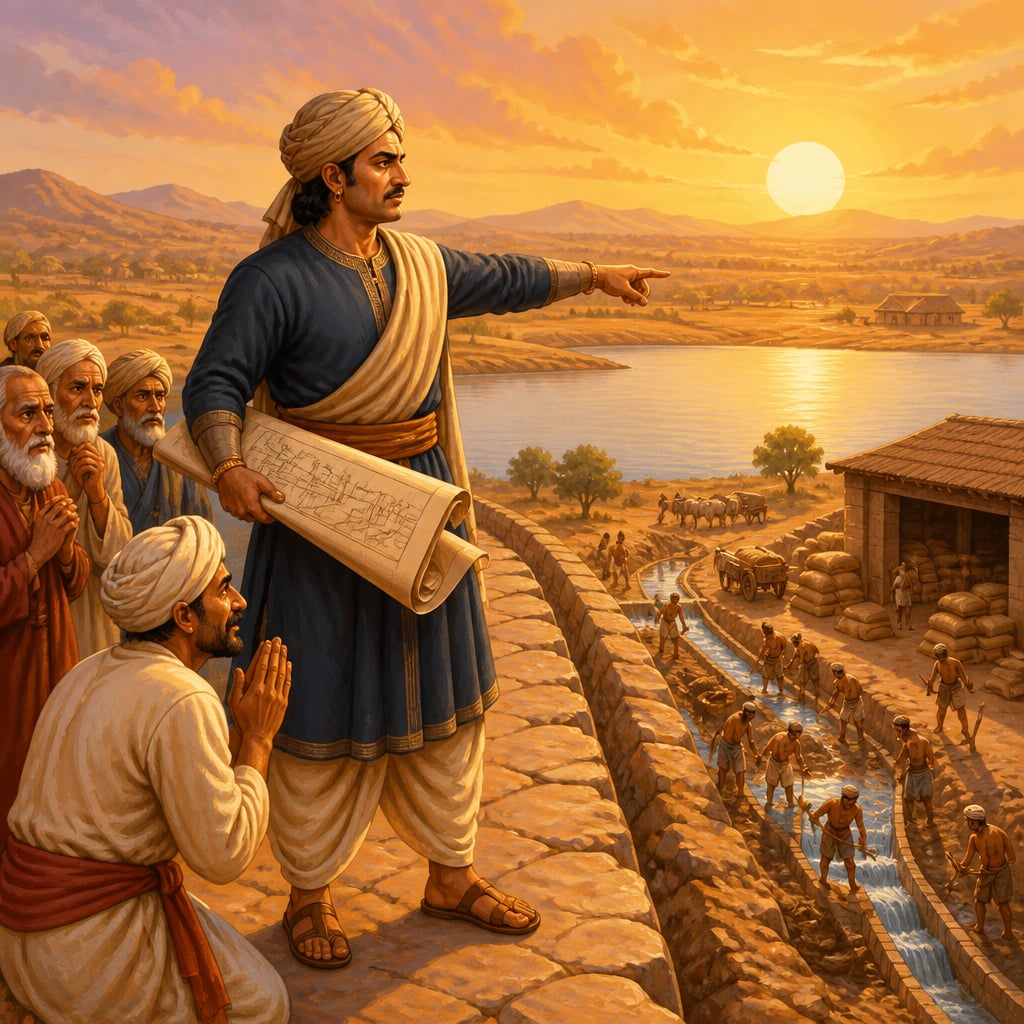
Pushyagupta opening granaries during the Saurashtra drought

Pushyagupta, the newly appointed governor of Saurashtra, faced a crisis. A drought had devastated the region's crops. His people were starving. He could wait for instructions from Pataliputra - a two-week journey each way - or he could act now.

He remembered what Kautilya had told him before his appointment: "A governor who always waits for orders is useless. A governor who never follows orders is dangerous. Wisdom is knowing which decisions to make yourself and which require the center."

Pushyagupta opened the royal granaries, reduced taxes, and commissioned emergency irrigation works - all without asking permission. When Chandragupta later heard what he had done, the emperor's response was approval, not punishment.

This story illustrates Kautilya's approach to decentralization: local authority with central accountability.

Why Decentralize?

The Mauryan empire was enormous - perhaps 5 million square kilometers, with populations speaking dozens of languages. Kautilya understood that trying to control everything from the capital would fail:

"What is distant cannot be governed like what is near."

His reasons for decentralization remain valid today:

  1. Speed - Local decisions don't require waiting for distant approval
  2. Local knowledge - People on the ground understand their conditions better than distant officials
  3. Morale - Officials with real authority take more responsibility
  4. Resilience - If one area fails, others continue functioning
  5. Scalability - The system can grow without overwhelming the center

The Structure of Delegation

Kautilya designed a hierarchical system with clear domains at each level:

Level Official Domain Key Responsibility
Empire King Overall policy Strategy, war, treaties
Province Mahamatyapurusa Regional governance Provincial administration
District Sthanika Area management Revenue, law, local projects
Village cluster Gopa Local coordination Village-level oversight
Village Gramika Community affairs Day-to-day matters

Each level had real authority within its domain, not just advisory roles. The gramika (village headman) could settle most disputes without involving higher levels.

The Village as Foundation

Village panchayat hearing a farmers' dispute under the banyan

Kautilya placed special emphasis on village self-governance. Most people never saw the king or his officials - their governance came from village elders:

"The village is the foundation of the kingdom. As the villages prosper, the kingdom prospers."

Villages handled:

The king's role was to protect village self-governance, not replace it. Heavy-handed interference destroyed the local capacity that made governance work.

Modern parallel: Switzerland's canton system gives substantial authority to local governments. Swiss villages make many decisions that in centralized countries would require national approval. The result is governance that fits local needs.

Subsidiarity Before Its Name

Kautilya articulated a principle that Europeans would later call subsidiarity - decisions should be made at the lowest level capable of handling them:

This wasn't just efficiency - it was respect for local capacity. Kautilya assumed that communities knew their own affairs better than distant officials could.

"The king should not take from the village what the village can provide for itself."

Modern parallel: The European Union's subsidiarity principle explicitly states that decisions should be taken at the most local level possible. Kautilya anticipated this by over two millennia.

Accountability Without Micromanagement

Decentralization didn't mean local officials could do whatever they wanted. Kautilya balanced autonomy with accountability:

Revenue accountability - Governors reported taxes collected and how they were spent. Discrepancies triggered investigation.

Spy oversight - The central intelligence network monitored local officials for corruption or oppression.

Rotation - Officials didn't stay in one place forever. Regular transfers prevented local power bases.

Appeals - Citizens could appeal local decisions to higher levels. This checked local abuse.

Standards - While methods varied locally, outcomes were measured against central expectations.

The goal was autonomy within accountability - freedom to decide how to achieve results, combined with responsibility for those results.

The Danger of Over-Centralization

Kautilya warned against the temptation to control everything from the capital:

"A king who interferes in every detail will exhaust himself and frustrate his officials."

Over-centralization creates problems:

Historical example: The late Mughal Empire became increasingly centralized under Aurangzeb. Every decision flowed through the emperor. When the center weakened, the entire system collapsed because no one had local authority to maintain order.

Guilds and Autonomous Bodies

Goldsmiths' shreni guild adjudicating a workmanship case

Kautilya's decentralization extended beyond geography to functional autonomy. Professional guilds (shrenis) largely governed themselves:

The state didn't try to regulate every transaction. It set broad rules and let specialized groups manage their own affairs.

Modern parallel: Professional associations (bar associations, medical boards) regulate their members with state oversight but substantial autonomy. Industry standards bodies set technical specifications without government micromanagement.

Modern Applications

Kautilya's decentralization principles inform modern governance:

Federalism - Countries like India, the United States, and Germany give substantial powers to states or provinces. The central government handles defense and foreign policy; states handle education, policing, and local affairs.

Corporate decentralization - Companies like Johnson & Johnson operate through semi-autonomous divisions. Each division has its own CEO, budget, and strategy - accountable to headquarters but not controlled in detail.

Agile organizations - Modern management emphasizes empowered teams making local decisions, with coordination rather than control from above.

Your Turn

Think about organizations you're part of - school, work, community groups. How are decisions distributed?

Kautilya would ask: Are you governing like everything must flow through you? Or have you built local capacity that functions when you're not watching?

The king who micromanages exhausts himself and insults his governors. The king who delegates wisely multiplies his effectiveness through capable people across the realm.

Management theory distinguishes 'what' from 'how' delegation. Stephen Covey's 'stewardship delegation' gives people outcomes to achieve and lets them determine methods.

Kautilya provides a complete system: geographic levels of authority, functional domains (guilds), and accountability mechanisms. It's delegation architecture, not just delegation advice.

The Roman Empire succeeded partly because provincial governors had substantial autonomy. When later emperors centralized control, the system became brittle and eventually collapsed.

The EU's subsidiarity principle states that decisions should be taken at the most local level capable of addressing them. Catholic social teaching developed similar ideas.

Kautilya provides implementation detail: what villages should handle, how disputes escalate, what central government should protect but not control.

Colonial administrations often destroyed local governance structures, creating dependency on central authority. When colonial powers left, the loss of local capacity caused governance failures.

Modern federalism includes judicial review, elections, and intergovernmental oversight. Corporate decentralization includes budgets, audits, and performance metrics.

Kautilya designed multiple reinforcing accountability mechanisms: financial reporting, intelligence oversight, rotation, and appeals. No single mechanism was trusted alone.

The Articles of Confederation gave American states too much autonomy without adequate accountability mechanisms. The Constitution corrected this with federal oversight while preserving state authority.

Verses

ग्रामो राज्यस्य मूलम्

grāmo rājyasya mūlam

The village is the foundation of the kingdom.

A kingdom rests on the prosperity and good governance of its villages. Central power depends on local health.

Book 2, Chapter 1, Verse 4 (R.P. Kangle)

दूरस्थं न यथा निकटस्थम्

dūrasthaṃ na yathā nikaṭastham

What is distant cannot be governed like what is near.

Distance changes the nature of governance. The same detailed control possible nearby becomes impossible at a distance.

Book 2, Chapter 35, Verse 2 (L.N. Rangarajan)

स्वधर्मं परिपालयेत्

svadharmaṃ paripālayet

Each should maintain their own sphere of duty.

Everyone has a defined role and domain. The king shouldn't do the governor's job; the governor shouldn't do the village headman's job.

Book 2, Chapter 1, Verse 18 (R. Shamasastry)

Case studies

Toyota's Production System

Toyota revolutionized manufacturing by pushing decision-making to the factory floor. Any worker can stop the production line if they see a problem. Teams manage their own quality and improvement processes. Middle management coordinates rather than commands.

Toyota embodies Kautilya's principles: (1) Decision authority at the lowest capable level. (2) Local knowledge valued over distant expertise. (3) Accountability through results, not surveillance. (4) Central coordination without central control.

Toyota became the world's largest and most admired automaker. Companies worldwide have tried to copy its system. The key isn't techniques but the principle: trust and empower the people closest to the work.

Decentralization isn't just a political principle - it's an organizational one. The same logic that made Kautilya's empire effective makes modern companies effective: local authority, clear accountability, central coordination.

Amazon's two-pizza team structure and Spotify's squad model apply the same decentralization principle. Small, autonomous teams with clear accountability consistently outperform centralized hierarchies in innovation speed and quality. The principle scales from ancient empires to modern tech companies.

Toyota's andon cord system, which allows any worker to halt the production line, results in approximately 1 million improvement suggestions per year from employees, with over 90% implemented.

Historical context

c. 4th century BCE

India had a long tradition of village self-governance predating Kautilya. The grama-sabha (village assembly) and panchayat (council of five) were ancient institutions. Kautilya systematized this tradition within an imperial framework.

The tension between centralization and decentralization remains central to governance debates today. Kautilya's framework - local authority with central accountability - offers a sophisticated answer that predates Western federalism by two millennia.

Reflection

More in The Limits of Power

All lessons in The Limits of Power · Arthashastra: Philosophy of Power course