The King is Not Above the Law

Dharma Binds All

Can a king do whatever he wants? Kautilya's answer was revolutionary: the king is bound by dharma, constrained by advisors, and accountable for results. Power without limits is tyranny - and tyranny destroys itself.

The Tyrant's Fall
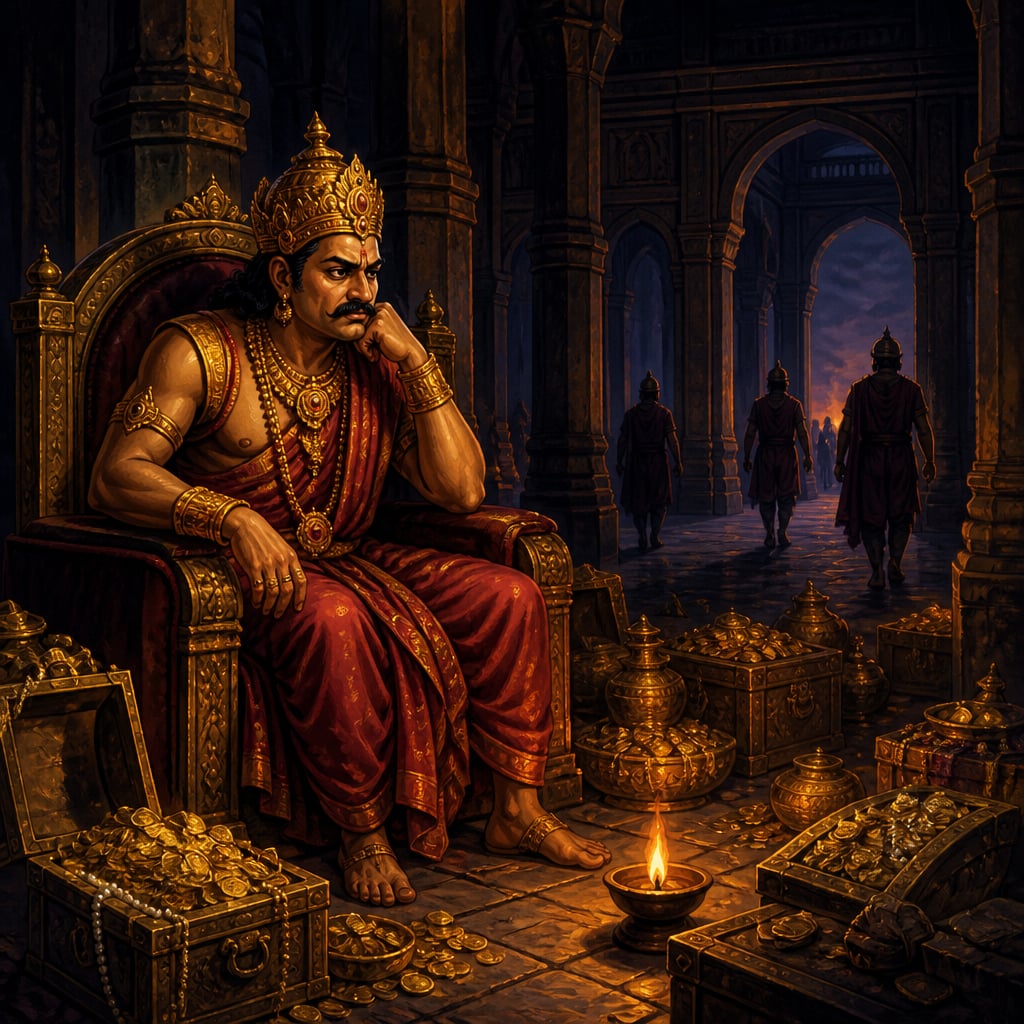
Dhana Nanda alone in his collapsing Pataliputra palace

Dhana Nanda sat alone in his palace in Pataliputra, surrounded by gold he had squeezed from his subjects. Outside, his army - once the largest in India - was melting away. His generals whispered of defection. His spies reported that a young prince named Chandragupta was marching toward the capital with an army that grew larger every day.

How had it come to this? Dhana Nanda had absolute power. He could take any property, imprison any citizen, execute any rival. Yet here he was, about to lose everything.

Watching from the shadows was a man who understood exactly what had gone wrong. Kautilya - the brilliant strategist who had orchestrated Dhana Nanda's downfall - was taking careful notes. He would later write:

"The king's vow is to do what needs to be done - राज्ञो हि व्रतं कार्यकरणम्"

Dhana Nanda had forgotten this. He thought kingship meant doing whatever he wanted. Kautilya knew better: power without limits destroys itself.

Dharma as Constitution

In modern democracies, constitutions limit government power. In Kautilya's framework, dharma serves the same function.

Dharma isn't just religion. It's the moral order - principles of right action that bind everyone, including kings:

A king who violates these principles isn't exercising legitimate authority - he's committing crimes. Kautilya was blunt: the king who upholds dharma is upheld by dharma. The king who violates dharma is destroyed by dharma.

Dhana Nanda learned this the hard way.

The Sage-King Ideal

Young Chandragupta receiving counsel at a forest sage's feet

Kautilya's ideal ruler is the rajarshi - the sage-king who combines wisdom with power.

When Chandragupta took the throne, Kautilya didn't let him rest. "You have power now," the old teacher warned. "That's when the real danger begins."

"Conquest of the senses is the foundation of discipline - इन्द्रियजयं विनयमूलम्"

The rajarshi is not above the law but exemplifies it. He follows the same rules he enforces. He restrains his desires for the people's benefit. He judges himself by results for the kingdom, not personal satisfaction.

Greek ambassadors who visited Chandragupta's court were astonished by his discipline - fixed hours for audiences, administration, exercise, and rest. No indulgence. No tyranny. This was Kautilya's teaching made flesh.

The Six Enemies Within

Kautilya devoted an entire chapter to the shadvarga - the six internal enemies that destroy rulers:

  1. Kama (lust) - pursuing pleasure over duty
  2. Krodha (anger) - making decisions in rage
  3. Lobha (greed) - taking more than your share
  4. Mada (pride) - ignoring good advice
  5. Moha (delusion) - believing your own propaganda
  6. Matsarya (envy) - destroying rivals out of jealousy

These enemies are more dangerous than any foreign army. Alexander the Great conquered half the known world but couldn't conquer his own temper - and died at thirty-two, his empire fragmenting within days.

Dhana Nanda had all six enemies. Chandragupta, guided by Kautilya, learned to master them.

Institutional Constraints

But Kautilya was too practical to rely on virtue alone. Good intentions fail. Institutions endure.

He designed specific checks on royal power:

The Mantriparishad (Council of Ministers) - The king must consult advisors before major decisions. Kautilya wrote: "Counsel is the foundation of the kingdom - मन्त्रो हि राज्यमूलम्"

The Purohita (Royal Priest) - A moral advisor who could warn the king when he strayed from dharma.

Independent Courts - Judges applied law, not royal whim.

The Treasury - Separate management of finances limited arbitrary spending.

Even the spy network that Kautilya created served as a check - spies reported on corrupt officials and on whether the king's own orders were just.

The Gardener's Wisdom

Nowhere are limits clearer than in taxation. Kautilya used a famous analogy:

"Like a gardener who gathers flowers and fruits without harming the trees, the king should collect revenue without harming the sources."

The traditional rate was one-sixth of produce. Higher rates required justification. Excessive taxation was compared to a farmer who pulls up his crops to check the roots - he destroys what he was trying to grow.

This wasn't just practical advice. It was a moral constraint. Taking more than the fair share is theft, even if the king does it.

Dhana Nanda's crushing taxes had made him wealthy but destroyed the productive capacity of his kingdom. When Chandragupta came, the people welcomed him as a liberator.

Modern Echoes

Kautilya's framework anticipated constitutional governance by two millennia:

James Madison, designing the American Constitution, wrote that "if men were angels, no government would be necessary." Kautilya said the same thing twenty-two centuries earlier - virtue isn't enough; you need institutional checks.

Singapore's Lee Kuan Yew built a modern state using similar principles: meritocracy, anti-corruption systems, results-focused governance. He admired Asian traditions of disciplined leadership.

The insight is universal: power must be constrained to be legitimate.

Your Turn

Consider your own positions of authority - at work, in your family, in any organization. What limits exist on your power? Are they adequate?

Kautilya would ask: Do you have advisors who tell you uncomfortable truths? Do you restrain your impulses? Do you judge yourself by results for those you serve?

The six enemies - lust, anger, greed, pride, delusion, envy - threaten everyone with power. Which is most dangerous for you?

Dhana Nanda thought absolute power was the goal. He was wrong. Sustainable power requires limits. The king who serves his people is served by his people. The king who exploits them falls - as every tyrant eventually does.

Plato's philosopher-king must master reason over appetite. Machiavelli focuses on appearing virtuous rather than being so. Modern leadership theory emphasizes 'emotional intelligence.'

Kautilya is more practical than Plato and more genuinely ethical than Machiavelli. He specifies the six enemies and provides concrete methods for self-discipline, not just abstract ideals.

Alexander the Great conquered half the known world but couldn't conquer his temper. His rage-killing of Cleitus, his closest friend, and his death at 32 from possible alcohol-related illness show the shadvarga in action.

Montesquieu's separation of powers, Madison's checks and balances, and modern corporate governance all require multiple parties in major decisions.

Kautilya specifies not just that consultation should happen, but how: different advisors for different domains, protection for dissenting opinions, and consequences for ignoring good counsel.

President Nixon's Watergate downfall came from making decisions in isolation, bypassing normal channels. The 'imperial presidency' violated the same principle Kautilya articulated.

Adam Smith's 'invisible hand' assumes light taxation. The Laffer Curve shows revenue decreasing beyond optimal tax rates. Modern economists debate optimal levels, but all agree extraction has limits.

Kautilya provides both the moral argument (excessive taxation is theft) and the practical one (it destroys the economy). He specifies one-sixth as baseline, with strict justification required for more.

Dhana Nanda's crushing taxes funded a massive army but destroyed his economic base. When Chandragupta came, artisans and merchants welcomed him as a liberator. The army couldn't protect Nanda from his own subjects.

Verses

राज्ञो हि व्रतं कार्यकरणम्

rājño hi vrataṃ kāryakaraṇam

The king's vow is to do what needs to be done.

The king is bound by duty, not free to do as he pleases. His 'vow' (vrata) - like a religious commitment - is to serve the kingdom's needs.

Book 1, Chapter 7, Verse 1 (R.P. Kangle)

इन्द्रियजयं विनयमूलम्

indriya-jayaṃ vinaya-mūlam

Conquest of the senses is the foundation of discipline.

Before a king can govern others, he must govern himself. Self-mastery is not optional but the foundation of everything else.

Book 1, Chapter 6, Verse 1-3 (L.N. Rangarajan)

मन्त्रो हि राज्यमूलम्

mantro hi rājya-mūlam

Counsel is the foundation of the kingdom.

The king should not rule alone. Counsel - seeking and heeding good advice - is foundational.

Book 1, Chapter 15, Verse 42 (R. Shamasastry)

Case studies

The Fall of Nixon

President Richard Nixon, frustrated by leaks and opposition, authorized illegal activities including break-ins and cover-ups. He famously declared that 'when the president does it, that means it is not illegal.' The Watergate investigation proved him wrong.

Nixon violated the principle that the ruler is bound by dharma. His statement perfectly captures the tyrannical view Kautilya rejects. The institutional constraints that brought Nixon down - a free press, independent judiciary, congressional oversight - are exactly the checks Kautilya prescribed.

Nixon resigned rather than face impeachment. The system of checks and balances worked, though it was a close call. The precedent that even presidents must obey the law was reinforced.

Power without limits tends toward tyranny. Kautilya's insight that even kings are bound by dharma found modern expression: no one is above the law. Institutions matter more than intentions.

The January 6, 2021 Capitol breach and subsequent investigations demonstrate that no democracy can take institutional checks for granted. When leaders claim to be above the law, the system's survival depends on whether courts, legislatures, and prosecutors maintain their independence.

Nixon's approval rating dropped from 67% in January 1973 to 24% by August 1974, when he became the first U.S. president to resign. The Watergate investigation involved 69 criminal indictments and 48 convictions.

Historical context

c. 4th century BCE

The transition from Nanda to Mauryan dynasty provided a natural experiment. The Nandas' tyranny led to their overthrow; the Mauryas' disciplined approach built a lasting empire. Kautilya witnessed both and drew lessons.

Kautilya's framework for limited government predates Western constitutional thought by nearly two millennia. This shows that constraining power is human wisdom, not a Western invention - and that ancient India contributed foundational insights to political philosophy.

Reflection

More in The Limits of Power

All lessons in The Limits of Power · Arthashastra: Philosophy of Power course