Checks on Royal Power
Engineering Against Tyranny
Good intentions fail. Institutions endure. Kautilya didn't just preach self-restraint - he designed interlocking constraints that made tyranny structurally difficult. This ancient blueprint for limited government still informs governance today.
The Architect's Problem
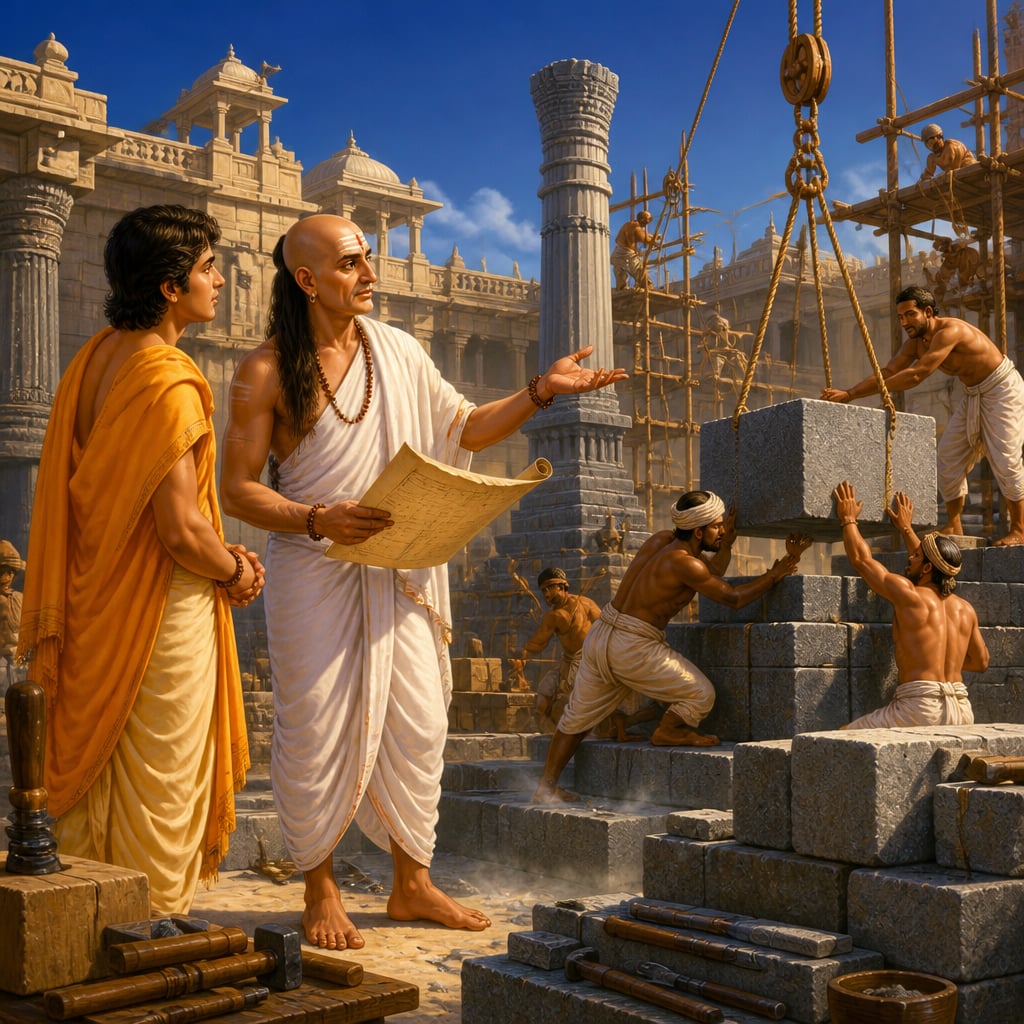
Kautilya stood in the half-built palace at Pataliputra, watching masons set stones into place. His student Chandragupta had just conquered the Nanda empire. Now came the harder task: building a government that wouldn't collapse like the Nandas had.
"I've studied every fallen kingdom," Kautilya told a young advisor who had asked about his plans. "They all have one thing in common. Not weak armies. Not poor harvests. One thing: a ruler with no one to tell him no."
The advisor looked confused. "But isn't the king supposed to be supreme?"
Kautilya smiled grimly. "That's what Dhana Nanda thought. How did that work out for him?"
That conversation captures Kautilya's central insight: good governance requires structural constraints, not just good rulers.
The Mantriparishad: No Decisions Alone
Kautilya's first structural check was the Mantriparishad - the Council of Ministers. The king couldn't make major decisions without consulting them.
"A single wheel cannot move a chariot - एकचक्रो न वर्तते रथः. The king should rule with the help of associates."
This wasn't advisory - it was mandatory. Kautilya specified which decisions required council approval:
- Declaring war or making peace
- Appointing or removing high officials
- Major construction projects
- Changes in taxation
- Treaties with other kingdoms
A king who bypassed his council was acting illegitimately. Ministers had the duty to voice disagreement.
Modern parallel: Corporate boards that must approve major decisions. CEOs who act unilaterally on acquisitions often face shareholder lawsuits. Kautilya understood this 2,300 years ago.
The Purohita: Moral Guardian
The Purohita (Royal Priest) wasn't just for ceremonies. He was the king's moral advisor - tasked with warning when the king strayed from dharma.
Kautilya gave the Purohita unusual protections:
- He couldn't be dismissed for giving unwelcome advice
- He had direct access to the king at any time
- His role was to represent dharmic constraints, not royal preferences
Think of it as a one-person ethics committee with guaranteed CEO access.
Modern parallel: Chief compliance officers or ombudsmen who report on ethical violations regardless of who commits them.
The Treasury: Separate Control of Money

Kautilya understood that whoever controls money controls everything. So he separated treasury management from royal discretion.
The Sannidhata (Treasurer) maintained independent accounts. The king couldn't simply withdraw funds at will. Major expenditures required documentation.
"The treasury is the foundation of authority - कोशमूलो दण्डः."
Kautilya specified detailed accounting:
- Daily reconciliation of income and expenditure
- Multiple officials cross-checking records
- Regular audits comparing expected and actual revenues
- Severe penalties for discrepancies
Modern parallel: The U.S. Constitution gives Congress, not the President, control over spending. Companies separate CFO authority from CEO authority.
The Spy Network: Watching the Watchers

Kautilya's elaborate spy system had an unexpected purpose: it watched the government itself.
Spies reported on:
- Corrupt officials taking bribes
- Judges making unjust decisions
- Governors oppressing their provinces
- Whether the king's own orders were implemented fairly
The last point is crucial. The spy network created accountability for the king himself. If royal orders caused suffering, Kautilya would know.
Modern parallel: Internal audit functions, whistleblower hotlines, inspector generals who investigate government agencies.
The Judiciary: Law Over Whim
Kautilya established courts with judges independent of royal control. They applied written law, not the king's mood.
- Judges appointed for competence, not loyalty
- Written legal codes binding everyone
- Appeal processes allowing review
- Public proceedings preventing secret injustice
The king himself was subject to legal process in certain matters.
Modern parallel: Independent judiciaries that can rule against the government. Constitutional courts that strike down executive actions.
The Checks Working Together
Kautilya's genius was making these constraints interlock:
| Action | Checks Required |
|---|---|
| Declare war | Council approval + Treasury funding + Military agreement |
| Appoint governor | Council consultation + Spy investigation + Purohita blessing |
| Major taxation | Council approval + Treasury accounting + Spy feedback |
Bypassing one check meant confronting others. A would-be tyrant had to corrupt multiple independent systems simultaneously.
Why It Worked
The Mauryan empire lasted about 130 years - far longer than most ancient empires. Its administrative framework influenced Indian governance for centuries.
Contrast this with Alexander's empire, which fragmented within a decade because everything depended on one man.
Kautilya's system survived because it didn't depend on perfect rulers. It assumed rulers would be tempted and designed structures to limit the damage.
Your Turn
Think about any organization you're part of - school, workplace, family, club. What checks exist on the people in charge?
- Can leaders make major decisions without consultation?
- Is there anyone whose job is to say "that's not right"?
- Who controls the money?
- Are there ways to report problems without retaliation?
Kautilya would say: if you can't point to structural checks, you're one bad leader away from tyranny. The solution isn't hoping for good leaders - it's building systems that work even with imperfect ones.
Max Weber distinguished 'rational-legal' authority (based on rules) from 'charismatic' authority (based on personality). Kautilya favored the former.
Kautilya provides specific mechanisms: which decisions need approval, how treasury should be organized, what spies should report. Actionable institutional design, not just theory.
The Roman Republic lasted centuries with complex checks. The Roman Empire, concentrating power in emperors, became unstable - assassination was a common succession mechanism.
The U.S. Constitution gives Congress the 'power of the purse.' Similar principles exist in corporate governance separating CEO and CFO authorities.
Kautilya specifies detailed accounting procedures - daily reconciliation, multiple verifiers, regular audits. Operational detail, not just principle.
Enron collapsed when executives controlled both operations and finances. Modern governance requires CFOs to have independent authority precisely to prevent such abuses.
Modern organizations use surveys, internal audits, and whistleblower hotlines for the same purpose - getting accurate information about how things really work.
Kautilya understood that people tell rulers what they want to hear. His spy network bypassed the filtering in normal reporting chains.
The Soviet Union collapsed partly because leadership couldn't get accurate information - everyone reported success even as the system failed.
Verses
एकचक्रो न वर्तते रथः
eka-cakro na vartate rathaḥ
A single wheel cannot move a chariot.
A ruler cannot govern alone any more than a one-wheeled chariot can move. Governance requires multiple components working together - ministers, advisors, officials - each essential for the system to function.
Book 1, Chapter 15, Verse 2 (R.P. Kangle)
सहायसाध्यं राजत्वम्
sahāya-sādhyaṃ rājatvaṃ
Sovereignty is achievable only with helpers.
Rule is not a solo performance. The king achieves sovereignty through associates - and remains accountable to them.
Book 1, Chapter 15, Verse 51 (L.N. Rangarajan)
कोशमूलो दण्डः
kośa-mūlo daṇḍaḥ
The treasury is the foundation of authority.
Power depends on money. Without a treasury, the king cannot maintain an army, pay officials, or undertake projects.
Book 2, Chapter 7, Verse 1-2 (R. Shamasastry)
Case studies
Enron's Collapse
Enron was once America's seventh-largest company. Its 2001 collapse revealed massive fraud. Key factor: the CEO and CFO worked together to hide losses, with no independent check. Board, auditors, and analysts all failed.
Enron violated multiple Kautilyan principles: (1) No separation between executive power and financial control. (2) No independent verification. (3) Board didn't fulfill its mantriparishad function. (4) Feedback mechanisms were co-opted.
Thousands lost jobs and retirement savings. Investors lost billions. Congress passed Sarbanes-Oxley Act requiring stronger controls - essentially mandating Kautilyan checks.
When structural checks fail, even successful organizations collapse catastrophically. The Sarbanes-Oxley reforms implemented what Kautilya prescribed: independent verification, separated authorities, protected whistleblowers.
The 2008 financial crisis revealed the same structural failures in banking. Rating agencies paid by the institutions they rated, auditors with consulting relationships, and regulators who rotated into the industries they oversaw. The Dodd-Frank Act, like Sarbanes-Oxley before it, attempted to rebuild the independent verification Kautilya prescribed.
Enron's stock price fell from $90.75 in August 2000 to $0.26 by November 2001. The Sarbanes-Oxley Act of 2002, passed in response, cost U.S. public companies an estimated $1.4 million per year in new compliance requirements.
Historical context
c. 4th century BCE
Kautilya built on earlier Indian traditions of consultative governance. The Vedic sabha and samiti (assemblies) and the concept of rajadharma contributed to the idea that rulers had obligations and limits.
Kautilya's framework for limiting power predates Western separation of powers by nearly two millennia. Constitutional thinking isn't a Western invention - it's human wisdom found across civilizations.
Reflection
- Think of an organization you know well. Can you identify at least three structural checks on leadership power?
- Have you seen a situation where lack of structural checks led to problems? What would Kautilya have designed differently?
- If you had to design a new organization from scratch, what checks and balances would you build in?