The Servant King

Praja-Sukhe Sukham Rajnah

The king's happiness lies in the happiness of his people. This powerful sutra captures Kautilya's entire political philosophy.

The old minister Katyayana found Chandragupta alone in the gardens of Pataliputra, staring at the moonlit waters of the Ganges. The emperor had just celebrated the conquest of the last Nanda stronghold. His armies controlled an empire stretching from Afghanistan to Bengal. Yet his face showed no joy.
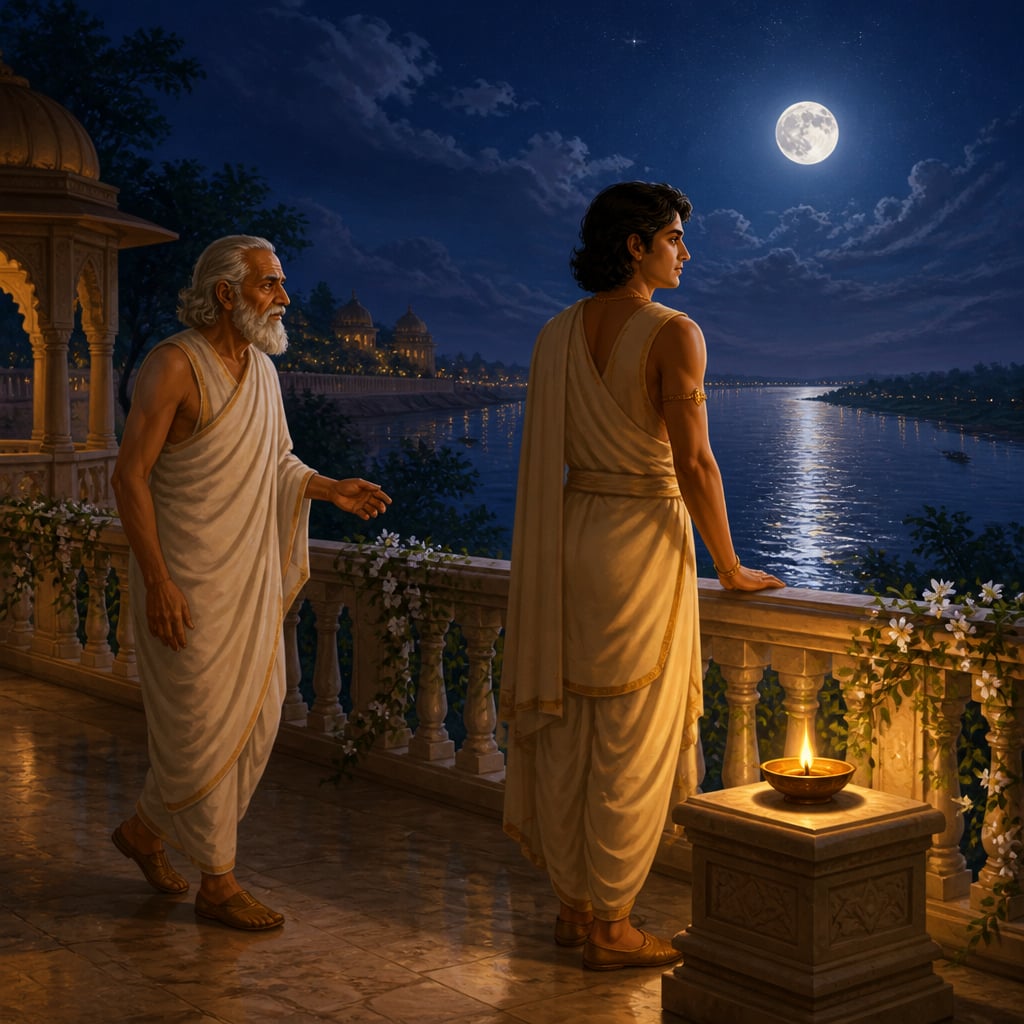
Old minister Katyayana approaching Chandragupta on the moonlit Ganges terrace

"You seem troubled, Maharaja," Katyayana ventured. "All India acknowledges your sovereignty. What more could you desire?"

Chandragupta turned, and his eyes held weariness rather than triumph. "I have taken a kingdom," he said. "Now I must learn what a kingdom is for."

It was to answer this question that Kautilya composed the most famous passage in the Arthashastra, words that would echo through Indian political thought for two millennia: "प्रजासुखे सुखं राज्ञः प्रजानां च हिते हितम्" (prajā-sukhe sukhaṃ rājñaḥ prajānāṃ ca hite hitam), "In the happiness of his subjects lies the king's happiness; in their welfare, his welfare."

This single sutra transforms the entire meaning of sovereignty. The king is not master but servant. His pleasures are not personal indulgences but public outcomes. His success is measured not by the gold in his treasury or the size of his armies, but by the flourishing of ordinary people he will never meet.

Kautilya continues with an even more radical statement: "नात्मप्रियं हितं राज्ञः प्रजानां तु प्रियं हितम्" (nātma-priyaṃ hitaṃ rājñaḥ prajānāṃ tu priyaṃ hitam), "What is dear to himself is not good for the king; what is dear to his subjects is good."

The king must sacrifice his personal preferences for his people's benefit. If the king loves hunting but hunting grounds would better serve as farmland, the farms must prevail. If the king prefers peace but war is necessary for the people's security, war must come. Royal desire bends to public need.

This was revolutionary doctrine. Ancient traditions often portrayed kings as divine beings whose pleasures were sacred obligations for subjects to fulfill. Kautilya inverted this relationship entirely. The king serves; the people are served. The king sacrifices; the people benefit. The king's personal happiness becomes irrelevant, only his public performance matters.

But Kautilya was too practical to rely on altruism alone. He understood that few rulers would embrace servitude from pure virtue. So he constructed a system of incentives that aligned royal self-interest with public welfare. The spy networks that pervaded society reported not just on conspiracies but on public satisfaction. A king who ignored his people's distress would soon face reports of unrest, followed by actual rebellion.

Moreover, Kautilya linked royal fame to royal service. "The king who makes his people prosperous will be remembered for a thousand years," he wrote. "The king who impoverishes them will be remembered only in curses." For rulers who cared about posterity, and most did, this argument proved powerful.

The modern parallel to servant leadership might be found in corporate governance debates. When Satya Nadella became CEO of Microsoft in 2014, the company had become known for internal politics, turf battles, and stagnation. Nadella's first message to employees emphasized empathy and service: the purpose of leadership was to bring out the best in others, not to glorify oneself. Over the following decade, Microsoft's market value increased tenfold as the company culture transformed from political infighting to collaborative innovation.

Kautilya would have recognized the principle: leadership exists to serve those being led. The moment a leader prioritizes personal benefit over institutional purpose, decline begins.

The Arthashastra operationalizes servant leadership through specific royal duties. The king should rise before dawn to hear petitions from even the poorest subjects. "A king who makes himself inaccessible," Kautilya warns, "is like a fire that gives no warmth. He exists but serves no purpose."

The king must personally oversee the administration of justice, ensuring that courts treat rich and poor equally. He must inspect infrastructure, roads, bridges, irrigation works, to verify that officials were maintaining what the people needed. He must visit temples and granaries, not for ritual purposes but to confirm that spiritual and physical nourishment remained available.

This active conception of service distinguished Kautilya from both earlier and later political theorists. Many philosophers conceived of the good ruler as one who simply refrained from oppression. For Kautilya, restraint was insufficient. The king must actively work for his people's benefit, not merely avoid harming them.

"The lazy king," the Arthashastra declares, "is as guilty as the tyrannical king. Both fail their subjects, one through action, the other through inaction." A ruler who inherited a prosperous kingdom and merely maintained it had not succeeded; he had merely postponed failure. Each generation must improve upon what it received.

This doctrine of active improvement carried risks. Kings who believed themselves servants of progress could justify great harms in the name of future benefits. Kautilya addressed this danger through his emphasis on consent and counsel. The king served, but he served through established means, not through revolutionary transformation that his advisors opposed or his people rejected.

The servant king was also bound by tradition. He inherited customs, laws, and expectations that preceded him and would outlast him. His service occurred within channels carved by generations of predecessors. Innovation was possible but should be gradual, building on what worked rather than demolishing it.

Chandragupta took these teachings to heart. Contemporary accounts describe him as austere in personal habits despite commanding vast wealth. He ate simple food, wore modest clothing, and maintained no harem beyond political necessity. His personal pleasures consisted of reviewing the welfare of his kingdom, inspecting troops, examining accounts, hearing reports from distant provinces.

When Greek ambassador Megasthenes visited Pataliputra around 300 BCE, he reported with astonishment that the Mauryan emperor personally adjudicated disputes throughout the day, even while being massaged and dressed. There was no separation between governing and living; the king's entire existence was dedicated to service.

Megasthenes watching Chandragupta personally adjudicate citizens' cases

The ultimate test of the servant king came at the end of life. According to Jain tradition, Chandragupta eventually abdicated his throne, walked south to Karnataka, and fasted unto death in the manner of Jain monks. Having served his people in power, he released that power rather than cling to it. The kingdom belonged to the people; the king was merely temporary steward.

This teaching, that power is stewardship, not possession, represents perhaps Kautilya's most enduring contribution to political thought. Every ruler since has faced the same question Chandragupta asked in the moonlit garden: what is a kingdom for? Kautilya's answer remains as relevant today as it was twenty-three centuries ago: a kingdom exists for its people. A king exists to serve.

Verses

प्रजासुखे सुखं राज्ञः प्रजानां च हिते हितम्

prajā-sukhe sukhaṃ rājñaḥ prajānāṃ ca hite hitam

In the happiness of his subjects lies the king's happiness; in their welfare, his welfare

This is perhaps the most famous sutra in the Arthashastra, encapsulating Kautilya's entire political philosophy. The king has no happiness separate from his people's happiness. His welfare is identical with theirs. This fundamentally redefines sovereignty as service.

नात्मप्रियं हितं राज्ञः प्रजानां तु प्रियं हितम्

nātma-priyaṃ hitaṃ rājñaḥ prajānāṃ tu priyaṃ hitam

What is dear to himself is not good for the king; what is dear to his subjects is good

This sutra radicalizes the first: the king's personal preferences are actually harmful to him as king. Royal self-interest must yield entirely to public interest. The king renounces personal desire as a condition of legitimate rule.

अहोरात्रं शरीरं दद्यात् प्रजाहिताय राजा।

ahorātraṃ śarīraṃ dadyāt prajā-hitāya rājā |

Day and night, the king must offer his very body for the welfare of the people.

This is the operational meaning of the servant-king ideal. Kautilya does not leave it as sentiment; he specifies ahorātram, day and night. The king belongs to the people, not the other way around.

Book 1, Chapter 19, Verse 35 (R.P. Kangle)

Reflection

More in The Limits of Power

All lessons in The Limits of Power · Arthashastra: Philosophy of Power course