Why Property Matters
Ownership and Freedom
Property rights might seem like a technical legal matter. For Kautilya, they were fundamental to human freedom. Without secure ownership, people cannot plan for the future, cannot keep the fruits of their labor, and cannot be truly free. The state's primary job is protecting what belongs to people.
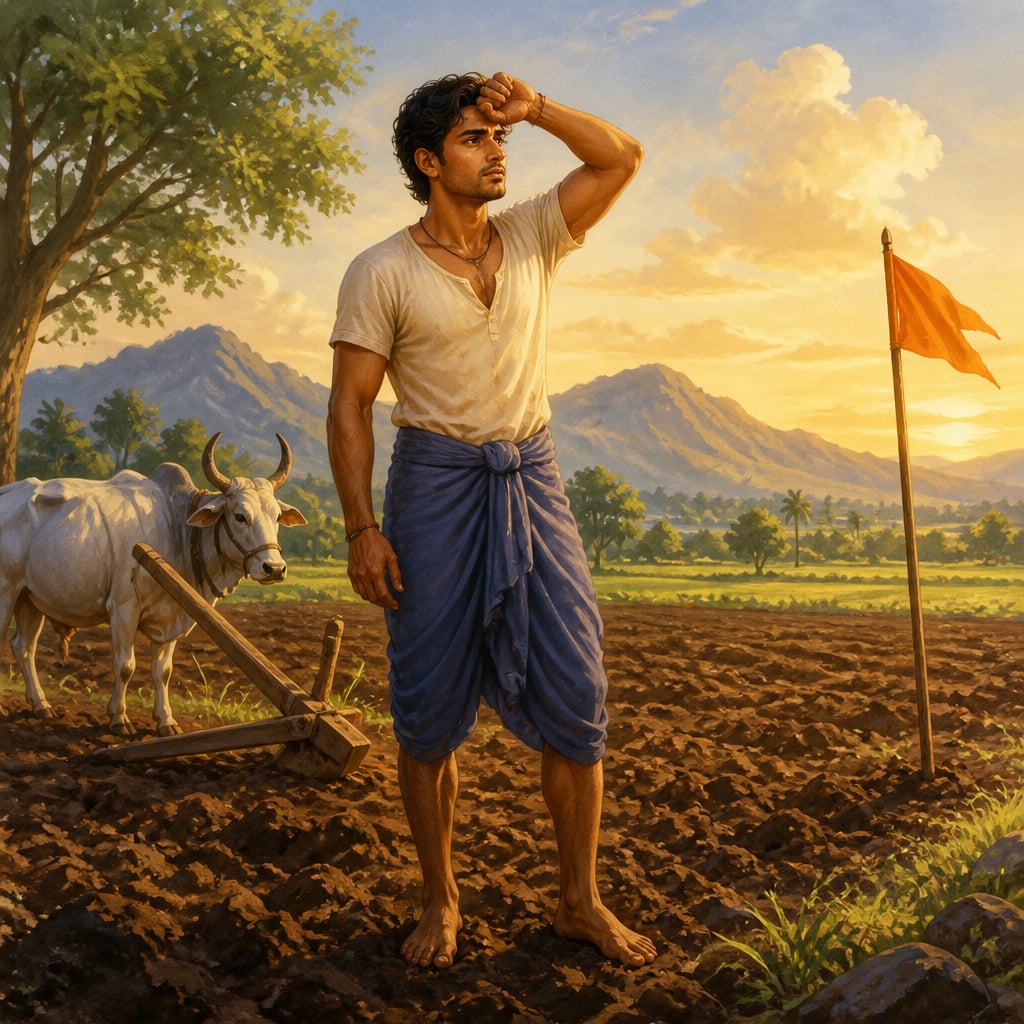
Raghava wiped the sweat from his brow and looked across the field he had cleared with his own hands. Twenty years of labor - removing stones, digging irrigation channels, enriching the soil with compost and cow dung. His father had begun the work; Raghava had finished it. Now golden wheat swayed in the monsoon breeze, and his children played at the edge of their family land.
Then the local lord's men arrived. "The master wants this field," their leader announced. "You have three days to leave."
Raghava's world collapsed. No court would hear him. No law protected him. No document proved what generations of labor had created. Everything his family had built could be taken by someone with more power.
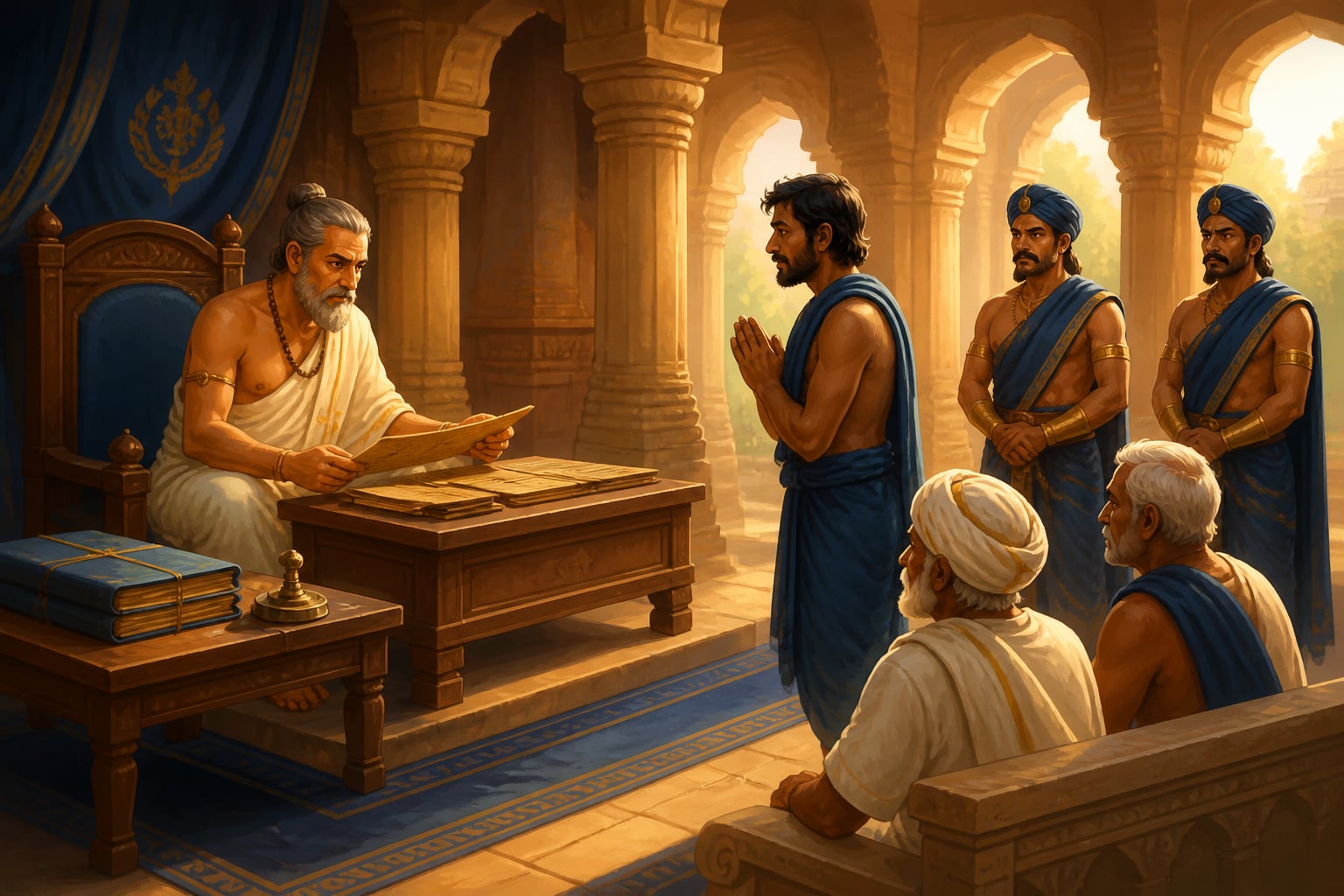
This scenario - repeated countless times across history - is exactly what Kautilya's property law was designed to prevent. And he understood something profound: this wasn't just personal injustice. It was economic catastrophe for society. Because without secure ownership, no one invests in the future.
Why plant an orchard that takes ten years to fruit if someone might seize the land tomorrow? Why build a sturdy house if you might be evicted next month? Why develop skills or save money if everything can be arbitrarily taken?
Property rights solve this problem. And Kautilya understood their importance with remarkable clarity:
स्वामित्वं परमं बलम् "Ownership is the supreme strength."
This isn't about material wealth for its own sake. Property gives people power - not power to dominate others, but power to be independent, to make choices, to resist exploitation. Secure ownership is the foundation of personal freedom.
The Arthashastra develops this insight into a sophisticated framework. Property isn't just things you possess. It's a bundle of rights: the right to use something, to exclude others from it, to transfer it to someone else, to keep its fruits. Each element matters.
The right to exclude means others can't simply take what's yours. The right to transfer means you can sell, gift, or bequeath your property. The right to keep the fruits means you benefit from your own work and investment.
Kautilya recognizes multiple forms of property: immovable (land, buildings, orchards), movable (cattle, gold, tools, grains), and intangible (debts owed to you, shares in partnerships). Each type has specific rules for acquisition, protection, and transfer.
How does one legitimately come to own something? Kautilya lists valid modes: inheritance from ancestors, purchase through fair exchange, gift voluntarily received, creation through one's own labor, discovery of unclaimed things, conquest in legitimate warfare, and royal grants for service.
Notice what's missing: theft, fraud, and coercion are never legitimate sources of ownership. Property obtained through wrong means doesn't create real ownership. The thief doesn't truly own what he steals.
This matters because it establishes ownership as prior to the state. The king doesn't grant property as a favor; he recognizes and protects what already belongs to people:
यस्य यत् स्वं तस्य तत् रक्षणीयम् "What belongs to someone must be protected for them."
The state's primary economic function is protection - police to prevent theft, courts to resolve disputes, records to document ownership, laws that define rights clearly. A state that fails to protect property has failed its basic function.
But here's the paradox Kautilya understood deeply: the state that protects property can also threaten property. A government powerful enough to stop thieves is powerful enough to become the biggest thief.
The Arthashastra contains multiple provisions to constrain state seizure: taxation must be moderate (the famous one-sixth limit), confiscation requires genuine cause, land taken for public use must be compensated, and officials who steal face severe punishment.
The goal is a state strong enough to protect property but constrained enough not to become predatory. This balance is the heart of good governance.
Why does property matter so much for freedom? Because a person who owns property has resources independent of others' favor. They can say no to bad deals, leave exploitative relationships, make choices based on their own judgment rather than survival desperation.
Property provides security against arbitrary power. A person with savings can survive setbacks. A person without property is vulnerable to every whim of fortune or force. This is why tyrants always attack property rights - they want dependence, and ownership creates independence.
Many other rights depend on property. Free speech requires platforms. Religious practice requires temples and implements. Even physical safety depends on having a secure place to live. Strip away property rights, and other freedoms become hollow.
And property creates incentives nothing else can match. When people keep the fruits of their labor, they work harder and smarter. When ownership is insecure, why bother creating anything that might be seized?
Modern research confirms Kautilya's ancient insight. Economist Hernando de Soto has documented how the world's poor often have assets but can't use them productively because they lack clear legal title. Without documented ownership, they can't use property as collateral, can't sell it easily, can't invest confidently. The same insight Kautilya articulated 2,300 years ago remains urgently relevant.

China's economic transformation provides dramatic illustration. When farmers were allowed to keep crops above their quotas - a partial property right - the same people on the same land produced vastly more. Property rights unleashed productivity that central planning couldn't.
The fundamental insight is timeless: secure ownership enables human flourishing. Property isn't just about things - it's about freedom, security, and the ability to build a future.
Verses
स्वामित्वं परमं बलम्
svāmitvaṃ paramaṃ balam
Ownership is the supreme strength.
This concise sutra captures a profound truth: property gives people power. Not the power to dominate others, but the power to be independent, to make choices, to resist exploitation.
Book 3, Chapter 1, Verse 1 (R.P. Kangle)
यस्य यत् स्वं तस्य तत् रक्षणीयम्
yasya yat svaṃ tasya tat rakṣaṇīyam
What belongs to someone must be protected for them.
This establishes property protection as a duty - specifically, a duty of the state. The king doesn't grant property as a favor; he recognizes and protects what already belongs to people.
Book 3, Chapter 5, Verse 28 (L.N. Rangarajan)
कोशमूलो दण्डः
kośa-mūlo daṇḍaḥ
The treasury is the foundation of state power.
State power depends on economic resources. But here's the implication: if the state destroys private property through excessive taxation or arbitrary seizure, it ultimately weakens itself.
Book 2, Chapter 1, Verse 32 (R. Shamasastry)
Case studies
China's Economic Transformation
In the late 1970s, China began allowing farmers to keep crops above their quotas, then gradually expanded private property rights. This partial property rights revolution transformed China from a poor country to an economic superpower.
China's experience confirms Kautilya's insight: when people can keep the fruits of their labor, they work harder and smarter. The same farmers on the same land produced vastly more when they had ownership stakes. Property rights unleashed productivity that central planning couldn't.
Hundreds of millions lifted out of poverty in a single generation - perhaps the greatest poverty reduction in human history. Property rights weren't the only factor, but they were essential.
Secure ownership creates incentives that no other system can match. Kautilya understood this in 300 BCE; China rediscovered it in 1978.
Vietnam's doi moi reforms starting in 1986 and India's 1991 liberalization both confirm this finding. In each case, expanding property rights and economic freedoms triggered dramatic growth. The pattern is so consistent across cultures and continents that it functions as close to a universal economic law as exists.
China's household farming reforms starting in 1978 lifted over 800 million people out of extreme poverty by 2020, according to the World Bank. Agricultural output increased 61% in just the first six years after farmers gained land-use rights.
Historical context
c. 4th century BCE
Ancient India had complex property systems including private ownership, village commons, and royal lands. The Arthashastra systematized existing practices into a coherent framework. Land was particularly important in an agricultural economy where most people were farmers.
Understanding Kautilya's property framework shows that sophisticated thinking about ownership and rights is not uniquely Western. Indian civilization had developed complex property law centuries before Rome's Twelve Tables.
Reflection
- Think about what you truly 'own' - not just legally, but in the sense of having secure control over. How does this ownership (or lack of it) affect your freedom and security?
- Some argue that property rights protect the wealthy at the expense of the poor. Others say property rights are essential for the poor to build wealth. What does Kautilya's framework suggest? What do you think?
- What could you do to strengthen your 'ownership' position - building assets, securing what you have, or clarifying ambiguous situations? What's one step you could take?