Protecting the Weak

Rights of Women, Servants, and Dependents

Property rights mean little if the powerful can exploit the weak. Kautilya understood that genuine freedom requires protecting vulnerable people - women, workers, servants, children, and the disabled. His surprisingly progressive protections reveal that a truly libertarian society limits not just state power but also private coercion. Protecting the weak isn't opposite to freedom - it is essential to it.

Freedom for Whom?

Sumitra crouched in the corner of her husband's house, nursing a bruised arm. Devadatta had struck her again - the third time this month. Her gold bangles, given by her father at marriage, had disappeared; her husband had gambled them away. When she protested, he beat her.

She had nowhere to go. Her parents lived far away. She owned nothing - or so her husband told her. She couldn't work without his permission. She was trapped.
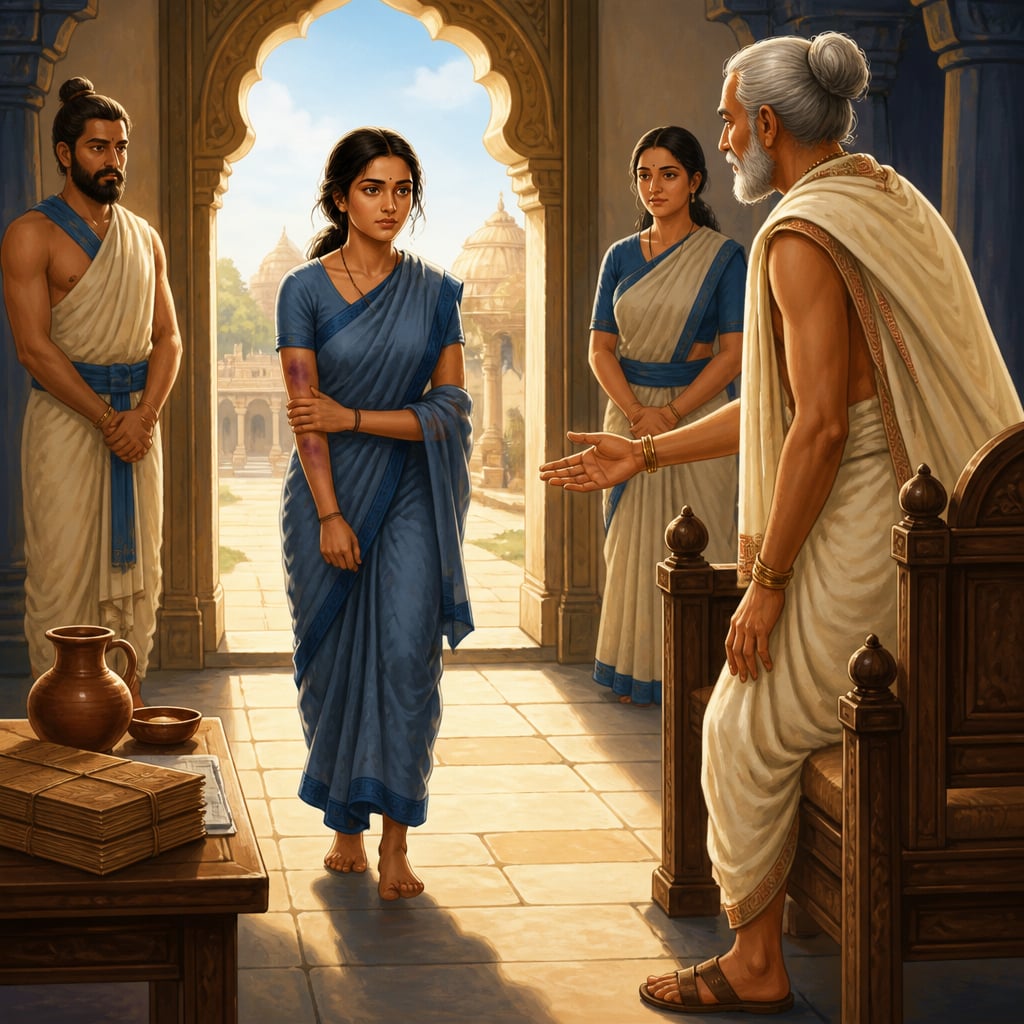
Sumitra entering the Mauryan magistrate's hall to file her complaint

But in Kautilya's India, Sumitra had options she didn't know about. The law said her husband could not beat her - and she could sue for damages. Those bangles were her stridhan, her personal property that no husband could take. She could seek divorce for cruelty. She could keep her property and leave.

This is the often-overlooked side of Kautilya's framework: genuine freedom requires limiting the power of the strong over the weak.

Property rights. Free contracts. Individual liberty. These principles sound noble. But there's a deeper question: Free for whom? If the strong can dominate the weak, if men can oppress women, if employers can exploit workers, then talk of "freedom" rings hollow. Liberty for lions is death for lambs.

Kautilya understood this paradox. His extensive protections for vulnerable people reveal a profound insight that completes his vision of freedom.

Women's Rights and Protections

Ancient India was patriarchal. But within that context, the Arthashastra gave women remarkable protections:

Economic Independence

Stridhan - Women's Property As we saw in the previous lesson, women could own property independently:

This property belonged to them absolutely. Husbands could not take it, spend it, or control it without permission.
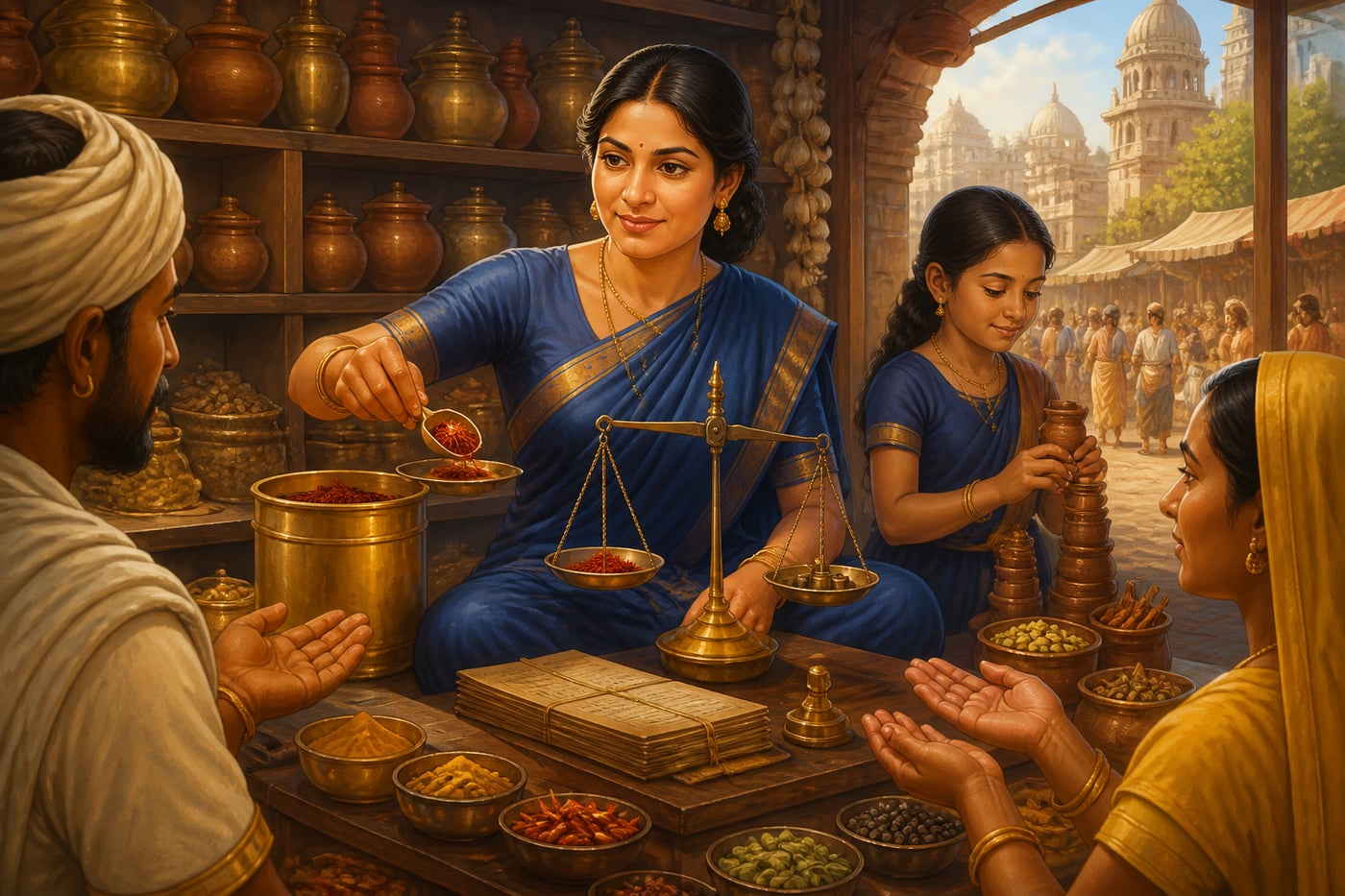
A Mauryan woman trader running her own spice shop with her daughter

Right to Work and Earn Women could:

Married women were not under complete control of husbands economically.

Protection from Abuse

Physical Violence Husbands who beat wives faced punishment:

This wasn't just moral condemnation - it was enforceable law.

Abandonment A husband who abandoned his wife:

Women weren't trapped in marriages with absent or abusive husbands.

Forced Labor Husbands couldn't force wives to:

There were limits on what could be demanded.

Divorce and Remarriage

Grounds for Divorce Women could seek divorce for:

Property After Divorce Divorced women kept:

Remarriage Widows and divorced women could remarry:

This was progressive for the ancient world.

Widow Protections

Maintenance Widows received:

They couldn't be cast out penniless.

No Forced Sati The Arthashastra never mentions or endorses sati (widow burning). This terrible practice arose later and was never part of Kautilyan law.

Property Management Widows with minor sons:

They had real authority, not just ceremonial roles.

Workers and Servants

The Arthashastra protected workers from exploitation:

Employment Rights

A labourer signing a witnessed Mauryan employment contract

Written Contracts Employment terms should be clear and witnessed:

Oral promises weren't sufficient for important employment.

Timely Wages As we've seen, wages must be paid on time. Delaying or withholding wages was illegal and punishable.

Safe Working Conditions Employers responsible for:

Workers weren't disposable.

Limits on Debt Bondage People who worked to repay debts (dasa-karmakara) had protections:

This prevented permanent bondage.

Against Slavery

The Arthashastra had surprisingly anti-slavery provisions:

No Slavery of Aryans People of Aryan background (roughly, Indians) could not be permanently enslaved:

Manumission Encouraged Paths to freedom:

Slavery wasn't meant to be permanent.

Slave Rights Even slaves had protections:

This limited the horror of slavery, though it didn't abolish it.

Why Not Complete Abolition? Kautilya lived in a world where slavery was universal. His reforms - limiting slavery, protecting slaves, encouraging manumission - were radical for the time. He pushed toward freedom within the constraints of his era.

Children's Protections

Against Exploitation Children couldn't be:

Parents had duties, not just rights.

Orphan Protection Orphaned children:

Vulnerable children had state protection.

Illegitimate Children Even children born outside marriage had rights:

Children weren't punished for parents' conduct.

The Disabled and Elderly

Maintenance Obligations Adult children must support:

This was legally enforceable.

State Support For those without family:

The helpless weren't abandoned.

Property Rights Disabled people:

Disability didn't mean loss of all rights.

Why These Protections Matter

Some might ask: if you believe in individual freedom, why these protections? Doesn't freedom mean non-interference?

Kautilya's answer is sophisticated:

Private Coercion is Still Coercion

A husband who beats his wife into submission is using force. An employer who withholds wages is essentially stealing. A parent who sells children is trafficking.

These are violations of freedom, not exercises of it.

Freedom Requires Resources

A woman with no property has no real choices. A worker with no wages cannot be free. A child with no protections is vulnerable to any abuse.

Protecting resources and basic rights enables freedom.

Contracts Require Rough Equality

Kautilya regulated employment contracts, marriage agreements, and debt terms. Why?

Because enormous power imbalances make "voluntary" agreements meaningless. If you're starving and I offer terrible terms, your acceptance isn't really free.

Protecting the weak makes contracts genuinely voluntary.

Strong Property Rights Require Limits

Property rights for all require preventing the strong from simply taking from the weak. A society where might makes right has no property rights - just continuous predation.

Protecting the weak protects property rights generally.

Modern Parallels

Labor Law Modern labor protections - minimum wages, safety regulations, anti-discrimination laws - echo Arthashastra principles. The debate continues: do these protect freedom or restrict it?

Domestic Violence Law Laws against domestic violence follow Kautilya's recognition that private violence is still violence. A home isn't a sovereign zone where anything goes.

Child Protection Child labor laws, mandatory education, foster care systems - all modern implementations of the principle that children need protection from exploitation.

Disability Rights The ADA and similar laws establishing rights for disabled people continue the Arthashastra's recognition that disability doesn't mean loss of personhood.

Human Trafficking Modern anti-trafficking law echoes Kautilya's limitations on debt bondage and slavery. The recognition that economic desperation can create slavery-like conditions.

The Deeper Principle

Beyond specific protections, Kautilya establishes a principle:

Freedom requires not just limiting state power but also limiting private coercion.

A society where:

...is not a free society. It is a society where freedom exists only for the powerful.

Genuine freedom requires:

This isn't contradiction. It is completion.

The Libertarian Critique and Response

Some libertarians object: if two adults agree to something, who is the state to interfere?

Kautilya's response:

  1. Gross inequality undermines genuine consent. A starving person "agreeing" to slavery isn't really free.

  2. Children and incompetent people can't genuinely consent. Someone must protect them.

  3. Violence isn't a contractual matter. A husband doesn't have a property right to beat his wife.

  4. Basic protections enable more freedom overall. When people have minimum protections, they can take risks, negotiate, and exercise more genuine freedom.

Kautilya was proto-libertarian in his emphasis on property rights and individual freedom. But he was a sophisticated libertarian who understood that protecting the weak is necessary for freedom to be real.

Verses

भर्तुः स्त्रीं न हिंस्यात्

bhartuḥ strīṃ na hiṃsyāt

A husband should not harm his wife.

This seemingly simple statement was revolutionary. It established that a husband doesn't have unlimited power over his wife.

Book 3, Chapter 3, Verse 1 (R.P. Kangle)

बलात्कारः सदण्डः

balātkāraḥ sa-daṇḍaḥ

Use of force is punishable.

Coercion - whether physical, economic, or through position - is wrong and punishable. This applies to employment (forced labor), marriage (forced marriage or rape), contracts (duress), and social relations.

Book 3, Chapter 13, Verse 9 (L.N. Rangarajan)

दासानामपि धर्मः

dāsānām api dharmaḥ

Even slaves have rights.

This establishes that there are limits to power over others - even in slavery. Human dignity doesn't completely disappear based on status.

Book 3, Chapter 13, Verse 1 (R. Shamasastry)

Case studies

The Fair Labor Standards Act (1938)

During the Great Depression, American workers faced terrible conditions: child labor, no minimum wage, unlimited working hours, no overtime pay. In 1938, the Fair Labor Standards Act established minimum wage, 40-hour work week, overtime pay, and prohibited most child labor.

This mirrors Kautilya's employment protections: wages must be paid on time, working conditions must be reasonable, children need protection. The FLSA recognized what Kautilya knew: enormous power imbalances between employers and desperate workers make 'voluntary' agreements potentially exploitative. Some protections enable genuine freedom.

Initially controversial, the FLSA transformed American labor. Child labor virtually ended. Workers had more stability and could plan lives. Critics warned it would destroy businesses, but prosperity increased. Most now accept basic labor standards, though debates continue about details.

Protecting vulnerable workers from exploitation doesn't destroy prosperity - it can enable it. Kautilya understood this in 300 BCE; modern societies rediscovered it. The question isn't whether to protect workers but how much and in what ways.

The gig economy reignites these same labor protection questions. Workers for platforms like Uber and DoorDash lack minimum wage guarantees, benefits, and overtime protections that traditional employees receive. Governments worldwide are debating how to extend Kautilyan worker protections to these new employment models.

The Fair Labor Standards Act of 1938 established a minimum wage of $0.25 per hour and a maximum work week of 44 hours. It immediately benefited 300,000 workers and within a year banned child labor for over 50,000 children.

India's Protection of Women from Domestic Violence Act (2005)

Despite various laws, domestic violence remained widespread in India, with women often trapped in abusive marriages. In 2005, India passed comprehensive domestic violence legislation giving women right to protection orders, residence orders, and easier access to justice for abuse.

This builds directly on Kautilyan principles: husbands shouldn't harm wives, women have rights to property and safety, the state should intervene to protect vulnerable people. The 2005 Act made these ancient principles more enforceable with modern legal machinery. It recognized that private relationships aren't zones of lawlessness.

The law has helped countless women escape abuse, though implementation remains uneven. Social attitudes change slowly - law can establish rights, but enforcing them requires cultural change. Still, having legal recourse empowers women who previously had no options.

Protecting vulnerable people from private abuse is a legitimate function of law. Marriage and family relationships don't create zones where violence is acceptable. Kautilya established this principle 2,300 years ago; modern India continues implementing it. Legal rights require enforcement to be meaningful.

Despite legal protections, domestic violence remains a global crisis. The WHO estimates that 1 in 3 women worldwide experiences physical or sexual violence. Countries that combine strong legislation with accessible support services and police training show the most significant reductions, confirming that law must be paired with implementation.

A 2014 study found that 70% of Indian women who experienced domestic violence never sought help. After the 2005 Protection Act, domestic violence complaints filed with police increased 300% by 2015, indicating greater willingness to seek legal remedy.

Historical context

c. 4th century BCE

Ancient India was patriarchal and hierarchical, with caste system and gender inequality. But compared to other ancient civilizations, the Arthashastra's protections for women and limitations on slavery were progressive. Women could own property, divorce, remarry - rights many didn't have in the West until modern times.

Understanding the Arthashastra's protections challenges narratives about ancient India being universally oppressive to women and lower castes. While deeply flawed by modern standards, Kautilyan law offered protections that many ancient societies lacked. It shows that concern for vulnerable people isn't uniquely modern or Western.

Reflection

More in Freedom & Property

All lessons in Freedom & Property · Arthashastra: Philosophy of Power course