Inheritance and Family Property
Daya - Rules of Succession
Property rights matter little if wealth cannot transfer across generations. Kautilya developed detailed inheritance law - daya - governing how property passes from parents to children and between relatives. These rules balanced family cohesion with individual rights, enabled intergenerational wealth building, and provided for dependents. Understanding inheritance law reveals how societies enable or constrain opportunity.
The Question of Succession
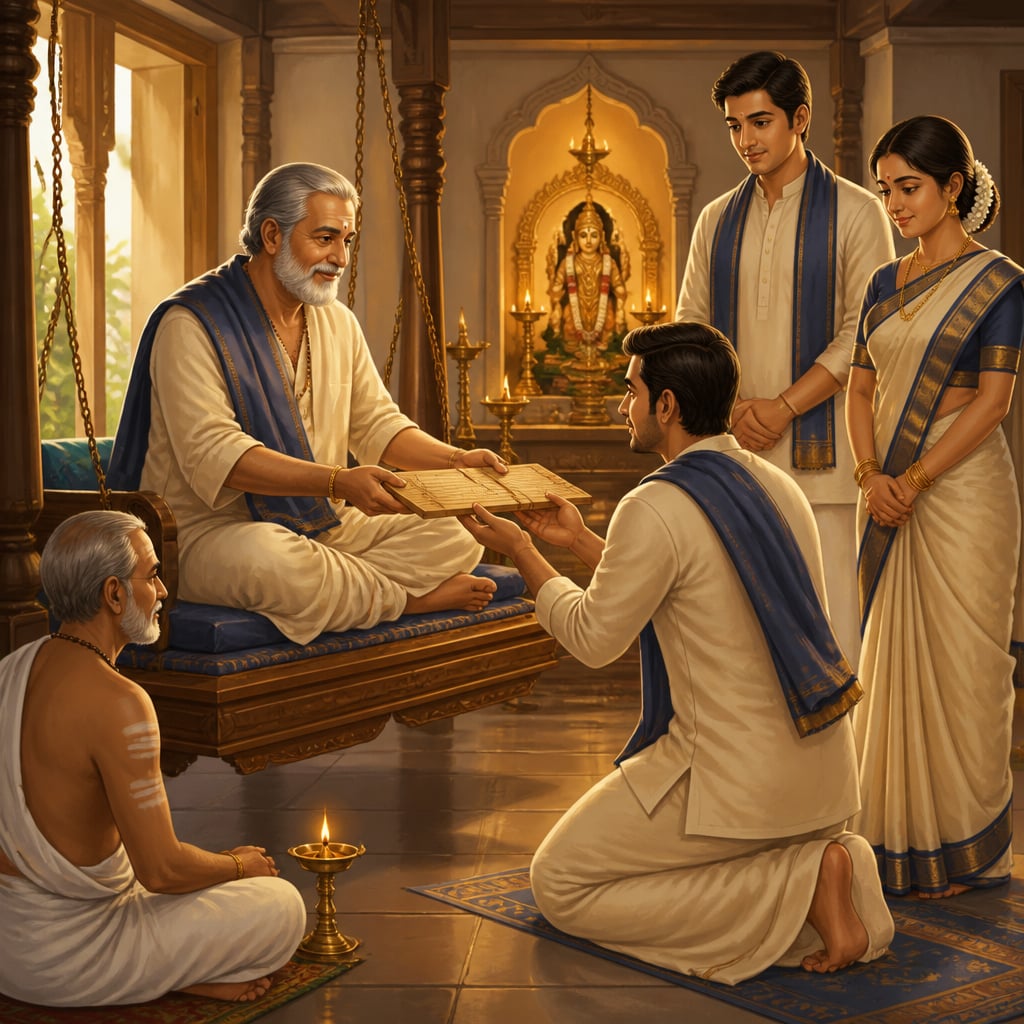
You work your entire life, building wealth through effort and prudence. You clear land, construct buildings, accumulate savings. Then you die.
What happens to everything you built?
This is not a morbid question - it is one of the most important questions in property law. How wealth transfers between generations shapes:
- Whether families can build lasting prosperity
- How children are motivated (or not) to productive effort
- What happens to widows, orphans, and dependents
- Whether society becomes more or less unequal over time
Kautilya devoted extensive attention to daya - inheritance law - because he understood: the rules of succession shape economic behavior across generations.
Why Inheritance Matters
Consider two societies:
Society A: All property reverts to the state when someone dies. Children inherit nothing.
Society B: Children automatically inherit their parents' property.
How do people behave differently?
In Society A:
- Why accumulate wealth if it dies with you?
- Why invest in improving property you can't pass on?
- Why teach children skills if they start from zero?
- Why maintain family cohesion if there's no shared property?
In Society B:
- Parents work not just for themselves but for their children
- Families maintain and improve property across generations
- Children are educated in family trades and property management
- Family identity is connected to family property
Kautilya understood: the ability to pass property to children is a powerful incentive for productive behavior.
Types of Property in Inheritance
The Arthashastra distinguishes between types of property for inheritance purposes:
Ancestral Property (Pitri-daya)
Property inherited from previous generations:
- Land passed down through families
- Traditional family businesses or trades
- Ancestral homes and buildings
This property had special rules:
- All sons had equal shares
- Could not be freely sold or given away
- Had to be maintained for future generations
- Daughters received maintenance from it but usually not ownership
Self-Acquired Property (Sva-arjita)
Property earned or created by the individual:
- Land purchased or cleared
- Wealth earned through business or service
- Property created through one's own labor
This property had more flexibility:
- Could be disposed of more freely by will
- Could be given to daughters, wives, or chosen heirs
- Owner had more control over distribution
This distinction balanced maintaining family property with rewarding individual achievement.
Order of Inheritance
Who inherits when someone dies? Kautilya established a clear hierarchy:
For a Man's Property:
- Sons - all legitimate sons share equally
- Grandsons - if sons are dead, grandsons inherit their father's share
- Wife/Widow - entitled to maintenance and often a share
- Daughters - entitled to dowry/marriage portion, sometimes more
- Parents - if no descendants
- Brothers - if no direct family
- Extended family - progressively more distant relatives
- The state - only if no family can be found
This order prioritized direct descendants but ensured property stayed in the family when possible.
For a Woman's Property:
Women could own property (stridhan) that they inherited:
- Children - daughters and sons
- Husband - if no children
- Parents - if unmarried
- Her own family - not her husband's family
This protected women's property from being absorbed entirely into their husband's family.
Rights of Different Heirs
Sons
Sons were the primary heirs:
Equal Division All legitimate sons received equal shares of ancestral property. Birth order didn't matter - the eldest and youngest got the same.
Responsibility With inheritance came obligations:
- Support of mother and unmarried sisters
- Payment of father's debts
- Performance of ancestral rites
- Maintenance of family property
Exclusions Some sons could be excluded:
- Those who renounced the world (sannyasis)
- Those with severe disabilities preventing property management
- Those who had rebelled against the family
But even excluded sons received maintenance.
Daughters
Daughters' inheritance rights were limited but real:

Stridhan (Women's Property) Daughters inherited:
- Property given at marriage (dowry)
- Gifts from parents and relatives
- Property earned by their own labor
- Sometimes a share of self-acquired property
This property belonged to them absolutely - husbands couldn't claim it.
Maintenance Rights Even without full inheritance, daughters had rights:
- Support from family property until marriage
- Marriage expenses paid from estate
- Maintenance if unmarried and unable to work
Rationale The limited inheritance reflected that daughters joined their husband's family. But stridhan ensured they had independent resources.

Widows
Widows had strong protections:
Maintenance A widow was entitled to:
- Lifetime support from her husband's property
- Continued residence in the family home
- Income from property for her needs
Property Rights Depending on circumstances:
- Control over property during minor sons' childhood
- Sometimes life interest in property (use but not sale)
- Her own stridhan remained hers absolutely
Remarriage If a widow remarried:
- She retained her stridhan
- But lost maintenance from late husband's family
- This was practical, not punitive - her new husband supported her
Wills and Testamentary Freedom
Could people control how property was distributed? Kautilya allowed limited testamentary freedom:
Ancestral Property Strict rules - equal division among sons. Wills couldn't override this.
Self-Acquired Property More flexibility:
- Could give larger shares to some children
- Could provide for daughters beyond minimum
- Could make charitable gifts
- Could reward particularly dutiful children
But even here, limits existed:
- Couldn't completely disinherit children without cause
- Had to provide minimum maintenance for dependents
- Couldn't create distributions violating dharma
Witnessed Wills Wills required:
- Written document or multiple credible witnesses
- Testator of sound mind
- No coercion or fraud
- Clear statement of intentions
This prevented later disputes about what the deceased wanted.
Disputes and Resolution
Inheritance disputes were common. The Arthashastra provided resolution mechanisms:
Common Disputes:
- Whether property was ancestral or self-acquired
- Whether all heirs were legitimate
- Whether a will was genuine and valid
- How to value and divide property fairly
- Rights of adopted children or stepchildren
Resolution Process:
- Parties present claims to judges
- Family members and neighbors testify
- Property records examined
- Shares calculated according to law
- Fair division arranged or property sold
Fairness Principles: When dividing property:
- Equal value, not necessarily identical assets
- Consider each heir's circumstances
- Avoid divisions that destroy value
- Keep productive property units together when possible
Protecting Dependents
A crucial purpose of inheritance law was protecting vulnerable family members:
Minor Children Property was managed by guardians:
- Typically the mother
- Or nearest capable male relative
- Guardians couldn't sell or waste property
- Accounts had to be kept
- Children received property when adults
Disabled Heirs Those unable to manage property:
- Received lifetime maintenance
- Property held in trust for them
- Couldn't be deprived of support
Elderly Parents Adult children had duty to support parents:
- From inherited property if necessary
- Could sue children for maintenance
- State would enforce these duties
Inheritance and Social Mobility
How did inheritance rules affect opportunity?
Enabling Wealth Building By allowing property transfer, Kautilya enabled:
- Families to accumulate wealth across generations
- Investment in long-term improvements
- Teaching children family trades and skills
- Creating family businesses and enterprises
But Also Inequality Inheritance means:
- Some start with advantages others lack
- Wealth (and poverty) perpetuate across generations
- Family background matters enormously
Kautilya's response: inheritance enables prosperity overall, even if unequally distributed. The alternative - everyone starting from zero each generation - prevents anyone from building lasting wealth.
Modern Parallels
Inheritance law remains controversial:
Estate Taxation Modern debates mirror ancient tensions:
- Should inheritance be taxed?
- Do heirs "deserve" inherited wealth?
- How much intergenerational transfer creates inequality?
- Can society allow wealth accumulation without inheritance?
Gender Equality Many countries have equalized inheritance rights between sons and daughters. India's Hindu Succession Act (2005 amendment) gave daughters equal rights in ancestral property - a significant departure from traditional practice.
Wills and Testamentary Freedom Different societies balance:
- Testator's wishes (freedom to dispose)
- Family obligations (forced heirship)
- State interests (taxation)
Kautilya's balance - freedom for self-acquired property, rules for ancestral property - offers one approach.
The Deeper Question
Beyond technical rules, inheritance law raises fundamental questions:
What do we owe the dead? Should we honor the wishes of the deceased, or can the living ignore them?
What do parents owe children? Is there a duty to provide for the next generation, or does each generation start fresh?
What do children owe parents? Should adult children support elderly parents? Is this enforceable?
How much inequality is acceptable? If inheritance perpetuates advantage, should it be limited?
Kautilya's framework provides one set of answers, grounded in pragmatic recognition that:
- Family bonds motivate productive behavior
- Intergenerational transfer enables wealth building
- Dependents need protection
- Property rights include the right to pass property on
These remain live questions today.
Verses
पुत्राः पितृधनभाजः
putrāḥ pitṛ-dhana-bhājaḥ
Sons are the sharers of the father's property.
This establishes the fundamental principle of inheritance: property passes from parents to children. This is not a favor or gift - it is a right.
Book 3, Chapter 5, Verse 1 (R.P. Kangle)
स्त्रीधनं स्त्रीस्वम्
strī-dhanaṃ strī-svam
A woman's property belongs to the woman.
This simple statement was radical. Women could own property independently - not through fathers or husbands but in their own right.
Book 3, Chapter 5, Verse 12 (L.N. Rangarajan)
वृद्धविधवासहायानां भरणम्
vṛddha-vidhava-asahāyānāṃ bharaṇam
The elderly, widows, and helpless must be supported.
Inheritance law wasn't just about transferring property - it was about ensuring vulnerable people were cared for. Heirs who received property had obligations to support those who couldn't support themselves.
Book 3, Chapter 2, Verse 41 (R. Shamasastry)
Case studies
The Hindu Succession Act Amendment (2005)
For centuries, Hindu law gave sons inheritance rights in ancestral property but not daughters. Daughters received stridhan and maintenance but didn't co-inherit the family property. In 2005, India amended the Hindu Succession Act to give daughters equal rights with sons in ancestral property.
The Arthashastra's framework distinguished between ancestral property (strict succession rules) and self-acquired property (more flexibility). The 2005 amendment essentially extended to daughters the rights sons had in ancestral property. This completed the logic of property rights: if individual ownership and freedom matter, gender shouldn't determine property rights.
The amendment has been transformative but contested. Daughters now have claims on family property, giving them stronger economic positions. But implementation has been uneven - many families still use social pressure to prevent daughters from claiming legal rights. The law has changed faster than culture.
Legal reform can advance justice but requires cultural change to be fully effective. Kautilya gave women some property rights - more than most ancient societies. Modern India has expanded these rights further. Full equality requires both law and social acceptance.
Globally, closing the gender property gap remains one of the most effective development interventions available. World Bank research shows that countries where women have equal property rights have 16% higher GDP per capita on average. Legal reform is necessary but insufficient without parallel changes in social norms and enforcement.
After the 2005 Hindu Succession Act amendment, women's land ownership in India increased from 10.9% to 13.9% by 2016, though the average size of women-owned agricultural plots remained 35% smaller than those owned by men.
Warren Buffett's Inheritance Philosophy
Warren Buffett, one of the world's wealthiest people, has pledged to give away 99% of his fortune to charity rather than leaving it to his children. He's said he wants to leave his children 'enough so they can do anything, but not enough so they can do nothing.' His children will inherit millions but tiny fraction of his wealth.
This reflects a tension Kautilya recognized: inheritance can either motivate or undermine recipients. Kautilya's solution was obligations that came with inheritance - support dependents, maintain property, fulfill duties. Buffett's approach is different: limit inheritance to preserve motivation. Both recognize that wealth transfer affects behavior.
Buffett's children have built independent careers and speak supportively of their father's decision. His wealth goes to the Gates Foundation and other charities. This represents massive voluntary redistribution - what estate taxes attempt coercively, Buffett does voluntarily.
Inheritance raises questions beyond legal rules: What motivates productivity? What undermines it? How much wealth transfer serves children vs. harms them? Kautilya required obligations with inheritance; Buffett limits inheritance itself. Both approaches recognize wealth transfer shapes behavior.
The debate over inheritance, meritocracy, and dynastic wealth is intensifying globally. Countries like Japan and South Korea impose inheritance taxes above 50% on large estates, while others like India have no inheritance tax at all. Each approach reflects a different answer to the same question Kautilya raised: how much wealth transfer serves society?
Warren Buffett pledged to donate 99% of his estimated $130+ billion fortune to philanthropy. His annual gifts to the Gates Foundation alone have totaled over $39 billion since the pledge in 2006.
Historical context
c. 4th century BCE
Ancient India had complex family structures - joint families where property was held collectively. The Arthashastra's inheritance law balanced maintaining joint family property with individual rights. This reflected practical reality: families worked land together, but individuals also created wealth independently.
Understanding ancient India's inheritance law challenges assumptions about property rights. The Arthashastra gave women independent property rights centuries before most other civilizations. Its balance between family obligation and individual freedom offers a model distinct from both Western individualism and collectivist approaches.
Reflection
- Kautilya allowed property to transfer across generations, enabling families to build wealth but also perpetuating inequality. Is this trade-off worth it? Could a society both enable wealth building and prevent hereditary inequality?
- The Arthashastra limited daughters' inheritance but protected their independent property (stridhan). Was this pragmatic accommodation to patriarchal society or unjust discrimination? How do we judge ancient laws by modern standards?
- If you expect to inherit property, what obligations do you think come with it? If you're building wealth, what claims do others (children, parents, dependents) have on it?