Land Ownership in Ancient India
Bhumi and Its Laws
Land was the foundation of ancient India's economy and the most important form of property. Kautilya developed sophisticated laws governing land ownership, boundaries, water rights, and disputes. Understanding these rules reveals how property rights enabled agricultural prosperity and social stability.
The Foundation of Everything
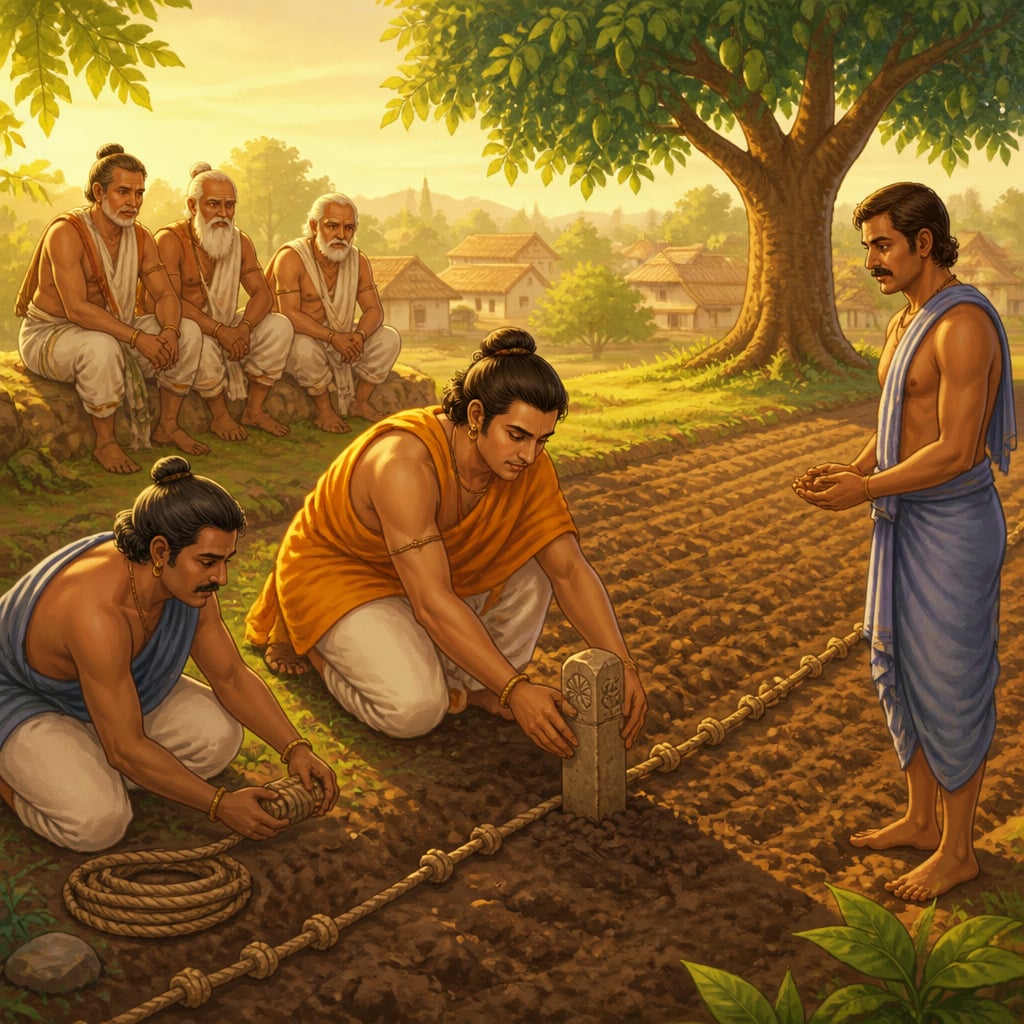
In an agricultural society, land is not just property - it is life itself. Without land, a family cannot grow food, build a home, or accumulate wealth. Control over land determines freedom or dependence, prosperity or poverty.
Kautilya understood this profoundly. The Arthashastra dedicates extensive attention to bhumi - land - and the complex laws governing its ownership, use, and transfer. These laws were not mere technical regulations. They were the foundation of economic freedom.
Categories of Land
The Arthashastra recognizes several types of land based on ownership:
1. Private Land (Sva-bhumi) Land owned by individual families through inheritance, purchase, or royal grant. This was the most common form and included:
- Agricultural fields (kshetra)
- Homesteads and gardens (vasti)
- Orchards and groves (upavana)
Private land could be freely bought, sold, mortgaged, gifted, or bequeathed. The owner had rights to all produce and improvements.
2. Crown Land (Rajya-bhumi) Land directly owned by the state and managed through appointed officers. This included:
- Newly cultivated wasteland
- Confiscated lands
- Land with no clear heir
Crown land could be granted to settlers, sold to farmers, or leased. The goal was not perpetual state ownership but bringing land into productive use.
3. Village Commons (Grama-bhumi) Land held collectively by villages for common purposes:
- Pastures for cattle
- Forests for firewood
- Water sources
- Cremation grounds
These commons were crucial for village life but carefully regulated to prevent overuse.
4. Religious Land (Devata-bhumi) Land granted to temples, brahmins, and religious institutions. These lands were tax-exempt and had special protections.
Establishing Ownership
How did one prove ownership of land? Kautilya established several principles:
Clear Documentation Land transactions should be witnessed and recorded. The state maintained registers (pustaka) documenting ownership. These records could be consulted to resolve disputes.
Continuous Possession Long, uncontested possession created ownership rights. If someone openly used land for twenty years without challenge, they acquired ownership. This prevented abandoned land from lying waste.
Visible Boundaries Land boundaries must be clearly marked with:
- Stones (pashana)
- Trees (vriksha)
- Posts (stambha)
- Embankments (setuka)
Moving boundary markers was a serious crime, harshly punished.
Witness Testimony Neighbors could testify about boundaries and ownership. Their knowledge of who had worked land and paid taxes carried weight.
Water Rights
In India's agricultural context, water rights were inseparable from land rights. The Arthashastra carefully regulates water:
Natural Water Sources Rivers and natural lakes were common resources, but land adjacent to water had preferential rights. Upstream users couldn't divert water to harm downstream users.

Constructed Irrigation If someone built a well, tank, or canal on their land, they owned the water. However, they couldn't waste it or prevent natural flow to others.
Shared Irrigation When multiple farmers shared irrigation systems, water was allocated by:
- Proportion of investment in construction
- Amount of land being irrigated
- Order of historical use
Disputes were common and carefully adjudicated.
Land Disputes
Boundary disputes were frequent and potentially violent. Kautilya established clear procedures:
Types of Evidence (in order of preference):
- Written documents - land grants, sale deeds, tax records
- Witnesses - neighbors, village elders, those who remember transactions
- Possession - who has been using the land and for how long
- Physical evidence - boundary markers, old maps, cultivation patterns
Resolution Process:
- Parties present claims to appointed judges
- Evidence is examined systematically
- Witnesses are questioned and credibility assessed
- Physical inspection of the disputed land
- Judgment based on preponderance of evidence
Penalties for False Claims: Kautilya knew people would lie about land. False witnesses and fraudulent claimants faced harsh fines - as much as the disputed land was worth. This discouraged frivolous litigation.
Protecting Farmers
Kautilya's land law especially protected farmers - the backbone of the economy:
Security of Tenure Farmers who worked land couldn't be arbitrarily evicted. Even on crown land, farmers who had cultivated for years gained strong rights.
Fair Rent On leased land, rent couldn't exceed one-fourth to one-third of produce. Excessive rent that prevented farmers from living was prohibited.
Investment Protection If a farmer improved land - building wells, clearing forests, planting orchards - they gained rights to those improvements even on leased land. This encouraged investment.
Disaster Relief Tax and rent could be suspended in case of flood, drought, or other calamities. Farmers couldn't be forced off land because of temporary inability to pay.
Wasteland Settlement

Kautilya actively encouraged bringing wasteland into cultivation:
Incentives for Settlers:
- Tax exemption for initial years (typically 2-5 years)
- Grants of seeds, tools, and oxen
- Ownership rights after continuous cultivation
- Protection from raiders and wild animals
This served multiple purposes: expanding taxable land, creating productive communities, and establishing presence in frontier areas.
Why This Mattered: By making it easy to acquire and secure land, Kautilya enabled anyone willing to work to become a property owner. Land ownership wasn't restricted to the elite - it was accessible to those who would make it productive.
Land and Freedom
Why did land ownership matter so much for freedom?
Economic Independence A family with their own land doesn't depend on others' favor. They can grow food, generate income, and survive setbacks.
Political Voice Landowners had standing in village councils and influence in local governance. Property gave people a stake in social order.
Intergenerational Wealth Land could be passed to children, enabling families to build wealth across generations. Without this, each generation starts from zero.
Bargaining Power Landless laborers were vulnerable to exploitation. Landowners could refuse unfair demands, leave bad situations, and negotiate from strength.
Modern Echoes
Kautilya's land law principles remain relevant:
Land Titling Programs Many developing countries are now implementing programs to give formal land titles to farmers who have farmed land for generations. This mirrors Kautilya's principle that long possession creates rights.
Water Rights Disputes Modern conflicts over water - between farmers, cities, and industries - show why Kautilya's careful water rights framework was necessary.
Land Records Digital land registries that India is implementing continue Kautilya's vision of clear, accessible documentation of ownership.
Slum Rehabilitation Debates about giving ownership to slum dwellers echo Kautilya's approach: recognize possession, encourage improvement, convert squatters into stakeholders.
The Deeper Principle
Beyond technical rules, Kautilya's land law embodies a principle:
Property rights should be clear, secure, and accessible.
- Clear - so people know what belongs to whom
- Secure - so people can invest and improve without fear
- Accessible - so anyone willing to work can acquire property
This creates a society where prosperity is possible for all, not just the powerful. That's the connection between property rights and freedom.
Verses
सीमाविवादे साक्षिणः पार्श्वस्थाः
sīmā-vivāde sākṣiṇaḥ pārśvasthāḥ
In boundary disputes, neighbors are the witnesses.
This sutra establishes a practical principle: those who live near land know its history and boundaries. By making neighbors witnesses, Kautilya created a community-based system of property verification.
Book 3, Chapter 9, Verse 1-2 (R.P. Kangle)
उप्तं बीजं कर्षकस्य स्वम्
uptaṃ bījaṃ karṣakasya svam
Seed sown by a farmer belongs to that farmer.
This seemingly simple rule has profound implications. The farmer who plants has rights to the harvest - even on land they don't own.
Book 2, Chapter 1, Verse 18-19 (L.N. Rangarajan)
विंशतिवर्षभोगः स्वामित्वकरः
viṃśati-varṣa-bhogaḥ svāmitva-karaḥ
Twenty years of use creates ownership.
This rule - similar to 'adverse possession' in modern law - served crucial purposes. It prevented land from lying abandoned while someone far away claimed theoretical ownership.
Book 3, Chapter 9, Verse 15 (R. Shamasastry)
Case studies
Peru's Land Titling Revolution
In the 1990s, Peru gave formal land titles to over 1.2 million families who had been living in informal settlements for decades. They had built homes and communities but lacked legal ownership. Economist Hernando de Soto led the program to formalize their property rights.
This mirrors Kautilya's principle that long use creates legitimate ownership. The Peruvian families had established possession through sustained occupation and improvement - exactly the basis Kautilya recognized for ownership claims. The formal titling program simply documented what was already real: these people had made the land productive.
Families with formal titles invested more in their homes, started businesses, accessed credit using property as collateral, and experienced significant increases in income. Children in titled families had better health and education outcomes. Property rights unleashed prosperity.
Secure ownership enables investment and prosperity. Kautilya understood this in 300 BCE; Peru rediscovered it in 1990. When people know what they build belongs to them, they build more and better.
Ethiopia's urban land certification program, launched in 2005, produced similar results. Households with certified land rights invested 20-30% more in their properties and experienced measurable improvements in food security, confirming that the ownership-investment link holds across very different economic contexts.
Peru's COFOPRI program issued formal titles to over 1.2 million urban households between 1996 and 2004. Titled households invested 68% more in home improvements and were 10% more likely to start a business.
Mauryan Wasteland Settlement
After Chandragupta Maurya unified northern India, vast tracts of land were depopulated or uncultivated due to previous wars. The Mauryan administration implemented programs to settle these wastelands with farmers, providing tax exemptions, seeds, tools, and protection.
The Arthashastra's detailed provisions for wasteland settlement weren't theoretical - they guided actual Mauryan policy. By giving settlers secure ownership after a period of cultivation, the state converted unproductive land into taxable agricultural communities. This served security (populated borders), economic (more production), and humanitarian (landless farmers gained property) purposes.
Archaeological evidence shows significant agricultural expansion during the Mauryan period. New villages and irrigation works appeared across the empire. The settled farmers became a stable tax base and loyal subjects - their prosperity was tied to the state that protected their ownership.
Enabling property ownership creates stakeholders in social order. Farmers with secure land had every reason to support the government that protected their property rights. Property rights and political stability reinforce each other.
Modern homesteading programs in Brazil and Indonesia follow similar principles, offering titled land to settlers who develop and cultivate it. These programs consistently show that formal ownership creates both economic productivity and political stability, as property owners become invested in the system that protects their rights.
Kautilya's Arthashastra (Book 2, Chapter 1) prescribes that new settlers on wasteland receive tax exemptions for 2-5 years and grants of cattle, seed, and money, with full property rights after the land was made productive.
Historical context
c. 4th century BCE
Ancient India was primarily agricultural, with land as the most valuable asset. Previous kingdoms had various land tenure systems, but the Arthashastra systematized and codified property rights across a vast empire. The Mauryan period saw large-scale settlement of wasteland and creation of new agricultural communities.
Understanding that sophisticated land law existed in ancient India challenges narratives that property rights are uniquely Western concepts. The Arthashastra's land law was as advanced as anything in the ancient world, and in some ways more progressive - particularly in protecting farmers and enabling upward mobility.
Reflection
- Kautilya established that twenty years of productive use creates ownership rights, even without formal title. What does this suggest about the nature of legitimate ownership - is it about legal documents or about actual use and improvement?
- Clear boundaries prevent conflict, but they also limit flexibility and can exclude. How do we balance the need for clear property lines with concerns about equality and access?
- Where in your life do unclear 'boundaries' or ambiguous 'ownership' of responsibilities, resources, or credit create problems? What could you do to clarify these?