Contracts and Promises

Vyavahara - The Law of Agreements

Property rights establish what you own, but economic prosperity requires something more: the ability to make enforceable agreements with others. Kautilya developed sophisticated contract law governing loans, partnerships, employment, and trade. Understanding vyavahara reveals how enforceable promises create trust, enable cooperation, and expand prosperity.

Beyond Ownership

Imagine you own land but cannot:

Your property would be largely useless. Economic activity requires more than ownership - it requires agreements between people that can be relied upon.
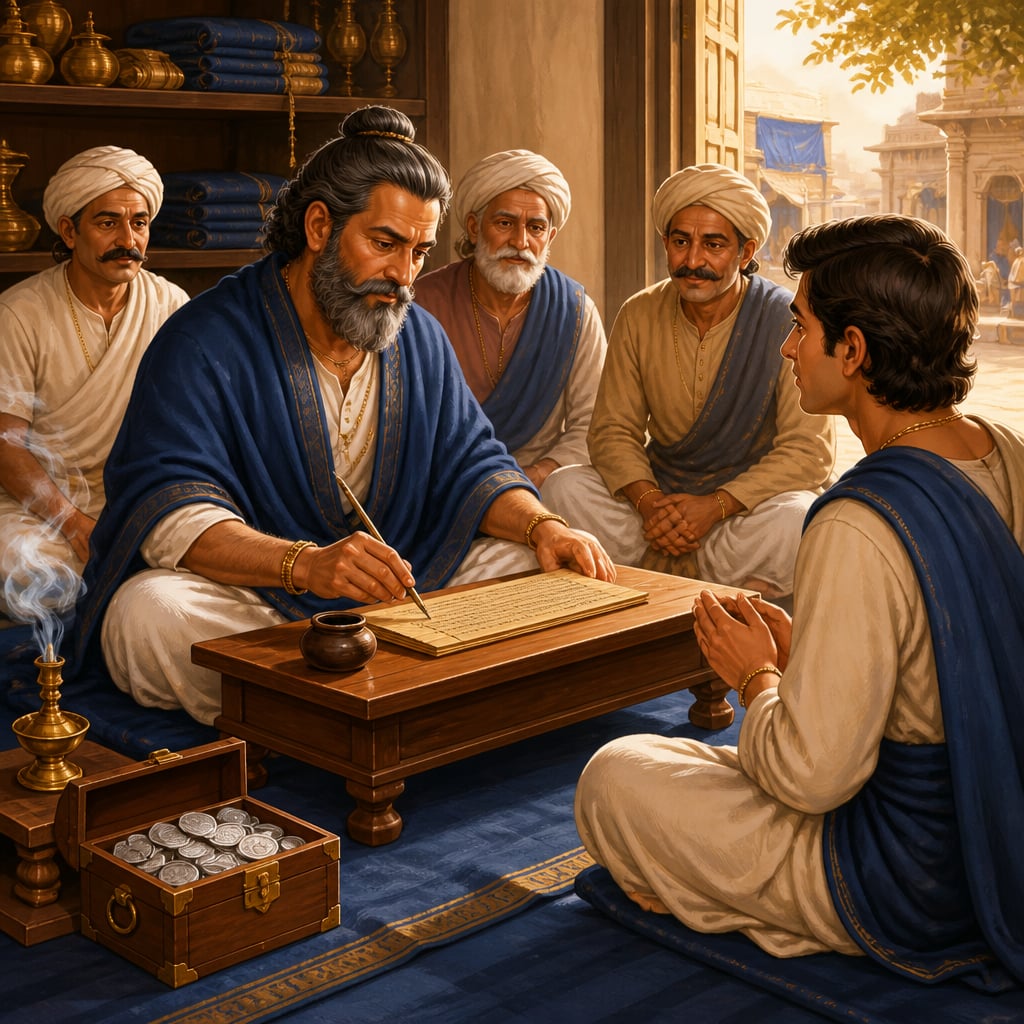
A Mauryan merchant inscribing a vyavahara loan contract with witnesses

This is where contract law enters. The Arthashastra dedicates extensive attention to vyavahara - the law of transactions and agreements. These rules made complex economic cooperation possible.

What is Vyavahara?

The term vyavahara encompasses:

Essentially, any agreement where one person promises something to another falls under vyavahara.

Why Contracts Matter

Without enforceable contracts:

No Credit Why lend money if you can't get it back? Credit enables investment and growth. But credit requires enforceability.

No Specialization Why hire skilled workers if they might not perform? Specialization increases productivity. But specialization requires reliable agreements.

No Large Enterprises Why partner with others if they might steal your investment? Complex projects require multiple contributors. But cooperation requires trust backed by enforcement.

No Long-Term Planning Why make agreements spanning years if they can be broken tomorrow? Long-term contracts enable infrastructure, trade networks, and stability.

Kautilya understood: enforceable agreements multiply economic possibilities.

Elements of Valid Contracts

What makes a contract valid in the Arthashastra? Kautilya established clear requirements:

1. Competent Parties Both parties must be capable of making agreements:

Contracts with incompetent parties are void.

2. Lawful Purpose The agreement cannot be for illegal purposes:

Illegal contracts have no force.

3. Clear Terms The agreement must be definite:

Vague agreements are unenforceable.

4. Witnesses (Preferably) While oral contracts could be valid, witnessed agreements were stronger:

Witnesses prevent denial and fraud.

5. Consideration (Exchange) Both parties must give something:

One-sided promises without exchange were gifts, not contracts, and harder to enforce.

Types of Contracts

The Arthashastra recognizes many contract types:

Loans (Rina)

Lending money was crucial for economic activity. Kautilya established:

Interest Limits Interest rates were regulated by risk:

This balanced enabling credit with preventing exploitation.

Repayment Terms Loans had clear schedules. Creditors couldn't demand early repayment without cause. But debtors couldn't indefinitely delay either.

Collateral Rules Secured loans required collateral:

Default Consequences Failure to repay had graduated consequences:

Three Mauryan partners pooling capital into a sambhuya partnership

Partnerships (Sambhuya)

When multiple people pooled resources for ventures:

Capital Contributions Each partner's investment was recorded. Profit shares were typically proportional to investment, though different arrangements could be agreed.

Management Rights Who makes decisions? All partners equally? Majority rule? One managing partner? This must be specified.

Profit and Loss Sharing Typically proportional to investment, but could be adjusted for:

Dissolution Terms How can partners exit? What happens to assets? The Arthashastra required these terms to be clear upfront.

Employment (Bhrita)

Contracts for labor and service:

Wages and Payment Payment terms must be clear:

Duration and Termination Employment could be:

Termination required either completion of term, completion of work, or cause.

Worker Protections Employers couldn't:

Workers couldn't:

A bustling Pataliputra marketplace under cloth canopies

Sales and Trade (Kraya-Vikraya)

Buying and selling goods:

Transfer of Ownership When does ownership transfer? Upon:

This must be clear to prevent disputes.

Quality Guarantees Sellers were responsible for:

Fraud in sales was heavily punished.

Risk of Loss If goods are destroyed before delivery, who bears the loss? Generally, whoever has ownership at the time.

Breach and Remedies

What happens when contracts are broken? Kautilya established clear remedies:

Specific Performance Courts could order the breaching party to actually perform what they promised:

This was preferred when possible.

Damages If performance wasn't possible, the breaching party must compensate:

Rescission The innocent party could cancel the contract and get their property/money back.

Penalties Deliberate breach, fraud, or bad faith brought additional fines payable to the state.

Why This Mattered for Freedom

Contract law might seem like dry technical rules. But enforceable contracts are essential to economic freedom:

Enables Cooperation People can work together without being family or close friends. Trust can be built between strangers.

Expands Possibilities With enforceable contracts, people can undertake projects impossible alone - building irrigation systems, trading across distances, creating large enterprises.

Protects the Weak Written contracts and courts prevent the powerful from simply imposing their will. A poor farmer's contract has the same force as a rich merchant's.

Creates Predictability People can plan based on agreements. This enables long-term thinking and investment.

Modern Parallels

Contract law remains fundamental:

International Trade Global commerce depends on enforceable contracts across borders. Modern commercial law builds on ancient principles like Kautilya's.

Employment Law Worker protections in the Arthashastra - wages must be paid, terms must be clear, excessive demands prohibited - echo in modern labor law.

Consumer Protection Kautilya's rules against fraud and misrepresentation parallel modern consumer protection laws.

Credit Markets Interest rate regulations, collateral rules, and bankruptcy protection all have ancient antecedents.

The Foundation of Prosperity

Property rights answer: "What is mine?"

Contract law answers: "What can I do with what's mine?"

Together, they create the legal infrastructure for economic activity. Secure ownership means nothing if you cannot transact. Enforceable agreements mean nothing without clear ownership.

Kautilya understood both were necessary. His vyavahara law made it possible for ancient India to have:

And most importantly: a society where ordinary people could make agreements that bound even the powerful. That is economic freedom.

Verses

साक्षिणो धर्मस्थीयाः

sākṣiṇo dharmasthīyāḥ

Witnesses are essential for courts of law.

This sutra establishes that contracts and disputes should be decided based on evidence from witnesses, not arbitrary authority. By requiring testimony and evidence, Kautilya created a system where agreements could be proven and enforced according to rules, not power.

Book 3, Chapter 1, Verse 1 (R.P. Kangle)

समयः पालनीयः

samayaḥ pālanīyaḥ

Agreements must be upheld.

Simple but profound: promises must be kept. This establishes the fundamental principle of contract law - agreements bind those who make them.

Book 3, Chapter 11, Verse 1 (L.N. Rangarajan)

भृतस्य भृतिः समये दातव्या

bhṛtasya bhṛtiḥ samaye dātavyā

Wages of workers must be paid at the agreed time.

This seemingly simple rule is revolutionary. It establishes that workers have enforceable rights against employers.

Book 3, Chapter 12, Verse 42 (R. Shamasastry)

Case studies

The Rise of Commercial Law in Medieval Europe

In medieval Europe, long-distance trade faced a problem: merchants from different kingdoms had no way to enforce contracts across borders. National courts wouldn't enforce foreign judgments. This limited trade. The solution: merchant courts (law merchant) that enforced contracts based on commercial custom, not royal authority.

This mirrors Kautilya's insight that commercial activity requires enforceable contracts. The medieval merchant courts were essentially creating vyavahara - a body of contract law recognized across jurisdictions. Like the Arthashastra, merchant law focused on enabling trade through reliable agreements, not on religious or moral principles.

Merchant courts enabled the expansion of European trade in the 12th-15th centuries. Merchants could do business across kingdoms because agreements were enforceable. This commercial law eventually influenced national legal systems. Many modern contract law principles originated in medieval merchant courts.

Enforceable contracts enable trade and prosperity. Different civilizations discovered this independently - Kautilya in ancient India, merchant courts in medieval Europe, modern international arbitration today. The need for vyavahara is universal.

International commercial arbitration through bodies like the ICC and LCIA now resolves over $100 billion in cross-border disputes annually. Companies choose these forums precisely because national courts cannot reliably enforce contracts across jurisdictions, recreating the medieval merchant court system at global scale.

The Lex Mercatoria (merchant law) developed across over 100 European trade fairs by the 13th century, resolving disputes within 24 hours. Merchants who violated rulings were banned from all participating fairs across the continent.

Silicon Valley's Handshake Culture

Silicon Valley venture capital often operates on trust and handshake agreements - term sheets are non-binding, many deals proceed on verbal commitments. This works within the tight-knit VC community because reputational enforcement is strong. But when dealing with outsiders or when relationships break down, lack of formal contracts creates problems.

Kautilya would recognize this as the difference between dealing within a community (where reputation enforces agreements) and dealing with strangers (where legal enforcement is needed). The Arthashastra allowed oral contracts between known parties but strongly preferred written agreements with witnesses for important transactions.

Silicon Valley's informal culture works well for repeat players who value their reputation. But startups dealing with VCs for the first time sometimes get hurt by ambiguous terms. And when disputes arise, lack of clear contracts creates expensive litigation. Smart players get even handshake deals confirmed in writing.

Trust and reputation can substitute for formal contracts in tight communities with repeat interactions. But as Kautilya understood, documentation protects all parties and becomes essential when dealing outside close communities or when relationships sour.

The crypto and Web3 space is learning this lesson in real time. Smart contracts on blockchain were supposed to eliminate the need for trust, but disputes over code bugs, hacks, and ambiguous terms reveal that even automated agreements need human adjudication. The DAO hack of 2016 forced Ethereum to choose between code and justice.

Approximately 70% of Silicon Valley venture capital deals begin with verbal or handshake agreements before formal contracts. But when disputes arise, the average VC lawsuit costs over $1 million to litigate.

Historical context

c. 4th century BCE

Ancient India had extensive internal and international trade networks. Merchants traveled from India to Rome, Southeast Asia, and Central Asia. Indian goods - spices, textiles, precious stones - were traded across the known world. This commerce required sophisticated contract law. The Arthashastra systematized existing commercial customs into enforceable law.

Understanding ancient India's contract law challenges the notion that commercial law is uniquely Western. The Arthashastra's vyavahara was as sophisticated as Roman contract law and perhaps more protective of workers and borrowers. Indian merchants operated on a global scale, enabled by this legal framework.

Reflection

More in Freedom & Property

All lessons in Freedom & Property · Arthashastra: Philosophy of Power course