When Calamity Strikes
Apad-kala - Times of Distress
Famine and disaster test a state's legitimacy. Kautilya's relief system was comprehensive yet temporary - designed to help people survive crisis and return to independence, not create permanent dependence on state support.
The Monsoon That Never Came
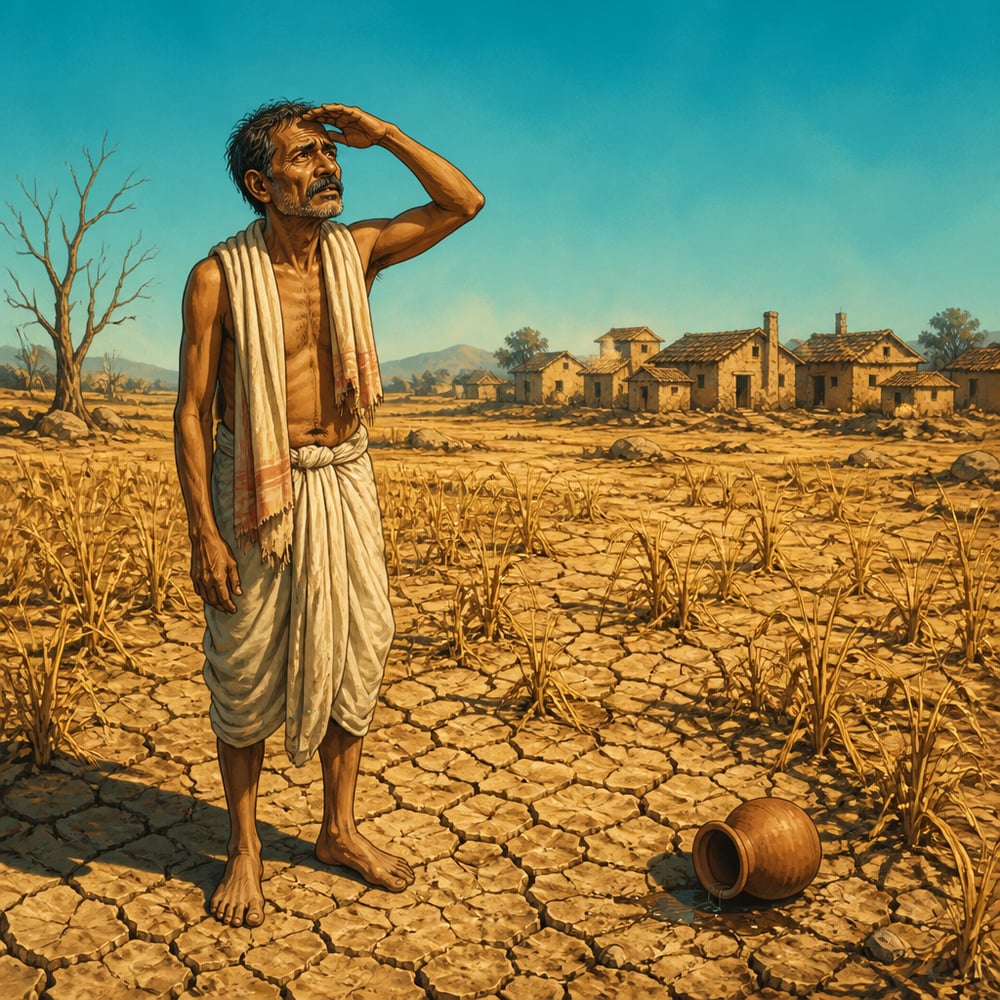
The fields should be green by now. Instead, they're brown, cracked, lifeless. This is the third month without rain. The stored grain from last harvest is running low. Children are already showing signs of hunger.
This is apad-kala - the time of distress. And it tests whether the state serves the people or merely rules them.
Kautilya understood that famines and disasters are when the social contract becomes most visible. In good times, people prosper largely through their own efforts. But when calamity strikes - drought, flood, epidemic, invasion - individual effort isn't enough. This is when the state must act, decisively and effectively.
But how? Kautilya's answer: provide emergency relief that helps people survive the crisis and return to independence, without creating permanent dependence.
The Three Phases of Relief
Kautilya's relief system had three distinct phases:
Phase 1: Immediate Emergency Response
Goal: Keep people alive (days to weeks)
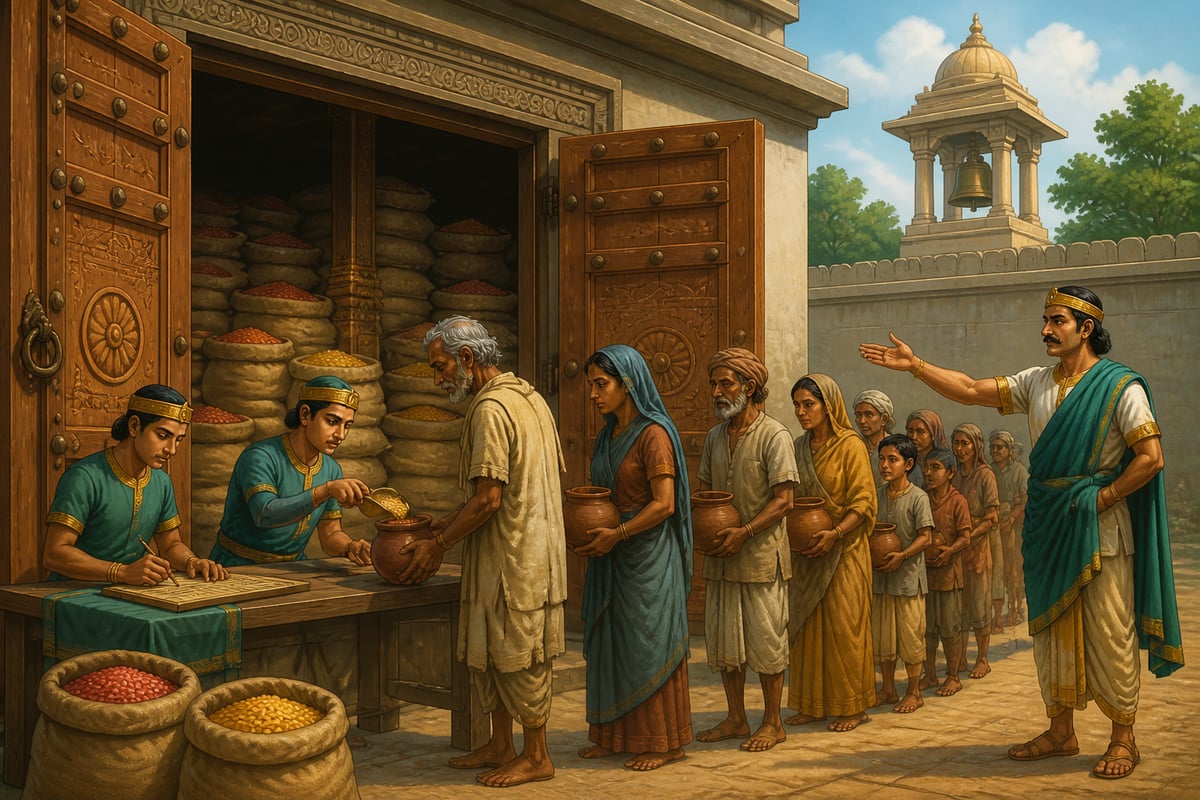
- Open royal granaries for distribution
- Provide cooked food at public kitchens
- Suspend certain taxes temporarily
- Prevent hoarding and price-gouging
- Ensure water supply
Phase 2: Economic Stabilization
Goal: Restart productive activity (weeks to months)
- Provide seed grain for next planting (as loan, not gift)
- Organize public works to provide employment
- Facilitate trade to bring in supplies
- Temporarily relax certain regulations
- Provide tools and working capital
Phase 3: Recovery and Prevention
Goal: Return to normal productivity (months to years)
- Collect loans given during relief
- Rebuild infrastructure damaged in crisis
- Improve water storage for future droughts
- Replenish treasury reserves
- Learn lessons to prevent recurrence
Public Works During Famine
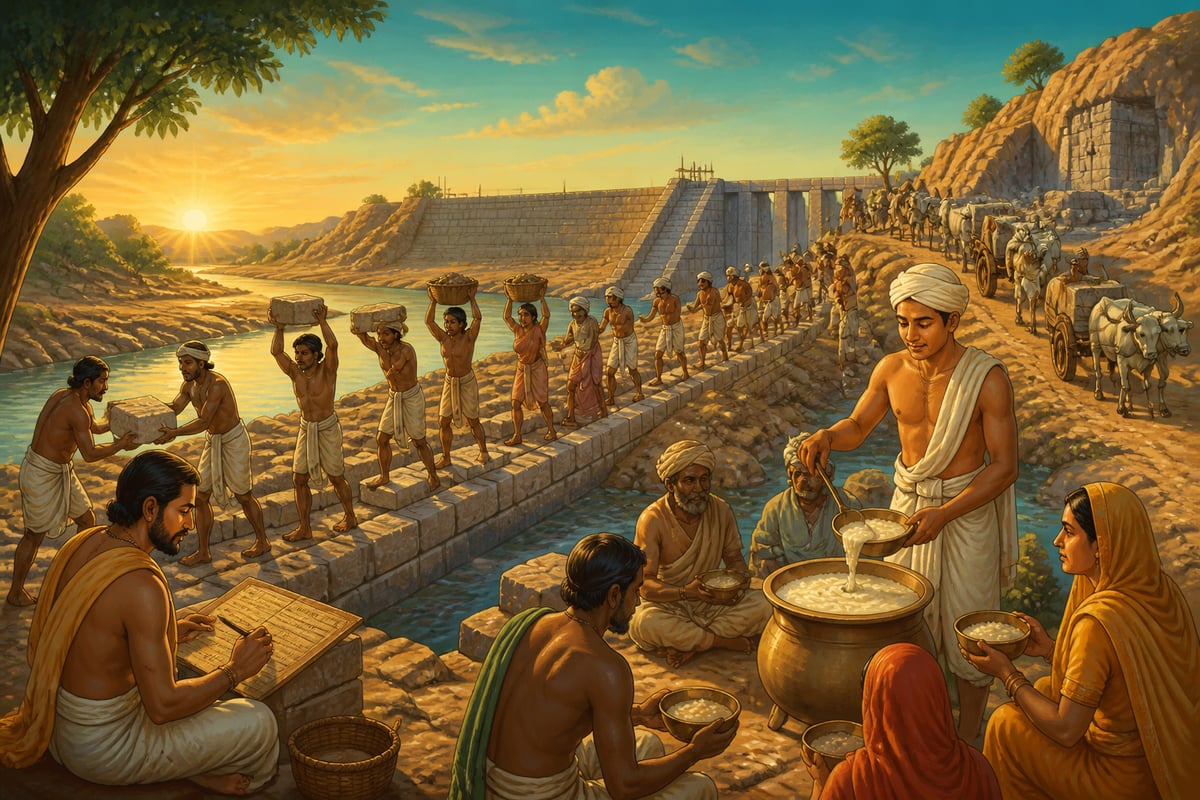
Kautilya's most innovative relief mechanism was employing the distressed on public works:
Why This Worked
Preserved dignity - people earned wages rather than receiving charity
Built useful infrastructure - roads, irrigation, fortifications that would benefit future generations
Kept skills active - farmers continued working rather than becoming idle
Self-targeting - those who could support themselves wouldn't take hard labor jobs at modest wages
What Kind of Work?
Projects that required mostly labor, could employ large numbers, could scale with need, and would benefit the region long-term. Examples: road building, canal digging, tank construction, fortification repair.
The Libertarian Insight
Kautilya's famine relief reflects sophisticated political economy:
1. Temporary, Not Permanent
Relief was explicitly emergency measure:
"As a physician treats disease until health returns, the king provides relief until prosperity returns. To continue treatment after health returns creates weakness, not strength."
Once crisis passed, relief ended. The goal was return to independence.
2. Loans, Not Gifts (Where Possible)
For those who could repay, seed grain was loaned, not given. Tools and working capital were credit, not charity. This preserved future state capacity to help others and signaled that recipients were expected to recover.
For those who couldn't repay (widows, orphans, disabled), outright gifts were appropriate as special cases.
3. Employment, Not Handouts
Public works relief was brilliant because it preserved dignity and work habits, built useful infrastructure, was self-targeting, and ended automatically when recovery allowed people to return to normal occupations.
4. Working With Markets, Not Against Them
Kautilya's approach:
- Release grain to stabilize prices, not replace markets
- Control gouging but don't eliminate profit
- Facilitate trade to bring in supplies from surplus regions
- Remove regulations that prevent market adjustment
The state intervened where markets failed but supported market function where possible.
When Relief Becomes Dependence
Kautilya warned against relief that creates permanent dependence:
Warning Signs
Relief continues after crisis passes - people who could work choosing to receive aid
Productive capacity declines - people abandon fields or trades to depend on relief
Fraud increases - people claiming need they don't have
Political manipulation - leaders maintain relief to keep populations dependent and grateful
The Exit Strategy
Planned from the beginning:
- Clear criteria for when relief would end
- Graduated reduction, not abrupt cutoff
- Support for restarting productive activity
- Consequences for refusing available work
The Test of Relief
How do you know if disaster relief is well-designed?
Ask: Does it keep people alive through the crisis? (If not, it's inadequate)
Ask: Does it enable return to productivity? (If not, it's creating dependence)
Ask: Does it preserve dignity and work habits? (If not, it's demoralizing)
Ask: Is it temporary with clear exit criteria? (If not, it's becoming permanent)
Ask: Does it build useful infrastructure or capacity? (If not, it's merely consumption)
Ask: Can it be sustained in future crises? (If not, it's depleting reserves)
Why This Matters
Famine relief is where competing philosophies of government clash:
Some say the state has no role - private charity will handle disasters.
Others say the state should comprehensively provide for all needs indefinitely.
Kautilya charts a middle path:
The state SHOULD intervene when disaster overwhelms individual and local capacity.
BUT intervention should be temporary - helping people through crisis, not creating permanent dependence.
AND relief should enable return to productivity - employment over handouts, loans over gifts where feasible.
AND the system must be sustainable - reserves in good times enable help in bad times.
This approach respects both compassion (we help those in genuine need) and liberty (we enable return to independence, not permanent dependence).
The monsoon will eventually come. The flood will recede. The epidemic will pass. When it does, do people return to productive independence? Or have they learned helplessness?
Kautilya's answer: Design relief to enable the first, avoid the second. Help people survive the storm so they can sail again when it passes.
That's the difference between rescue and dependency - and Kautilya knew it well.
This reflects understanding that disaster preparedness is cheaper than disaster response. Building reserves during good times enables effective crisis response without bankrupting the treasury. It's strategic investment in state capacity and legitimacy.
Employment-based relief serves multiple strategic purposes: maintains work habits and skills, self-targets those truly needing help, builds useful infrastructure, and prevents demoralization of idleness. It's politically sustainable because it creates visible value.
Permanent programs for temporary problems create dependence and drain resources that could help others. Clear exit strategies from the start prevent political dynamics that perpetuate relief beyond genuine need. Temporary help enables recovery; permanent help prevents it.
Verses
आपत्सु रक्षति यः स राजा
āpatsu rakṣati yaḥ sa rājā
He who protects in times of calamity is truly a king.
The test of legitimate government isn't what it does in good times, but whether it protects people when disaster strikes. This is when the social contract becomes visible - the state's obligation to help those facing catastrophes beyond individual control.
Book 2, Chapter 1, Verse 39 (R.P. Kangle)
कोष्ठागारं पूर्णं कुर्यात्
koṣṭhāgāraṃ pūrṇaṃ kuryāt
The king should keep the granary full.
Preparation in good times enables response in bad times. Maintaining reserves isn't wasteful - it's the foundation of effective disaster relief.
Book 4, Chapter 3, Verse 22 (L.N. Rangarajan)
कर्मान्तं च प्रजानां दद्यात्
karmāntaṃ ca prajānāṃ dadyāt
And the king should provide employment to the people.
Relief should be employment, not handouts. Public works during famine preserve dignity, build useful infrastructure, and maintain work habits.
Book 4, Chapter 1, Verse 57 (R. Shamasastry)
Case studies
The Bengal Famine of 1943
In 1943, Bengal experienced a catastrophic famine killing an estimated 2-3 million people, despite total food availability being sufficient for the population. Causes included wartime disruption, hoarding by merchants, administrative failures, and lack of relief coordination.
This violates Kautilyan principles: (1) No maintained grain reserves for crisis. (2) No prevention of hoarding and price-gouging. (3) No organized public works to provide employment. (4) No effective distribution system. (5) No early warning response to price signals. Had Kautilya's system been in place - reserves, anti-hoarding enforcement, public works employment, organized distribution - most deaths could have been prevented even with the same total food supply.
The famine's severity despite adequate total food demonstrated that famines result from entitlement failures and distribution problems, not just absolute shortage - exactly what Kautilya understood when he emphasized distribution systems and employment programs.
Preparation and systems matter more than total resources. Good distribution with adequate resources saves lives. Poor distribution even with sufficient total supply causes catastrophe.
Amartya Sen's Nobel Prize-winning work on famines confirmed that no functioning democracy with a free press has ever experienced a major famine. The mechanism is exactly Kautilyan: information systems (free press), accountability (elections), and distribution infrastructure (market systems and safety nets) prevent starvation even when food is scarce.
The Bengal Famine of 1943 killed an estimated 2 to 3 million people despite total food grain availability being sufficient for the population. Amartya Sen's research showed that Bengal's per-capita food supply in 1943 was actually higher than in 1941, when no famine occurred.
The New Deal's WPA
During the Great Depression, the U.S. Works Progress Administration (WPA) employed millions on public works projects - building roads, schools, parks, and infrastructure. Workers earned wages rather than receiving handouts, preserving dignity while constructing lasting value.
This echoes Kautilyan principles: (1) Employment rather than pure charity. (2) Building useful infrastructure. (3) Preserving work habits and skills. (4) Self-targeting (those with other options didn't choose WPA jobs). (5) Temporary program that ended when economy recovered. However, some later programs became permanent, violating Kautilya's emphasis on temporary relief with clear exit strategies.
The WPA employed 8.5 million people and built infrastructure still in use today. It helped families survive without becoming permanent welfare, and workers transitioned back to private employment as the economy recovered.
Employment-based relief can work at scale, preserving dignity while building value. The key is keeping it temporary with clear transition paths back to regular economy.
India's MGNREGA (Mahatma Gandhi National Rural Employment Guarantee Act) directly applies this model at massive scale. It guarantees 100 days of employment on public works projects to any rural household that requests it. The program provides income during agricultural off-seasons while building rural infrastructure like roads, irrigation, and water conservation.
The WPA (1935-1943) employed 8.5 million Americans and built 651,087 miles of roads, 125,110 public buildings, 8,192 parks, and 853 airport runways. Total cost was $11.4 billion (roughly $250 billion in 2024 dollars), and most workers transitioned back to private employment by 1943.
Historical context
c. 4th century BCE
The Indian subcontinent's monsoon-dependent agriculture made it vulnerable to drought and famine. Previous states had limited systematic relief - famines caused mass death and social breakdown. The Mauryan systematic approach was unprecedented.
Effective famine relief strengthened the Mauryan state's legitimacy and prevented the social breakdown that had destabilized previous kingdoms. People supported the empire because it protected them when they couldn't protect themselves.
Living traditions
- Public Distribution Systems: Government-maintained grain reserves and distribution networks for price stabilization and crisis relief
- Rural Employment Guarantee Programs: Government programs providing work during agricultural off-seasons and economic distress
- Cash for Work Programs: Disaster relief approaches that provide employment opportunities rather than pure aid distribution
- National Disaster Management Authority: Government body coordinating disaster preparedness and relief
- World Food Programme Headquarters: UN agency addressing hunger and food security in crises
- Annapurna Temples across India: Temples dedicated to Goddess Annapurna (giver of food) maintain traditions of charitable feeding during festivals and crises
- Golden Temple (Harmandir Sahib): Operates world's largest free community kitchen serving over 100,000 meals daily to anyone regardless of background
Reflection
- Kautilya prescribed employment on public works rather than free food distribution for able-bodied people. Is this compassionate or harsh? Does requiring work during crisis add insult to injury?
- What's the difference between helping someone through temporary crisis versus creating permanent dependence? Where is that line, and how do we know when we've crossed it?
- Think about your own 'reserves' - financial, emotional, relational. What crises might you face? Are you prepared? What should you be building now to handle potential future distress?